Islam, migration and religious pluralism
What you'll learn
- How Muslim migration to Britain from the 1950s onwards helped create a multicultural society.
- Why British Islam is internally diverse, not one single viewpoint or community.
- How freedom of religion in European human-rights law shapes Muslim life in secular societies.
- How Muslims debate exclusivism, inclusivism, salvation, minority groups, and freedom of religious expression.
1. The background: migration and multicultural Britain
Migration
Migration means the movement of people from one country or region to another, either permanently or for a significant period of time.
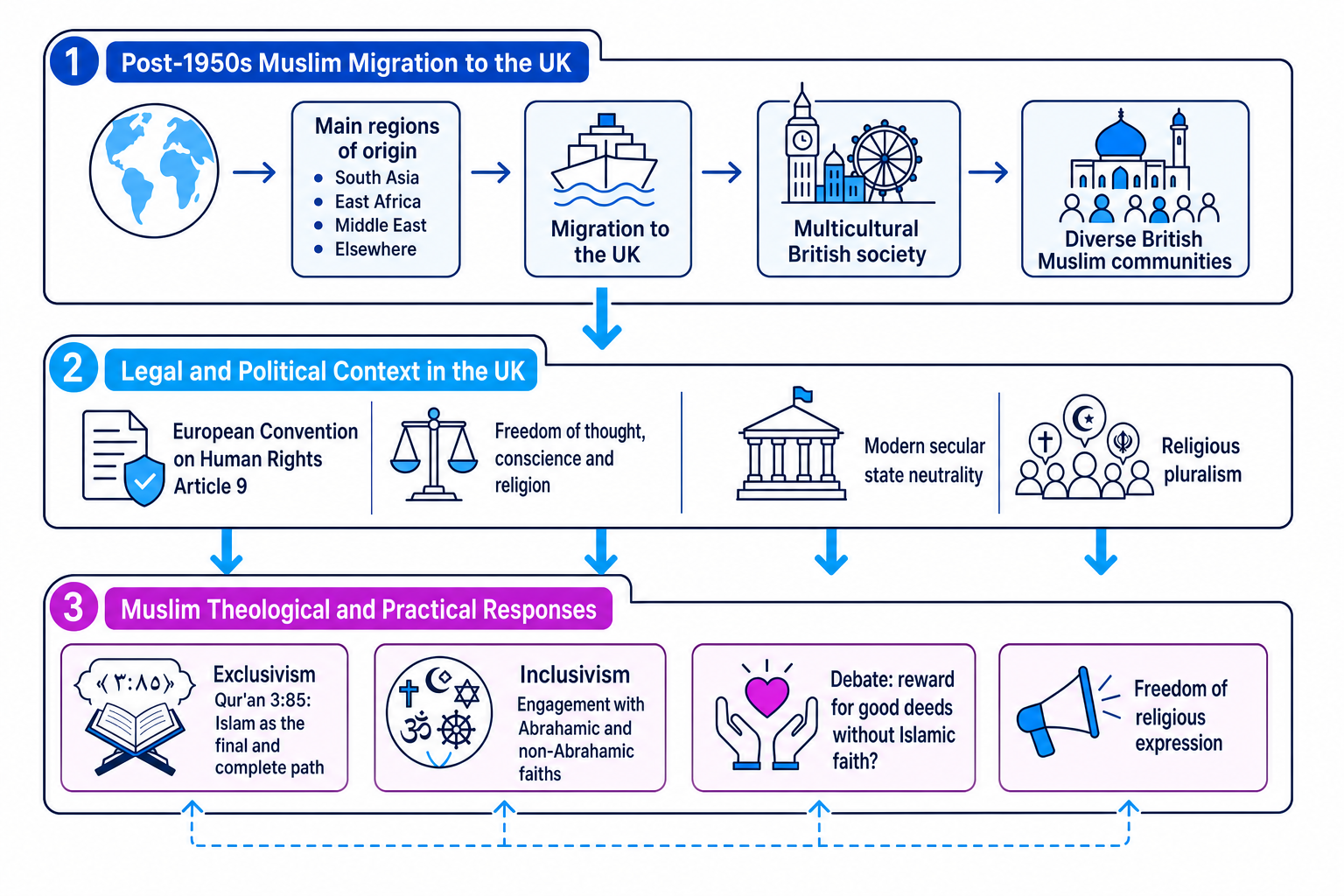
After the Second World War, Britain needed workers in industries such as textiles, transport, steel, catering and the NHS. From the 1950s onwards, many Muslims migrated to the UK, especially from South Asia: Pakistan, Bangladesh and India. Later Muslim migration also included East African Asians, Turkish Cypriots, Somalis, Iraqis, Afghans, Syrians, Bosnians, Iranians, Nigerians and others.
At first, many migrants expected to work temporarily and return home. Over time, family reunification, settlement, new generations born in Britain, and the building of mosques, community centres and schools helped create permanent British Muslim communities.
Multicultural society
A multicultural society is one in which different ethnic, cultural and religious communities live alongside one another within the same state.
Britain therefore became more visibly religiously diverse. Islam was no longer only something associated with countries abroad; it became part of British public life through mosques, halal food, Muslim schools, Islamic charities, chaplaincy, Muslim politicians, media voices and interfaith work.
Migration changed the questions
For Muslims living as minorities in Britain, key questions include: How can Muslims preserve Islamic identity? How should Muslims relate to non-Muslim neighbours? How far should secular law accommodate religious practice? How should Muslims understand salvation outside Islam?
2. Diversity within the Muslim community in Britain
It is a common mistake to speak about “the Muslim community” as if it has one ethnicity, one theology or one political view. British Muslims are highly diverse.
Important forms of diversity include:
- Ethnic and cultural diversity: Pakistani, Bangladeshi, Indian, Arab, Turkish, Somali, Kurdish, Iranian, West African, Bosnian, Malaysian, white British converts and many others.
- Denominational diversity: most British Muslims are Sunni, but there are also Shi‘a communities, including Twelver Shi‘a, Isma‘ilis and others.
- Legal and devotional traditions: British Sunni Muslims may identify with Deobandi, Barelvi, Salafi, Sufi or other movements.
- Generational diversity: first-generation migrants may think differently from British-born Muslims negotiating school, university, work and citizenship.
- Levels of practice: some Muslims are highly observant; others identify culturally or ethically with Islam.
Treating Muslims as a single bloc
Do not write as if all Muslims in Britain respond to pluralism in the same way. A stronger essay says “some Muslims argue…” or “many mainstream Sunni and Shi‘a scholars…” and then gives a precise example.
3. Freedom of religion and secular pluralism
Freedom of religion
Freedom of religion is the right to hold religious beliefs, change religion, practise religion, worship, teach, observe religious duties, or have no religion.
In European law, freedom of religion is protected by Article 9 of the European Convention on Human Rights. In the UK, this is given domestic effect through the Human Rights Act 1998.
Article 9 protects two related things:
- The inner right to hold beliefs, sometimes called freedom of thought, conscience and religion.
- The outward right to manifest religion, meaning to express or practise it publicly, for example through dress, worship, dietary rules or teaching.
However, outward manifestation can be limited when necessary for public safety, public order, health, morals, or the rights and freedoms of others.
Religious pluralism
Religious pluralism can mean the social fact that many religions coexist in one society. In theology, it can also mean the view that more than one religion may contain truth or lead people towards God.
Modern secular states usually try to govern citizens without making one religion the legal basis for everyone. The UK is complicated because it has an established Church of England, but in practice it operates as a liberal pluralist society where Muslims, Christians, Jews, Hindus, Sikhs, Buddhists, atheists and others have legal rights.
Applying Article 9 to religious dress
-
Decide whether the practice is religious manifestation. Wearing hijab, for example, can be understood as an outward expression of modesty and religious identity, so it falls within Article 9.
-
Ask whether there is a restriction. If a school, workplace or state institution bans it, that limits the person’s ability to manifest religion.
-
Test the reason for the restriction. A limited rule for safety, such as no loose clothing around dangerous machinery, may be easier to justify than a general dislike of religious symbols.
-
Evaluate proportionality. A strong answer asks whether the same aim could be achieved with less interference, such as adapting uniform rules rather than banning the practice entirely.
4. How this context influences Muslim thought
Living in a pluralist society has encouraged new forms of Muslim reflection. Some thinkers speak of minority fiqh, meaning Islamic legal and ethical reasoning for Muslims living as minorities in non-Muslim states.
Questions include:
- Can Muslims be fully British and fully Muslim?
- Should Muslims participate in secular democracy?
- How should Muslims relate to people of other faiths or no faith?
- Are non-Muslims saved or rewarded by God?
- How should Muslims defend religious freedom while also accepting criticism and free speech?
Link context to doctrine
For essays, do not separate migration from theology. The best answers show how social change creates new pressure on old questions about identity, salvation, law and public expression.
5. Exclusivism in Muslim thought
Exclusivism
Exclusivism is the view that one religion alone is finally true and that salvation, in the fullest sense, depends on belonging to or accepting that true path.
In Islam, exclusivism is often based on verses such as Qur’an 3:85:
“Whoever seeks a religion other than Islam, it will never be accepted of him, and in the Hereafter he will be among the losers.”
This can be read to mean that Islam, as revealed through the Prophet Muhammad, is the final and complete revelation of God’s will. Related ideas include the Prophet Muhammad as the Seal of the Prophets in Qur’an 33:40, and Islam as the completed religion in Qur’an 5:3.
Exclusivism can strengthen Muslim identity in a pluralist society. It gives clear boundaries: Islam is not merely one lifestyle option among many, but the final revelation from Allah. This may be especially important for communities worried about assimilation or loss of faith.
However, exclusivism can create difficulties. If expressed harshly, it may encourage separation from wider society or dismiss the moral and spiritual seriousness of non-Muslims. It can also create tensions within Islam.
Attitudes to minority Muslim groups
Some Muslim groups are treated as controversial by other Muslims. A key example is the Ahmadiyya movement, whose followers identify as Muslim. Many mainstream Sunni and Shi‘a scholars reject Ahmadi claims because of beliefs about Mirza Ghulam Ahmad, which they see as conflicting with the finality of prophethood.
Takfir
Takfir means declaring someone who claims to be Muslim to be outside Islam. It is a serious and controversial act because it affects identity, belonging and sometimes safety.
Attitudes to minority groups vary widely. Some Muslims emphasise doctrinal boundaries; others warn that excessive takfir damages the ummah, the worldwide Muslim community, and contradicts Islamic values of justice and mercy.
Using Qur’an 3:85 in an argument
-
Start with the claim: Qur’an 3:85 appears to say that seeking a religion other than Islam is not accepted by God.
-
Connect this to Islamic finality: if Muhammad is the final prophet, then later or alternative claims to revelation may be judged against that final message.
-
Apply it carefully: an exclusivist may argue that salvation requires Islam, but should still distinguish theological disagreement from hostility towards non-Muslims.
-
Evaluate the limitation: other Qur’anic passages stress God’s mercy and justice, so an essay should ask whether 3:85 is about formal membership of Islam or sincere submission to God.
6. Inclusivism in Muslim thought
Inclusivism
Inclusivism is the view that one religion may be the fullest or final truth, but people outside that religion may still receive God’s mercy, guidance or reward.
Muslim inclusivism often argues that Islam is the complete revelation, but God’s justice and mercy are not limited by human labels. Some Qur’anic passages support a more open approach, especially towards Abrahamic faiths.
Abrahamic faiths
Abrahamic faiths are religions connected to the figure of Abraham, especially Judaism, Christianity and Islam.
Qur’an 2:62 says that those who believe, Jews, Christians and Sabians, “whoever believes in Allah and the Last Day and does righteousness” will have their reward with their Lord. Qur’an 5:69 gives a similar message. Qur’an 29:46 also says to the People of the Book: “Our God and your God is one.”
For non-Abrahamic faiths, inclusivists may point to verses such as Qur’an 16:36, which says God sent a messenger to every community, and Qur’an 35:24, which says no people were without a warner. Qur’an 5:48 says God could have made humanity one community, but instead gave different communities a “law and a way” and commands them to “compete in good deeds.”
This does not automatically mean all religions are equally true. Many Muslim inclusivists still believe Islam is the final revelation. Their point is that God may judge people according to their sincerity, knowledge, circumstances and response to the guidance available to them.
Are good deeds without faith rewarded?
This is a major debate.
An exclusivist answer says that good deeds without true faith may have worldly value but not ultimate saving value. This view may appeal to Qur’an 3:85 and to the importance of tawhid, belief in the oneness of God.
An inclusivist answer says God is perfectly just and merciful, so sincere moral action matters. Qur’an 17:15 says God does not punish until a messenger has been sent. This can support the idea that people who never properly encountered Islam may be judged differently from those who knowingly rejected it.
The hardest case is good deeds by someone with no belief in God at all. Some Muslims argue that God can still reward moral action as He wills. Others argue that ultimate reward requires faith, because good deeds should be oriented towards Allah.
The debate is about God’s justice
The central issue is not simply “are non-Muslims good people?” but whether salvation depends on explicit Islamic faith, sincere submission to God, righteous action, or God’s mercy beyond human understanding.
7. Freedom of religious expression in society
Muslim responses to freedom of expression include two sides.
First, Muslims often defend their own freedom to express Islam publicly: wearing hijab or niqab, building mosques, praying, fasting, giving da‘wah, eating halal food, and educating children in Islamic values.
Second, Muslims also respond to expression about Islam, including criticism, satire, cartoons of the Prophet Muhammad, Qur’an burning, Islamophobic abuse and public debate about Shari‘a.
Islamic sources can support both commitment and restraint. Qur’an 2:256 says, “There is no compulsion in religion.” Qur’an 16:125 says to invite people to God’s way “with wisdom and good instruction.” Qur’an 6:108 warns Muslims not to insult what others worship, because this may lead them to insult Allah in return.
In a secular society, many Muslims argue for legal protection against hatred and discrimination, but not necessarily for banning all offence. Others believe blasphemy against the Prophet is so serious that society should restrict such expression. A balanced essay should recognise the tension: free speech protects Muslim da‘wah and religious identity, but unrestricted speech can also enable hostility towards Muslims.
Confusing offence with illegality
In UK law, something may be deeply offensive without being illegal. Strong essays distinguish criticism of religion, which may be protected speech, from incitement to hatred or harassment, which may be restricted.
8. Quick comparison: exclusivism and inclusivism
| Issue | Exclusivism | Inclusivism |
|---|---|---|
| Main claim | Islam alone is finally accepted as the true path. | Islam is final, but God may reward or save some outside explicit Islam. |
| Key Qur’anic support | Qur’an 3:85; Qur’an 33:40; Qur’an 5:3. | Qur’an 2:62; Qur’an 5:48; Qur’an 16:36; Qur’an 17:15. |
| Strength | Preserves doctrinal clarity and Muslim identity. | Fits divine mercy, justice and pluralist experience. |
| Weakness | Can seem narrow or socially divisive. | May appear to weaken the uniqueness of Islam. |
For evaluation, avoid simply choosing the “nice” view. Ask which interpretation best accounts for the whole Qur’anic picture: final revelation, divine justice, human responsibility, and God’s mercy.
In the exam
-
Anchor your answer in the social context: post-1950s migration, diversity within British Islam, and life in a secular pluralist society.
-
Use Qur’anic evidence precisely, especially Qur’an 3:85 for exclusivism and Qur’an 2:62, 5:48 or 16:36 for inclusivism.
-
Evaluate both sides: show how pluralism can enrich Muslim thought, but also how it can create pressure over identity, salvation and freedom of expression.
Check yourself
- How did Muslim migration from the 1950s onwards change Britain’s religious landscape?
- Why might Qur’an 3:85 support exclusivism, and how might Qur’an 2:62 support inclusivism?
- What is the difference between protecting religious freedom and banning offence to religion?

Keep learning
Make a free account to read the full revision notes and worked examples.