Sources of wisdom and authority
What you'll learn
- What the Tenakh is and why Jews disagree about the exact nature of its authority.
- How the Babylonian Talmud preserves rabbinic interpretation and shapes Jewish law.
- What rabbis and a Beth Din do in contemporary Judaism.
- How to turn this topic into balanced AO1 explanation and AO2 evaluation.
Starting point: what counts as authority?
In this topic, you are not just learning “important Jewish books”. You are learning how Jews decide what should guide belief, worship and daily life.
Authority
Authority means the recognised right of a text, tradition, person or institution to guide what Jews believe and how they live.
A useful way to picture the topic is as a chain: sacred text, interpretation, and living application. The Tenakh gives foundational revelation; the Talmud interprets and debates it; rabbis and courts apply it to real situations.
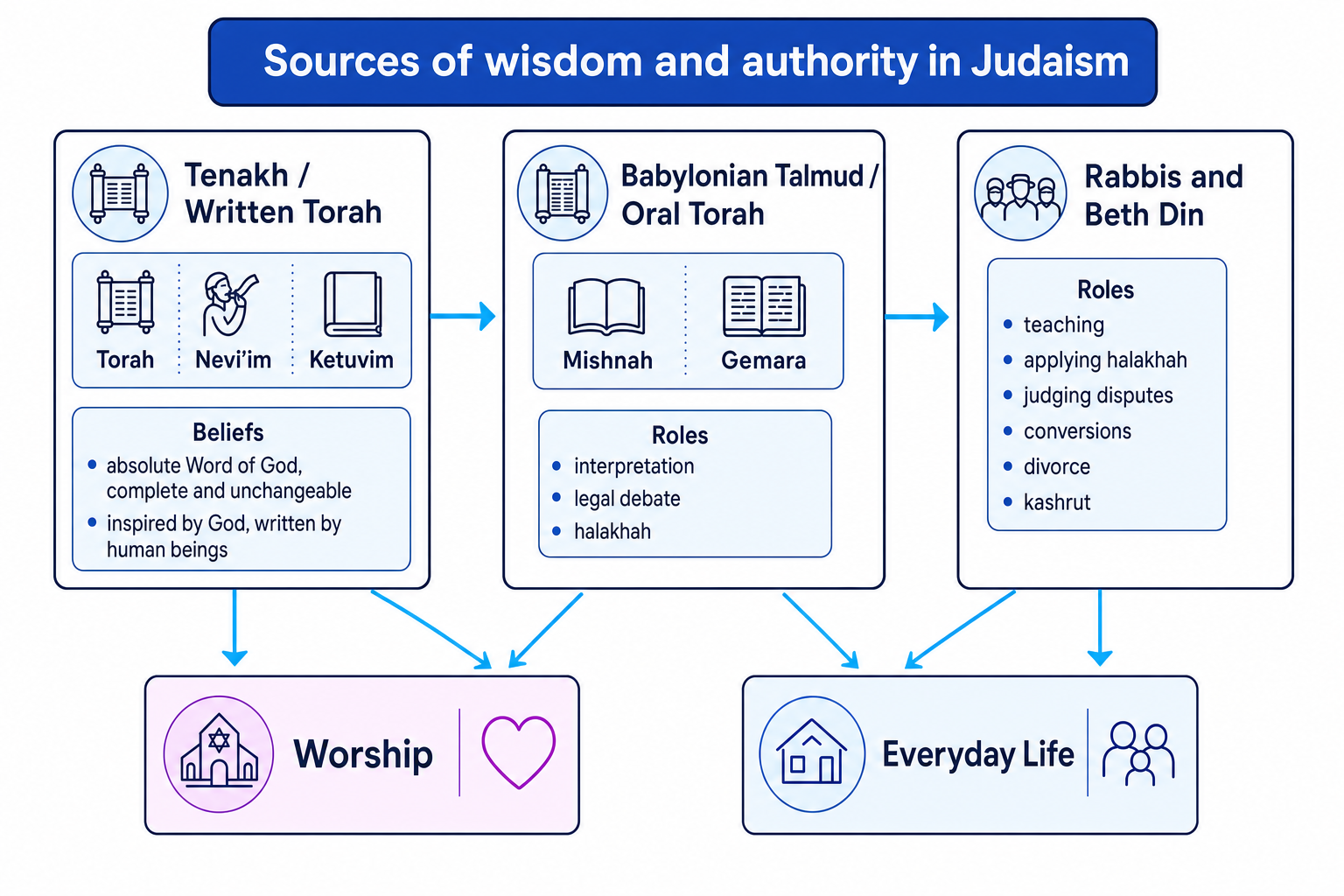
Authority is layered
In Judaism, authority is often layered rather than located in one place: scripture, oral tradition, rabbinic interpretation and community practice work together, but different Jewish groups weigh them differently.
The Tenakh
Tenakh
The Tenakh is the Jewish Bible. The name comes from three sections: Torah meaning “teaching” or “law”, Nevi’im meaning “Prophets”, and Ketuvim meaning “Writings”.
The Torah usually means the first five books: Genesis, Exodus, Leviticus, Numbers and Deuteronomy. It contains key stories of creation, covenant, slavery and liberation, Sinai, and the mitzvot.
Mitzvot
Mitzvot are commandments. In traditional Judaism, there are 613 mitzvot in the Torah, shaping worship, ethics, food laws, festivals, family life and social justice.
The Tenakh is not simply an “information book”. It is a source of identity: Jews understand themselves as part of a covenant relationship with God, especially through the promises to Abraham and the giving of Torah at Sinai.
The Tenakh as the absolute Word of God
Many Orthodox Jews believe the Torah was revealed by God to Moses and is therefore the absolute Word of God. In this view, it is complete and unchangeable because it expresses divine will rather than merely human opinion.
This does not mean interpretation is unnecessary. In fact, Orthodox Judaism usually holds that the Written Torah must be read alongside the Oral Torah, the inherited tradition of interpretation later recorded in rabbinic texts.
Important examples include:
- Exodus 20: the Ten Commandments, including Shabbat and the prohibition of murder, theft and idolatry.
- Deuteronomy 6:4–9: the Shema, beginning “Hear, O Israel”, central to Jewish prayer and identity.
- Leviticus and Deuteronomy: laws on kashrut, festivals, purity and social ethics.
The Tenakh as inspired but humanly written
Progressive, Reform and Liberal Jews are more likely to describe the Tenakh as inspired by God but written by human beings. This means the text is sacred and spiritually important, but it also reflects historical context, human language and ancient culture.
This view often gives more room for:
- critical study of how texts developed;
- moral evaluation of difficult passages;
- adapting practice in light of conscience, reason and modern experience.
For example, a Progressive Jew may treat Shabbat as deeply authoritative but may not accept every traditional rabbinic restriction on technology or travel.
How beliefs about the Tenakh affect worship
In synagogue worship, the Torah scroll is treated with great reverence. It is kept in the Aron Hakodesh, the holy ark, and read publicly according to a weekly cycle. The reading from the Torah is often followed by a reading from the Prophets, called the Haftarah.
The Shema from Deuteronomy is recited daily by many Jews and appears in synagogue services. Psalms and other biblical passages also shape prayer.
Belief in the Tenakh’s divine authority affects the seriousness with which it is handled. In Orthodox communities, the scroll must be handwritten by a trained scribe and is read in Hebrew. Progressive communities also treat the Torah with reverence, but may use more vernacular language, mixed seating, or different patterns of participation.
How beliefs about the Tenakh affect everyday life
The Tenakh shapes daily Jewish life through commandments and values. Examples include:
- Shabbat: rest and worship from Friday evening to Saturday evening.
- Kashrut: dietary laws rooted in Torah passages.
- Mezuzah: placing words from Deuteronomy on doorposts.
- Tzedakah: charitable giving and justice for the vulnerable.
- Festivals: Pesach, Sukkot and Shavuot are rooted in biblical memory and commandment.
Moving from Tenakh to Shabbat practice
- The Tenakh commands Jews to “remember” and “observe” Shabbat, and it forbids work on the seventh day.
- The command raises an interpretive question: what counts as “work”? Cooking, carrying, writing, driving and switching on electricity are not all named directly in the biblical command.
- Rabbinic tradition, especially through the Talmud, develops detailed categories of prohibited labour, so Orthodox Jews often follow specific restrictions.
- A Progressive Jew may still treat Shabbat as authoritative but apply the principle more flexibly, focusing on rest, prayer, family and freedom from ordinary pressures.
Do not call the Tenakh simply the Old Testament
“Old Testament” is a Christian term. In Judaism, use Tenakh or Hebrew Bible, and remember that the order, interpretation and theological context are Jewish.
The Babylonian Talmud
Babylonian Talmud
The Babylonian Talmud, often called the Bavli, is a major rabbinic text containing the Mishnah and Gemara. It records legal debate, interpretation, stories and ethical teaching from the rabbis.
The Mishnah was compiled around 200 CE, traditionally associated with Rabbi Judah haNasi. It organises oral legal traditions. The Gemara is later commentary and debate on the Mishnah. Together, they form the Talmud.
There are two Talmuds: the Jerusalem Talmud and the Babylonian Talmud. The Babylonian Talmud became more widely authoritative in much of Jewish history because it is fuller and became central to later legal decision-making.
Its nature and importance
The Talmud is not a simple law code. It often records disagreement between rabbis. This matters because Jewish authority is not only about receiving answers; it is also about learning how to reason from Torah, precedent and principle.
The Talmud contains:
- halakhah: Jewish law and legal reasoning;
- aggadah: stories, theology, moral teaching and interpretation;
- debate about how biblical commandments should be lived.
Halakhah
Halakhah means Jewish law, literally “the way” or “the path”. It covers religious, ethical and practical life, not just synagogue worship.
Different Jewish beliefs about its authority
Orthodox Judaism usually treats the Talmud as highly authoritative because it preserves the Oral Torah. A traditional statement from Pirkei Avot says: “Moses received the Torah at Sinai and transmitted it…” This supports the idea of an unbroken chain of teaching.
Conservative or Masorti Judaism often sees the Talmud as binding but historically developing. Change is possible, but it should happen through serious engagement with halakhic tradition.
Reform and Liberal Judaism generally value the Talmud as a profound record of Jewish wisdom, but not as automatically binding. A Reform Jew may consult it, learn from it and respect it, while still giving significant authority to conscience, equality, modern scholarship and community decision-making.
Weighing the Talmud's authority
- Start with the issue: the Tenakh is the foundational sacred text, so it might seem more authoritative than later rabbinic discussion.
- Add the complication: many biblical commandments need interpretation before they can be practised, so the Talmud becomes practically essential.
- Compare Jewish views: Orthodox Judaism sees this interpretive tradition as divinely authorised, while Reform Judaism is more likely to see it as human and revisable.
- Reach a balanced judgement: the Talmud’s authority is strongest where a community accepts Oral Torah as binding; where that belief is rejected, its authority becomes advisory rather than compulsory.
Rabbis in contemporary Judaism
Rabbi
A rabbi is a trained Jewish teacher and leader. The word means “my teacher”. A rabbi’s authority comes from learning, ordination, community recognition and ability to apply Jewish teaching.
Rabbis are not the same as priests. In ancient Judaism, priests served in the Temple. Since the destruction of the Second Temple in 70 CE, Judaism has centred more on Torah study, prayer, synagogue life and home practice. Rabbis became crucial as teachers and interpreters.
Contemporary rabbis may:
- teach Torah and Talmud;
- give sermons and lead learning;
- offer pastoral support;
- conduct weddings, funerals and other life-cycle events;
- answer questions about halakhah;
- represent the Jewish community publicly;
- guide ethical reflection on modern issues.
Their authority varies. In Orthodox Judaism, a rabbi may be treated as a posek, a legal decisor, whose rulings are taken very seriously. In Progressive Judaism, a rabbi may act more as educator, spiritual guide and facilitator of informed personal choice.
No Jewish pope
Judaism has no single worldwide authority equivalent to the Pope in Roman Catholicism. Authority is more decentralised, so denomination, community and local rabbinic leadership matter.
The Beth Din
Beth Din
A Beth Din means “house of judgement”. It is a Jewish religious court, usually made up of qualified rabbinic judges called dayanim.
A Beth Din may deal with:
- conversions to Judaism;
- Jewish divorce through a get;
- disputes between Jewish individuals or businesses;
- questions of Jewish status;
- supervision of kashrut;
- guidance for schools, synagogues and communal institutions.
In Orthodox Judaism, the Beth Din can have strong authority because it applies halakhah in a formal way. In the UK, for example, Orthodox batei din such as the London Beth Din are influential in matters like conversion and kashrut certification.
However, its authority is also limited. It is not a replacement for the state’s criminal courts. In financial disputes, a Beth Din may function through arbitration if both parties accept its role. Progressive communities may have their own structures and may not recognise Orthodox decisions as the only valid Jewish authority.
Bringing it together for evaluation
A strong essay should avoid saying “the Tenakh is the authority” as if that settles everything. The better answer is more nuanced.
The Tenakh has foundational authority because it is sacred scripture and contains the covenant story, commandments and core prayers. However, scripture alone often does not tell Jews exactly how to live in every situation. The Talmud becomes crucial because it interprets the commandments and models rabbinic reasoning. Rabbis and the Beth Din then apply those sources to contemporary questions.
Your judgement should depend on the Jewish group being discussed. For Orthodox Jews, Tenakh, Talmud and rabbinic authority form a connected system of divine revelation and interpretation. For Reform or Liberal Jews, the Tenakh and Talmud remain sources of wisdom, but authority is shared with conscience, reason, ethical development and community autonomy.
In the exam
- Define each source clearly: Tenakh, Babylonian Talmud, rabbi and Beth Din.
- Always compare Jewish views: Orthodox, Conservative/Masorti and Reform/Liberal approaches are not identical.
- For evaluation, ask whether authority is foundational, interpretive or practical: Tenakh often grounds authority, Talmud interprets it, and rabbis apply it.
Check yourself
- Why might an Orthodox Jew see the Tenakh as complete and unchangeable, but still need the Talmud?
- How does a Reform view of inspiration differ from a belief in the Tenakh as the absolute Word of God?
- What kinds of issues might a Beth Din deal with today?

Keep learning
Make a free account to read the full revision notes and worked examples.