God
What you'll learn
- How Judaism understands God as one, eternal, omniscient, omnipotent, creator and controller.
- How Maimonides’ Thirteen Principles of Faith express key Jewish beliefs about God.
- Why biblical language about God as King, Father, and “walking” in Genesis 3:8 creates debate.
- How Martin Buber understands God as the Eternal Thou, encountered through genuine relationships.
The big picture
In this topic, you are not just learning a list of divine attributes. You are learning a tension at the heart of Jewish theology: God is utterly beyond human limits, yet the Hebrew Bible also presents God as personally involved with human beings.
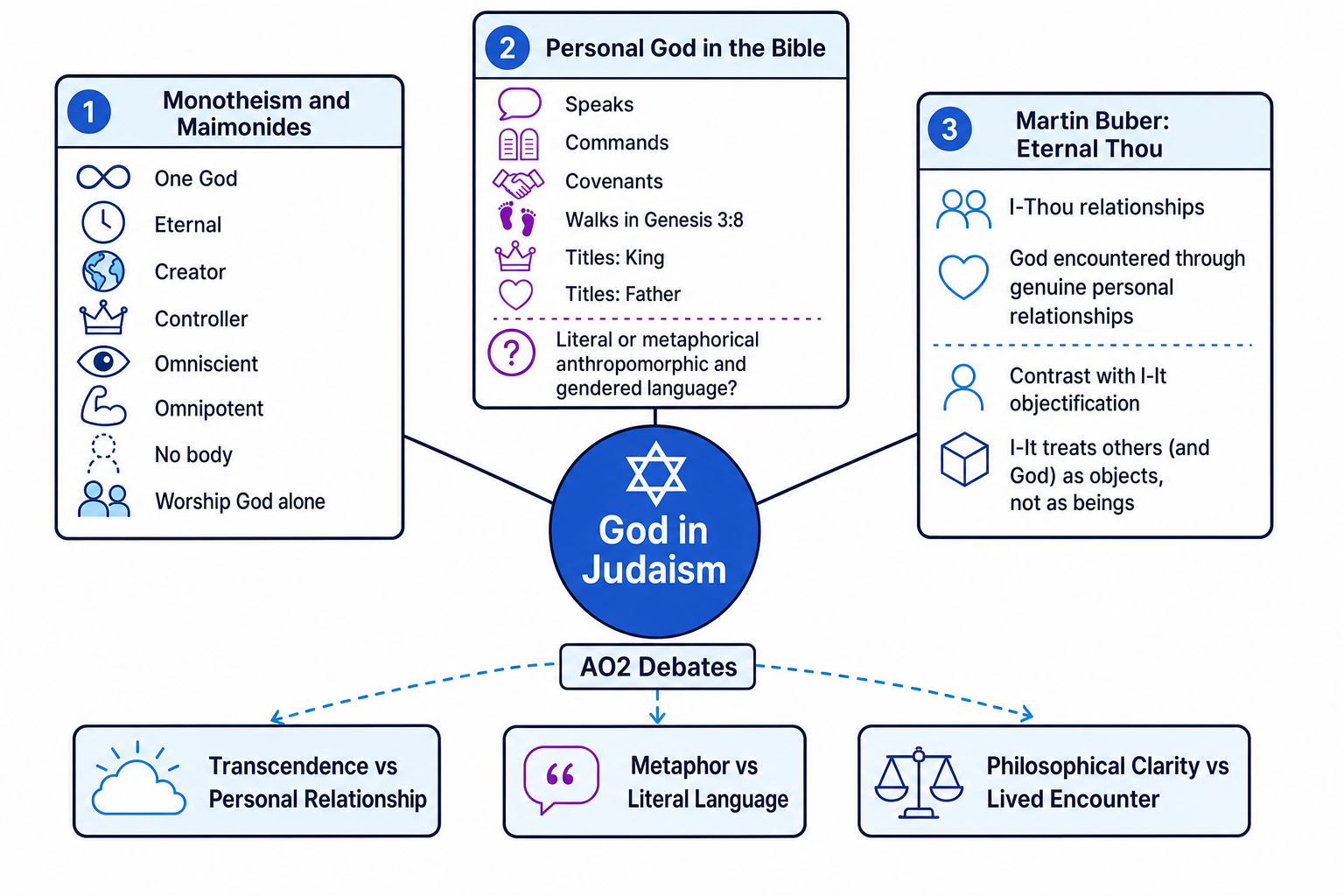
That tension is very useful for essays. Strong answers can compare philosophical clarity about God’s nature with biblical and relational language about meeting, obeying, loving, and responding to God.
Jewish monotheism: God is one
Monotheism
Monotheism is belief in one God. In Judaism, this is expressed most famously in the Shema: “Hear, O Israel: the LORD is our God, the LORD is one” (Deuteronomy 6:4).
The Shema is not just a statement that there is only one God. It is also a declaration of loyalty: Israel is to worship God alone. Jewish monotheism rejects worship of many gods, worship of idols, and any idea that God is one being among others.
Judaism traditionally describes God as:
- One: God is unique and indivisible, not part of a group of divine beings.
- Eternal: God has no beginning or end and is not dependent on time in the way created things are.
- Omniscient: God is all-knowing.
- Omnipotent: God is all-powerful.
- Creator: God brings the world into being; Genesis 1:1 begins, “In the beginning God created…”
- Controller: God is sovereign over creation and history.
Aseity
Aseity means God’s self-existence: God depends on nothing else for existence. Everything else depends on God.
God as “controller” needs careful handling. It does not simply mean human beings are puppets. Jewish thought strongly preserves human moral responsibility: people are commanded, judged, forgiven, and expected to choose obedience. So there is a real theological tension between God’s sovereignty and human freedom.
Jewish monotheism
For Judaism, God is not one powerful object inside the universe. God is the unique, eternal source and ruler of all reality.
Maimonides and the Thirteen Principles
Maimonides
Maimonides was a major medieval Jewish philosopher and legal scholar, also known as Moses ben Maimon or Rambam. His Thirteen Principles of Faith summarise beliefs he saw as central to Judaism.
Maimonides’ principles are especially influential in Orthodox Judaism, though not all Jewish communities treat them as a formal creed in exactly the same way. Judaism is often practice-centred as well as belief-centred: law, worship, ethics, and community matter alongside doctrine.
For this topic, the most relevant principles are the ones about God’s nature:
- God exists and is the creator and ruler of all things.
- God is one.
- God has no body and is not physical.
- God is eternal.
- God alone should be worshipped.
The other principles also express beliefs about God’s relationship with the world:
- God communicates through prophecy.
- Moses is the greatest prophet.
- The Torah comes from God.
- The Torah is not to be replaced.
- God knows human actions and thoughts.
- God rewards and punishes.
- The Messiah will come.
- The dead will be resurrected.
A key point is Maimonides’ insistence that God is incorporeal, meaning not bodily or physical. This matters when you later interpret biblical descriptions of God “walking”, “speaking”, or acting like a human person.
Via negativa
The via negativa is the “negative way” of speaking about God: saying what God is not, rather than claiming to describe exactly what God is. Maimonides often prefers this because positive descriptions can make God sound limited or human-like.
For evaluation, Maimonides gives Judaism philosophical precision. His view protects God’s transcendence, meaning God’s existence beyond and above the created world. However, critics may argue that this makes God seem distant compared with the personal God of the Bible.
Turning Maimonides into all of Judaism
Do not write as if every Jewish believer simply “follows Maimonides’ creed” in the same way. His principles are hugely influential, but Jewish belief is diverse, and Judaism is not only a religion of abstract doctrines.
God as personal in the Bible
Personal God
A personal God is not a human being, but a God who can know, address, command, love, judge, forgive, and enter into relationship with people.
The Hebrew Bible, or Tanakh, presents God as deeply involved with human beings. God creates, speaks, commands, makes covenants, hears cries, judges injustice, and forgives wrongdoing.
Covenant
A covenant is a solemn relationship or agreement. In Judaism, covenant is central to God’s relationship with Israel, especially through Abraham and Moses.
This biblical picture is more relational than purely philosophical. God is not just “the eternal creator”; God is also the God who calls Abraham, liberates Israel from slavery, gives Torah, and demands justice.
Anthropomorphic language
Anthropomorphic language
Anthropomorphic language describes God using human characteristics, such as walking, speaking, remembering, or becoming angry.
Genesis 3:8 says Adam and Eve “heard the sound of the LORD God walking in the garden.” Read literally, this seems to imply that God has a body. But Maimonides’ third principle says God is not physical, so many Jewish interpreters treat this as metaphorical language.
Metaphor
A metaphor describes one thing in terms of another to communicate meaning without being literally identical. Saying God “walks” can express presence and relationship without claiming God has legs.
Interpreting Genesis 3:8
-
The verse describes God “walking” in the garden, so the first issue is whether this should be read literally or figuratively.
-
A literal reading creates a problem for classical Jewish theology, because Maimonides insists God has no body and is not physical.
-
A metaphorical reading fits better with divine incorporeality: “walking” communicates God’s personal presence, closeness, and judgement after human disobedience.
-
The evaluation is balanced: the verse supports belief in a personal God, but not necessarily belief in a bodily God.
Gendered language: King and Father
Gendered language about God
Gendered language uses masculine or feminine terms for God, such as Father, King, mother, or bridegroom. In Judaism, titles like King and Father are common, but God is not understood as biologically male.
Calling God King emphasises sovereignty, authority, judgement, and rule. It fits well with belief in God as controller of all things. Jewish liturgy often speaks of God as King, especially in prayers focused on judgement and repentance.
Calling God Father emphasises care, origin, discipline, and relationship. The prayer phrase Avinu Malkeinu, meaning “Our Father, our King,” brings these ideas together: God is both loving and authoritative.
The debate is about how this language should be interpreted.
One view is that titles such as King and Father are necessary religious metaphors. Human beings need familiar language to speak about the divine. On this view, masculine titles do not mean God is male; they express relationship, authority, and care.
A critical view is that repeated masculine language can shape people’s imagination of God in male terms, even if theologians say God has no gender. Some feminist Jewish thinkers, such as Judith Plaskow, argue that religious language should be examined because it can reinforce male-centred assumptions in worship and community life.
A strong comparison
Pair Genesis 3:8 with Maimonides. Genesis gives you vivid personal language; Maimonides gives you the reason not to read that language crudely or physically.
Martin Buber: God as the Eternal Thou
Martin Buber
Martin Buber was a twentieth-century Jewish philosopher best known for his work I and Thou. He argued that God is encountered through genuine personal relationship, not grasped as an object.
Buber distinguishes between two basic ways of relating.
I-It relationship
An I-It relationship treats something, or someone, as an object to be used, analysed, controlled, or classified.
I-Thou relationship
An I-Thou relationship is a genuine meeting between persons, marked by openness, presence, and mutual recognition.
For Buber, much of ordinary life involves I-It relations. That is not always evil: you need to use, organise, and analyse things. The problem comes when a person treats everything, including other human beings and even God, merely as an object.
Buber calls God the Eternal Thou.
Eternal Thou
The Eternal Thou is Buber’s term for God as the ultimate personal presence encountered in every genuine I-Thou relationship.
This does not mean God is simply another human person. It means that when you truly meet another person as a “Thou”, rather than reducing them to an “It”, that relationship opens onto God. Buber famously writes that “all real living is meeting.”
For this AQA topic, the crucial phrase is: God is known in and through personal human relationships. Buber is not mainly offering a proof of God’s existence. He is describing a way God is encountered.
Using Buber to evaluate Father language
-
If “Father” is used as a fixed description of what God literally is, Buber might say this risks turning God into an “It” — an object captured by human concepts.
-
If “Father” is used as a prayerful address expressing trust, dependence, and relationship, it can function more like I-Thou language.
-
The judgement depends on use: personal language can deepen encounter with God, but it becomes dangerous if it controls God or reinforces narrow human images.
Evaluating Buber
Buber’s view has several strengths. It fits the biblical idea that God addresses people personally. It also connects theology with ethics: how you treat other people becomes bound up with how you encounter God. This is powerful in Judaism because relationship with God is not separated from moral responsibility.
It also avoids making God into a thing to be proved, measured, or defined. That makes Buber very different from a purely philosophical approach. God is not an “It” at the end of an argument; God is the Eternal Thou encountered in living relationship.
However, Buber’s view can be criticised. It may seem too subjective, because personal encounters are hard to verify from the outside. A sceptic could argue that Buber describes intense human relationships and then labels their depth “God”. Others may ask whether Buber gives enough detail about God’s attributes, such as omnipotence or omniscience.
A balanced judgement is that Buber works best alongside, not instead of, other Jewish ideas. Maimonides protects God’s transcendence; biblical language protects God’s personal involvement; Buber explains how relationship can become the place where God is encountered.
Bringing the topic together
Jewish thought holds together two claims: God is beyond human form and limitation, yet God is personally encountered through scripture, covenant, prayer, and relationship.
In the exam
-
Start by defining the key term in the question, such as monotheism, personal God, anthropomorphic language, or Eternal Thou.
-
Use precise evidence: mention the Shema, Maimonides’ principles, Genesis 3:8, and Buber’s I-Thou/I-It distinction where relevant.
-
Build evaluation through tension: transcendence versus personality, metaphor versus literal meaning, philosophical doctrine versus lived encounter.
-
Reach a judgement that compares views rather than just listing them. For example, argue whether Maimonides and Buber conflict or complement each other.
Check yourself
- Why does Maimonides’ belief that God has no body affect how Genesis 3:8 should be interpreted?
- What is the difference between an I-It relationship and an I-Thou relationship?
- Is calling God “Father” helpful, problematic, or both?

Keep learning
Make a free account to read the full revision notes and worked examples.