Self, death and afterlife
What you'll learn
- How Judaism understands the meaning and purpose of life, especially through obedience, tikkun olam and messianic hope.
- What the Tenakh suggests about death, including She’ol and I Samuel 28:11–20.
- How Jewish beliefs about the soul, resurrection, immortality and reincarnation developed.
- How to evaluate the link between belief in an afterlife and belief in the justice of God.
Judaism is often described as a this-worldly religion: it usually puts more emphasis on living faithfully here and now than on speculating about the next life. However, Jewish thought contains a wide range of afterlife beliefs, and AQA expects you to understand that diversity rather than write as if there is one simple “Jewish view”.
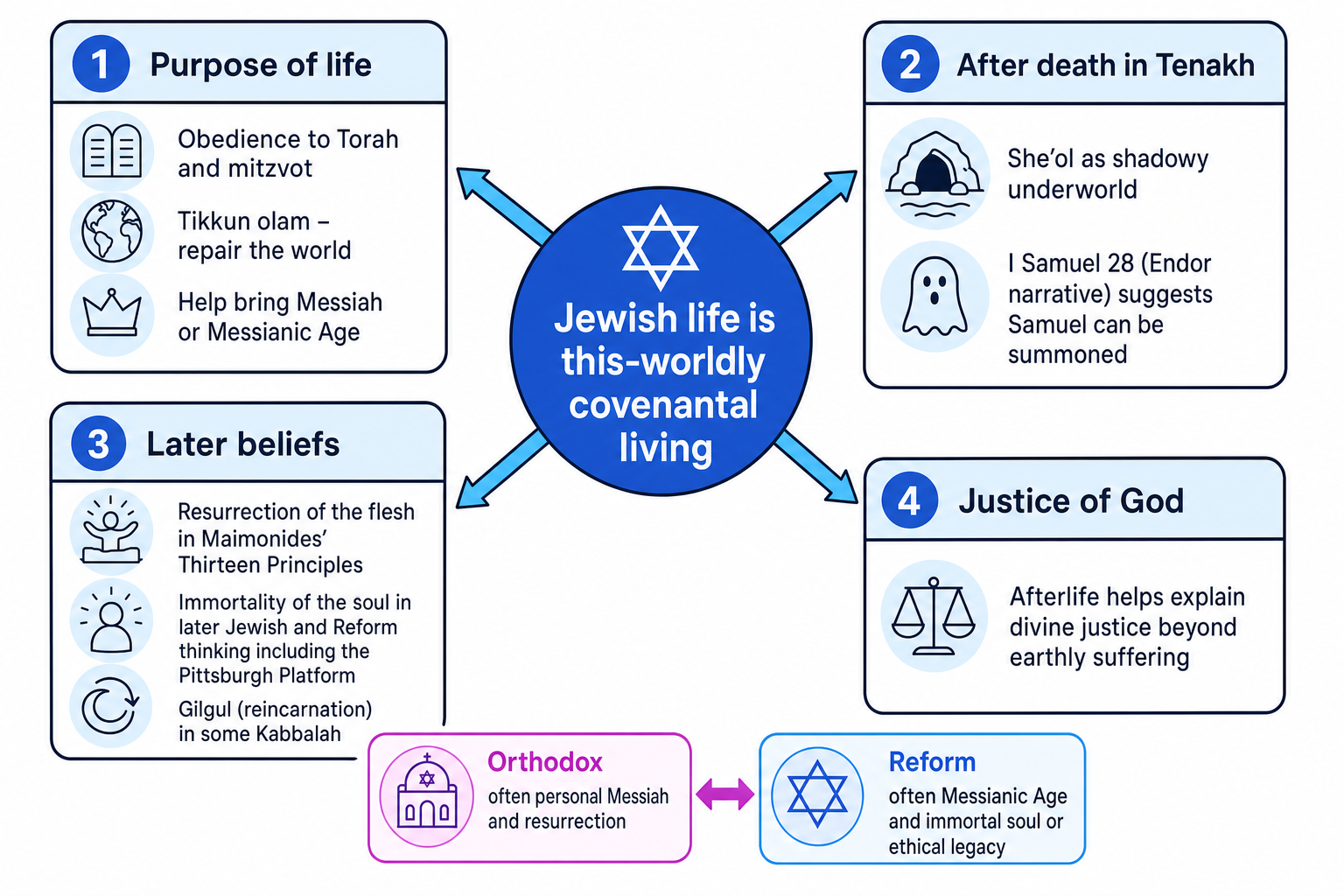
The purpose of life: covenantal living
A good starting point is the covenant, the binding relationship between God and the Jewish people. In Judaism, life has purpose because humans are called to live in relationship with God, other people and creation.
Covenant and mitzvot
A covenant is a sacred agreement or relationship between God and human beings. The mitzvot are the commandments of the Torah, traditionally counted as 613, through which Jewish life is shaped and sanctified.
Obedience to God
For many Jews, especially in Orthodox Judaism, the purpose of life is to obey God by following the Torah, the first five books of the Tenakh, and by living according to halakhah, Jewish law. This is not meant to be mere rule-following. It is a way of making ordinary life holy: food, family, work, prayer, justice and festivals all become ways of serving God.
The Shema, beginning “Hear, O Israel: the Lord is our God, the Lord is one” (Deuteronomy 6:4), expresses this life-orientation. Loving God with “all your heart, all your soul and all your might” means obedience is not only external behaviour but whole-person devotion.
Purpose begins with practice
In Judaism, “What is the purpose of life?” is often answered practically: live faithfully before God through commandments, worship, justice and community.
Tikkun olam: repairing the world
Tikkun olam means “repairing the world”. In modern Jewish usage it often refers to social justice, ethical action and working to make society more compassionate. It is important in many Reform and Liberal Jewish communities, though the phrase also has older rabbinic and mystical meanings.
This purpose is not separate from obedience. Commands such as giving tzedakah, meaning righteous charitable giving, and pursuing justice are part of covenantal life. The difference is emphasis: some Jews stress ritual obedience, while others stress ethical transformation of society.
Bringing the Messiah and the Messianic Age
The Messiah, from the Hebrew mashiach, means “anointed one”. In many traditional Jewish views, the Messiah will be a future Davidic king who gathers the exiles, restores Israel, brings peace and leads the world into knowledge of God.
The Messianic Age is the future era of peace, justice and divine rule associated with the Messiah. Jews differ on whether this involves a personal Messiah, a transformed age brought about by human action, or a more miraculous divine intervention.
Traditional Judaism often expects a personal Messiah. Maimonides, also known as Rambam, includes belief in the coming of the Messiah in his Thirteen Principles of Faith. Reform Judaism has often preferred belief in a Messianic Age rather than a personal Messiah, emphasising human responsibility to work for peace and justice.
Comparing purposes of life
- Start with the shared foundation: both Orthodox and Reform Judaism see life as purposeful because it is lived before God and shaped by ethical responsibility.
- Then identify the difference in emphasis: Orthodox Judaism often gives greater weight to obedience to Torah and halakhah, while Reform Judaism often stresses moral progress, social justice and tikkun olam.
- Connect this to messianic belief: an Orthodox answer may focus on preparing for a personal Messiah through mitzvot, whereas a Reform answer may focus on helping create a Messianic Age through human action.
- Evaluate the relative importance: obedience gives Jewish life concrete structure and continuity, but tikkun olam may seem more directly relevant to modern global problems; a strong essay can argue that the best Jewish answer holds both together.
Writing as if all Jews agree
Avoid saying “Jews believe…” followed by one view. Use phrases such as “many Orthodox Jews”, “some Reform Jews”, “traditional Jewish thought” or “some kabbalistic traditions”.
Death in the Tenakh: She’ol and I Samuel 28
The Tenakh is the Hebrew Bible, made up of the Torah, Nevi’im, meaning Prophets, and Ketuvim, meaning Writings. Its picture of life after death is not always detailed or systematic.
She’ol
She’ol is the shadowy realm or underworld of the dead in parts of the Tenakh. It is often presented less as a place of reward and punishment and more as a dim existence beyond ordinary life.
In early biblical material, death is often described as going down to She’ol, the pit or the grave. It is not the same as later ideas of heaven and hell. It suggests some kind of continued existence, but one that is vague and diminished.
I Samuel 28:11–20
In I Samuel 28:11–20, King Saul consults the medium of Endor and asks her to bring up the prophet Samuel. Samuel appears and rebukes Saul, predicting Saul’s defeat and death. The passage is important because it appears to assume that Samuel continues to exist after death and can be “brought up”.
However, the passage should be handled carefully. It does not celebrate necromancy, which is forbidden in the Torah. It also does not give a full doctrine of heaven, hell or resurrection. It is better used as evidence that the Tenakh contains belief in some form of post-mortem existence, but not a clear systematic afterlife doctrine.
Using I Samuel 28
- Identify what the passage shows: Samuel is portrayed as existing after death, so the text can support belief in some kind of continued existence.
- Notice the direction of the imagery: Samuel is “brought up”, which fits the idea of She’ol as a realm below rather than a heavenly paradise above.
- Limit the claim: because Saul is condemned for consulting a medium, the passage cannot be used as straightforward approval of contacting the dead.
- Evaluate its significance: it is strong evidence for ancient Jewish belief in shadowy survival after death, but weak evidence for later doctrines such as bodily resurrection or immortal reward.
The nature of the soul
Jewish thought does not always treat the soul in the same way as Greek philosophy or Christianity. In the Tenakh, human beings are often viewed holistically: body and life-breath belong together.
Important Hebrew terms include nefesh, often meaning life, self or living being; ruach, meaning spirit, wind or breath; and neshamah, meaning breath or soul. Genesis 2:7 says God breathes life into the human, and the human becomes a living being. This suggests that life itself is God-given.
Later Jewish thought sometimes speaks more clearly of the soul as distinct from the body, especially when discussing immortality, judgement and the World to Come. But it is still important not to assume that Judaism sees the body as bad. Bodily life is created by God and therefore valuable.
Soul language
If you mention the soul, show nuance: early biblical thought is often holistic, while later Jewish philosophy and Reform thought can sound more dualistic by stressing the soul’s immortality.
Resurrection of the flesh
Resurrection of the flesh means that the dead will be raised bodily by God. This is different from saying only the soul survives. The Hebrew term often used is tehiyyat ha-metim, meaning resurrection of the dead.
Maimonides’ Thirteen Principles include belief that God will resurrect the dead. His thirteenth principle affirms that resurrection will occur when God wills it. This belief remains significant in Orthodox Judaism and is reflected in traditional prayer, including praise of God as the one who “revives the dead”.
There are debates about how literally resurrection should be understood. Many Orthodox Jews affirm it as a real future event, often connected with the Messianic Age. Some modern Jews interpret it symbolically, as hope that God’s justice and covenant faithfulness are stronger than death. Reform Judaism has often rejected bodily resurrection, preferring belief in the immortality of the soul or focusing on moral legacy.
Why resurrection matters
Resurrection fits well with the Jewish belief that the body is part of God’s good creation. It also supports the idea that God’s justice is not defeated by earthly suffering. If righteous people suffer and die, resurrection allows for their ultimate vindication.
The challenge is that bodily resurrection can seem difficult for modern believers to accept literally. It can also appear less central to Jewish daily life than Torah, covenant and ethics.
Immortality of the soul and the Pittsburgh Platform
Immortality of the soul means that the soul survives bodily death. This became increasingly important in later Jewish thinking, especially in philosophical and Reform contexts.
The Pittsburgh Platform of 1885, a major statement of Classical Reform Judaism in America, expressed belief in the immortality of the soul. It grounded this belief in the divine nature of the human spirit and connected it with moral consequences: righteousness brings bliss, wickedness brings misery. At the same time, it rejected bodily resurrection and rejected Gehenna and Eden as literal places of everlasting punishment and reward.
This is a major contrast with traditional belief in resurrection. Reform thought often judged bodily resurrection to be less compatible with modern reason and universal ethical religion. Immortality of the soul seemed to preserve moral accountability without requiring a literal future raising of bodies.
Confusing resurrection and immortality
Resurrection means God raises the dead bodily. Immortality of the soul means the soul continues after bodily death. They are related afterlife beliefs, but they are not the same.
Reincarnation in some kabbalistic thinking
Kabbalah is Jewish mysticism. In some kabbalistic traditions, especially later mystical thought, there is belief in gilgul, meaning the reincarnation or transmigration of souls.
In this view, a soul may return in another life to complete unfinished spiritual tasks, repair damage caused by sin, or fulfil mitzvot it has not yet fulfilled. This connects with the wider mystical idea of repair: human action helps restore spiritual harmony.
This belief is not equally important across Judaism. It is found in some mystical and Hasidic communities, but many rationalist, Reform or Liberal Jews would not treat reincarnation as central. In an essay, it is best to say “some kabbalistic Jews” rather than presenting reincarnation as mainstream Judaism.
Afterlife and the justice of God
The justice of God means that God is righteous, fair and morally trustworthy. Belief in an afterlife can help explain how God’s justice is fulfilled when earthly life appears unfair.
If the wicked prosper and the righteous suffer, then resurrection, judgement or immortality can show that earthly death is not the final word. The afterlife can therefore support a kind of theodicy, which is an attempt to defend God’s goodness and justice in the face of evil and suffering.
However, Judaism is cautious about making afterlife reward the only reason to be moral. The purpose of life is not simply to “earn heaven”. Many Jewish approaches stress obedience, covenant and justice in this life. The Book of Job also challenges simplistic claims that suffering is always deserved.
Evaluating afterlife and divine justice
- Present the positive argument: if God is just, then innocent suffering and unpunished evil require a future setting in which wrongs are put right.
- Apply Jewish beliefs: resurrection can vindicate the righteous bodily, while immortality of the soul can preserve moral consequences beyond death.
- Add a challenge: She’ol in the Tenakh is vague, and much Jewish practice focuses more on this life than detailed afterlife speculation.
- Reach a balanced judgement: afterlife belief can strengthen belief in divine justice, but in Judaism it works best alongside covenantal living and tikkun olam, not as a replacement for them.
A quick comparison grid
| Belief | Main idea | Often associated with | AO2 point |
|---|---|---|---|
| She’ol | Shadowy realm of the dead | Earlier Tenakh material | Shows survival after death, but not a full reward-punishment system |
| Resurrection | God raises the dead bodily | Orthodox Judaism; Maimonides’ Thirteen Principles | Fits embodied Jewish anthropology, but can be hard for modern believers |
| Immortality of the soul | The soul survives death | Later Jewish philosophy; Reform Judaism; Pittsburgh Platform | Easier to modernise, but less traditional than bodily resurrection |
| Gilgul | Reincarnation of souls | Some kabbalistic thinking | Links afterlife with spiritual repair, but is not universal in Judaism |
| Messianic Age | Future era of peace and justice | Traditional and Reform Judaism, interpreted differently | Connects purpose of life with hope for history |
In the exam
- Show diversity within Judaism: compare Orthodox, Reform and kabbalistic views where relevant rather than giving one flat answer.
- Use the set references precisely: I Samuel 28:11–20 supports shadowy post-mortem existence, while Maimonides supports resurrection and the Pittsburgh Platform supports immortality of the soul.
- Evaluate, don’t just describe: weigh whether afterlife beliefs are central to Judaism or secondary to this-worldly covenant, mitzvot and tikkun olam.
Check yourself
- How is She’ol different from later ideas of resurrection or immortality of the soul?
- Why might Reform Judaism prefer a Messianic Age and immortality of the soul over a personal Messiah and bodily resurrection?
- Does belief in an afterlife strengthen or weaken the Jewish focus on repairing the world now?

Keep learning
Make a free account to read the full revision notes and worked examples.