Good conduct and key moral principles
What you'll learn
- Why good moral conduct in Judaism is closely linked to obedience to God, Torah and the mitzvot.
- How Jewish ethics balances divine command, human freedom, individual reasoning and pikuach nefesh.
- How sanctity of life affects Jewish views on embryos, abortion, war and weapons of mass destruction.
- How stewardship shapes Jewish attitudes to animals, the environment and modern ecological crises.
1. Good moral conduct: living before God
Judaism is not only a set of beliefs; it is a way of life. Moral conduct matters because Jews are understood to live in a covenant relationship with God: a binding relationship of commitment, promise and responsibility. Obedience to God is therefore not just “following rules”; it is a response to the God who created, liberated and commands Israel.
The Torah contains commandments about worship, food, festivals, family life, justice, honesty, sexuality, business and care for the vulnerable. This means Judaism does not sharply separate “religious” duties from “ethical” duties.
Mitzvot
Mitzvot are commandments or duties. Traditionally, Judaism counts 613 mitzvot in the Torah, including both positive commands, such as giving charity, and negative commands, such as not stealing or murdering.
A key idea is that good conduct is shown through action. Belief matters, but Judaism often emphasises what a person does: keeping Shabbat, giving tzedakah, acting justly, protecting life and avoiding cruelty.
Halakhah
Halakhah means “the way” and refers to Jewish law: the practical guidance developed from Torah, rabbinic interpretation, the Talmud, later legal codes and responsa.
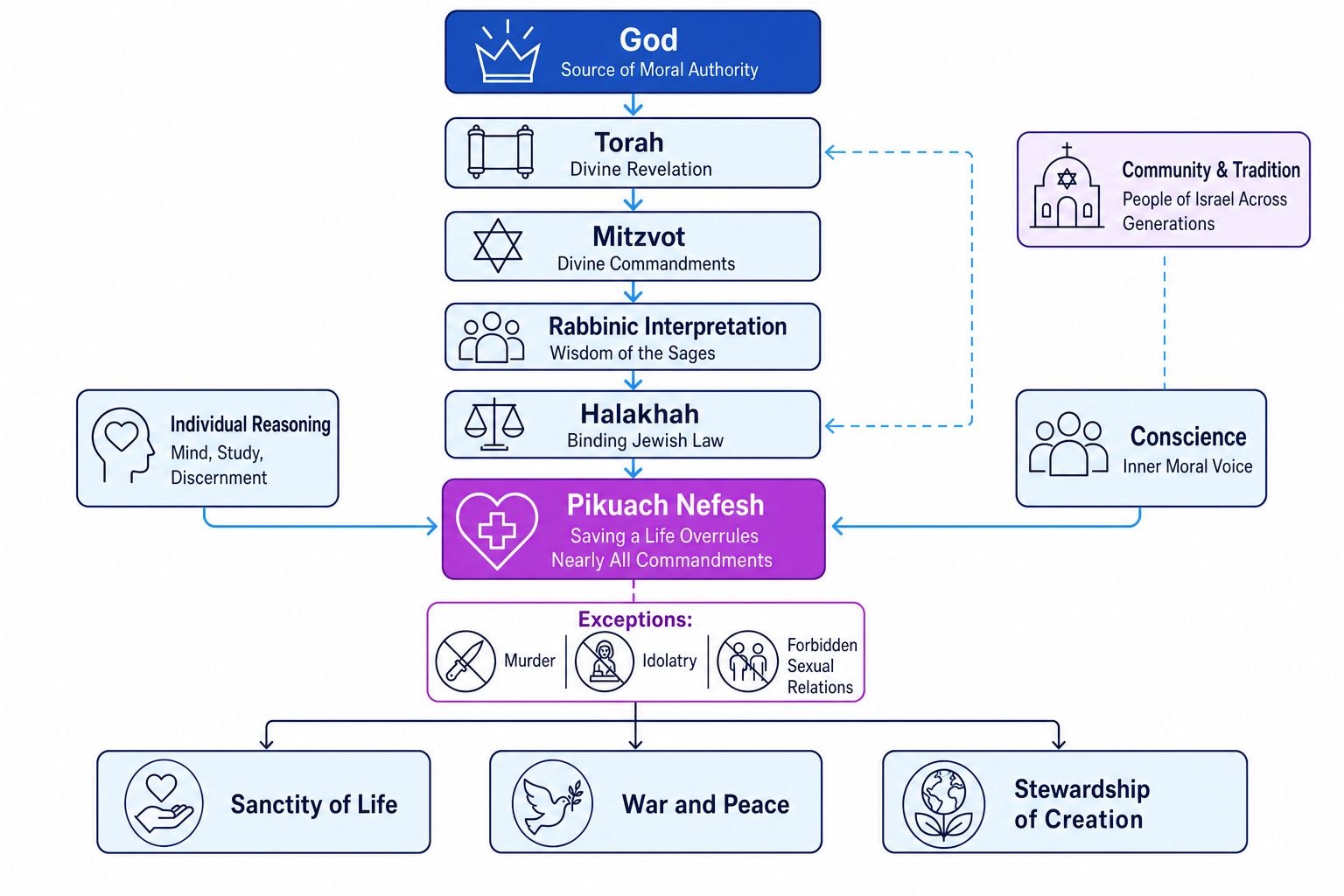
This map shows how moral decision-making in Judaism usually moves from God and Torah into practical judgement.
Obedience is not mindless
Jewish moral obedience is usually obedience through study, interpretation and practice. A Jew may ask: what does Torah command, how has halakhah understood it, and how should it be applied in this situation?
2. Human freedom and moral responsibility
Judaism generally assumes that humans are morally responsible because they are free enough to choose good or evil. Deuteronomy 30:19 says, “I have set before you life and death, blessing and curse. Therefore choose life.” This only makes sense if humans are genuinely accountable.
Rabbinic Judaism often speaks of two inclinations: the yetzer ha-tov, the good inclination, and the yetzer ha-ra, the evil or selfish inclination. The yetzer ha-ra is not simply “Satan”; it can include ordinary desires for food, sex, status or wealth. The moral task is to discipline desire and direct life towards God.
Maimonides strongly defended free will. In his Mishneh Torah, he argues that every person can become righteous or wicked; otherwise, commandments, punishment and repentance would be unjust. This fits the Jewish emphasis on teshuvah, meaning repentance or “return” to God.
There is a tension, though. If God knows all things, does God already know what humans will choose? Pirkei Avot 3:15 expresses the tension: “Everything is foreseen, yet freedom of choice is given.” For essays, this is useful because it shows Judaism can affirm both divine sovereignty and human responsibility without fully resolving the philosophical puzzle.
3. Individual reasoning and decision-making
Jewish ethics is not simply individual opinion. Decisions are made within a tradition: Torah, Talmud, rabbinic authorities, community practice and conscience all matter.
Different Jewish groups place the emphasis differently. Many Orthodox Jews give binding authority to halakhah and rabbinic rulings. Reform and Liberal Jews often stress informed personal autonomy: the individual studies Jewish sources seriously, but may make a personal moral decision. Masorti or Conservative Judaism usually sits between these, treating halakhah as authoritative but historically developing.
Thinking Judaism has only one answer
Avoid writing “Jews believe…” as if all Jews agree. Better phrasing is: “Many Orthodox Jews argue…”, “Some Reform Jews may stress…”, or “Jewish tradition contains a range of views…”
4. Pikuach nefesh: saving life
Pikuach nefesh
Pikuach nefesh is the Jewish principle that saving a human life overrides almost all other commandments. It is based on texts such as Leviticus 18:5, interpreted to mean that one should “live by” the commandments, not die because of them.
The Talmud, especially Yoma 85b, teaches that Shabbat may be broken to save life. A doctor may drive to hospital on Shabbat; a phone may be used to call emergency services; non-kosher food may be eaten if medically necessary.
There are traditional exceptions. A Jew may not commit murder, idolatry or forbidden sexual relations even to save a life. This shows that pikuach nefesh is extremely powerful, but not unlimited.
Applying pikuach nefesh on Shabbat
- A person becomes seriously ill on Shabbat, so the moral issue is a conflict between Shabbat observance and preserving life.
- Pikuach nefesh gives priority to saving life, because the commandments are meant to support life rather than endanger it.
- The correct Jewish response would normally be to call emergency help or travel to hospital, even though this breaks ordinary Shabbat restrictions.
AO2 point: pikuach nefesh makes Jewish ethics flexible and humane, because it avoids rigid rule-following when life is at stake. However, it can also create difficult debates about what counts as a real threat to life, especially in medicine and war.
5. Sanctity of life
Sanctity of life
Sanctity of life means that human life is holy and of special value because it comes from God. In Judaism this is linked to humans being made b’tzelem Elohim, “in the image of God” in Genesis 1:26–27.
The commandment “You shall not murder” and the teaching in Mishnah Sanhedrin 4:5 that saving one life is like saving a whole world both support the idea that life has immense value.
But sanctity of life in Judaism is not always the same as saying “life must be preserved at absolutely any cost.” Jewish law also considers suffering, obligation, intention, the mother’s life, public safety and the difference between potential and actual life.
The embryo and the unborn child
Jewish views on the embryo and unborn child are distinctive. Judaism values unborn life, but many Jewish authorities do not give the embryo the same legal status as a born person. A key text is Mishnah Ohalot 7:6: if a woman’s life is endangered in childbirth, the foetus may be removed to save her; but once the head has emerged, one life may not be set aside for another.
This supports the view that the mother’s life takes priority before birth. Some rabbinic sources also describe the embryo in the first forty days as “mere fluid”, which has influenced more permissive Jewish views on early embryo research, especially when it may help save life.
Orthodox Judaism is usually more restrictive about abortion, often permitting it where the mother’s life is at risk and sometimes where her serious physical or mental health is threatened. Reform Judaism is generally more willing to include the woman’s autonomy, wellbeing and circumstances in the decision.
Assessing embryo research
- The first question is whether the embryo is being treated as a full person or as potential life with serious moral value.
- Many Jewish authorities would then weigh the possible medical benefit, especially if research could save lives through treatments.
- If the embryo is very early and outside the womb, some Jewish thinkers may permit research under strict conditions, while others may reject it as disrespectful to potential life.
AO2 point: Judaism can be seen as compassionate and nuanced here, because it protects unborn life without ignoring the mother. Critics may argue that this produces uncertainty, since “potential life” is morally significant but not always clearly defined.
War and weapons of mass destruction
Judaism is not purely pacifist. The Hebrew Bible contains wars, and Jewish law recognises the duty to defend life and community. A milchemet mitzvah is an obligatory war, often understood as defensive or necessary for survival. A milchemet reshut is a discretionary war, which requires proper authority.
At the same time, peace is a major Jewish ideal: shalom means peace, wholeness and wellbeing. Deuteronomy 20 includes rules for warfare, and Deuteronomy 20:19–20 forbids destroying fruit trees during a siege, later developed into the principle of bal tashchit, “do not destroy.”
Weapons of mass destruction
Weapons of mass destruction are weapons such as nuclear, chemical or biological weapons that can kill on a huge scale and often cannot discriminate between combatants and civilians.
Most Jewish arguments against using weapons of mass destruction appeal to sanctity of life, proportionality, the protection of innocents and environmental destruction. However, some Jews might defend nuclear deterrence if it prevents a greater war. The distinction between possessing such weapons as deterrence and actually using them is important.
Judging the use of a nuclear weapon
- Sanctity of life counts strongly against the action because a nuclear weapon would kill many civilians as well as soldiers.
- Bal tashchit also counts against it because the weapon would cause vast environmental damage and long-term suffering.
- Even if self-defence is a serious aim, many Jewish thinkers would judge actual use disproportionate and indiscriminate, though some might debate deterrence separately.
6. Stewardship: animals and the environment
Stewardship
Stewardship means responsible care for creation. In Judaism, humans may use the world, but they do not own it absolutely; they are accountable to God for how they treat it.
Genesis 1:28 speaks of humans “ruling” over living things, which can sound like dominance. But Genesis 2:15 says Adam is placed in the garden “to till it and keep it.” This balances human authority with responsibility. Psalm 24:1 says, “The earth is the Lord’s,” so creation is not merely human property.
Jewish attitudes to animals include the principle of tza’ar ba’alei chayim, avoiding unnecessary suffering to living creatures. Examples include allowing animals to rest on Shabbat, not muzzling an ox while it works, and the law about not taking a mother bird with her young. Shechita, Jewish ritual slaughter, is defended by many Jews as a disciplined method intended to reduce suffering, though it is criticised by some animal welfare campaigners.
For the environment, bal tashchit began with not destroying fruit trees in war, but modern Jewish environmental ethics applies it more widely to waste, pollution, deforestation and climate change. The Sabbatical year, shemitah, also teaches that land should not be exploited without rest.
Changing scientific understanding has deepened this role. Modern knowledge of climate change, biodiversity loss, plastic pollution and factory farming means many Jews now see stewardship as a global moral duty, not just a local agricultural rule.
Applying bal tashchit to modern consumption
- A community considers whether its pattern of energy use causes avoidable waste and environmental harm.
- Bal tashchit challenges unnecessary destruction, so the issue is not only cost but moral responsibility before God.
- Reducing waste, choosing renewable energy where possible and protecting vulnerable people affected by climate change can be justified as modern stewardship.
Strong essay contrast
A good evaluation might ask whether Judaism is mainly anthropocentric, centred on human needs, or whether its belief that the earth belongs to God creates a genuinely ecological ethic.
7. Pulling the topic together
The key link across this topic is responsibility. Jews are responsible to God through mitzvot, responsible for their choices through free will, responsible for life through pikuach nefesh and sanctity of life, and responsible for creation through stewardship.
For AO2, do not present Jewish ethics as either rigid legalism or vague compassion. The strongest essays show both: Judaism has firm commands and principles, but also a long tradition of interpretation, debate and application to new circumstances.
In the exam
- Start with the principle, not just the issue: explain mitzvot, halakhah, pikuach nefesh, sanctity of life or stewardship before applying it.
- Use named sources where possible: Genesis 1:26–27, Genesis 2:15, Deuteronomy 30:19, Mishnah Ohalot 7:6, Yoma 85b and bal tashchit from Deuteronomy 20.
- Evaluate diversity: compare Orthodox and Reform approaches, and weigh whether Jewish ethics is flexible, coherent and realistic in modern moral problems.
Check yourself
- Why does pikuach nefesh override most mitzvot, and what are its traditional exceptions?
- How does Jewish teaching on the unborn child differ from the claim that life has full legal status from conception?
- Is Jewish stewardship best understood as human control over nature or responsibility to God for creation?
Keep learning
Make a free account to read the full revision notes and worked examples.