Expressions of religious identity
What you'll learn
- Why “being a Jew” can mean religious, ethnic, cultural, legal and communal identity.
- How Jewish identity is expressed through circumcision, bar/bat mitzvah, dress, kashrut and Shabbat.
- How synagogue worship, Yom Kippur and Pesach show both shared identity and diversity.
- Why the synagogue became especially important during the Babylonian Exile and how its role has changed today.
The big picture: identity is layered
Judaism is not just a set of private beliefs. It is also a way of belonging to a people, a covenant, a history and a community. This means Jewish identity can be inherited, chosen through conversion, marked through rituals, and expressed through daily practice.
The map below shows how the main strands of this topic connect.
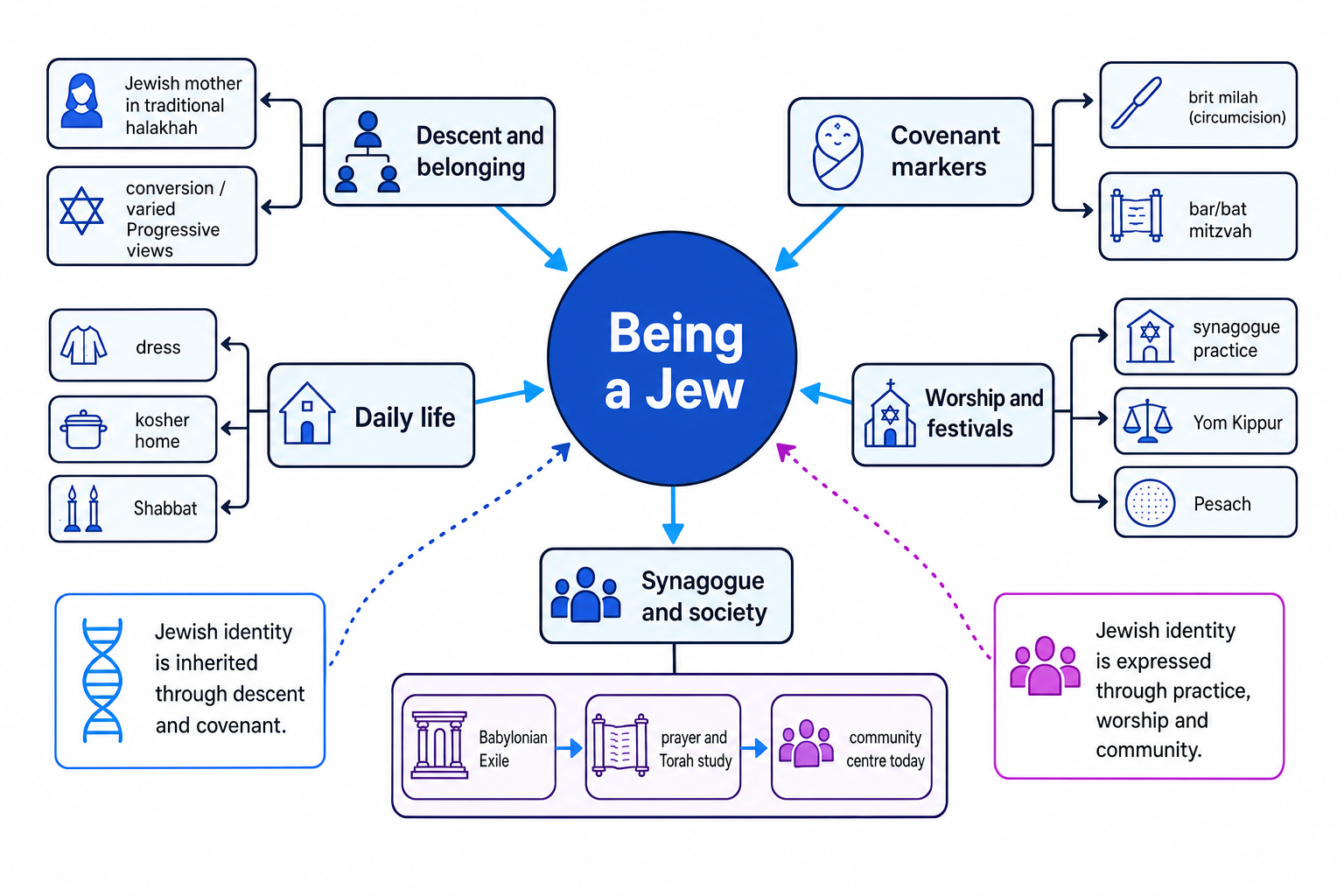
Identity is not one-dimensional
For A-Level essays, avoid treating “Jewish identity” as only belief, only ethnicity or only practice. Strong answers show how Jewish identity combines descent, covenant, law, worship, memory and community.
What does it mean to be a Jew?
A Jew may be understood as a member of the Jewish religion, the Jewish people, or both. Many Jews are religiously observant; others may be secular but still strongly Jewish through ancestry, culture, language, history, family memory or community.
Covenant
A covenant is a binding relationship or agreement. In Judaism, the covenant between God and the Jewish people creates obligations, often expressed through the mitzvot, meaning commandments.
This is why Jewish identity is different from a purely “belief-based” religion. A person may be Jewish even if they struggle with belief in God, and a person who believes in Jewish teachings does not automatically become Jewish without conversion or communal recognition.
Descent, conversion and the Jewish mother
Halakhah
Halakhah means Jewish religious law. It covers worship, ethics, family life, food, festivals and questions of Jewish status.
In Orthodox Judaism, a person is traditionally regarded as Jewish if they are born to a Jewish mother or have undergone a valid conversion. This is called matrilineal descent, meaning identity is passed through the mother.
Many Progressive communities, such as Reform and Liberal Judaism, may recognise someone as Jewish if either parent is Jewish, especially where the child is brought up as Jewish. Requirements vary between communities, so Jewish status can be accepted by one group but questioned by another.
Conversion is also important because it shows Judaism is not simply an ethnicity. Converts can become fully Jewish, though Orthodox, Masorti, Reform and Liberal communities may have different conversion processes and standards.
Applying different understandings of Jewish status
A person has a Jewish father and a non-Jewish mother, was raised in a Liberal synagogue, and has not formally converted.
- Apply the Orthodox halakhic criterion: the mother is not Jewish and there has been no Orthodox conversion, so the person would not usually be recognised as halakhically Jewish by an Orthodox community.
- Apply many Progressive approaches: the person has a Jewish parent and has been raised within Jewish life, so they may be accepted as Jewish in that community.
- Consider cultural identity: the person may sincerely identify as Jewish through family, education, festivals and community belonging, even if not all Jewish authorities recognise their status.
- Draw the evaluative point: “being a Jew” involves both communal rules and lived identity, and these do not always line up neatly.
Circumcision: brit milah
Brit milah
Brit milah means “covenant of circumcision”. It is the ritual circumcision of a Jewish boy, traditionally on the eighth day after birth, linked to God’s covenant with Abraham in Genesis 17.
For many Jews, brit milah is a powerful sign that Jewish identity begins within the covenant community, before the child can personally choose it. In Orthodox Judaism, it is a major religious obligation. Male converts may also require circumcision, or a symbolic ritual if already circumcised.
Progressive Jews often continue the practice, but some may place more emphasis on parental choice, medical concerns, or wider ceremonies of welcome. Many communities also celebrate girls through naming ceremonies such as simchat bat, meaning “joy of the daughter”.
Circumcision does not create Jewishness
Do not write that a boy “becomes Jewish” through circumcision. In traditional Judaism, a boy born to a Jewish mother is already Jewish; brit milah marks covenant identity and obedience.
Bar and bat mitzvah
Bar mitzvah and bat mitzvah
Bar mitzvah means “son of the commandment” and bat mitzvah means “daughter of the commandment”. These ceremonies mark a young person becoming responsible for observing the mitzvot.
Traditionally, boys become bar mitzvah at 13. Girls become bat mitzvah at 12 or 13 depending on the community. The ceremony may include reading from the Torah, leading prayers, giving a speech, or taking on new responsibilities.
Attitudes vary. In many Orthodox communities, boys and girls may have different public roles in worship. In Progressive communities, bar and bat mitzvah are usually more equal, with girls and boys both able to read from the Torah and lead parts of the service.
The key point is that bar/bat mitzvah is not simply a “Jewish birthday party”. It expresses the move into religious responsibility, communal belonging and adult participation.
Jewish identity in daily life
Daily practice matters because Judaism is often described as an orthopraxic religion, meaning it places strong emphasis on right practice. Belief matters, but identity is also shaped by what Jews do with time, food, clothing, family life and community.
Dress
Jewish dress can express reverence, modesty and group identity. Examples include:
- Kippah: a head covering often worn by men, especially during prayer, and in some communities throughout the day.
- Tallit: a prayer shawl with fringes, used in prayer.
- Tzitzit: fringes worn on a garment, based on the commandment to remember God’s commandments.
- Tefillin: small leather boxes containing scriptural passages, worn by many Jewish men during weekday morning prayer.
Some Orthodox and Charedi Jews wear very distinctive clothing, including modest dress and, for some married women, hair coverings. Progressive or secular Jews may not wear visible Jewish dress except during worship or festivals.
Dress therefore expresses identity, but it can also show diversity: some Jews make identity highly visible, while others express it more privately.
Keeping a kosher home
Kashrut and kosher
Kashrut means the Jewish dietary laws. Food that is permitted under these laws is called kosher, meaning fit or proper.
Kosher practice includes avoiding pork and shellfish, eating only permitted animals, and separating meat and milk. Many observant homes have separate utensils, plates or preparation areas for meat and dairy. These laws are linked to biblical texts such as Leviticus 11 and Deuteronomy 14.
A kosher home expresses identity because it brings Judaism into ordinary life. Eating becomes an act of discipline, holiness and belonging. It can also create a boundary between Jewish and non-Jewish life, helping preserve communal distinctiveness.
Attitudes vary widely. Orthodox Jews may keep kosher strictly at home and outside. Some Progressive Jews keep selected aspects, such as avoiding pork. Some secular Jews may not keep kosher but still see Jewish food traditions as culturally important.
Keeping Shabbat
Shabbat
Shabbat is the weekly Sabbath, from Friday sunset to Saturday night. It recalls God’s rest after creation and the liberation from slavery in Egypt.
Shabbat is marked by candle-lighting, wine or grape juice for Kiddush, challah bread, family meals, synagogue worship, rest and study. In Orthodox Judaism, many avoid melakhah, meaning creative or productive work, which may include driving, writing, using money or switching on electrical devices.
Progressive Jews may interpret Shabbat more flexibly, focusing on rest, family, worship, justice and spiritual renewal. Some may drive to synagogue, seeing that as helping them keep Shabbat communally.
Link practice to identity
When writing about kashrut or Shabbat, do not just describe rules. Explain what the practice does: it sanctifies ordinary life, creates Jewish rhythm, strengthens family memory and marks covenant obedience.
Expressions of identity in worship
Synagogue
A synagogue is a Jewish place of assembly, prayer and study. It is often called a beit knesset: a house of gathering.
Synagogue worship usually includes readings from the Torah, prayers from a siddur prayer book, the Shema from Deuteronomy 6:4, and the Amidah, a central standing prayer. The Torah scrolls are kept in the ark, and readings often take place from a raised platform called the bimah.
There is significant diversity. Orthodox synagogues often have separate seating for men and women, and a minyan of ten adult Jewish males is traditionally required for certain prayers. Progressive synagogues usually count women equally, have mixed seating, may use more English, and may include musical instruments. Sephardi and Ashkenazi traditions can also differ in melodies, pronunciation and customs.
This diversity is important for AO2: synagogue worship shows shared Jewish identity, but not uniformity.
Yom Kippur: identity through repentance
Yom Kippur
Yom Kippur is the Day of Atonement, the holiest day of the Jewish year, focused on repentance, fasting, confession and reconciliation with God and others.
Yom Kippur follows Rosh Hashanah and concludes the Ten Days of Repentance. Many Jews fast for about 25 hours and attend long synagogue services, including Kol Nidrei on the evening before and Ne’ilah, the closing service.
Yom Kippur expresses Jewish identity as moral accountability. It reminds Jews that covenant identity is not only inherited; it requires repentance, repair and renewed commitment. Even some Jews who rarely attend synagogue may attend on Yom Kippur, showing its deep cultural and spiritual significance.
Pesach: identity through memory
Pesach
Pesach, or Passover, is the festival remembering the Exodus from Egypt, when God liberated the Israelites from slavery.
Pesach is especially centred on the home. Families hold a Seder meal using the Haggadah, a text that retells the Exodus story. Symbolic foods include matzah, bitter herbs and wine. Many Jews remove chametz, meaning leavened food, from the home.
Pesach expresses identity through shared memory. The story is not treated as distant history only; Jews are encouraged to see themselves as personally connected to liberation. This makes Pesach a powerful festival for passing Jewish identity to children.
Comparing Yom Kippur and Pesach as identity markers
- Compare their main focus: Yom Kippur stresses repentance and moral renewal, while Pesach stresses collective memory and liberation.
- Compare their setting: Yom Kippur is strongly synagogue-centred, while Pesach is strongly home-centred through the Seder.
- Compare their effect on identity: Yom Kippur renews the individual and community before God; Pesach teaches children that they belong to the Jewish story.
- Make a judgement: Pesach may be especially powerful for cultural transmission, but Yom Kippur may show the seriousness of covenant responsibility.
The changing role of the synagogue in society
The synagogue’s role developed significantly during the Babylonian Exile. In 586 BCE, the Babylonians destroyed the First Temple in Jerusalem and many Jews were exiled to Babylon. Without access to the Temple and its sacrifices, Jewish religious life increasingly centred on prayer, Torah study and community gathering.
Exile
Exile means forced removal from one’s homeland. The Babylonian Exile was a major crisis because it separated Jews from Jerusalem and the Temple.
The synagogue did not simply replace the Temple overnight. However, the Exile helped develop patterns of worship that could continue outside the land of Israel. After the destruction of the Second Temple in 70 CE, synagogue-based prayer and rabbinic teaching became even more central to Judaism.
Today, the synagogue has several roles:
- House of prayer: regular services, Shabbat worship, festivals and life-cycle events.
- House of study: Torah study, adult education, Hebrew classes and preparation for bar/bat mitzvah.
- Community centre: social events, charity, pastoral care, youth groups and support for Jewish identity in the diaspora.
- Public identity marker: a visible sign of Jewish presence in wider society.
From sacrifice to study
The synagogue’s importance grew because Judaism had to survive without Temple sacrifice. Prayer, Torah study and community became portable ways of preserving Jewish identity.
AO2 evaluation should be balanced. On one hand, the synagogue is central because it gathers Jews publicly, preserves tradition and educates the next generation. On the other hand, many Jewish practices are home-based, especially Shabbat, kashrut and Pesach. Some Jews also identify strongly as Jewish while rarely attending synagogue. So it is better to argue that the synagogue is a major expression of identity, not the only one.
Bringing it together: what best expresses Jewish identity?
There is no single answer. Descent gives continuity. Circumcision and bar/bat mitzvah mark covenant belonging. Kashrut and Shabbat shape daily life. Festivals preserve memory. Synagogue worship builds public community.
A strong judgement might say: Jewish identity is most fully expressed when inherited belonging and active practice come together. However, the diversity within Judaism means you should never imply that less observant Jews are “less Jewish”. Different communities define and express identity in different ways.
In the exam
- Define “Jewish identity” broadly: include religion, peoplehood, covenant, culture, descent and practice.
- Always show diversity: contrast Orthodox, Progressive and secular/cultural Jewish approaches where relevant.
- Link description to meaning: explain how each practice expresses covenant, memory, holiness, community or responsibility.
- For the synagogue, include history: mention the Babylonian Exile, loss of Temple worship, and the growth of prayer and Torah study.
- Make a justified judgement: avoid listing practices; weigh which expressions are most central and why.
Check yourself
- Why might one Jewish community recognise someone as Jewish while another does not?
- How do kashrut and Shabbat express Jewish identity in different ways?
- Why did the Babylonian Exile increase the importance of prayer, study and community gathering?

Keep learning
Make a free account to read the full revision notes and worked examples.