Judaism, gender and sexuality
What you'll learn
- How social change, secular law, Torah and Halakhah have shaped Jewish thinking about gender and sexuality.
- Why Jewish movements disagree about women rabbis, agunot, minyan and LGBTQ+ matters.
- How the Jewish Orthodox Feminist Alliance and Rachel Adler contribute to feminist Jewish thought.
- How to turn this topic into balanced AO1 explanation and AO2 evaluation.
1. Start with the core vocabulary
Sex usually refers to biological characteristics. Gender refers to identity, roles and expectations connected with being male, female, both, neither or another identity. Sexuality refers to sexual orientation, desire and relationships.
In Judaism, debates about gender and sexuality are rarely just “personal opinion”. They depend on how a community understands revelation, authority and law.
Torah and Halakhah
- Torah means “teaching” or “instruction”; narrowly, it refers to the Five Books of Moses, and more broadly to Jewish sacred teaching.
- Halakhah means Jewish law, drawn from Torah, rabbinic interpretation, the Talmud, legal codes and later rabbinic responsa.
- A responsum is a written rabbinic answer to a legal or ethical question.
Different Jewish movements use these sources differently. Orthodox Judaism generally sees Halakhah as divinely rooted and binding. Masorti Judaism — called Conservative Judaism in North America — sees Halakhah as binding but historically developing. Reform and Liberal Judaism usually give greater weight to conscience, equality and ethical development, while still valuing Torah.
The main debate
The key question is whether change on gender and sexuality is a faithful development of Jewish values, or an unacceptable surrender to modern secular culture.
2. Historical and social factors behind development
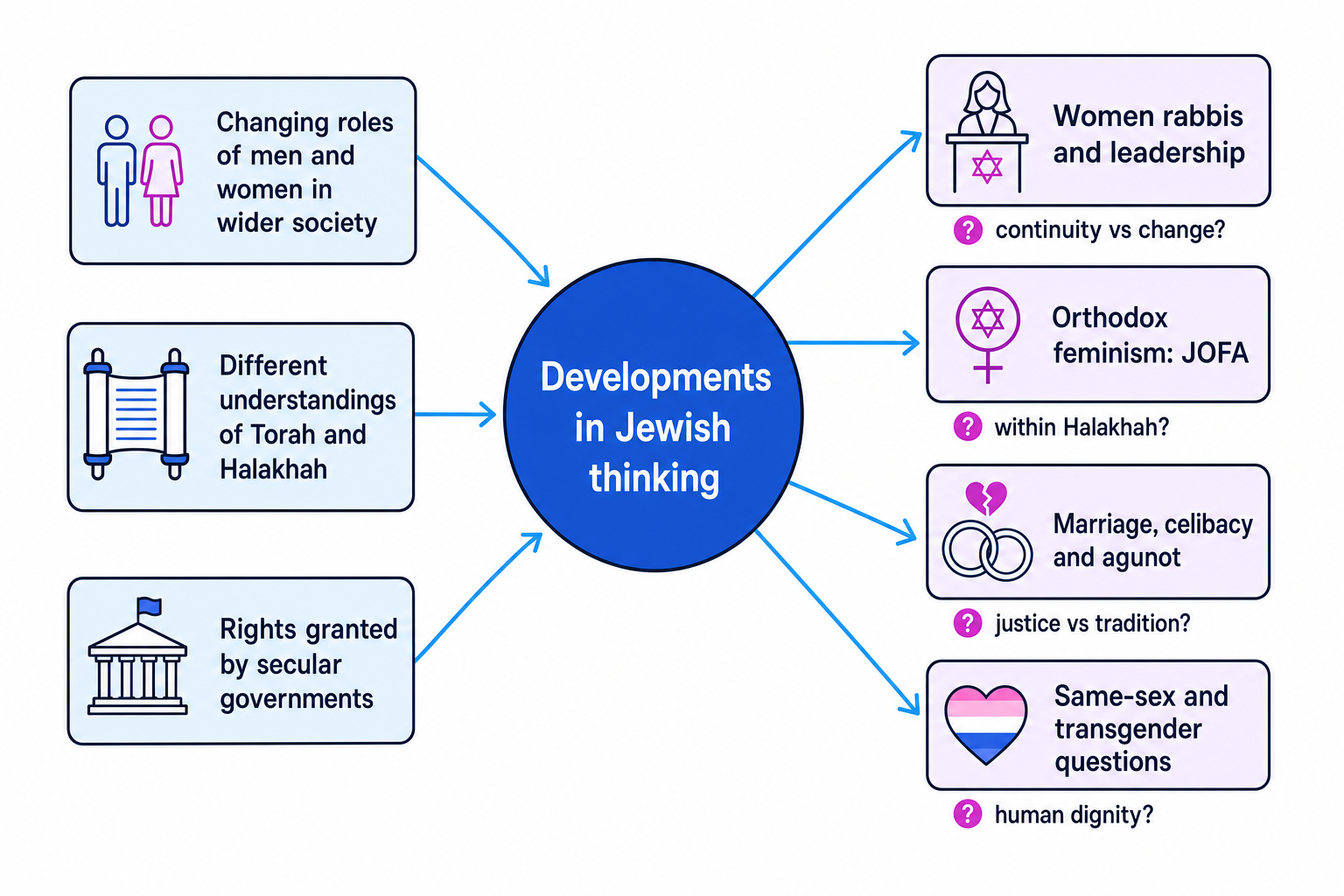
Jewish thinking has developed within changing societies. Three factors matter especially:
- Changing roles of men and women outside religion: women’s access to higher education, employment, political leadership and public authority made exclusion from religious leadership seem increasingly questionable.
- Different understandings of Torah and Halakhah: some Jews argue that inherited roles are binding; others argue that Judaism has always developed through interpretation.
- Rights given by secular governments: women’s rights, divorce rights, anti-discrimination law, same-sex marriage and gender recognition have shaped expectations, even though civil law does not automatically change Halakhah.
The map below shows how these pressures feed into the main AQA debates.
Applying the three influences to women rabbis
- Start with social change: by the late twentieth century, many Jewish women were highly educated and held public roles in wider society.
- Add interpretation: Progressive Jews argued that if women can study and teach Torah, they can also lead communities as rabbis; many Orthodox Jews argued that traditional Halakhah limits certain public religious roles.
- Add secular rights: equality law and changing social expectations increased pressure on communities to justify exclusion.
- Evaluate: the debate is not simply “modernity versus religion”; it is about which interpretation of Jewish authority is most convincing.
3. Women as rabbis, c1970 to the present
Ordination means formal authorisation to serve as a rabbi. Historically, rabbinic leadership was male. There were earlier exceptions, most famously Regina Jonas, ordained in Germany in 1935, but the major debate from around 1970 onwards concerns mainstream communal acceptance.
Important developments include:
- Sally Priesand was ordained in 1972 in the American Reform movement.
- Jackie Tabick became the first woman rabbi in Britain in 1975.
- Amy Eilberg was ordained in 1985 as the first woman rabbi in Conservative Judaism in North America.
- Today, Reform, Liberal and many Masorti communities ordain women. Orthodox communities remain divided, with some Modern Orthodox initiatives training women as halakhic advisers or spiritual leaders, while mainstream Orthodox bodies usually reject the title “rabbi” for women.
Arguments for women’s ordination often appeal to tzelem Elohim, the belief from Genesis 1:27 that all humans are created in the image of God, and to examples of female leadership such as Deborah in Judges 4–5. They also argue that excluding women wastes gifts that could serve the community.
Arguments against women’s ordination, especially in Orthodox contexts, often appeal to inherited Halakhah, tradition, modesty, and the view that some public ritual obligations have historically belonged to men.
Avoid one-size-fits-all answers
Do not write “Judaism says women cannot be rabbis” or “Judaism accepts women rabbis”. Always name the movement: Orthodox, Masorti, Reform or Liberal.
4. Orthodox feminism and JOFA
Jewish feminism is the attempt to critique male-dominated structures in Jewish life while recovering women’s agency, dignity and religious authority. A key example is the Jewish Orthodox Feminist Alliance or JOFA, founded in 1997 and associated with figures such as Blu Greenberg.
JOFA is important because it works within Orthodox Judaism rather than simply rejecting Halakhah. It argues that women’s fuller participation is often possible through serious halakhic reasoning.
Agunah and minyan
- An agunah is a “chained woman”: a woman unable to remarry under Jewish law because her husband refuses, or is unable, to give a get, a Jewish religious divorce document.
- A minyan is the quorum traditionally required for public prayer. In Orthodox practice this is usually ten adult Jewish men; Progressive communities commonly count women equally.
JOFA campaigns against the injustice of agunot by supporting halakhic prenuptial agreements, education and pressure on religious courts to prevent get-refusal. On minyan, JOFA supports greater women’s participation in prayer, women’s prayer groups, partnership minyanim and serious discussion about counting women, while still framing the issue as halakhic rather than purely secular.
AO2 point: JOFA is powerful because it is an internal critique — it challenges inequality using Orthodox language. However, critics argue that its changes either go too far for Orthodoxy or not far enough for full equality.
5. Celibacy, marriage and Rachel Adler
Celibacy means abstaining from sexual relationships. Judaism has generally not idealised celibacy in the way some Christian traditions have. Genesis 1:28 commands humans to “be fruitful and multiply”, and marriage is usually seen as a positive context for love, sex, family and covenant.
Traditional Judaism sees marriage as a union between a Jewish man and woman, often described through kiddushin, the sanctification of marriage. Progressive Judaism is more likely to emphasise equality, mutual consent and the possibility of same-sex marriage.
Rachel Adler is a major Jewish feminist theologian. In Engendering Judaism she criticises traditional marriage language because the Mishnah, an early rabbinic legal text, describes a woman as being “acquired” in marriage. Adler argues that women must be subjects of Jewish law, not objects within it. She proposes brit ahuvim, meaning “covenant of lovers”, as an egalitarian model of marriage based on mutual partnership rather than male acquisition.
Using Rachel Adler to evaluate marriage
- Identify the problem: traditional kiddushin can appear unequal because the groom acts and the bride is acted upon.
- Explain Adler’s solution: brit ahuvim reframes marriage as a mutual covenant between equal partners.
- Apply it: this supports feminist Jewish arguments for egalitarian marriage and can also support recognition of same-sex relationships.
- Evaluate: Adler preserves covenantal Jewish language, but Orthodox critics may argue that she reconstructs marriage too radically.
6. Same-sex relationships and transgender matters
Jewish views on same-sex relationships vary widely. Traditional readings focus on Leviticus 18:22, which prohibits male same-sex intercourse. Orthodox responses often distinguish between orientation and prohibited acts: a person’s dignity must be respected, but same-sex sexual relationships are usually not accepted. This can lead to an expectation of celibacy for gay Jews, which critics see as pastorally damaging.
Reform, Liberal and Reconstructionist communities generally affirm same-sex relationships, conduct same-sex marriages or blessings, and ordain LGBTQ+ rabbis. They often argue that the Torah’s deepest values include justice, love, human dignity and tzelem Elohim. Masorti responses vary, but many have become more affirming while still wrestling with the authority of traditional texts.
Transgender refers to a person whose gender identity differs from the sex assigned to them at birth. Progressive Jewish communities usually affirm trans identities, support name-change rituals and include trans people in leadership. Orthodox responses vary: some emphasise compassion and human dignity, while others argue that Halakhah treats sexed obligations as fixed and therefore resists gender transition.
The Talmud includes categories such as androgynos, a person with both male and female sexual characteristics, and tumtum, a person whose sex characteristics are unclear or hidden. These categories show that Jewish legal discussion has never been entirely simplistic about sex and gender.
Ancient categories are not modern labels
Do not claim that androgynos and tumtum are simply “transgender” categories. They are ancient halakhic categories, but they can still be used in modern discussions about gender complexity.
7. Bringing it together for essays
The strongest essays compare authority. A traditional answer may value continuity with Torah and Halakhah; a feminist or Progressive answer may argue that justice and dignity are also central Jewish principles. Your job is not to caricature either side, but to judge which approach gives the most convincing account of Judaism today.
In the exam
- Name the Jewish movement you are discussing; avoid vague phrases like “Jews believe”.
- Link each issue to authority: Torah, Halakhah, rabbinic interpretation, secular rights or feminist theology.
- Use named examples — JOFA, agunot, minyan, women rabbis and Rachel Adler — then evaluate whether development is faithful or too radical.
Check yourself
- Why have secular rights and changing gender roles influenced Jewish thinking?
- How does JOFA approach agunot and minyan while remaining Orthodox?
- What is Rachel Adler’s brit ahuvim, and why is it significant for Jewish sexual ethics?

Keep learning
Make a free account to read the full revision notes and worked examples.