Self, death and afterlife
What you'll learn
- How Muslims understand life as worship of Allah and a moral test.
- How al-Qadr raises questions about divine control, freedom and responsibility.
- What Muslims believe about the soul, Barzakh, resurrection, judgement, heaven and hell.
- How to evaluate whether this life is “only” a preparation for the life to come.
Life as worship and moral test
A good starting point is tawhid, the absolute oneness and uniqueness of Allah. If Allah is the creator and sustainer of everything, then human life is not accidental: it has a God-given purpose.
The Qur’an states: “I did not create jinn and mankind except to worship Me” (51:56). It also describes life and death as a test: Allah “created death and life to test which of you is best in deed” (67:2). So, for Muslims, life is both a gift and an examination of faith, intention and conduct.
Ibadah
Ibadah means worship or service of Allah. It includes formal acts such as prayer, fasting, zakah and hajj, but also moral living, justice, family life, work and care for others when done with the right intention, called niyyah.
This means worship is not just “religious activities” separated from ordinary life. A Muslim might understand honest business, kindness to parents, or resisting injustice as worship if done in obedience to Allah.
Muslims often describe human beings as ‘abd — servants of Allah — and khalifah — stewards or vicegerents on earth. These ideas keep two truths together: humans depend on Allah, but they are also entrusted with real moral responsibility.
Life is not meaningless
For Muslims, earthly life, or dunya, is temporary, but it is not pointless. It is the place where worship, moral choice and preparation for the akhirah — the afterlife — happen.
The big picture is a journey from created purpose, through earthly moral testing, to death, resurrection, judgement and final destiny.
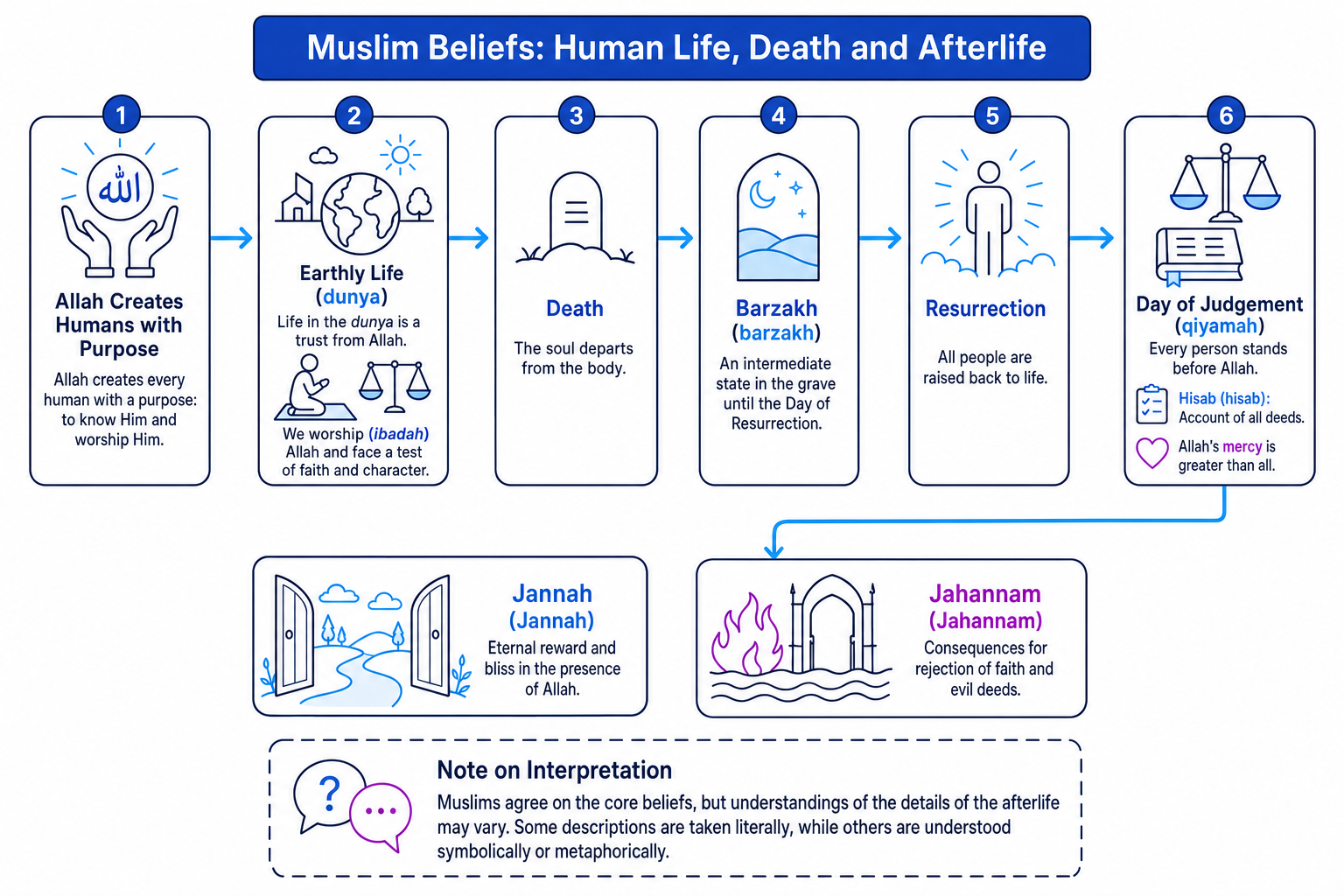
Is this life only preparation for the next?
There is strong support for saying that the afterlife gives earthly life its deepest significance. The Qur’an repeatedly warns that worldly pleasures are temporary, while the akhirah is lasting. However, the word “only” can mislead. Islam does not normally teach withdrawal from the world as if family, society and justice are worthless.
Qur’an 28:77 gives a balanced view: seek the home of the Hereafter, “but do not forget your share of the world.” So the world is not the final goal, but it is still the arena in which obedience to Allah becomes real.
Evaluating this life as preparation
- Start with the strongest reason for the claim: if judgement and the akhirah are eternal, then earthly life is clearly preparation for what comes next.
- Add the balance: if “only” means this world has no value in itself, that conflicts with Muslim ideas of stewardship, social justice and gratitude for Allah’s creation.
- Reach a precise judgement: a stronger answer says this life is important because it prepares for the next, not that it is “only” important in a dismissive or world-denying sense.
Al-Qadr: divine control and human responsibility
Al-Qadr
Al-Qadr means divine decree or predestination: the belief that Allah has complete knowledge, power and control over all things.
The difficulty is easy to see: if Allah knows and controls everything, how can humans be genuinely free and morally responsible? Yet if humans are completely independent, does that weaken Allah’s sovereignty?
This issue matters because Islam teaches both divine power and judgement. A moral test only seems fair if people are responsible for their choices. But tawhid also requires that Allah is not limited by anything outside himself.
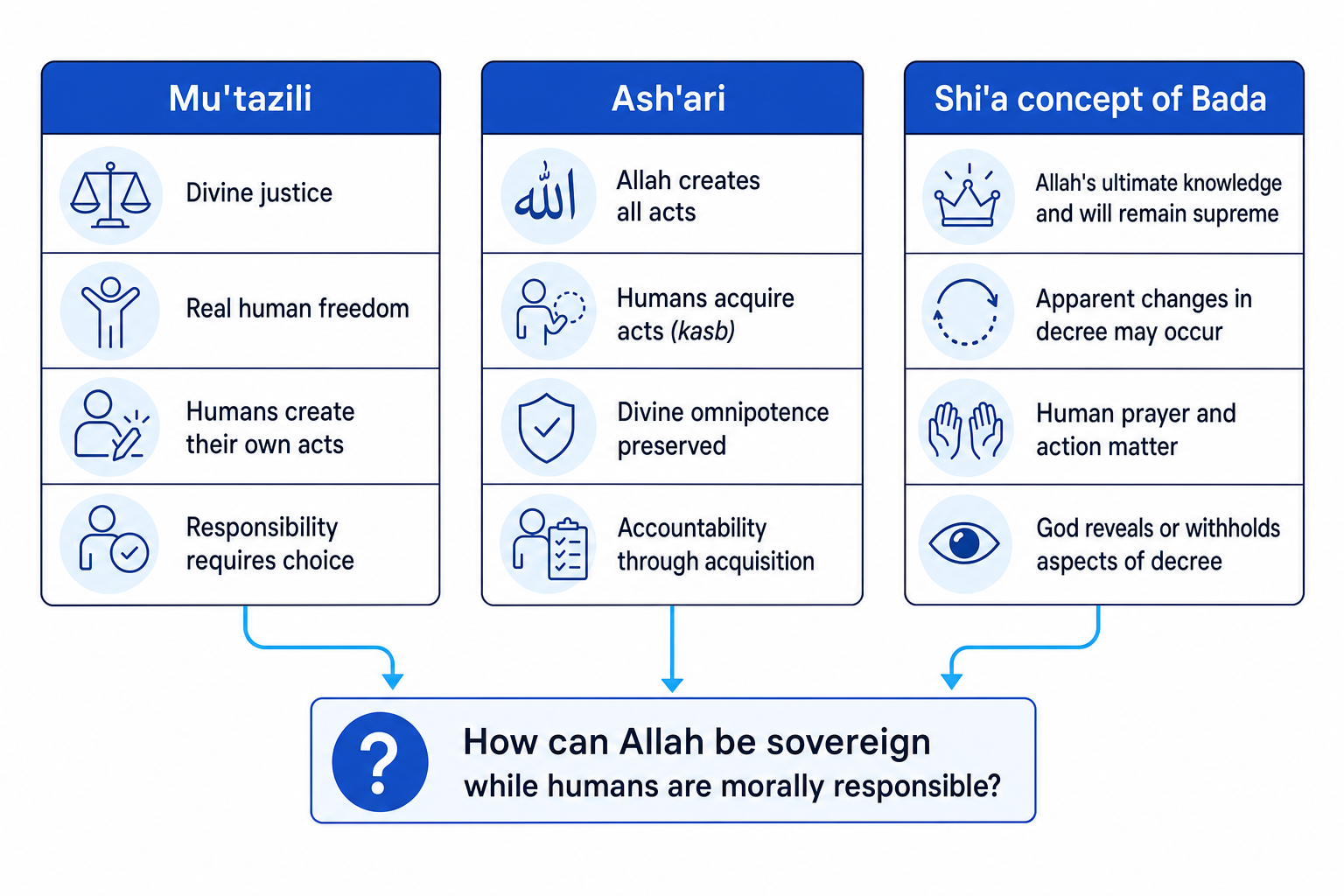
The Mu'tazili view
The Mu'tazili were an early school of Islamic theology that strongly emphasised divine justice, or ‘adl. They argued that Allah would not justly punish people for actions they had no real power to choose.
Therefore, they defended a strong form of human freedom: humans create their own voluntary acts, although Allah creates human beings and their capacities. This protects moral responsibility. Its weakness is that critics think it risks making human action too independent from Allah’s control.
The Ash'ari view
The Ash'ari school, influential in Sunni theology, emphasised Allah’s omnipotence — his all-powerful control. Ash'aris argued that Allah creates all acts, but humans acquire their acts. This doctrine is called kasb.
Kasb tries to say two things at once: Allah remains the ultimate creator of every act, but humans are accountable because they will, intend and “acquire” the act as theirs. Its strength is that it protects divine sovereignty. Its weakness is that critics argue it can make human freedom difficult to explain clearly.
Shi'a concept of Bada
In Shi'a thought, Bada refers to an apparent change in divine decree. It does not mean Allah learns something new or changes his mind through ignorance. Rather, Allah may reveal or enact a different outcome from what humans expected, while his ultimate knowledge remains perfect.
This supports the importance of prayer, repentance and moral action. Human choices matter within Allah’s wider knowledge and will. Its weakness is that Bada can be misunderstood as limiting divine omniscience unless carefully explained.
Predestination does not equal fatalism
Do not write as if all Muslims simply believe “everything is fixed, so choices do not matter.” The exam rewards explaining the tension: Allah is sovereign, yet humans are still judged as responsible agents.
Comparing freedom and responsibility
- Apply the test of justice: if humans are judged, the Mu'tazili view explains responsibility clearly because people genuinely choose their voluntary acts.
- Apply the test of divine sovereignty: the Ash'ari view explains Allah’s total control more strongly because even human acts are created by Allah.
- Evaluate the trade-off: Mu'tazili thought may protect justice better, while Ash'ari thought may protect omnipotence better; Bada adds that prayer and repentance remain meaningful within divine decree.
Akhirah: soul, Barzakh, judgement, heaven and hell
Akhirah
Akhirah means the afterlife: the reality after death, including resurrection, judgement and final destiny with Allah.
Islam does not usually treat the body as a worthless prison for the soul. Human beings are embodied creatures, and mainstream Muslim belief strongly affirms resurrection. The Qur’an challenges those who doubt that bones can be brought back to life, insisting that the creator can restore life.
The Qur’an uses terms such as nafs, meaning self or soul, and ruh, meaning spirit. The exact nature of the soul is ultimately mysterious: Qur’an 17:85 says the spirit is by the command of the Lord and humans have been given only limited knowledge. The key belief is that personal identity and accountability continue beyond death.
Barzakh: the intermediate state
Barzakh means barrier or interval. It is the state between death and resurrection. Qur’an 23:99–100 refers to a barrier behind the dead until the day they are raised.
Many Muslims also believe, based on hadith, in questioning in the grave by the angels Munkar and Nakir, and in comfort or punishment before the final judgement. The exact details are interpreted differently, but Barzakh shows that death is not annihilation.
Resurrection and judgement
The Day of Resurrection, or Yawm al-Qiyamah, is when the dead are raised. The Day of Judgement, or Yawm al-Din, is when Allah judges every person. Hisab means reckoning or accounting.
Judgement involves deeds, intentions, faith and Allah’s mercy. Muslims often refer to records of deeds and the scales of justice. However, Islamic judgement is not a simple points system: Allah is just, but also merciful and forgiving.
Faith, deeds and mercy
A strong essay avoids saying Muslims believe they “earn” heaven mechanically. Better: faith and deeds matter, but final judgement belongs to Allah’s justice and mercy.
Jannah and Jahannam
Jannah means paradise or garden. It is described as reward, peace, fulfilment and closeness to Allah. Jahannam means hell, associated with fire, regret, punishment and separation from Allah’s favour.
Qur’an 47:15 is especially important. It describes paradise with rivers of pure water, milk whose taste does not change, wine delightful to drink, and purified honey, along with fruits and forgiveness from the Lord. The same verse contrasts this with the people of fire, who are given scalding water.
Muslims differ over how literally to read these descriptions. Many take them as real descriptions of bodily resurrection and physical reward or punishment. Others read them more symbolically or analogically: the Qur’an uses images humans can understand to point towards realities beyond ordinary experience.
Interpreting Qur'an 47:15
- Identify the imagery: the verse uses sensory language — rivers, milk, wine, honey, fruit and scalding water.
- Explain a literal reading: these details support bodily resurrection and real reward or punishment after judgement.
- Explain a symbolic reading: the images may communicate purity, abundance, joy, forgiveness and terror in language suited to human understanding.
- Evaluate fairly: the strongest answer does not mock either approach; it explains why some Muslims prioritise the plain meaning of revelation while others emphasise the limits of human language about the afterlife.
Do not reduce Jannah to pleasure
Qur’anic descriptions of paradise include physical imagery, but they also emphasise forgiveness, peace and nearness to Allah. For many Muslims, the greatest joy of Jannah is spiritual, not merely sensory.
Bringing the topic together
This topic is about a connected worldview. Life has purpose because Allah created humans to worship him. Moral responsibility matters because life is a test. Al-Qadr raises the deep question of how that responsibility fits with Allah’s complete power and knowledge. Death is not the end, because the soul continues and the person is raised for judgement. Heaven and hell express the seriousness of human response to Allah.
For evaluation, aim for balance. Do not present Muslim beliefs as simplistic. The best essays show the internal debate: justice and power, freedom and decree, literal and symbolic language, worldly responsibility and preparation for the akhirah.
In the exam
- Define key Arabic terms accurately before evaluating them: ibadah, al-Qadr, Barzakh, Yawm al-Qiyamah, Jannah and Jahannam.
- For al-Qadr, compare named positions rather than giving a vague “free will versus predestination” answer: Mu'tazili, Ash'ari and Shi'a Bada.
- When evaluating the afterlife, use Qur’an 47:15 and then discuss whether descriptions of heaven and hell are literal, symbolic, or both.
- For AO2, make a judgement on wording such as “only preparation” or “true freedom”, rather than just describing beliefs.
Check yourself
- Why might a Muslim reject the claim that this life is “only” a waiting room for the afterlife?
- How do Mu'tazili and Ash'ari thinkers differ on human responsibility?
- What are two possible ways to interpret Qur’anic descriptions of Jannah and Jahannam?

Keep learning
Make a free account to read the full revision notes and worked examples.