God
What you'll learn
- How tawhid shapes everything Muslims say about God.
- What the Throne Verse teaches about God as creator, controller and sustainer.
- How Muslims interpret Qur’anic descriptions such as the hand and face of God.
- How Sufi thought balances God’s incomparability with divine nearness and spiritual union.
The starting point: Allah and tawhid
In Islam, God is called Allah: the one, eternal, unique God worshipped by Muslims. The central doctrine is tawhid, the absolute oneness and unity of God. This is not just “there is one God” in a simple numerical sense. It means God has no partners, no equals, no divisions, no rivals and no created thing that can share His divine status.
Tawhid
Tawhid means the oneness and unity of God. It is the belief that Allah alone is God, uniquely worthy of worship, and completely unlike created things.
The opposite of tawhid is shirk, which means associating partners with God. In Islamic thought, shirk is the gravest theological error because it compromises God’s uniqueness.
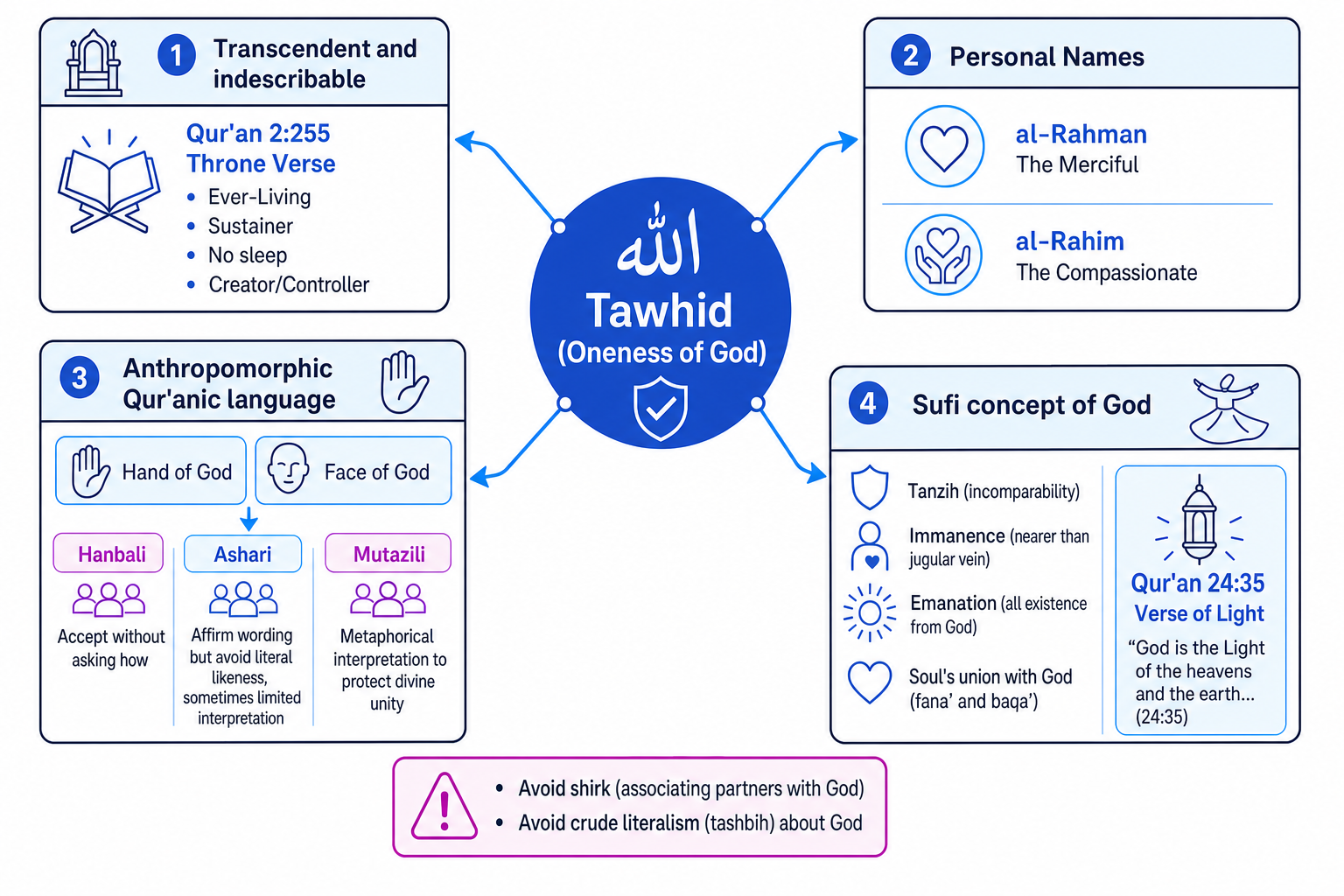
God as transcendent and indescribable
To say God is transcendent means God is beyond the created universe and not limited by space, time, matter or human categories. God is not one object among other objects. He is the creator of all things, so He cannot be fully contained within creation.
Transcendence
Transcendence means God is beyond and greater than the universe, not limited by physical form, human weakness or created categories.
This connects to the idea that God is ultimately indescribable. Muslims do use names and descriptions for God, especially from the Qur’an, but these do not capture God’s essence fully. Human language is limited; God is not.
This is important for essays because it creates a careful balance: Islam teaches that God can be known truly through revelation, but not known completely in His inner reality.
Knowable but not containable
Islam does not usually say God is totally unknowable. Rather, God is known through His revealed names, actions and attributes, while His essence remains beyond full human understanding.
The Throne Verse: Qur’an 2:255
The Throne Verse, Qur’an 2:255, is one of the most important Qur’anic passages about God. It begins: “Allah — there is no deity except Him, the Ever-Living, the Sustainer of existence.” It says that neither sleep nor drowsiness overtakes Him, that everything in the heavens and earth belongs to Him, and that His knowledge and power extend over all things.
Omnipotence
Omnipotence means being all-powerful. In Islamic belief, Allah has complete power over creation and is not weakened, tired or limited.
The Throne Verse teaches several key ideas:
- God is one: “there is no deity except Him”.
- God is living and self-sustaining: He depends on nothing.
- God is creator and controller: all things belong to Him.
- God is omniscient, meaning all-knowing.
- God is not human-like: He does not sleep, tire or lose control.
- God’s “Throne” symbolises supreme authority and majesty.
Using the Throne Verse in an essay
-
Start with the doctrinal point: Qur’an 2:255 supports tawhid because it declares that there is no deity except Allah.
-
Develop the attributes: the verse presents Allah as “Ever-Living” and “Sustainer”, so God is not merely the first cause of creation but the continuing controller of all existence.
-
Add evaluation: this strengthens Islamic transcendence because God is unlike humans — He does not sleep or tire — but it also supports a personal religious relationship because God actively preserves and knows creation.
Personal aspects of God: mercy and compassion
Although God is transcendent, Islam also presents God as personally involved with creation. Two of the most important Names of God are al-Rahman and al-Rahim. These are often translated as The Merciful and The Compassionate.
The Names of God
The Names of God are revealed names or attributes of Allah, such as al-Rahman and al-Rahim, which tell believers how God relates to creation.
Most surahs of the Qur’an begin with the phrase: “In the name of Allah, the Most Merciful, the Most Compassionate.” This makes mercy central to how Muslims encounter God. God is not only powerful and majestic; He is forgiving, generous and responsive.
For A-Level evaluation, this matters because it prevents a one-sided view of Islamic monotheism. If you only say “God is transcendent and indescribable”, you may make Islamic belief sound distant or impersonal. The Qur’an also presents God as merciful, forgiving and near to human beings.
Making Allah sound only distant
Do not write as if Islamic belief is only about an abstract, remote God. Tawhid includes transcendence, but Qur’anic names such as The Merciful and The Compassionate show a God who actively cares for creation.
Anthropomorphic language in the Qur’an
The Qur’an sometimes uses language that sounds human-like, such as the hand of God or the face of God. This is called anthropomorphic language.
Anthropomorphic language
Anthropomorphic language describes God using human features or actions, such as “hand”, “face”, “seeing” or “hearing”.
This creates a theological problem. If Muslims take this language too literally, God might seem to have a physical body, which threatens transcendence. But if they explain it all away too quickly, they may seem to ignore the wording of revelation.
Hanbali view
The Hanbali approach is traditionally conservative and text-focused. It tends to accept the Qur’anic wording as true without asking how. This is often described with the phrase bi-la kayf, meaning “without [specifying] how”.
So, if the Qur’an mentions God’s “hand”, a Hanbali theologian may affirm that the wording is true because revelation says it, but reject the idea that God’s hand is like a human hand.
Ashari view
The Ashari school is a major Sunni theological tradition that tries to protect both revelation and reason. Asharis affirm God’s attributes, but insist they are not like human attributes. Some Ashari thinkers accept the wording without literal physical interpretation; others allow limited figurative interpretation where needed.
For example, “hand” might be understood as divine power, favour or authority — but without denying that the Qur’an’s language is meaningful.
Mutazili view
The Mutazili school strongly emphasised divine unity and justice, using reason to defend tawhid. Mutazilis were more likely to interpret anthropomorphic language metaphorically. For them, God cannot literally have a hand or face, because that would make God bodily and therefore created or divisible.
So “the hand of God” may mean God’s power, and “the face of God” may mean God’s essence, presence or approval.
| School | Basic approach | Why it matters |
|---|---|---|
| Hanbali | Accept the wording without asking how | Protects revelation from over-rationalising |
| Ashari | Middle approach: affirm attributes while avoiding likeness | Balances scripture and theological caution |
| Mutazili | Interpret metaphorically | Protects tawhid and divine transcendence |
Interpreting the hand of God
-
Identify the issue: “hand” sounds bodily, but Islamic tawhid teaches that Allah is not a physical being like created things.
-
Compare interpretations: a Hanbali may affirm the phrase bi-la kayf, an Ashari may affirm the attribute while avoiding literal likeness, and a Mutazili may treat “hand” as a metaphor for power or authority.
-
Evaluate the tension: the Hanbali view preserves submission to revelation, while the Mutazili view more clearly protects transcendence; the Ashari view may be strongest if you want a balanced position between scripture and reason.
Key evaluation phrase
A strong essay can say that Islamic theology tries to avoid both tashbih — making God too like creation — and emptying revelation of meaning by over-explaining every description as mere metaphor.
Sufi ideas about God
Sufism is the mystical dimension of Islam. It focuses on inner purification, love of God, remembrance of God and direct spiritual awareness. Sufis still affirm tawhid, but often express it through the language of nearness, light, love and union.
Sufism
Sufism is Islamic mysticism: the spiritual path of drawing closer to Allah through purification, remembrance, love and inner knowledge.
God as incomparable and unknowable in Himself
Sufis often emphasise that God is incomparable in His essence. This is sometimes called tanzih, meaning God’s absolute otherness and incomparability.
Tanzih
Tanzih means declaring God to be utterly incomparable and unlike creation.
For Sufis, God’s essence cannot be grasped by the ordinary intellect. However, God can be encountered through His signs, names, light and presence. This allows Sufis to say God is both beyond all things and nearer than anything else.
Creation as emanation and God as immanent
Some Sufi thinkers describe creation as an emanation from God. This means that all existence flows from God and depends on God at every moment. It does not usually mean that creation is identical with God in a crude sense. Rather, creation reflects or manifests divine reality.
Immanence
Immanence means God’s presence within or nearness to creation. In Sufi thought, God is not only beyond the world but also intimately present to it.
This can be controversial. Critics worry that strong language about divine presence risks pantheism, the belief that God and the universe are simply the same. Many Sufis respond that God remains incomparable; creation depends on God, but does not exhaust God.
The soul as one with God
Some Sufi traditions speak of the soul becoming “one with God”. This needs careful handling. In mainstream Islamic terms, it should not mean that a human being literally becomes Allah. Instead, it often refers to the loss of selfish ego and complete awareness of God.
Two useful Sufi terms are fana and baqa. Fana means the annihilation or passing away of the ego in God. Baqa means remaining or subsisting in God after this transformation.
Confusing Sufi union with becoming God
Do not say simply that Sufis believe humans become Allah. A more precise answer is that Sufi “union” often means mystical closeness, annihilation of ego and total dependence on God, while God remains transcendent.
The Verse of Light: Qur’an 24:35
The Verse of Light, Qur’an 24:35, says: “Allah is the Light of the heavens and the earth.” It compares God’s light to a niche containing a lamp, shining like a brilliant star. The imagery is symbolic and rich.
Sufis often understand this verse as teaching that God is the source of all spiritual illumination, knowledge and existence. The “light” is not ordinary physical light. It is a way of speaking about divine presence, guidance and reality.
Explaining the Verse of Light
-
Begin with the image: Qur’an 24:35 presents Allah as “the Light of the heavens and the earth”, suggesting that all guidance and existence depend on God.
-
Apply Sufi interpretation: Sufis may see the lamp imagery as a symbol of divine illumination within the purified heart.
-
Evaluate carefully: this supports a more immanent understanding of God, but it must be balanced with tawhid so that “light” is not misunderstood as a physical substance or as proof that creation is literally God.
Bringing the topic together
The key tension in this topic is between God’s transcendence and God’s nearness. The Throne Verse stresses majesty, control and incomparability. The Names of Mercy show that God relates personally and compassionately to creation. The debate about God’s hand and face shows how carefully Muslims protect tawhid when reading scripture. Sufi thought then explores how the transcendent God can also be experienced as inwardly present.
For AO2, the strongest essays do not treat these as contradictions too quickly. Instead, they ask whether Islam offers a coherent balance: God is not like creation, yet God is not absent from creation.
The central balance
Islamic teaching about God is built around tawhid: Allah is utterly one and incomparable, yet known through revelation, mercy, creation and spiritual experience.
In the exam
-
Anchor your answer in tawhid first, then use Qur’an 2:255, the Names of Mercy, anthropomorphic language and Sufi ideas as developments of that core belief.
-
For evaluation, focus on tensions: transcendence versus immanence, literal wording versus metaphor, and mystical union versus the risk of shirk.
-
Use named schools accurately: Hanbali for accepting without asking how, Ashari for a balanced theological approach, and Mutazili for metaphorical interpretation to protect divine unity.
Check yourself
- How does the Throne Verse support both God’s oneness and God’s control over creation?
- Why do the “hand” and “face” of God create a theological problem?
- How can Sufi ideas of divine nearness be defended without denying tawhid?

Keep learning
Make a free account to read the full revision notes and worked examples.