The Role of Personal Freedom and Judgement in Shari'ah
While the Qur'an and Sunnah are immutable, the world changes. Where scripture is silent or ambiguous, scholars use independent reasoning (Ijtihad) to apply Shari'ah principles to new situations. This process involves:
- Qiyas (Analogy): Comparing a new issue to an established one (e.g., banning modern synthetic drugs because the Qur'an bans wine due to intoxication).
- Ijma (Consensus): Agreement among recognized religious scholars (ulema) on a particular ruling.
The balance of authority and freedom
Shari'ah is not a rigid, static code. It is a dynamic legal process that balances divine revelation (which is permanent) with human reason and ijtihad (which allows adaptation to new times and places).
Confusing Shari'ah and Fiqh
Students often treat Shari'ah and Fiqh as identical. Shari'ah is the divine, immutable path of God’s law. Fiqh is human jurisprudence—the fallible, changing interpretation and application of Shari'ah by scholars. Make sure to distinguish between them in your AO1 explanations.
2. Sanctity of Life and its Ethical Applications
In Islam, human life is a sacred trust (Amanah) from Allah. Because Allah is the creator and sustainer of all things, He alone has the right to give and take life.
Sanctity of Life
The belief that human life is sacred, holy, and of infinite value because it is created by God and possesses a soul (Ruh) breathed into it by Allah.
This is rooted in key Qur'anic passages, such as:
"If anyone kills a person... it is as if he kills all mankind, and if anyone saves a life, it is as if he saves the life of all mankind." (Surah 5:32)
Application to the Embryo and the Unborn Child
Islamic rulings on abortion and embryo research are heavily informed by the concept of ensoulment (nafkh al-ruh).
- The Timing of Ensoulment: According to Hadith traditions, the soul is breathed into the fetus either at 40 days or 120 days of pregnancy.
- Abortion (Iqhad):
- Before Ensoulment: Many classical scholars permit abortion under strictly defined, serious conditions (e.g., threat to the mother’s physical or mental health, severe fetal abnormality, rape) before ensoulment occurs. However, it is never treated lightly.
- After Ensoulment: Abortion is strictly forbidden (Haram) and is treated as homicide, because the fetus is now considered a full human being with its own rights.
- The Absolute Exception: The only universally accepted reason for abortion at any stage of pregnancy is to save the mother's life. This is based on the legal maxim of the lesser of two evils (the mother is an established life with duties and relationships; the fetus is a potential life).
- Embryo Research and IVF: IVF is generally permitted for married couples. Excess embryos are allowed to be used for therapeutic research (e.g., stem cell research to cure diseases) before the 14-day mark (well before ensoulment), as this is seen as fulfilling the Islamic duty to heal the sick.
Evaluating the morality of abortion using Shari'ah
A married Muslim couple discovers at week 10 of pregnancy that the fetus has a severe genetic defect that means it will not survive more than a few hours after birth. They consult an Islamic jurist (mufti) on whether they can legally have an abortion under Shari'ah.
- Identify the gestational stage: The pregnancy is at 10 weeks (approximately 70 days). This is after 40 days but before the 120-day mark, which is the most widely accepted time of ensoulment in Hanafi, Shafi'i, and Hanbali jurisprudence.
- Consult key scriptural principles: The jurist weighs the Sanctity of Life (Surah 5:32) against the principle of preventing hardship (Yusr) and the preservation of human well-being (Maslahah).
- Apply the rule of necessity and the "lesser of two evils": Because the fetus has a fatal condition and the soul has not yet been breathed into it, forcing the mother to carry the pregnancy to term would cause immense psychological trauma without saving a viable life.
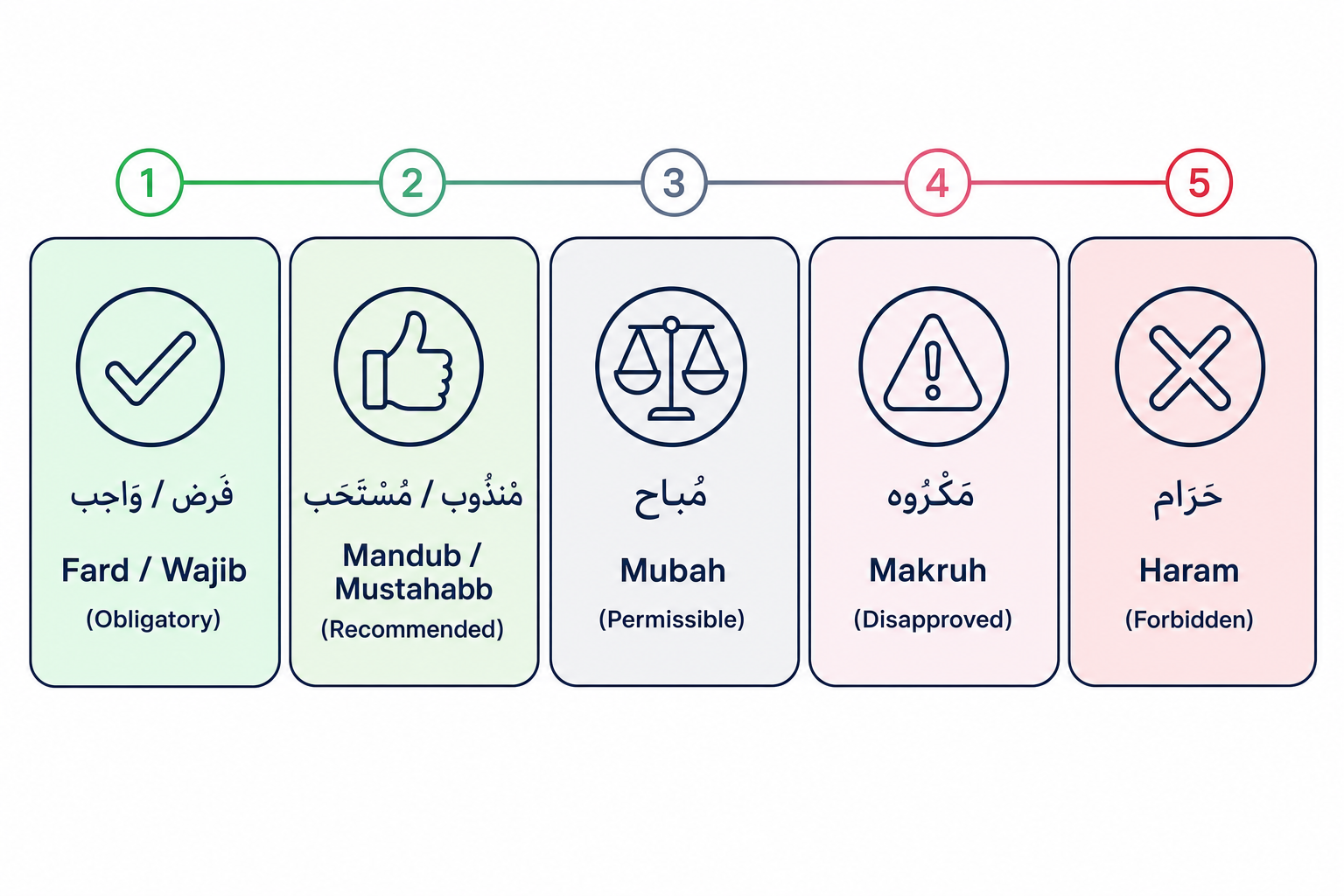
- Determine the five-fold classification: The jurist issues a fatwa (ruling) that in this specific case, before the 120-day limit, an abortion is permissible (Mubah) or even recommended (Mandub) to prevent unnecessary suffering, but must not be done after 120 days.
3. Lesser Jihad and Rules of War
While Greater Jihad is the internal struggle, Lesser Jihad refers to the outward, physical struggle. It is the duty of the Ummah to defend Islam, secure justice, and protect the vulnerable.
Lesser Jihad
An outer, physical struggle or holy combat in defense of Islam, justice, or the oppressed. It must be declared by a legitimate religious authority and follow strict ethical rules.
Warfare at the Time of the Prophet
In the early years of Islam, Muslims faced severe persecution in Makkah. It was only after migrating to Madinah that permission to fight was granted. The rules of engagement were highly progressive for their time, established by the Prophet Muhammad and expanded by the first Caliph, Abu Bakr.
- Strict Conditions for Justifying War:
- It must be defensive: "Fight in the way of Allah those who fight you but do not transgress. Indeed. Allah does not like transgressors." (Surah 2:190)
- It must be a last resort.
- It must be declared by a legitimate, recognized state leader (not individual groups).
- Strict Rules of Conduct (Abu Bakr's Code):
- Non-combatants (women, children, the elderly, monks, and priests) must not be harmed.
- Crops, orchards, and livestock must not be destroyed.
- Places of worship must not be damaged.
- Prisoners of war must be treated humanely.
Contemporary Debates on Lesser Jihad
Modern warfare poses deep challenges to traditional Islamic military ethics, leading to intense debate within the global Ummah.
- Weapons of Mass Destruction (WMDs):
- The traditionalist/prohibitive view: Modern scholars argue that chemical, biological, and nuclear weapons are inherently Haram. They are indiscriminate, meaning they violate the absolute requirement to protect non-combatants, and they destroy the environment (violating Abu Bakr's ban on destroying crops and trees).
- The deterrence view: A minority argue that possessing (though not necessarily using) WMDs may be permitted under the principle of deterrence to protect Islamic nations from external aggression, citing Surah 8:60 ("And prepare against them whatever you are able of power...").
- Terrorism and Non-State Actors:
- Mainstream Islamic scholars globally have issued fatwas condemning terrorism (such as suicide bombings and targeting civilians). They argue that modern terrorist groups lack the authority to declare jihad, violate the rules of combat by targeting innocents, and bring disrepute to Islam.
4. Stewardship (Khilafah) and Islamic Eco-Theology
In Islam, humanity's relationship with the environment is defined by responsibility, not ownership. The Earth belongs to Allah alone; humans are merely temporary trustees.
The Role of the Ummah as Khalifah
The Qur'an states that Allah created humans to be His Khalifah (stewards or vicegerents) on Earth.
"It is He who has made you successors [stewards] upon the earth..." (Surah 6:165)
To understand Islamic eco-theology, you must know four interconnected theological principles:
- Tawhid (Oneness): Because God is one, all of His creation is unified. Everything is interconnected and reflects the divine.
- Mizan (Balance): God created the universe in perfect ecological balance. Human activity must not disrupt this harmony ("And the heaven He raised and imposed the balance, that you not transgress within the balance." - Surah 55:7-8).
- Amanah (Trust): Earth is a trust given to humans. We do not own it and will be held accountable for how we treat it on the Day of Judgment (Akhirah).
- Khalifah (Stewardship): Our role is to protect, nurture, and sustain the environment.
Responsibility to Animal Life
Animals are not seen as mere resources for human exploitation. The Qur'an teaches that animals form communities just like humans:
"And there is no creature on the earth or bird that flies with its wings except that they are communities like you." (Surah 6:38)
Islamic teachings demand the humane treatment of animals:
- Cruelty to animals, hunting for sport, or keeping them in poor conditions is strictly forbidden.
- Animals slaughtered for food must be killed using the Halal method (Dhabihah), which ensures the animal is killed quickly, with minimum pain, and with the pronouncement of God's name, acknowledging the sacrifice of its life.
Changing Understandings and the Modern Ecological Crisis
In the past, traditional stewardship focused on local duties, like not wasting water during ablutions or avoiding cruelty to domestic animals.
However, the rise of industrialization, global warming, and mass species extinction has forced the Ummah to re-evaluate the scale of its responsibilities.
Modern "Islamic Green Movements" argue that systemic environmental damage is a physical manifestation of human greed and a spiritual failure to maintain the Mizan. Modern stewardship now requires systemic activism—opposing fossil fuel dependence, reducing plastic waste, and lobbying for sustainable farming—to preserve the planet for future generations.
5. AO2: Analysis and Evaluation
For top-tier marks in AQA 7062, you must be able to critically evaluate these concepts. Here are the key debates you should integrate into your essays:
Is Shari'ah adaptable enough for modern ethical dilemmas?
- Yes (The Reformist/Liberal View): Through Ijtihad, Islamic ethics is incredibly flexible. Modern jurists are constantly updating rulings on IVF, cloning, and climate change, ensuring Islam remains relevant and compassionate.
- No (The Traditionalist/Literalist View): Some conservative schools of thought heavily restrict Ijtihad, arguing that the doors of independent reasoning closed centuries ago. They rely strictly on medieval rulings which may not fit modern scientific realities, leading to a clash between religious authority and modern medical ethics.
Can Lesser Jihad be justified in the modern world?
- Yes: The core defensive principles of Lesser Jihad match international Just War criteria (e.g., self-defense, proportional force, protecting innocents). It remains a valid moral framework for resisting oppression.
- No: The nature of modern warfare—especially asymmetric warfare, guerrilla tactics, and modern weaponry—makes it almost impossible to fight without causing civilian casualties and environmental destruction. Therefore, some modern Muslim pacifists argue that only absolute non-violence can truly honor the sanctity of life today.
In the exam
- Always back up your ethical claims with Qur'an or Hadith quotes. Memorize 3 or 4 versatile verses (such as Surah 5:32 on saving life, or Surah 55:7-8 on the Mizan) that can be applied to multiple topics like abortion, war, or the environment.
- Use precise terminology. Don't just say "stewardship"; use Khilafah. Don't just say "trust"; use Amanah. This demonstrates high-level AO1 knowledge.
- Structure your AO2 arguments clearly. Show the tension between different Muslim interpretations (e.g., Sunni vs. Shi'a views on abortion timeline, or Reformist vs. Traditionalist approaches to climate change) rather than presenting Islam as a monolith.
Check yourself
- How does the concept of ensoulment differentiate Islamic perspectives on abortion from absolute pro-life Christian views?
- Explain how the theological principle of Mizan applies directly to modern global warming.
- What are three traditional rules of warfare established during the time of the Prophet Muhammad that directly challenge modern acts of terrorism?

Keep learning
Make a free account to read the full revision notes and worked examples.