Expressions of religious identity
What you'll learn
- What it means to be a Muslim, and how Sunni and Shi’a Muslims understand this similarly and differently.
- How the Five Pillars of Islam express religious identity through belief, worship and community life.
- Why salah, Jummah and Hajj matter as both outward actions and inward devotion.
- How the mosque has developed as a community hub, especially through London Central Mosque.
Expressions of religious identity: the big idea
An expression of religious identity is a visible or lived way in which belief is shown: words, rituals, clothing, worship, community life, moral action and shared institutions. In Islam, identity is not only “what I believe privately”; it is also “how I submit to Allah in daily life”.
This topic is best understood as a movement from belief to practice to community.
1. The concept of Muslim
Muslim
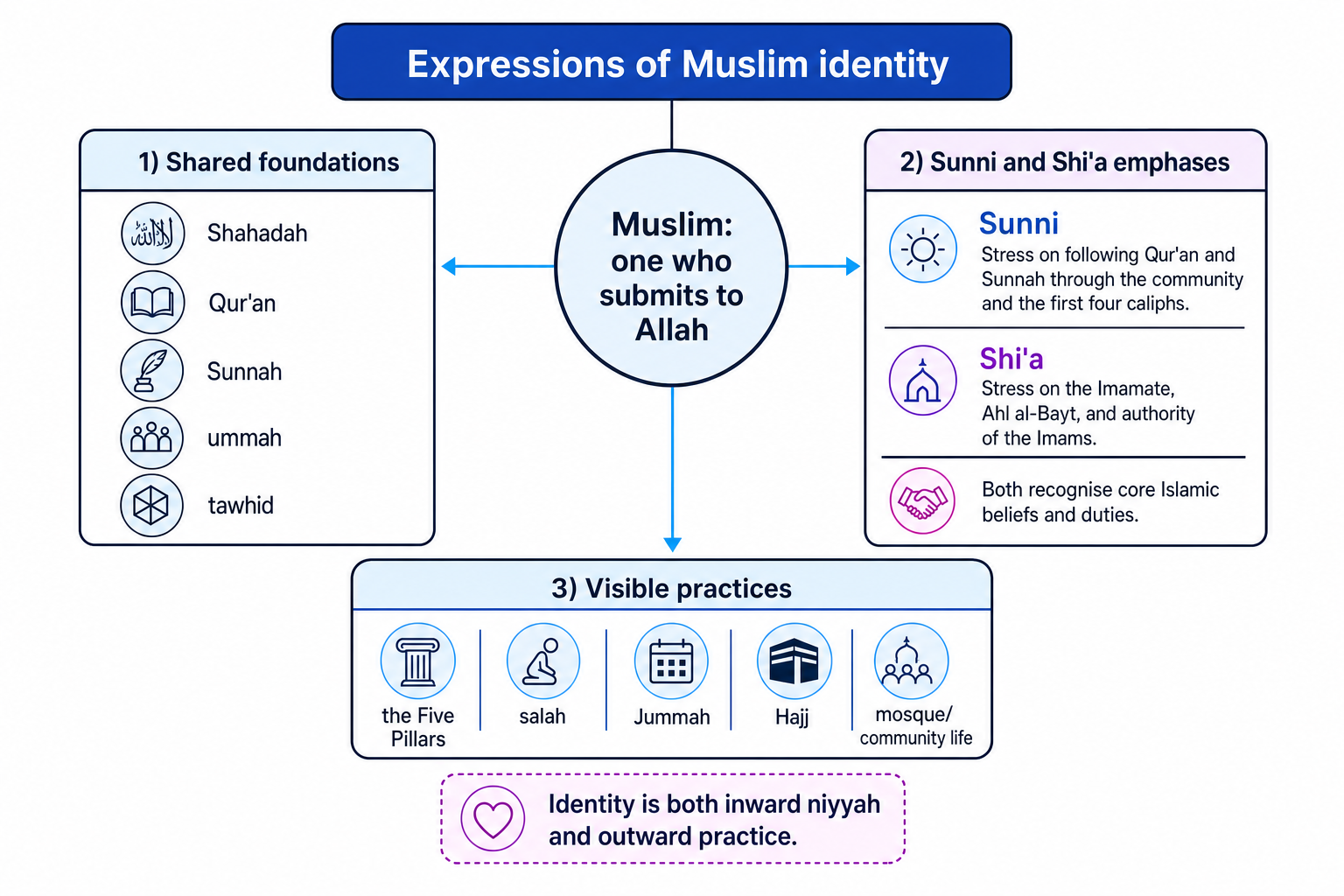
A Muslim is one who submits to Allah, the one God. The Arabic word Islam is linked to submission, surrender and peace. Muslim identity therefore begins with recognising Allah’s authority and living in obedience to him.
All Muslims share core foundations: tawhid means the oneness of Allah; the Qur’an is understood as Allah’s revelation; Muhammad is the final prophet; and the ummah is the worldwide Muslim community. The Shahadah, “There is no god but Allah, and Muhammad is the Messenger of Allah,” expresses this shared identity.
Sunni and Shi’a: shared Islam, different authority
Sunni Islam is the largest branch of Islam. “Sunni” comes from Sunnah, the example and practice of Muhammad, preserved in hadith reports. Sunni Muslims accept the first four caliphs as rightly guided leaders after Muhammad. A caliph is a successor-leader, but not a prophet.
Shi’a Islam began from the belief that leadership after Muhammad should have passed to Ali, Muhammad’s cousin and son-in-law, and then through the Prophet’s family, the Ahl al-Bayt. In Shi’a thought, the Imamate is central: the Imams are divinely guided authorities. For Twelver Shi’a Muslims, the twelfth Imam is in occultation, meaning hidden from ordinary human sight until his return.
Similarity first, difference second
Sunni and Shi’a Muslims normally share the central beliefs and duties of Islam. Their major difference is not whether Allah is one or whether Muhammad is prophet, but where religious authority lies after Muhammad: community and caliphal tradition for Sunni Islam; the Imamate and Ahl al-Bayt for Shi’a Islam.
Treating Shi’a Islam as non-Muslim
Do not write as if Shi’a Muslims are “less Muslim” because they differ from Sunni Muslims. A stronger answer explains shared foundations first, then evaluates how differences over authority shape identity.
Comparing Sunni and Shi’a identity
-
Begin with the shared definition: both Sunni and Shi’a Muslims understand being Muslim as submission to Allah, expressed through the Shahadah, the Qur’an, prayer and membership of the ummah.
-
Identify the dividing issue: Sunni identity is closely linked to following the Sunnah through the wider community and legal traditions; Shi’a identity gives special importance to loyalty to Ali, the Ahl al-Bayt and the Imams.
-
Make the evaluation: if “Muslim” is defined by core belief in Allah and Muhammad, the similarities are more fundamental; if identity is defined by rightful religious authority, the differences become more significant.
2. The Pillars of Islam
A pillar is a support: something that holds a structure up. The Five Pillars of Islam are the main practices that support Muslim life, especially in Sunni Islam:
- Shahadah: declaration of faith.
- Salah: prescribed ritual prayer.
- Zakah: giving wealth for purification and support of the needy.
- Sawm: fasting during Ramadan.
- Hajj: pilgrimage to Makkah for those able to perform it.
Shi’a Muslims practise these core duties too, but often organise teaching differently, using the Roots of Religion and Branches of Religion. For example, Twelver Shi’a Islam includes Imamah among the roots, and also includes duties such as khums, a religious tax.
The purpose of the Pillars is not just to create a checklist. They train the whole person: belief through Shahadah, discipline through salah and sawm, justice through zakah, and unity through Hajj.
Remember the purpose
In essays, do not merely list the Five Pillars. Explain what they do: they shape obedience, discipline, equality, generosity, remembrance of Allah and belonging to the ummah.
3. Salah: prayer as embodied identity
Salah
Salah is the prescribed ritual prayer performed five times daily. It includes purification, facing the qiblah towards Makkah, recitation from the Qur’an, standing, bowing and prostration.
Salah shows that Muslim identity is both outward and inward. The outward actions matter because they train the body in submission: standing before Allah, bowing in humility, and prostrating in surrender. But the inner state also matters. Niyyah means intention, and khushu means humble concentration or attentiveness in prayer.
A famous hadith says that “actions are judged by intentions.” This means salah is not meant to be empty performance. Qur’an 20:14 also links prayer to remembrance: “establish prayer for My remembrance.”
Balancing action and intention in salah
-
Establish the outward side: salah has fixed times, movements and recitations, so it gives Muslim identity a recognisable shared form.
-
Establish the inward side: without niyyah and khushu, the action risks becoming mechanical or hypocritical.
-
Reach a balanced judgement: in Islam, outward action and inward intention are not rivals. The action expresses submission, while intention gives the action its spiritual meaning.
Sunni and Shi’a differences in salah
Both Sunni and Shi’a Muslims pray to Allah, face Makkah and recognise five obligatory prayers. However, there are differences in practice.
Many Sunni Muslims pray the five prayers at five separate times and fold their hands during standing, though practice varies between legal schools. Shi’a Muslims often combine the noon and afternoon prayers, and the sunset and night prayers, so five prayers may be performed in three prayer periods. Shi’a Muslims also commonly prostrate on a small clay tablet called a turbah, often made from natural earth, because prostration should be on earth or natural material.
Saying Shi’a Muslims only pray three times
Shi’a Muslims do not reject the five daily prayers. Many combine them into three prayer periods while still performing five prayers.
Daily prayer and Jummah
Daily salah structures time around Allah rather than around work, school or personal convenience. It repeatedly returns the believer to taqwa, God-consciousness.
Jummah is the Friday congregational prayer, including a khutbah, or sermon. Qur’an 62:9 calls believers to leave trade and come to the remembrance of Allah when the Friday call is made. Jummah strengthens public Muslim identity because the ummah gathers, listens, prays and receives guidance together.
4. Hajj: pilgrimage and global identity
Hajj
Hajj is the pilgrimage to Makkah, required once in a lifetime for Muslims who are physically and financially able to perform it. Qur’an 3:97 presents pilgrimage to the House as a duty for those who can find a way.
Hajj includes entering ihram, a sacred state marked by simple clothing; circling the Ka‘bah in tawaf; travelling between Safa and Marwah; standing at Arafat; and rituals connected with Ibrahim, Hajar and Isma‘il. It expresses equality because rich and poor stand together before Allah.
In the 20th century, Hajj changed dramatically. Air travel, passports, visas, vaccination systems, Saudi administration, roads, hospitals, crowd-control measures and expanded facilities made pilgrimage possible for far greater numbers. Hajj became more global, more organised and more visible.
Ability matters
Hajj is not required at any cost. The obligation applies to those who are able; illness, poverty, danger or serious responsibilities may remove the duty.
Evaluating modern Hajj
-
Consider the criticism: modern Hajj can seem affected by crowds, cost, hotels, travel packages and commercialisation.
-
Consider the defence: modern developments have made Hajj safer and more accessible for Muslims across the world.
-
Judge the issue: the conditions of Hajj have changed, but the central meaning remains powerful because the core rites still express obedience, repentance, equality and unity.
5. The mosque: from prayer space to community hub
Mosque
A mosque, or masjid, is a place of prostration and communal worship. It is not only a building for prayer but can also be a centre for learning, charity, advice and community identity.
The Prophet Muhammad’s mosque in Madinah was not simply a worship space; it was also a place of teaching, leadership and community decision-making. In Britain today, many mosques continue this wider role through Qur’an classes, youth work, marriage services, funeral support, counselling, charity collections and interfaith work.
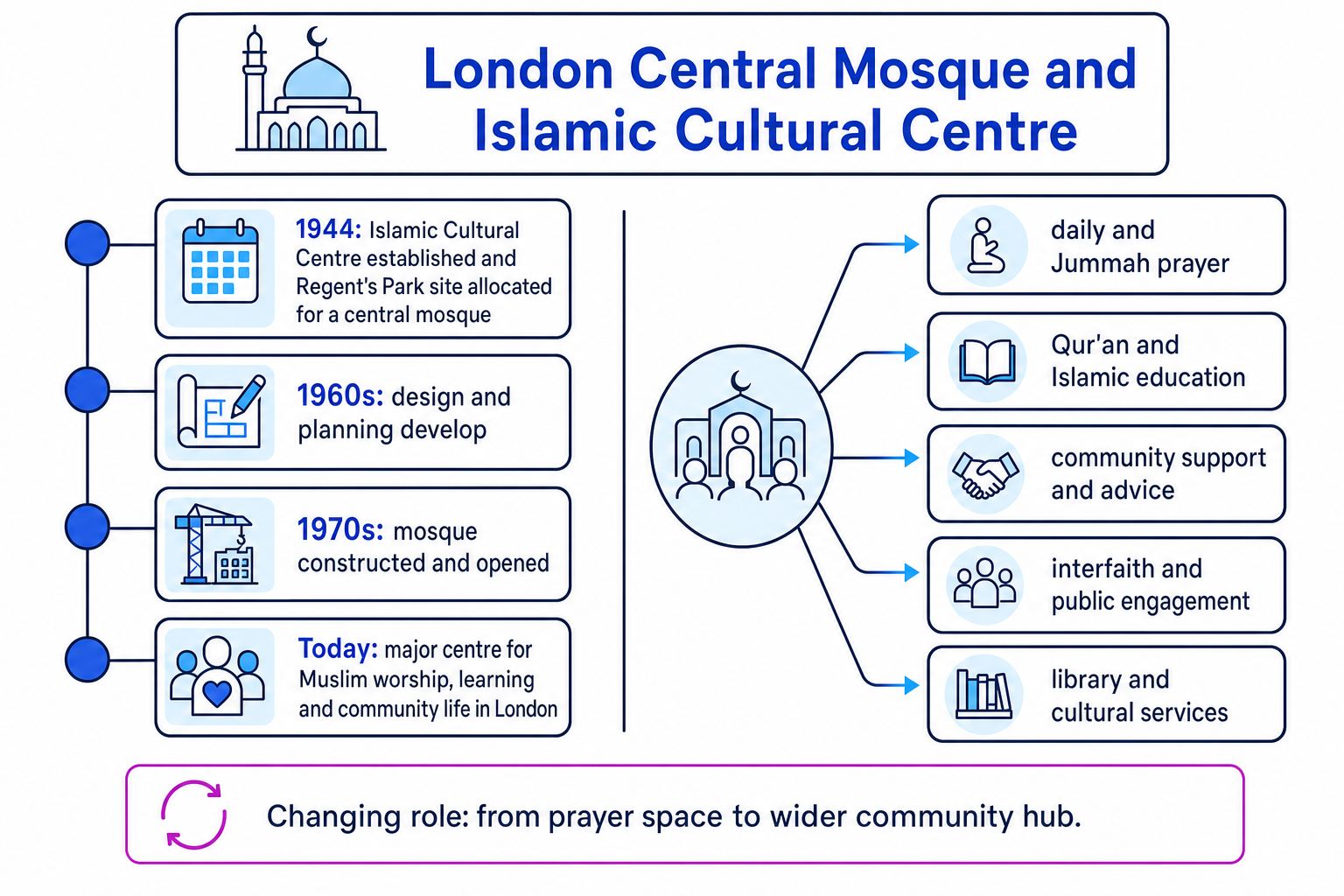
London Central Mosque, linked with the Islamic Cultural Centre in Regent’s Park, is a useful AQA example. The Islamic Cultural Centre was established in 1944, planning developed in the 1960s, and the mosque was constructed and opened in the 1970s. Today it serves as a major centre for prayer, education, community support, public engagement and cultural services.
Using London Central Mosque as evidence
-
Link it to the claim: London Central Mosque shows that a mosque can express Muslim identity publicly, not just privately.
-
Use historical detail: its development from the Islamic Cultural Centre and Regent’s Park site shows a growing recognised Muslim presence in Britain.
-
Use current work: prayer, education, interfaith engagement and community support show the mosque as a wider hub for the ummah.
In the exam
-
Define key terms early: Muslim, pillar, salah, niyyah, Hajj and mosque.
-
For Sunni and Shi’a comparisons, write “shared foundations, different authority” rather than exaggerating division.
-
For the Pillars, explain purpose and meaning; do not just list the five practices.
-
For Hajj and the mosque, include specific development: 20th-century changes to pilgrimage and London Central Mosque’s community role.
Check yourself
- Why might a Shi’a Muslim see the Imamate as important to Muslim identity?
- How do outward action and inward intention work together in salah?
- How has London Central Mosque developed beyond being only a prayer space?

Keep learning
Make a free account to read the full revision notes and worked examples.