Islam, gender and sexuality
Welcome to this key topic in your A-Level Islam studies. This area of the specification focuses on how modern Islamic thought has responded to shifting global contexts, Western cultural values, and secularism. You will explore how contemporary Muslims navigate traditional teachings alongside modern understandings of gender, feminism, and sexuality.
What you'll learn:
- How historical shifts—such as Western colonialism and immigration—have shaped Muslim debates on gender.
- The differing viewpoints surrounding the veil (hijab) and the arguments of early reformers like Qasim Amin.
- How feminist theologians, particularly Amina Wadud, challenge traditional interpretations of Quranic authority and Surah 4:34.
- Contemporary Islamic perspectives on marriage, celibacy, same-sex relationships, and transgender issues.
1. Historical and Social Factors Shaping Muslim Thought
Developments in Muslim thinking about gender and sexuality do not occur in a vacuum. They are deeply influenced by historical transformations and encounters with the non-Muslim world.
The Encounter with Western Values and Colonialism
During the 19th and 20th centuries, much of the Muslim world was colonized or heavily influenced by European powers, particularly the British and French Empires. This historical encounter introduced Western secular frameworks, education systems, and cultural ideas to Muslim-majority lands.
For many Muslim reformers, this encounter highlighted a perceived need to modernise Islamic societies to compete with the West. However, for others, Western ideas of gender equality were viewed as a form of cultural imperialism—an attempt to dismantle Islamic family structures and religious identity from the outside.
Post-WWII Immigration and the British Muslim Experience
The mass migration of Muslims to Britain after the Second World War (primarily from South Asia) created a unique environment. British Muslims found themselves living as a minority within a secular, pluralistic democracy.
This transition forced a conscious engagement with British laws and cultural norms. Younger generations of British Muslims, raised with dual identities, have increasingly sought to separate their Islamic faith from the cultural patriarchy of their parents' countries of origin. This has led to a vibrant reassessment of what "authentic" Islam says about gender roles, free from cultural baggage.
Changing Roles of Men and Women in Secular Society
In modern secular societies, women have achieved greater economic independence, educational parity, and legal protection. Laws like the UK’s Equality Act 2010 enshrine equal rights regardless of sex or sexual orientation.
These secular developments have had a dual impact on Muslim communities:
- The Reformist Response: Argues that Islam’s core ethical message is aligned with justice and equality. Therefore, Islamic law must evolve to reflect these secular advancements, which are seen as fulfilling the spirit (maqasid) of Sharia.
- The Traditionalist Response: Expresses concern that secularism leads to moral relativism, the breakdown of the traditional family unit, and the loss of distinct, divinely-ordered gender roles.
2. The Veil: Barrier to Achievement or Symbol of Empowerment?
The debate over the veil (hijab, niqab, or burqa) is one of the most visible battlegrounds in discussions of Islam and gender.
Hijab & Niqab
Hijab: Broadly refers to the practice of modest dressing, but specifically refers to the headscarf worn by many Muslim women.
Niqab: A face veil that covers the face, leaving only the area around the eyes clear.
Qasim Amin and "The Liberation of Women" (1899)
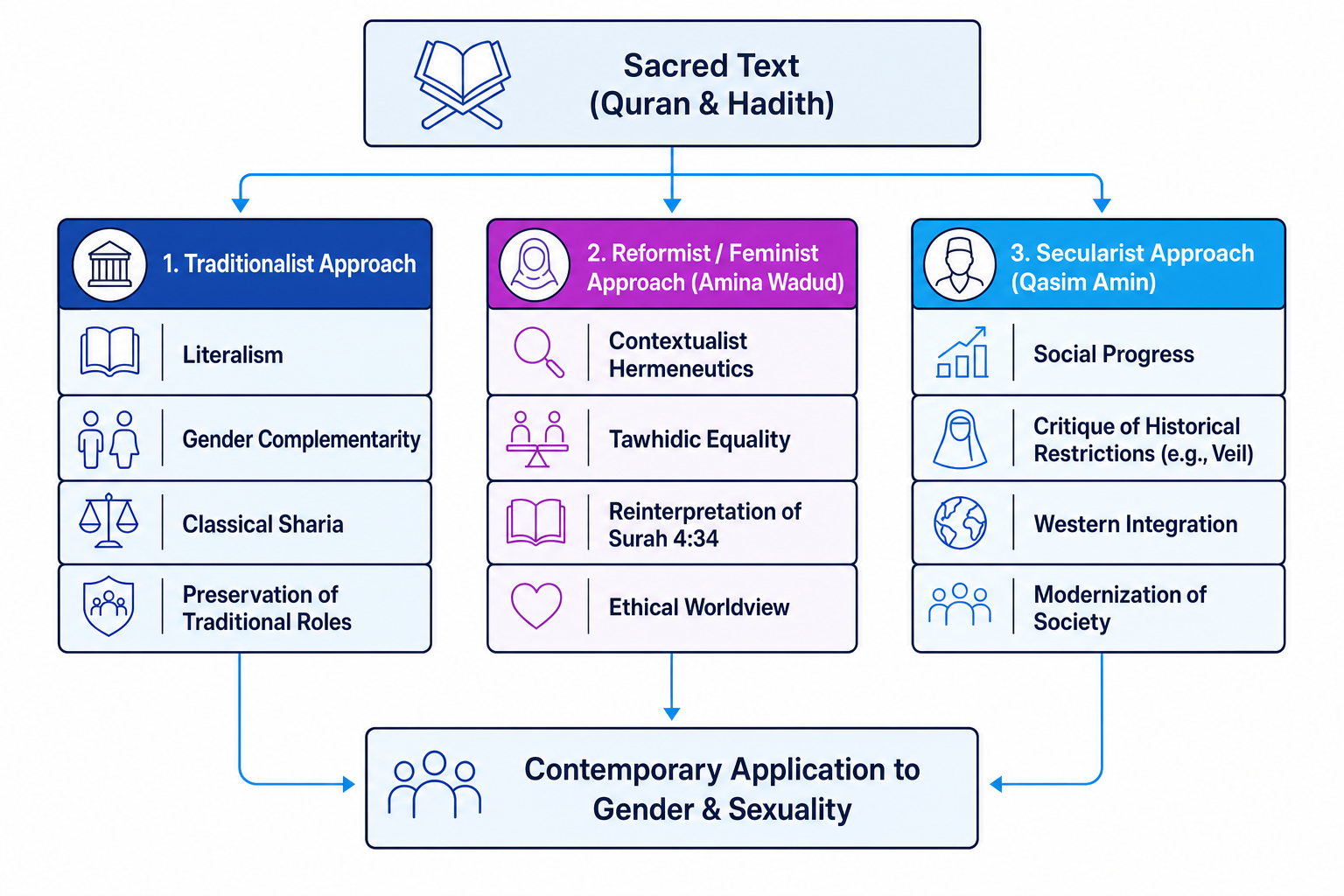
Egyptian jurist Qasim Amin (1863–1908) is often regarded as one of Arab society's earliest feminists, though his work is highly controversial. In his influential 1899 book, The Liberation of Women (Tahrir al-Mar'a), Amin argued that the status of women in Muslim societies was the primary cause of those societies' weakness relative to the West.
Amin targeted the practice of strict female seclusion (sefr) and the veil:
- He argued that the veil was not an Islamic requirement, but rather a cultural custom that had been falsely integrated into religion.
- He claimed the veil acted as a physical and intellectual barrier to achievement, preventing women from receiving an education, working, and participating in public life.
- Amin maintained that educating women and removing the veil was essential for the moral and intellectual development of the family, as mothers are the primary educators of children.
Alternative and Modern Muslim Perspectives on the Veil
While Amin saw the veil as a symbol of backwardness, many contemporary Muslim women and theologians have reclaimed it.
- Feminist and Agency-Based Interpretations: Writers like Saba Mahmood have argued that wearing the veil can be an active expression of female agency, piety, and resistance against Western consumerism and the sexual objectification of women's bodies. For these women, the veil is liberating because it forces society to judge them on their intellect and character rather than their physical appearance.
- Traditionalist Perspectives: Traditionalists view the headscarf as a direct command from God, pointing to verses like Surah 24:31 (which commands women to draw their veils over their bosoms) and Surah 33:59. For them, modesty is a spiritual virtue that protects the sacred boundaries of the family and society.
3. The Role and Status of Women: Textual Debates
At the heart of modern debates on women's status in Islam is how sacred texts are interpreted. A-Level students must understand the tension between traditional literalist readings and feminist hermeneutics.
The Battleground Text: Surah 4:34
Surah 4:34 is historically one of the most debated verses regarding gender relations in Islam.
"Men are the protectors and maintainers [qawwamun] of women, because Allah has given the one more [strength] than the other, and because they support them from their means... As to those women on whose part you fear disloyalty and ill-conduct, admonish them, refuse to share their beds, and [finally] strike them [daraba]..." (Surah 4:34)
Traditional commentators have historically used this verse to justify male authority (qiwamah) over women and to permit a husband to physically discipline his wife as a last resort.
Amina Wadud and Feminist Hermeneutics
Amina Wadud (born 1952) is a pioneering American Muslim theologian who revolutionized the field of Islamic feminism with her 1992 book, Qur'an and Woman.
Hermeneutics
Hermeneutics: The branch of knowledge that deals with interpretation, especially of literary texts, sacred scripture, and philosophical works.
Wadud argues that traditional interpretations of the Quran are inherently patriarchal because they were written exclusively by men living in patriarchal societies. She advocates for a hermeneutic of Tawhid (divine unity):
Wadud's Tawhidic Hermeneutics
Because God (Allah) is one and absolute, no human can be spiritually superior to another based on gender. To place men in absolute authority over women is a form of shirk (associating partners with God), because it elevates men to a god-like status over women.
To demonstrate how these concepts are applied to texts, let’s look at how a feminist theologian unpacks a difficult scripture like Surah 4:34.
Applying Wadud's Hermeneutical Method to Surah 4:34
How does a reformer like Amina Wadud deconstruct the patriarchal interpretation of Surah 4:34? Here is the step-by-step hermeneutical breakdown:
-
Analyse the socio-historical context (Asbab al-nuzul): Wadud notes that the Quran was revealed in 7th-century Arabia, a highly patriarchal tribal society where women had no independent financial or legal standing. The term qawwamun (protectors/maintainers) was descriptive of that specific economic reality—men had to financially support women because women could not safely do so themselves. It is not an eternal, ontological rule of male superiority. If a woman is financially independent today, the descriptive condition of qiwamah no longer applies.
-
Conduct linguistic analysis of key Arabic terms: Wadud explores the root meaning of the controversial word daraba. While classical translators translated this as "strike/beat," the Arabic root D-R-B has over 25 meanings in the Quran, including "to go along," "to set an example," or "to separate/leave." Wadud argues that, given the Prophet Muhammad’s own recorded absolute refusal to ever strike a woman, translating daraba as "to separate from" or "to set a clear boundary" is linguistically and ethically superior.
-
Verify alignment with the Quran's holistic ethical worldview: Wadud asserts that individual verses cannot be read in isolation. They must align with the overarching Quranic principles of justice ('adl), mercy (rahmah), and mutual consultation (shura) between spouses. Any interpretation of 4:34 that permits domestic violence or subjugation contradicts the primary ethical mandate of the Quran and must therefore be rejected as invalid.
Confusing 'Islamic Feminism' with 'Secular Feminism'
Students often mistakenly assume that Islamic feminists like Amina Wadud want to discard the Quran or Sharia. This is incorrect. Unlike secular feminists who may reject religious texts entirely, Islamic feminists work within the Islamic tradition. They believe the Quran is the infallible word of God, but argue that human interpretations (fiqh) are flawed, historical, and subject to reform.
4. Contemporary Views on Celibacy, Marriage, and Sexuality
Modern developments have also brought debates about relationships, sexual identity, and bodily autonomy to the forefront of Muslim discourse.
Celibacy
Unlike Catholic Christianity, which values celibacy for priests and monastic orders, Islam generally rejects celibacy (rahbaniya).
- Marriage (nikah) is considered a fundamental religious duty and a Sunnah (the practice of the Prophet).
- A famous Hadith quotes the Prophet Muhammad as saying: "Marriage is my Sunnah. Whoever turns away from my Sunnah is not of me."
- Sexuality within marriage is viewed positively—not just for procreation, but as a spiritual and physical blessing. Therefore, intentional, lifelong celibacy is actively discouraged because it goes against the natural disposition (fitrah) created by God.
Marriage
In Islamic law, marriage is not a sacrament but a legal and spiritual contract between consenting adults.
- Traditional View: Emphasises gender complementarity. Men and women have different, complementary duties: the husband is the financial provider and protector, while the wife manages the domestic sphere and nurtures children.
- Progressive/Egalitarian View: Many modern Muslims reject strict roles, arguing that marriage should be a partnership of absolute equality, mutual consultation, and shared domestic and financial responsibilities.
Same-Sex Relationships
This is one of the most challenging dialogues for modern Muslims, presenting a stark divide between orthodox theology and contemporary inclusive movements.
- The Traditionalist Position: The vast majority of orthodox Sunni and Shia scholars hold that same-sex sexual acts are strictly prohibited (haram). This position is based on the Quranic narrative of the People of Lut (Lot) in Sodom (e.g., Surah 7:80-81), which condemns men who "approach men with desire instead of women." Traditional jurisprudence (fiqh) classifies homosexual acts as major sins.
- The Inclusive/Reformist Position: Progressive scholars, such as Scott Siraj al-Haqq Kugle, challenge this consensus. Kugle argues that the sin of Sodom was not homosexuality itself, but rather sexual violence, rape, and xenophobic aggression. Reformists argue that loving, consensual same-sex relationships are consistent with a merciful God who created human diversity, and that the Quran’s primary message is one of justice and love.
Key Scholar Connection
If you get an essay on sexuality in Islam, referencing Scott Siraj al-Haqq Kugle’s book "Homosexuality in Islam" is an excellent way to show top-tier AO1 knowledge of progressive scholarship.
Transgender Matters
Perhaps surprisingly, the debate around transgender matters has developed differently in various parts of the Muslim world, most notably in Iran.
- The Iranian (Shia) Model: In the 1980s, Ayatollah Ruhollah Khomeini issued a landmark fatwa (legal ruling) declaring gender confirmation surgery (GCS) permissible for "gender transsexuals." The theological reasoning was that the physical body must be aligned to match the gender of the true "soul" or spirit. Under this framework, the transition is viewed as a medical cure for a physical condition. The state even subsidises these surgeries. However, critics note this is often used to forcibly transition homosexual individuals to avoid same-sex relationships, which remain criminalised.
- The Sunni Position: Most major Sunni authorities (such as Al-Azhar in Egypt) are far more conservative. They generally prohibit transition surgeries, viewing them as "changing the creation of God" (taghyir khalq Allah), which is forbidden in the Quran. However, exception is widely made for individuals born with intersex conditions (historically referred to in Islamic law as khuntha), where medical intervention is permitted to clarify a biological sex.
In the exam
- Balance AO1 and AO2: Do not just list facts or quote verses. Ensure you evaluate why these interpretations differ. For instance, contrast Amina Wadud's contextualist method with a traditionalist literalist approach to Surah 4:34, and explain which approach is more persuasive in a modern British context.
- Handle the terminology carefully: Use precise Arabic terms like Tawhid (divine unity), Sharia (Islamic law), fiqh (jurisprudence), fitrah (natural disposition), and qiwamah (male guardianship). Doing so demonstrates deep subject-specific scholarship.
- Reference historical context: Always link modern debates to the historical factors mentioned in the specification. Show how the encounter with the British Empire or modern UK secular laws (like the Equality Act) has forced these theological developments to occur.
Check yourself
- How does Qasim Amin's critique of the veil in 1899 differ from the ways contemporary Muslim feminists might view or defend wearing the hijab?
- Explain the key linguistic and theological arguments Amina Wadud uses to challenge traditional interpretations of Surah 4:34.
- Why does Ayatollah Khomeini's fatwa permit gender confirmation surgery in Iran, while same-sex relationships remain strictly prohibited?

Keep learning
Make a free account to read the full revision notes and worked examples.