Judaism and the challenge of secularisation
For centuries, Jewish life was defined by traditional communities structured around the Torah and Jewish law (Halakha). However, the rise of the modern secular world has disrupted this continuity. In this topic, we explore how Judaism responds to the challenges of secularisation, the decline of religious authority, and the allure of materialistic values. We will also examine how these pressures have reshaped Jewish identity, from physical separation to political activism and Zionism.
What you'll learn
- How secularisation and militant atheism challenge Jewish authority, practice, and social standing.
- The differences between ghettoism (with reference to Nehemiah 10), assimilation, and integration as responses to modern culture.
- How Jewish thought addresses modern materialistic values and wealth.
- The theological debates surrounding the State of Israel, specifically comparing Political and Religious Zionism.
- How liberationist approaches and organisations like the Jewish Social Action Forum (JSAF) assert the social relevance of Judaism today.
The challenge of secularisation
To understand modern Jewish thought, we must first understand the social forces that have reshaped the Western world over the last three centuries.
Secularisation
Secularisation is the historical process by which religion loses its social, cultural, and political significance. It is characterised by the decline of religious belief, the privatisation of practice, and the replacement of religious institutions by secular ones.
The challenge of secularisation manifests in three main ways:
1. The replacement of religion as the source of truth and moral values
Historically, the Torah and the Rabbis were the ultimate arbiters of truth and morality for Jewish communities. With the advent of the Enlightenment (the Haskalah in Jewish history), scientific rationalism, empiricism, and secular humanism emerged as alternative, non-religious frameworks. Questions of origin, ethics, and law are now largely decided by secular courts and scientific consensus rather than scripture.
2. The relegation of religion to the personal sphere
Secular societies tend to privatise religion. While individuals are free to practice their faith in private, public institutions (such as governments, schools, and workplaces) are expected to remain neutral. This poses a major challenge for traditional Judaism, which is inherently communal and designed to govern every aspect of life, from food (Kashrut) to business ethics.
3. The rise of militant atheism
In recent decades, the secular landscape has shifted from passive indifference to active critique, often referred to as "militant atheism" or "New Atheism" (associated with figures like Richard Dawkins and Christopher Hitchens).
Militant Atheism
Militant atheism is the view that belief in God is not only false and irrational, but also actively harmful and a threat to social stability.
For Judaism, this critique is often focused on specific practices:
- Brit Milah (Male Circumcision): Critics argue it violates the bodily autonomy of infants.
- Shechita (Kosher Slaughter): Animal rights advocates challenge it as inhumane compared to pre-stunning methods.
- Faith Schools: Secularists argue that state-funded religious schools promote division and restrict a child's freedom of thought.
Preservation, integration, and assimilation
Faced with a secularising world, Jewish communities have adopted radically different strategies to survive. These can be mapped on a spectrum from total separation to complete absorption.
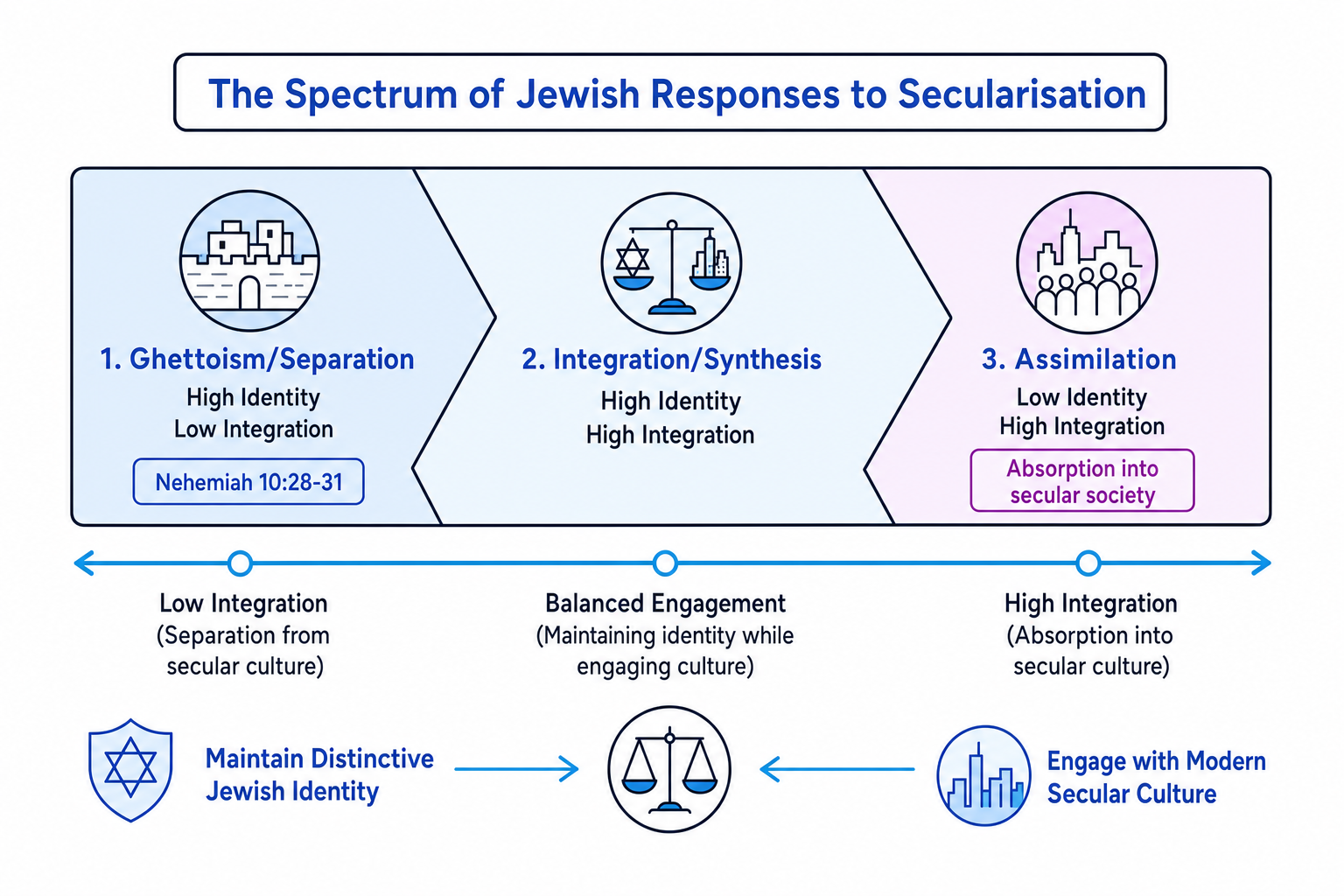
Ghettoism
Ghettoism is the deliberate physical, social, and cultural separation of the Jewish community from the surrounding non-Jewish (Gentile) world to preserve religious purity and protect against secular erosion. This is championed today by the Haredi (Ultra-Orthodox) communities.
The biblical precedent for this approach is found in the Book of Nehemiah, written during the return from the Babylonian Exile when the Jewish community faced the threat of cultural extinction:
"The rest of the people... separated themselves from the neighboring peoples for the sake of the Law of God... They bind themselves with a curse and an oath to follow the Law of God... We promise not to give our daughters in marriage to the peoples around us or take their daughters for our sons." — Nehemiah 10:28–31
This passage outlines three key elements of separation:
- Sacred Separation: Distancing oneself from foreign influences to focus entirely on Torah study and practice.
- Endogamy: A strict prohibition against intermarriage to maintain the physical and spiritual continuity of the covenant.
- Sabbath Preservation: Refusing to engage in commerce or trade with outsiders on the Sabbath, protecting sacred time from economic exploitation.
Assimilation
At the opposite end of the spectrum is assimilation. This occurs when an individual or group loses their distinctive Jewish identity by fully absorbing the cultural, social, and religious norms of the secular host society. For many secularised Jews, Jewishness becomes a matter of ancestry or culture rather than active religious practice.
Integration
Integration (sometimes called acculturation) is the attempt to synthesize Jewish identity with active participation in secular society. Integrated Jews dress in modern clothing, attend secular universities, and pursue secular careers, yet remain committed to Jewish identity.
- Modern Orthodox Jews do this by maintaining strict adherence to Halakha (Orthodox law) while engaging with modern culture.
- Reform and Liberal Jews achieve integration by adapting Jewish law itself, viewing Halakha as evolutionary and choosing which ethical commands remain relevant in a secular world.
Confusing Assimilation with Integration
Do not use these terms interchangeably in your essays. Integration means maintaining a distinct Jewish identity while participating in secular society (e.g., being a Jewish doctor who keeps kosher). Assimilation means the loss of distinctiveness as the individual merges entirely into secular culture, often leading to the abandonment of Jewish practices.
Responses to materialistic secular values
Secularisation is closely linked to materialism—the belief that physical comfort, wealth, and material possessions are the primary sources of happiness and success.
Traditional Judaism does not view material wealth as inherently sinful or dirty; unlike some Christian monastic traditions, Judaism does not promote asceticism or poverty as a spiritual ideal. However, modern consumerism presents a major challenge to Jewish spiritual values.
The dual Jewish view of wealth
- Wealth as a Blessing and Stewardship: In the Hebrew Bible, wealth is often seen as a sign of God's blessing (e.g., Abraham and Solomon were wealthy). However, this wealth does not belong to the individual; it is held in trust. God is the ultimate owner of the Earth: "The earth is the Lord’s, and everything in it" (Psalm 24:1).
- The Danger of Arrogance: Wealth can lead to self-reliance and the forgetting of God: "You may say to yourself, 'My power and the strength of my hands have produced this wealth for me.' But remember the Lord your God" (Deuteronomy 8:17-18).
Practical Jewish responses to modern materialism
Jewish communities counter materialistic values through several structural practices:
- Tzedakah (Justice/Charity): Giving is not seen as an act of voluntary benevolence, but as an act of justice required to restore balance to the world. Jews are traditionally commanded to give at least 10%10\%10% (a tithe, or ma'aser) of their income to those in need.
- Shabbat (The Sabbath): The Sabbath acts as a weekly antidote to materialism. For 25 hours, Jews are prohibited from buying, selling, working, or using technology. It forces a radical pause in the cycle of consumption, reorienting the family toward spiritual, relational, and intellectual pursuits.
- Bal Tashchit (Do Not Destroy): Derived from Deuteronomy 20:19, this principle forbids needless waste and excessive consumption, directly challenging the "throwaway" culture of secular materialism.
Different responses to the State of Israel
The relationship between Judaism and the modern State of Israel (established in 1948) is highly complex. The debate centers on whether the return to the Land of Israel should be achieved through human political effort or through divine intervention.
Political Zionism
Political Zionism emerged in the late 19th century, championed by Theodor Herzl, as a direct response to rising European antisemitism.
- It is a secular nationalist movement.
- Herzl argued that Jews could never be truly safe or integrated into European nations, as antisemitism was an incurable disease.
- The solution was the establishment of a sovereign, secular Jewish state where Jews could defend themselves, free from dependency on the goodwill of non-Jewish governments.
Religious Zionism
Religious Zionism, famously developed by Rabbi Abraham Isaac Kook, synthesised secular Zionist efforts with traditional theology.
- Rabbi Kook argued that the secular pioneers building the land of Israel were actually acting as unconscious agents of God.
- He viewed the physical re-establishment of Jewish sovereignty in the Land of Israel as the beginning of the messianic redemption (Atchalta De'Geulah).
- For Religious Zionists, settling the land is a holy commandment (Mitzvah) that prepares the world for the ultimate coming of the Messiah.
Haredi (Ultra-Orthodox) Non-Zionism and Anti-Zionism
In stark contrast, many Haredi groups historically opposed the state, and some (like the Satmar Hasidim) remain actively anti-Zionist.
- They argue that attempting to build a Jewish state by human, secular political means is a rebellion against God.
- According to the Talmud (the "Three Oaths"), the Jewish people are forbidden from returning to the land en masse by force before the Messiah arrives.
- To them, a "secular Jewish state" is a contradiction in terms that replaces God's Torah with secular nationalism.
Key distinction for the exam
Remember that Political Zionism seeks a safe, secular refuge for Jews as a nation, whereas Religious Zionism views the land and state as fundamentally holy and integral to the cosmic messianic process.
Analysing the theological tension between Political and Religious Zionism
Evaluate the view that the State of Israel is a purely secular phenomenon.
-
Step 1: Identify the secular perspective (Political Zionism) Start by explaining the origins of Political Zionism. Emphasise that Theodor Herzl and the early pioneers were secular Jews who did not base their claim on messianic expectations, but rather on the universal human right to self-determination and safety from antisemitism. Use terms like nationalism and sovereignty.
-
Step 2: Contrast with the religious synthesising view (Religious Zionism) Introduce Rabbi Abraham Isaac Kook's theological counter-argument. Explain his concept that physical, secular work has hidden spiritual holiness. Argue that from this perspective, the secular state is a necessary, divinely orchestrated step toward messianic redemption. The secular shell (Klipah) contains a holy spark.
-
Step 3: Evaluate the conflict and reach a justified conclusion Weigh up these two sides. Evaluate whether a state founded on secular democratic principles can truly be considered "holy" in a religious sense, or if the Haredi critique is more logically consistent (i.e., that a state not governed by Halakha cannot be a truly "Jewish" state). Conclude by showing how this theological tension remains unresolved in contemporary Israeli society and global Jewish thought.
The social relevance of Judaism: Liberationist approaches
One way Judaism has adapted to the challenge of secularisation is by emphasising its social relevance—showing that ancient teachings have powerful applications to modern social justice, poverty, and human rights.
Liberationist approaches in Judaism
While Liberation Theology is famously associated with Latin American Catholicism, Judaism has its own rich liberationist tradition rooted in the Exodus narrative.
- The story of the Hebrew slaves being liberated from Pharaoh's oppression is the ultimate template for social liberation.
- Prophets like Isaiah, Amos, and Micah continually demanded that religious ritual (like fasting and sacrifices) is meaningless unless accompanied by social justice:
"Is not this the kind of fasting I have chosen: to loose the chains of injustice... to share your food with the hungry and to provide the poor wanderer with shelter...?" — Isaiah 58:6-7
Tikkun Olam
In modern Progressive (Reform and Liberal) Judaism, the kabbalistic concept of Tikkun Olam (literally "repairing the world") has been reinterpreted as an ethical imperative to engage in social action, environmental protection, and human rights advocacy.
The Jewish Social Action Forum (JSAF)
The Jewish Social Action Forum (JSAF) is a key modern UK organisation that coordinates social action across different Jewish denominations.
The JSAF
The Jewish Social Action Forum (JSAF) brings together major Jewish charities and social action groups (such as Tzedek and Mitzvah Day) to tackle poverty, environmental degradation, and global injustice, proving the modern, ethical relevance of Jewish teachings to a secular world.
By focusing on outward-facing charity and universal human rights, organizations under the JSAF banner argue that Judaism is not an insular, outdated faith, but an active force for positive change in the wider secular world.
AO2 Balance on Social Action
While Progressive Jews celebrate Tikkun Olam and JSAF as the peak of Jewish expression, some Orthodox critics argue that reducing Judaism to universal social justice risks losing what makes Judaism unique. They warn that if Judaism is just "social work with a Jewish label," it can easily lead to complete secular assimilation.
In the exam
- Unpack the Scripture: When discussing ghettoism or separation, do not just namecheck Nehemiah 10. Explicitly reference the details of the text—the ban on intermarriage, the commitment to the Sabbath, and the vow of separation—and show how these map precisely onto the lifestyle of modern Haredi communities.
- Handle the Zionism spectrum with care: Make sure you can distinguish between Political Zionism (Herzl), Religious Zionism (Kook), and Haredi anti/non-Zionism. This is a classic area where students oversimplify Jewish views.
- Structure for Dialogue: Remember that this topic directly connects the Study of Religion (Component 2) with Ethics and Philosophy. Be prepared to link Jewish responses to materialism to ethical theories (like Utilitarianism or Virtue Ethics) or debates on secularism in the Philosophy of Religion.
Check yourself
- How does the covenant in Nehemiah 10:28–31 justify the modern practice of "ghettoism" in Ultra-Orthodox communities?
- What is the difference between Political Zionism and Religious Zionism regarding the role of the Messiah?
- In what ways does the Jewish Social Action Forum (JSAF) demonstrate the modern ethical relevance of Judaism to a secular audience?

Keep learning
Make a free account to read the full revision notes and worked examples.