Judaism and science
What you'll learn
- How science’s emphasis on evidence and reason has influenced Jewish thought.
- Why Maimonides saw nature as a route to love and awe of God.
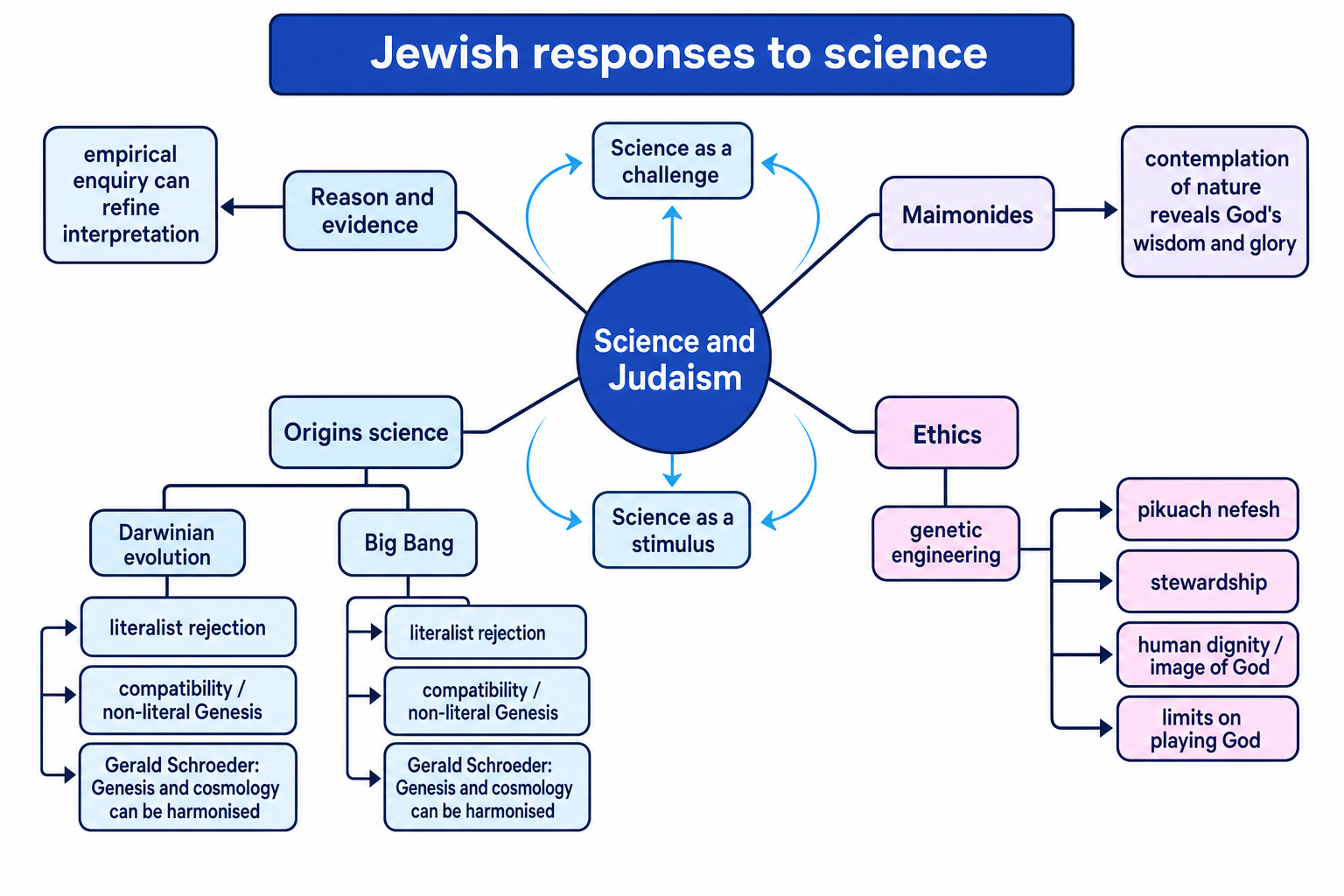
- How Jews have responded differently to Darwinian evolution and the Big Bang, including Gerald Schroeder.
- How scientific developments such as genetic engineering stimulate Jewish ethical reflection.
1. The big picture: why science matters for Judaism
Science can influence Judaism in three main ways:
- It encourages careful use of evidence and reason.
- It produces discoveries that seem to challenge traditional readings of sacred texts.
- It creates new ethical questions, especially in medicine and genetics.
Judaism is not simply “faith instead of reason”. Jewish tradition includes intense debate, interpretation and legal reasoning through the Torah, Talmud and later rabbinic commentary. This means many Jewish thinkers have seen scientific knowledge as something to engage with rather than automatically reject.
Science, evidence and reason
Science is a method of investigating the natural world through observation, evidence, testing and rational explanation. Evidence means the data or observations used to support a claim. Reason means using logic to draw conclusions from that evidence.
Science as challenge and stimulus
For Judaism, science is both a challenge to some literal readings of scripture and a stimulus for deeper interpretation, ethical reflection and wonder at creation.
2. Maimonides: nature reveals the glory of God
Maimonides was a medieval Jewish philosopher, rabbi and physician. His Hebrew name is Moses ben Maimon, often abbreviated as Rambam. He is important because he combined Jewish faith with philosophy, medicine and scientific learning.
In the Mishneh Torah, Maimonides argues that when a person contemplates God’s “great and wondrous works and creatures”, they recognise divine wisdom and are moved to love, praise and awe of God.
Contemplation of nature
Contemplation of nature means thoughtful reflection on the order, beauty and complexity of the natural world. For Maimonides, this is not just curiosity: it becomes a religious act because it reveals God’s wisdom.
This matters for the Judaism and science topic because Maimonides gives a positive religious reason to study the natural world. Science is not necessarily a threat to faith; it can deepen worship.
He also thought that if a literal interpretation of scripture conflicted with a genuinely proven truth, scripture might need to be interpreted non-literally. This does not mean abandoning Torah. It means reading Torah with intellectual seriousness.
Applying Maimonides to modern cosmology
-
Begin with Maimonides’ principle: studying the natural world can lead to love and awe of God because nature displays divine wisdom.
-
Apply this to cosmology: a Jew influenced by Maimonides might see the scale, order and intelligibility of the universe as religiously significant rather than spiritually empty.
-
Evaluate the strength: this approach avoids a false choice between science and faith, but it depends on the claim that nature genuinely points beyond itself to God, which a non-religious scientist may reject.
3. How science can challenge religious beliefs
Scientific discoveries can challenge Judaism when they appear to conflict with traditional beliefs about creation, humanity or divine action.
The key biblical text is Genesis. Genesis 1 describes God creating the world in six days and humans as made in the image of God. Genesis 2 gives a more human-focused account involving Adam, Eve and the Garden of Eden.
Literal and non-literal interpretation
A literal interpretation treats the words of a text as straightforward factual description. A non-literal interpretation treats the text as symbolic, theological or poetic while still seeing it as religiously true.
Assuming one Jewish reading of Genesis
Do not write as if “Judaism says Genesis must be literal”. Jewish responses vary: some Jews defend literal readings, while others read Genesis as theological teaching about God, creation and human responsibility.
4. Darwinian evolution
Darwinian evolution is the theory that living things develop over long periods through inherited variation and natural selection, where organisms better adapted to their environment are more likely to survive and reproduce.
Darwinian evolution
Darwinian evolution explains the diversity of life through common descent, variation and natural selection, rather than through each species being separately created in its present form.
Why evolution can be challenging
Evolution may seem to challenge Judaism because:
- Genesis appears to describe direct divine creation.
- Humans may seem less “special” if they share ancestry with other animals.
- Natural selection involves struggle, suffering and death.
- Evolution can appear random, whereas Judaism teaches divine purpose.
Jewish responses to evolution
Some strict Orthodox or Haredi Jews reject Darwinian evolution, especially if it is used to deny divine creation. They may argue that Torah has greater authority than scientific theories, which are provisional and changeable.
Many Modern Orthodox Jews accept evolution as the mechanism through which God created life. On this view, Genesis teaches that God is creator and humans have spiritual dignity; it does not need to function as a biology textbook.
Many Reform and Liberal Jews accept the scientific consensus on evolution and read Genesis symbolically. They often focus on the ethical meaning of being made in God’s image: humans have responsibility, dignity and moral awareness.
Evaluating evolution and Genesis
-
Identify the possible conflict: evolution suggests humans developed through natural processes, while Genesis presents humans as intentionally created by God.
-
Test a compatibility response: if “image of God” means moral and spiritual vocation rather than biological origin, evolution does not remove human dignity.
-
Weigh the objection: a literalist may argue this weakens the plain meaning of Genesis, but a non-literal reader can reply that Jewish interpretation has always allowed deeper meanings beyond surface description.
5. The Big Bang theory and Jewish creation belief
The Big Bang theory is the scientific view that the universe expanded from an extremely hot, dense early state. It does not simply mean “an explosion in space”; it is about the expansion of space itself.
Big Bang theory
The Big Bang theory explains the development of the universe from an early hot, dense state and is usually linked with the view that the universe is around 13.8 billion years old.
Why the Big Bang can challenge Judaism
The Big Bang may challenge literal readings of Genesis because Genesis describes creation over six days, while modern cosmology speaks of billions of years. It also raises questions about what science can and cannot explain: does it remove the need for God, or does it describe the process through which God creates?
Jewish responses to the Big Bang
Some literalist Jews may reject modern cosmology if they believe it contradicts the Torah’s chronology.
Many Jewish thinkers, however, see the Big Bang as broadly compatible with belief in creation. Genesis begins with God creating the heavens and the earth; the Big Bang also suggests the universe has a finite history rather than being obviously eternal.
A careful answer should avoid saying “the Big Bang proves Genesis”. Science does not prove the theological claim that God created the universe. But it can be interpreted by some Jews as consistent with belief in a beginning.
6. Gerald Schroeder: harmonising Genesis and science
Gerald Schroeder is an Orthodox Jewish physicist and writer. He is known for arguing that modern science and Genesis can be harmonised.
Gerald Schroeder
Gerald Schroeder is a Jewish scientist who argues that the Big Bang and the six days of Genesis can be understood as compatible, especially using ideas about time, perspective and cosmic expansion.
Schroeder argues that the six days of Genesis can be understood from a cosmic or divine perspective rather than from an ordinary human clock on Earth. He uses scientific ideas such as relativity and the stretching of the universe to suggest that billions of years from one perspective could correspond to six creation days from another.
He also argues that the sequence of creation in Genesis broadly fits the scientific development of the universe and life. On evolution, Schroeder is more open to scientific development than a simple literalist, but he rejects the idea that life and humanity are merely purposeless accidents.
Schroeder’s approach
Schroeder does not simply reject science. He tries to show that Torah and science describe the same reality from different perspectives.
Evaluating Schroeder
Schroeder’s view is attractive because it takes both scientific evidence and Jewish scripture seriously. It can help religious believers avoid anti-scientific literalism.
However, critics may accuse him of concordism: trying too hard to make an ancient religious text match modern science. If scientific theories develop, the interpretation may need to change again. Others argue that Genesis is not trying to teach physics at all, so reading relativity into it may miss its theological purpose.
7. Genetic engineering: science as a stimulus to Jewish ethics
Science does not only challenge beliefs about origins. It also creates new moral questions.
Genetic engineering
Genetic engineering means deliberately altering genetic material. In ethics, this can include gene therapy to treat disease, embryo selection, germline editing that affects future generations, or enhancement for non-medical traits.
Judaism often approaches these issues through halakhah, meaning Jewish law and ethical reasoning.
Important Jewish principles include:
- Pikuach nefesh: the duty to save life, which overrides most other commandments.
- B’tzelem Elohim: humans are made in the image of God, so human dignity must be protected.
- Stewardship: humans are entrusted to care for creation, not exploit it recklessly.
- Healing as a duty: Jewish tradition often sees medicine as permitted and even required.
- Concern about “playing God”: humans must recognise limits and avoid arrogance.
Therapeutic genetic engineering, such as treating a serious inherited disease, may be supported by many Jewish thinkers because it protects life and reduces suffering. Genetic screening for conditions such as Tay-Sachs disease has often been accepted in Jewish communities.
However, enhancement is more controversial. Editing embryos to create “designer babies” could treat children as products, increase inequality, and undermine respect for human dignity. Germline editing is especially difficult because it affects future generations who cannot consent.
Applying Jewish principles to gene therapy
-
Distinguish the purpose: if genetic engineering is used to cure a life-threatening disease, it strongly connects with pikuach nefesh and the duty to heal.
-
Consider human dignity: the treatment should protect the person as made b’tzelem Elohim, not treat them as an experiment or product.
-
Check the limits: if the change is heritable or aimed at enhancement rather than healing, Jewish thinkers may become more cautious because of risk, consent and “playing God” concerns.
-
Reach a balanced judgement: many Jewish responses would support carefully regulated therapeutic use, while rejecting reckless or consumer-style genetic enhancement.
Reducing Jewish ethics to ‘playing God’
“Playing God” is only one concern. A stronger answer also uses positive Jewish principles such as pikuach nefesh, healing, stewardship and human dignity.
8. Overall evaluation: conflict or compatibility?
The strongest answer is usually not “science defeats Judaism” or “Judaism ignores science”. A better judgement is that Jewish responses depend on how scripture and tradition are interpreted.
Literalist approaches protect the authority of Torah but can struggle when scientific evidence is strong. Liberal and non-literal approaches fit modern science more easily but may be accused of adapting religion too quickly. Maimonides and Schroeder show a middle path: using reason and scientific knowledge while maintaining belief in God as creator.
For essays, remember that science affects Judaism in two directions: it challenges some beliefs, but it also deepens awe and creates new areas for ethical responsibility.
In the exam
-
Link each scientific issue to a Jewish response: do not just describe evolution, the Big Bang or genetics in scientific terms.
-
Use named material precisely: Maimonides for contemplation of nature; Schroeder for harmonising Genesis and cosmology.
-
Evaluate throughout: compare literalist, Orthodox, Reform/Liberal and compatibility responses, then explain which is most convincing and why.
Check yourself
- How does Maimonides’ view of nature make science religiously valuable?
- Why might Darwinian evolution challenge a literal reading of Genesis?
- Which Jewish principles could support or limit genetic engineering?

Keep learning
Make a free account to read the full revision notes and worked examples.