Islam and the challenge of secularisation
What you'll learn
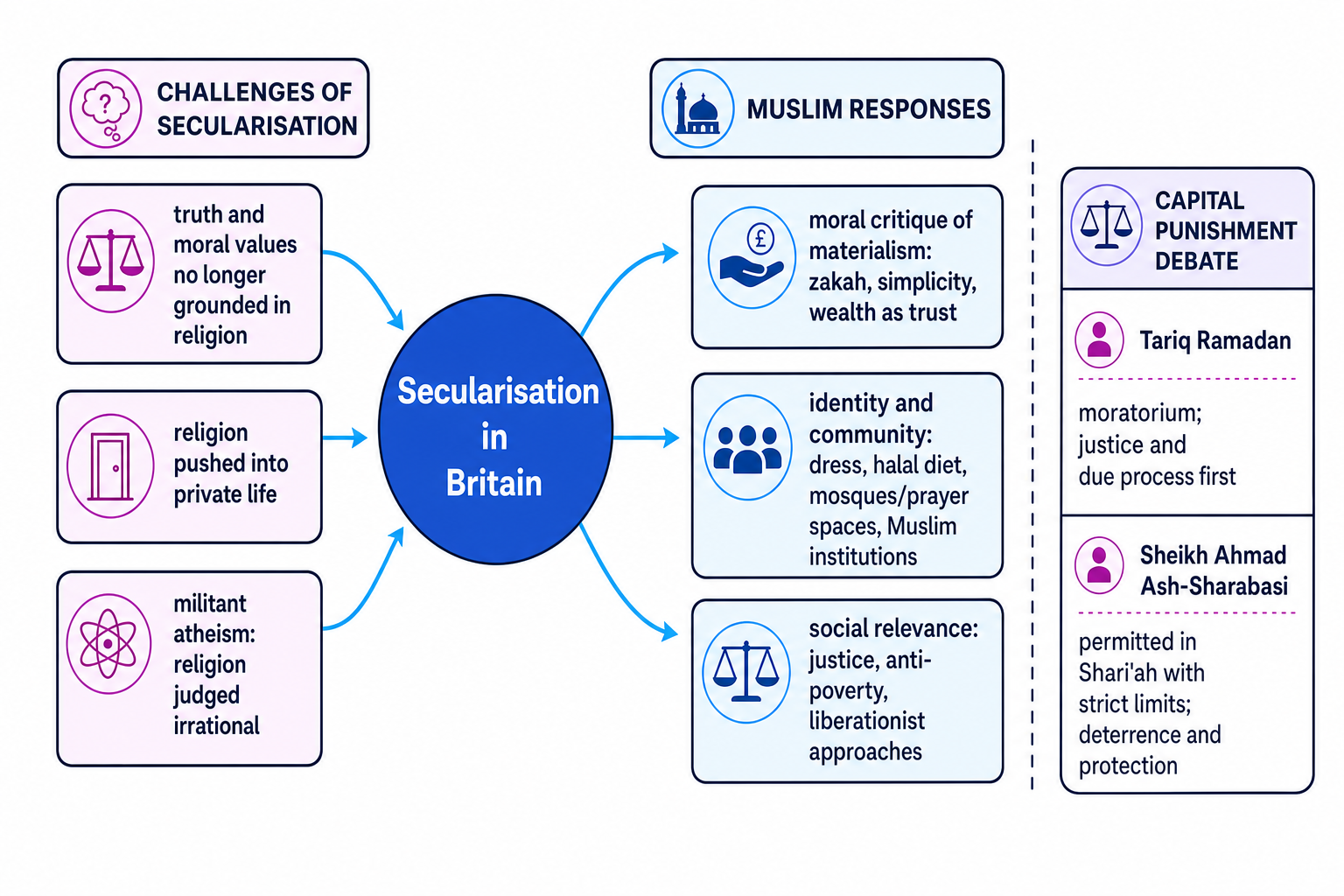
- What secularisation challenges in Islam: truth, morality, public religion and reason.
- How Muslim thinkers respond to materialism, especially wealth, possessions and capital punishment.
- Why Muslim identity in Britain often focuses on dress, diet, prayer, mosques and community self-reliance.
- How Islam can be presented as socially relevant through justice, anti-poverty work and liberationist approaches.
The starting point: what is secularisation?
Secularisation
Secularisation is the process by which religion loses social influence over public institutions, moral decision-making and people’s understanding of truth. In this topic, you may focus especially on the British context.
Secularisation is not simply “fewer people going to mosque, church or synagogue”. For this topic, the key issue is authority: who decides what is true, what is good, and how society should be organised?
In Islam, ultimate truth and moral guidance come from Allah, revealed through the Qur’an and embodied in the Sunnah, the example and teachings of the Prophet Muhammad. Secularisation challenges this by making human reason, individual choice, law, science, democratic consensus or consumer preference the main public authorities.
Secularisation is not the same as atheism
Secularisation is a social process; atheism is disbelief in God. A secular society may still contain many religious people, but religion has less public authority.
Challenge 1: religion replaced as the source of truth and moral values
A major challenge of secularisation is that religion is no longer assumed to be the foundation of truth or morality. In a secular society, moral values may be grounded in human rights, personal autonomy, scientific knowledge, democratic law or public opinion.
For Islam, this can be difficult because morality is not merely invented by society. Muslims believe Allah is the ultimate source of guidance. The Qur’an repeatedly connects belief with righteous action, social justice, prayer and charity. For example, Qur’an 4:135 commands believers to “stand firmly for justice”, even against themselves or their own relatives.
Shari’ah and fiqh
Shari’ah means the divine “path” or guidance for human life. Fiqh is human interpretation of that guidance through Islamic jurisprudence. This distinction matters because Muslims may agree that Allah’s guidance is perfect while disagreeing about how it should be applied today.
AO2 evaluation matters here. A secular critic might argue that moral values can be defended without religion: for example, through human dignity, equality and harm reduction. A Muslim response might agree that non-religious people can be moral, but argue that revelation gives morality a deeper foundation, purpose and accountability before God.
The key tension
Secularisation challenges Islam most sharply when it treats religion as one private opinion among many, while Islam understands submission to Allah as a complete way of life.
Challenge 2: religion relegated to the personal sphere
A second challenge is the idea that religion should be private: acceptable as personal belief, family practice or worship, but not as a public influence on politics, law, education or economics.
This is a challenge because Islam is often understood as din, a whole way of life. The Five Pillars include personal worship, but they also have public and social dimensions. Zakah, compulsory almsgiving, directly links worship with economic justice. Jumu’ah, Friday congregational prayer, makes worship communal. The ummah, the worldwide Muslim community, gives Islam a social identity beyond private belief.
In Britain, this issue appears in debates about prayer spaces, halal food, Islamic schools, modest dress, public funding, chaplaincy, and whether religious arguments should influence law.
Distinguishing private and public religion
- If a Muslim prays privately at home, secular society usually treats this as personal religious freedom.
- If Muslims request prayer space in a school, university or workplace, religion becomes public because an institution must decide whether to accommodate it.
- If Muslims campaign on poverty, war, racism or capital punishment using Islamic principles, religion becomes politically relevant.
- The evaluation is balanced: public religion may enrich society through justice and service, but in a plural democracy it must also respect people who do not share Islamic authority.
Challenge 3: militant atheism and the claim that religion is irrational
Militant atheism
Militant atheism is a strongly anti-religious form of atheism which argues not only that God does not exist, but that religion is irrational, harmful or socially dangerous.
In the British context, “New Atheist” writers such as Richard Dawkins and Christopher Hitchens have often presented religion as superstition, anti-science or a cause of violence. Islam may be especially targeted through media discussions of extremism, gender, terrorism or Shari’ah.
Muslim responses often stress that Islam has a long intellectual tradition. The Qur’an encourages reflection on creation, history and human responsibility. Classical Islamic thought included theology, philosophy, law, medicine and science. So a Muslim may argue that faith and reason are not enemies.
However, a strong AO2 answer should not simply dismiss the atheist challenge. It can recognise that some religious communities have acted irrationally or unjustly, while arguing that abuse of religion does not disprove the truth or value of Islam itself.
Responses to materialistic secular values
Materialism
In this topic, materialism means an outlook that treats wealth, possessions, status and consumption as the main goals of life.
Islam does not teach that wealth is evil in itself. The Prophet Muhammad worked as a trader, and Khadijah was a successful businesswoman. The issue is whether wealth becomes an idol: something loved more than Allah, justice or compassion.
Islamic teaching presents wealth as an amanah, a trust from God. Muslims are expected to earn lawfully, avoid exploitation, give zakah, practise charity and show concern for the poor. Qur’an 102 warns that competition for worldly increase can distract people from ultimate accountability.
This is a direct response to secular consumer culture. Islam challenges the idea that human worth is measured by income, possessions or lifestyle. But it also avoids romanticising poverty: responsible earning, business and community prosperity can be positive if directed towards justice.
Capital punishment: Ramadan and Ash-Sharabasi
Capital punishment is a good example of the clash between secular values and Islamic legal tradition. In Britain, the death penalty has been abolished and is often regarded as a violation of human rights. In classical Islamic law, however, capital punishment has been permitted in restricted cases, especially under qisas, retaliatory justice for murder, and in some interpretations of hudud, fixed punishments for specific serious offences.
Qur’an 5:32 strongly affirms the sanctity of life: killing one soul unjustly is like killing all humanity. Qur’an 2:178 permits qisas in cases of murder, but also praises forgiveness and compensation. So the tradition contains both justice and mercy.
| Thinker | Main position | Why it matters |
|---|---|---|
| Tariq Ramadan | Calls for a moratorium on corporal punishment, stoning and the death penalty in Muslim contexts. | He argues that modern legal systems often lack justice, equality and due process, so applying such punishments betrays the objectives of Shari’ah. |
| Sheikh Ahmad Ash-Sharabasi | Defends capital punishment as permitted within Shari’ah when strictly limited and legally controlled. | He sees it as a divinely authorised protection for society and a deterrent against serious crime. |
Ramadan is not simply saying “ignore Islam and follow secular human rights”. His argument is internal to Islam: Shari’ah aims at justice, mercy and protection of life, so punishments should not be applied where courts are corrupt, poverty is widespread, or the powerful escape punishment.
Ash-Sharabasi represents a more traditional defence. He argues that if Allah has permitted a punishment, humans should not reject it as immoral. Yet it must be applied by legitimate authority, with strict evidence, and not as private revenge.
Comparing Ramadan and Ash-Sharabasi
- Start with the shared ground: both thinkers care about justice, social protection and the seriousness of murder.
- Identify the disagreement: Ramadan focuses on whether modern societies meet the conditions for just application; Ash-Sharabasi focuses on the continuing authority of Shari’ah punishments.
- Evaluate Ramadan: his view fits better with human rights concerns and the risk of wrongful conviction, but critics may say a moratorium avoids the harder question of whether capital punishment is ever morally right.
- Evaluate Ash-Sharabasi: his view is coherent if one accepts divine command and classical jurisprudence, but it is harder to defend in a plural British democracy where law is not based on Shari’ah.
- Reach a judgement: Ramadan may be more persuasive in the British secular context because he preserves Islamic principles while recognising legal injustice and public moral concern.
Preserving Muslim identity
Secularisation can make Muslims feel pressure to assimilate, meaning to lose visible or distinctive religious identity. Many Muslim responses therefore emphasise preserving identity through daily practice.
Dress and diet
Muslim dress can express modesty, obedience and belonging. The hijab is often linked to Qur’an 24:30–31, which teaches modesty for men and women, though Muslims interpret the details differently. Some see Islamic dress as empowerment and public witness; others worry that it can become a focus of social control or prejudice.
Diet also preserves identity. Eating halal food, avoiding pork and alcohol, and fasting in Ramadan make faith part of ordinary life. These practices resist the secular idea that religion is merely private belief.
Prayer, mosques and community self-reliance
Prayer maintains identity because salah structures the day around Allah rather than work, school or consumer routines. Mosques are not only places of worship; they can also provide education, counselling, charity, youth work and community leadership.
Self-reliance means Muslims developing institutions that allow the community to flourish: mosques, madrasahs, charities, halal certification, Islamic schools, welfare networks and burial services. This can strengthen belonging, but it can also raise concerns about separation from wider society.
Do not treat Muslims as one single viewpoint
British Muslims are diverse: Sunni, Shi’a, Sufi, reformist, conservative, liberal, cultural, practising, and from many ethnic backgrounds. Strong essays avoid phrases like “Muslims believe…” when the issue is debated.
Democracy and political involvement
Muslims differ over democracy. Many support participation, arguing that voting can promote justice, protect religious freedom and serve the common good. They may connect democracy with shura, consultation, which is valued in Islamic tradition.
Others are cautious. They argue that sovereignty belongs to Allah, not human beings, and that democratic law may permit what Islam forbids. For them, involvement in party politics can seem like accepting secular moral authority.
A third position is pragmatic: Muslims can participate in democracy without treating it as ultimate. They may vote, campaign or stand for office to reduce harm and pursue justice, while still believing that Allah is the highest authority.
Democracy essays need nuance
Do not write “Islam is against democracy” or “Islam fully supports democracy”. The better point is that Muslims disagree over whether democracy is a tool for justice, a rival source of authority, or both.
The social relevance of Islam: liberationist approaches
Secularisation often assumes religion is outdated or socially irrelevant. A major Muslim response is to show that Islam speaks powerfully to poverty, oppression and injustice.
Liberationist approach
A liberationist approach reads and applies religion from the perspective of oppressed people, focusing on justice, dignity and freedom from exploitation.
In Islam, liberationist approaches draw on tawhid, the oneness of God, to reject racism, class oppression and human domination. If Allah alone is ultimate, no ruler, market, nation or social class should be treated as absolute. The Qur’an repeatedly commands care for orphans, travellers, debtors and the poor.
Muslim liberationist thinkers and activists may campaign against poverty, racism, Islamophobia, war, unjust imprisonment and economic exploitation. Zakah, sadaqah and community organising become evidence that Islam is not merely private identity but a public force for human dignity.
AO2 balance: this is a strong response to secularisation because it shows Islam contributing to the common good in language non-Muslims can recognise. However, if Islam is reduced only to social activism, it loses its distinctively theological foundation: worship of Allah, revelation, prayer and accountability in the afterlife.
Building an evaluative judgement about social relevance
- Make the claim: liberationist Islam answers secularisation by proving that religion can address real social problems.
- Support it with Islamic teaching: zakah, justice and concern for the oppressed are central Qur’anic themes, not optional extras.
- Add the counterpoint: secular charities and human rights groups also fight poverty, so social action alone does not prove religion is necessary.
- Refine the judgement: the strongest Muslim response is not that only Islam can help the poor, but that Islam gives social justice a sacred foundation and a disciplined community practice.
In the exam
- Define secularisation precisely, then link it to the specific challenge: truth, morality, private religion, militant atheism, materialism or public identity.
- Use named material: especially Tariq Ramadan and Sheikh Ahmad Ash-Sharabasi on capital punishment.
- Keep evaluating as you go: ask whether each Muslim response protects Islam, adapts Islam, isolates Muslims, or helps Islam contribute to wider British society.
Check yourself
- Why is secularisation a challenge to Islam as a complete way of life, not just to mosque attendance?
- How do Ramadan and Ash-Sharabasi differ on capital punishment?
- In what ways can preserving Muslim identity be both a strength and a difficulty in secular Britain?

Keep learning
Make a free account to read the full revision notes and worked examples.