Islam and science
What you'll learn
- Why science has mattered within Islam, especially through evidence, reason, and the study of creation.
- How Muslims have responded differently to Darwin’s theory of evolution and the Big Bang theory.
- Why Maurice Bucaille argued that the Qur’an anticipated modern science — and why that view is debated.
- How genetic engineering has stimulated Muslim ethical reflection.
The big picture: conflict is not the only model
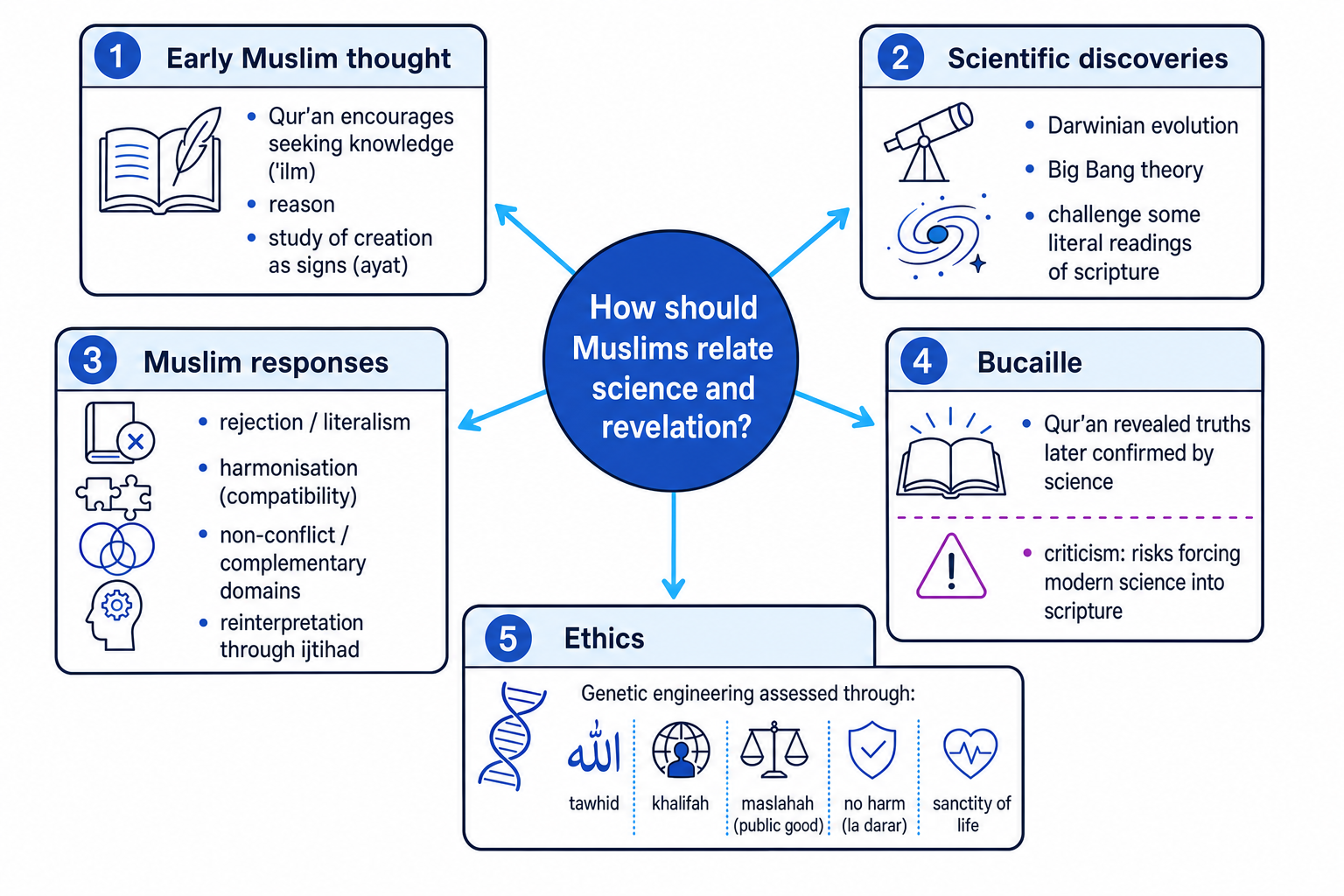
The relationship between Islam and science is not simply “religion versus science”. Many Muslims see science as a way of studying Allah’s creation. Others think some scientific theories challenge literal readings of scripture. The key exam skill is to show different Muslim responses, not to pretend there is only one Islamic view.
Empirical science
Empirical science is knowledge gained through observation, evidence, experiment, and reason. It usually works by looking for natural explanations of natural events.
Islam also values revelation, meaning knowledge believed to be disclosed by Allah, especially through the Qur’an and the Sunnah, the example and teaching of the Prophet Muhammad. Tension can arise when empirical investigation appears to conflict with a literal interpretation of revelation.
Main line of argument
Science has influenced Islam by encouraging fresh interpretation, challenging some traditional beliefs, and creating new ethical questions; Islam has responded through rejection, harmonisation, reinterpretation, and ethical reasoning.
Science, evidence, and reason in early Muslim thought
A common Muslim starting point is that the universe is not chaotic or meaningless. It is created by Allah, who is one, wise, and purposeful. This links to tawhid, the belief in the oneness and unity of Allah. If creation is ordered, it can be studied.
The Qur’an repeatedly encourages reflection on the natural world. For example, Qur’an 3:190 speaks of “signs” in the creation of the heavens and the earth. Qur’an 96:1–5 begins with the command to “Read” or “Recite”, and Qur’an 39:9 asks whether those who know are equal to those who do not know. These verses have often been used to support the pursuit of knowledge.
Ayat and ilm
Ayat means “signs” or “verses”. In Islam, both Qur’anic verses and features of the natural world can be seen as signs pointing to Allah. Ilm means knowledge.
During the early Islamic period, especially under the Abbasids, Muslim scholars made major contributions to mathematics, astronomy, medicine, optics, and philosophy. The House of Wisdom in Baghdad became a centre of translation and learning. Figures such as al-Khwarizmi, Ibn Sina, and Ibn al-Haytham show that scientific inquiry could be seen as part of religious civilisation, not a threat to it.
However, be careful: the Qur’an does not command “modern laboratory science” in the contemporary sense. A stronger answer says that the Qur’an encourages knowledge, reason, and reflection on creation, which many Muslims have understood as supporting scientific study.
Overstating the claim
Do not write, “Islam invented science” or “the Qur’an is a science textbook.” A better claim is that many Muslims have seen scientific inquiry as compatible with, and sometimes required by, faith.
Maurice Bucaille and the “scientific miracles” approach
Maurice Bucaille was a French doctor whose book The Bible, the Qur’an and Science argued that the Qur’an contains statements later confirmed by modern science. This approach is often called concordism, meaning the attempt to show agreement between scripture and scientific discovery.
Bucaille argued that, unlike some biblical passages, the Qur’an is not contradicted by modern science. Supporters point to verses such as Qur’an 21:30, which says the heavens and the earth were once joined and then separated, and link this to the Big Bang. They may also cite Qur’an 51:47, sometimes translated as referring to the expansion of the heavens, or Qur’an 23:12–14 on stages of human development.
The strength of Bucaille’s approach is that it can reinforce Muslim belief in the Qur’an as divine revelation. If a seventh-century text appears to anticipate later discoveries, believers may see this as evidence of Allah’s knowledge.
The weakness is that it can become selective. Translations may be stretched to fit modern science, and scientific theories can change. If faith is based too heavily on today’s science, then tomorrow’s science could appear to threaten that faith.
Evaluating a scientific miracle claim
-
Start with the actual claim: for example, Qur’an 21:30 is linked by some Muslims to the Big Bang because it describes the heavens and earth as once joined, then separated.
-
Compare the religious meaning with the scientific theory: the verse may be read as a sign of Allah’s creative power, while the Big Bang theory describes the early development of the universe from an extremely hot, dense state.
-
Test whether the link is strong or forced: the verse is suggestive, but it is not a detailed scientific explanation, so the argument depends heavily on interpretation.
-
Reach a balanced judgement: Bucaille’s approach may strengthen faith for some Muslims, but it is weaker if it treats poetic or theological language as if it were a physics textbook.
Darwin’s theory of evolution
Darwin’s theory of evolution argues that living organisms develop over time through common ancestry and natural selection. Natural selection is the process by which organisms with traits better suited to their environment are more likely to survive and reproduce.
This has challenged some Muslim beliefs because the Qur’an describes Allah creating Adam, sometimes understood literally as the first human specially created from clay. It can also challenge the idea that human beings are uniquely created and spiritually distinct.
Different Muslim responses include:
| Response | Main idea | Strength | Weakness |
|---|---|---|---|
| Literalist rejection | Human evolution is rejected because Adam was directly created by Allah. | Preserves a straightforward reading of scripture. | Can appear to ignore strong scientific evidence. |
| Partial acceptance | Evolution may apply to animals and plants, but not to humans. | Accepts much science while protecting Adam’s special status. | May seem inconsistent if human biology also shows common ancestry. |
| Harmonisation | Evolution is the method Allah used to create life. | Takes science seriously while keeping Allah as creator. | Some argue it weakens the traditional doctrine of Adam. |
| Symbolic or non-literal reading | Qur’anic creation accounts teach theological truths, not biology. | Avoids conflict between science and scripture. | More conservative Muslims may see this as undermining revelation. |
Comparing responses to human evolution
-
Identify the pressure point: evolution challenges a literal reading of Adam’s creation and the belief that humans are uniquely created by Allah.
-
Apply the literalist response: a Muslim may reject human evolution because the Qur’an’s description of Adam is treated as direct historical truth.
-
Apply the harmonising response: another Muslim may accept biological evolution but argue that Allah guides or sustains the whole process, and that human spiritual status comes from Allah, not from biology alone.
-
Evaluate the comparison: the literalist view protects traditional belief more clearly, but the harmonising view may better engage with scientific evidence and Islam’s wider respect for reason.
Calling evolution purely random
Do not say “Darwin says life is completely random.” Mutations may be random, but natural selection is not simply random; it favours traits that aid survival and reproduction. The religious issue is whether this process leaves room for divine purpose.
The Big Bang theory
The Big Bang theory is the scientific theory that the universe developed from an extremely hot, dense early state and has been expanding. Many Muslims find this easier to harmonise with Islam than evolution, because Islam already teaches that Allah is the creator of the universe.
Some Muslims connect the Big Bang with Qur’an 21:30 and cosmic expansion with Qur’an 51:47. Others use the Big Bang more generally to support the idea that the universe is not eternal and depends on Allah.
However, the Big Bang does not prove Islam by itself. Science describes physical development; it does not automatically answer why there is a universe at all. A strong answer can say that the Big Bang may be compatible with Islamic creation, but it should not be used as a simplistic “proof” of Allah.
Avoid the God of the gaps
A “God of the gaps” argument puts God only where science has not yet explained something. This is risky because if science later fills the gap, the argument weakens. Islamic belief in Allah is usually broader: Allah sustains all existence, not just unexplained events.
Science as a stimulus to Muslim ethical thinking
Modern science does not only challenge beliefs about origins. It also creates new ethical questions. Genetic engineering means deliberately altering genetic material in an organism. In humans, this may include gene therapy, which aims to treat disease, or enhancement, which aims to improve traits beyond medical need.
Muslim ethical reflection often uses:
- Khalifah: humans are stewards or trustees of Allah’s creation.
- Maslahah: public benefit or welfare.
- Maqasid al-shari’ah: the objectives of Islamic law, often including protection of life, intellect, family, religion, and property.
- La darar wa la dirar: the principle that harm should not be caused or reciprocated.
- Sanctity of life: human life has God-given value.
- Ijtihad: careful independent reasoning by qualified scholars when new issues are not directly answered in scripture.
Ijtihad
Ijtihad is reasoned interpretation used by Muslim scholars to apply Islamic principles to new situations, such as genetic engineering, where there may be no direct Qur’anic ruling.
Many Muslims would support genetic engineering when it heals serious disease, because it protects life and reduces suffering. Qur’an 5:32 is often used to stress the value of saving life. But there is more concern about germline editing, where changes can be inherited by future generations, and about “designer babies”, because these may involve unknown harms, inequality, arrogance, or changing Allah’s creation for vanity rather than necessity.
Some Muslims also cite Qur’an 4:119, where Satan is associated with commanding people to alter Allah’s creation. But this is not always taken as a ban on all medical intervention. Surgery, vaccination, and medicine also “alter” nature, yet many Muslims accept them when they restore health.
Applying Islamic principles to gene therapy
-
Classify the case: if gene therapy treats a serious inherited disease in an existing patient, it is therapeutic rather than enhancement.
-
Weigh the benefit: protecting life and reducing suffering support approval through maslahah and the sanctity of life.
-
Weigh the risk: if the treatment is unsafe, affects future generations, or damages human dignity, the principle of avoiding harm becomes stronger.
-
Form a judgement: many Muslims would be more likely to permit safe somatic gene therapy than risky germline editing or non-medical enhancement.
How to evaluate the whole topic
For AO2, avoid a one-sided answer. Science can be a challenge to Islam when it seems to conflict with literal readings of creation, especially around evolution. But science can also support Muslim faith by revealing order, complexity, and intelligibility in creation. It can also push Muslims to use ijtihad responsibly in new ethical situations.
The best judgement is usually nuanced: Islam is not inherently anti-science, but particular scientific theories and technologies can create real interpretative and ethical tensions.
In the exam
-
Use precise examples: early Muslim science, Bucaille, Darwin, the Big Bang, and genetic engineering.
-
Compare responses rather than listing them: literalist rejection, partial acceptance, harmonisation, and reinterpretation lead to different strengths and weaknesses.
-
Keep evaluating: ask whether each view handles both Islamic sources and scientific evidence convincingly.
Check yourself
- Why might some Muslims see science as a duty encouraged by the Qur’an?
- What are two different Muslim responses to Darwin’s theory of evolution?
- Why is genetic engineering not automatically accepted or rejected in Islamic ethics?

Keep learning
Make a free account to read the full revision notes and worked examples.