What you'll learn
- What psychologists mean by obedience and how it differs from conformity.
- How Milgram’s agency theory explains obedience to authority.
- How Latané’s social impact theory explains pressure from others.
- How to evaluate both theories using AO3 evidence, ethics, and real-world application.
Starting point: what is obedience?
In everyday life, obedience can be useful: you follow a teacher’s instruction, stop when a police officer tells you to, or listen to a doctor’s advice. In psychology, though, obedience becomes especially important when people follow orders that conflict with their own values.
Obedience
Obedience is a form of social influence where a person changes their behaviour in response to a direct order from an authority figure — someone seen as having power, status, or the right to give instructions.
Obedience is different from conformity, where you change your behaviour because of real or imagined group pressure, but there may be no direct order.
Distinguishing obedience from conformity
A student laughs at a joke because everyone else is laughing. Later, a teacher tells the student to move seats and the student does so.
- Check for a direct order. The teacher explicitly tells the student to move seats, so that behaviour is obedience.
- Check for group pressure without an order. Laughing because everyone else laughs is conformity, because the group influences behaviour without directly commanding it.
- Use the authority test. The teacher has recognised authority in the classroom, so following the teacher’s instruction fits the definition of obedience.
Agency theory: Milgram’s explanation
Agency theory was developed by Stanley Milgram in 1974 after his famous obedience research, including Milgram’s 1963 study where many participants gave what they believed were dangerous electric shocks when instructed by an experimenter.
Agency theory
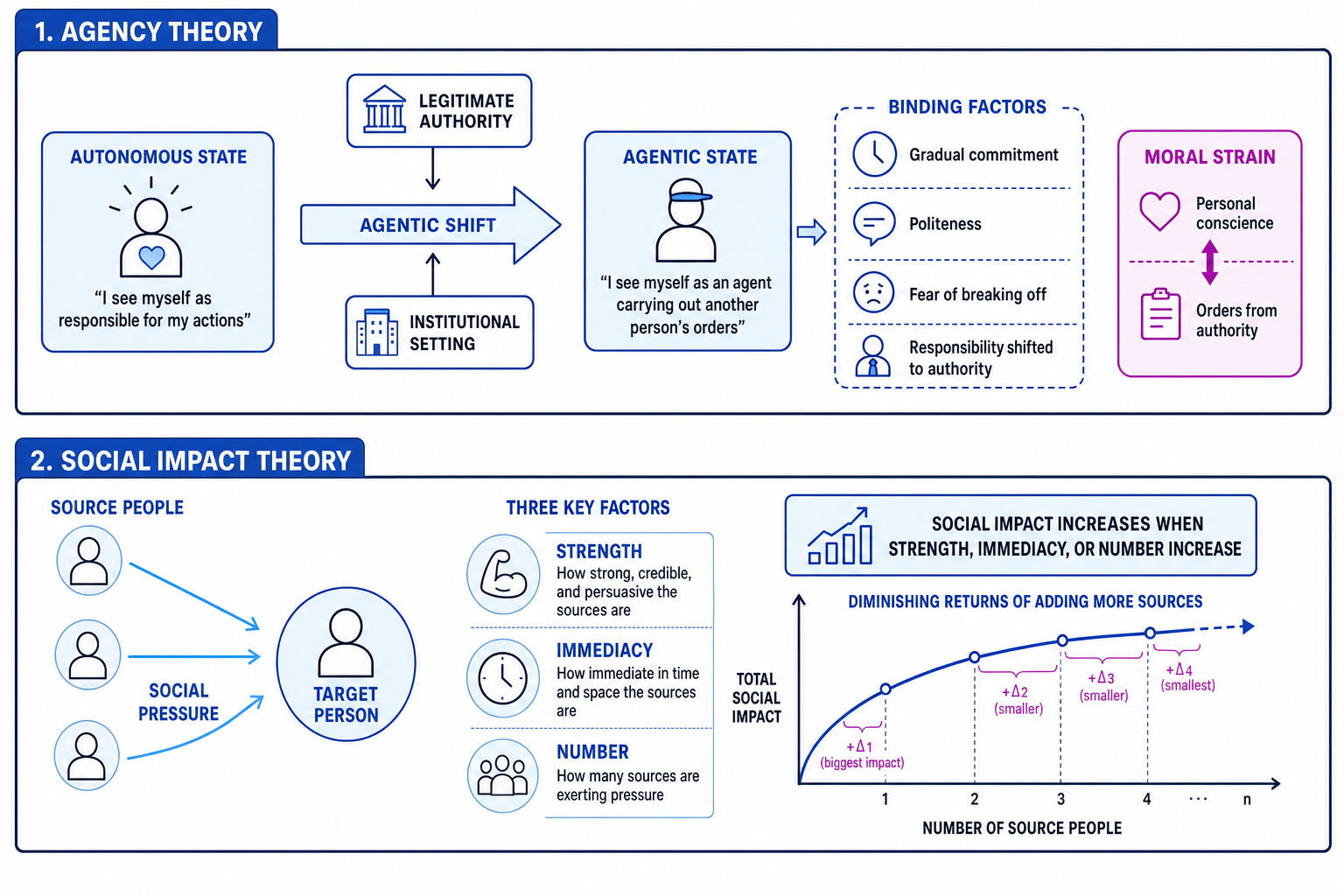
Agency theory explains obedience by suggesting that people can shift from seeing themselves as personally responsible for their actions to seeing themselves as an agent carrying out another person’s orders.
The key idea is that obedience becomes more likely when a person enters an agentic state.
Autonomous state
The autonomous state is when you see yourself as personally responsible for your own behaviour. You make decisions using your own conscience.
For example, if you refuse to harm someone because you believe it is wrong, you are acting autonomously.
Agentic state
The agentic state is when you see yourself as acting on behalf of an authority figure. You may still feel uncomfortable, but you believe responsibility belongs to the person giving the order.
Milgram argued that this helps explain why ordinary people may obey harmful instructions: they do not necessarily become cruel; they redefine their role as “just following orders”.
Agentic shift
The agentic shift is the movement from the autonomous state into the agentic state. This shift is more likely when the authority figure appears legitimate.
Legitimate authority
Legitimate authority means the authority figure is accepted as having the social right to give orders, often because of their role, uniform, status, expertise, or institutional setting.
In Milgram’s research, the experimenter wore a lab coat and the study took place at Yale University. These cues made the experimenter appear legitimate.
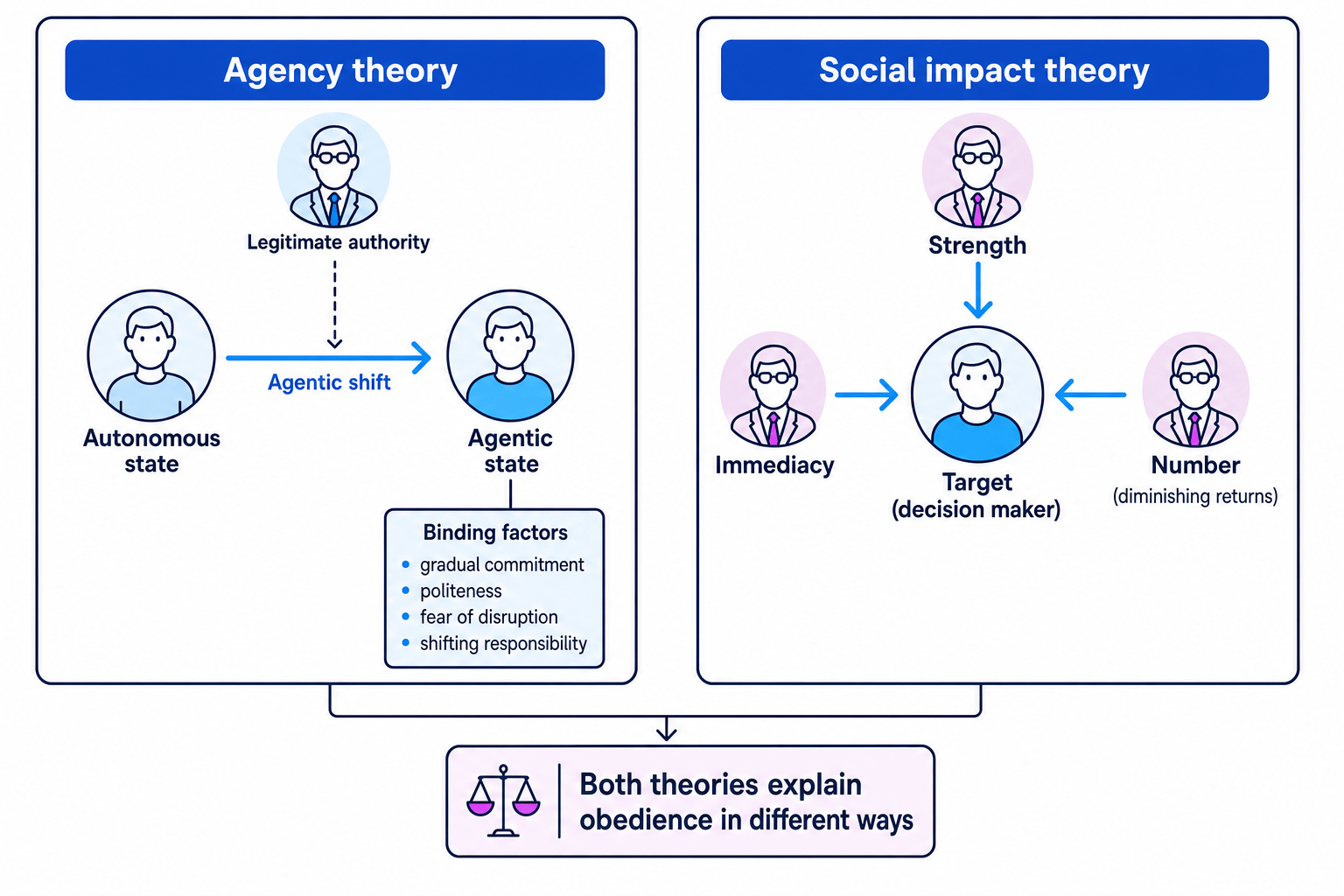
The diagram below summarises the two theories you need for this topic.
Binding factors
Once obedience has started, people may find it difficult to stop. Milgram called these pressures binding factors.
These include:
- Gradual commitment: the person has already obeyed small orders, so the next step feels less dramatic.
- Politeness and social expectations: stopping may feel rude or disruptive.
- Fear of breaking off: the person may worry about embarrassment, confrontation, or consequences.
- Shifting responsibility: the person tells themselves the authority figure is responsible.
Agency theory in one sentence
Agency theory says people obey because legitimate authority can produce an agentic shift, where they see themselves as carrying out orders rather than making fully responsible personal choices.
Applying agency theory to a scenario
A junior nurse is told by a senior doctor to give a patient a drug dose the nurse feels unsure about.
- Identify the legitimate authority. The senior doctor has high status, specialist knowledge, and authority within the hospital.
- Apply the agentic shift. The nurse may move from “I am responsible for this decision” to “I am following the doctor’s instruction.”
- Add binding factors. The nurse may worry about challenging a senior professional, delaying treatment, or appearing incompetent.
- Explain the likely obedience. Agency theory predicts obedience becomes more likely because responsibility is psychologically shifted upwards to the doctor.
Evaluating agency theory
Agency theory has strong support from Milgram’s obedience research. In Milgram’s 1963 study, 65% of participants continued to the maximum 450 volts, suggesting that ordinary people may obey a legitimate authority even when distressed.
There is also real-world support. Hofling et al. (1966) found that nurses often obeyed an unknown doctor’s telephone order to give an excessive drug dose, showing how professional authority can influence obedience in medical settings.
However, agency theory does not explain everything. Some participants in Milgram’s study disobeyed, even though they were exposed to the same authority figure. This suggests individual differences, moral reasoning, personality, and social support also matter.
Overstating agency theory
Do not write that people in the agentic state “have no choice”. Agency theory says they perceive responsibility as belonging to the authority figure, but they can still resist or disobey.
A further weakness is that the agentic state is difficult to measure directly. It can sound like a description after the event: if someone obeys, we might say they were “agentic”, but that does not prove the state caused the obedience.
Ethics are also important. Milgram’s study involved deception, psychological distress, and questions about the right to withdraw. Under the BPS Code of Ethics and Conduct (2009), psychologists must consider consent, deception, right to withdraw, protection from harm, confidentiality, and debriefing. Burger’s 2009 partial replication improved ethical safeguards by stopping at 150 volts and screening participants, while still finding notable obedience.
Social impact theory: Latané’s explanation
Social impact theory was proposed by Bibb Latané in 1981. It explains social influence by looking at how much pressure a person experiences from others.
Social impact theory
Social impact theory says the amount of social pressure on a target person depends on the strength, immediacy, and number of source people influencing them.
In obedience, the source is usually the authority figure giving the order, and the target is the person being ordered.
Strength
Strength means how powerful, important, credible, or high-status the source is perceived to be.
A police officer, doctor, teacher, or experimenter in a lab coat may have high strength because they are seen as knowledgeable or entitled to give instructions.
Bickman (1974) supports this factor: people were more likely to obey a person dressed as a guard than someone dressed as a milkman or civilian, suggesting uniform and status can increase obedience.
Immediacy
Immediacy means how close the source is to the target in time and space.
In Milgram’s variations, obedience dropped when the experimenter gave instructions by telephone rather than being physically present. This supports the idea that pressure is stronger when the authority figure is nearby.
Number
Number means how many sources are applying pressure.
If several authority figures give the same order, obedience may increase. However, Latané argued that number has diminishing returns: adding a second source has a bigger effect than adding a tenth source.
A simple way to remember the theory is:
Social pressure∝strength⋅immediacy⋅number\text{Social pressure} \propto \text{strength} \cdot \text{immediacy} \cdot \text{number}Social pressure∝strength⋅immediacy⋅numberThis is not a calculation you need to perform in the exam; it is a way of expressing the relationship.
Social impact theory in one sentence
Social impact theory says obedience is more likely when authority figures are strong, close, and numerous — but each extra source adds proportionally less pressure.
Comparing social impact in two situations
A student is told to hand over their phone. In Situation A, one supply teacher asks from across the room. In Situation B, the headteacher and deputy head stand beside the student and both ask.
- Compare strength. The headteacher and deputy head have more recognised authority than a supply teacher, so Situation B has greater source strength.
- Compare immediacy. Standing beside the student creates more immediate pressure than asking from across the room.
- Compare number. Two authority figures create more pressure than one, although the increase is not unlimited.
- Make the prediction. Social impact theory predicts obedience is more likely in Situation B because strength, immediacy, and number are all higher.
Evaluating social impact theory
A strength of social impact theory is that it explains several obedience findings clearly. Milgram’s proximity variations support immediacy, while Bickman’s uniform study supports strength. The theory is also useful in real life because organisations can reduce harmful obedience by encouraging people to question authority, seek second opinions, and create clear whistleblowing procedures.
Another strength is that the theory is broader than agency theory. It can explain obedience, conformity, and bystander behaviour because all involve social pressure from others.
However, social impact theory can be criticised for being more descriptive than explanatory. It tells us when pressure is likely to be stronger, but it does not fully explain what happens psychologically inside the person. Agency theory gives a deeper account of responsibility and moral strain.
It can also be hard to measure the three factors objectively. “Strength” is especially subjective: one person may see a teacher as highly authoritative, while another may not.
Confusing strength and number
Strength is about the status or power of the source. Number is about how many sources there are. One very powerful authority figure can have high strength even if they are the only source.
How the two theories work together
You do not have to treat agency theory and social impact theory as enemies. They can complement each other.
Agency theory focuses on responsibility: “Who do I think is accountable for my actions?” Social impact theory focuses on pressure: “How strong is the social force acting on me?”
| Theory | Best AO1 focus | Useful AO2 application | Main AO3 issue |
|---|---|---|---|
| Agency theory | Agentic state, autonomous state, agentic shift, binding factors | People obey because they feel responsibility belongs to authority | Hard to measure; does not explain all disobedience |
| Social impact theory | Strength, immediacy, number, diminishing returns | Obedience rises when authority is powerful, close, and supported by others | Can describe pressure without fully explaining inner processes |
Essay shortcut
For a balanced answer, describe agency theory first as a psychological explanation of responsibility, then use social impact theory to show how features of the situation increase or reduce obedience pressure.
In the exam
- Define the theory accurately before evaluating it. For agency theory, use terms like agentic state, autonomous state, agentic shift, legitimate authority, and binding factors.
- Use evidence selectively. Milgram (1963/1974), Burger (2009), Hofling et al. (1966), Bickman (1974), and Latané (1981) can all support or challenge parts of the explanations.
- Make AO3 evaluative, not just descriptive. Explain why evidence supports or weakens the theory, and include ethical issues when using obedience studies.
Check yourself
- What is the difference between the autonomous state and the agentic state?
- How do strength, immediacy, and number affect obedience in social impact theory?
- Why might agency theory struggle to explain people who disobey authority?