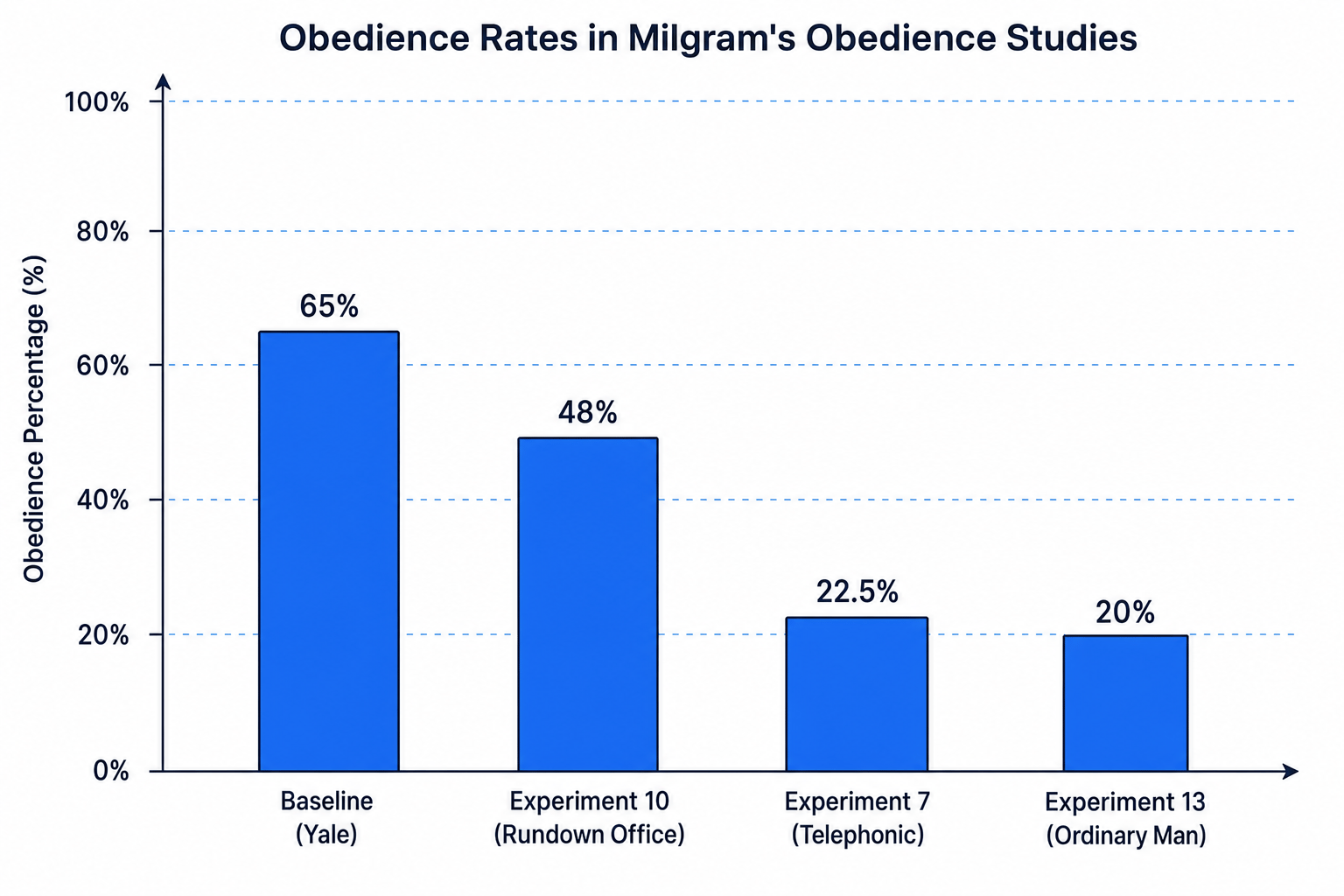
Stanley Milgram’s baseline obedience study (1963) shocked the scientific community by showing that 65% of ordinary American men would deliver a fatal 450-volt shock to an innocent stranger simply because an authority figure in a lab coat told them to.
However, obedience is not a fixed trait. To understand what specific environmental forces drive this behavior, Milgram conducted several variation studies. By systematically altering a single variable at a time, he demonstrated how specific situational factors can either reinforce obedience or encourage dissent.
What you'll learn
- How three of Milgram's variation studies (Experiments 7, 10, and 13) were conducted.
- How situational factors (proximity, legitimacy of location, and status of authority) influence obedience rates.
- How to use quantitative data to analyze shifts in obedience and dissent.
- How to evaluate these variations for your Edexcel exam using AO1, AO2, and AO3 skills.
Key Terms
Before exploring the variations, we must define the core social processes at play.
Situational Factors
Features of the immediate physical or social environment (such as location, uniform, or physical distance) that influence how an individual behaves, rather than their internal personality traits (dispositional factors).
Dissent
Refusing to carry out an order from an authority figure. In Milgram’s paradigm, dissent is demonstrated when a participant stops pressing the shock switches and explicitly rebels against the experimenter's prods.
The Three Variations
In his original 1963 baseline study, the setup was designed to maximize obedience: it took place at prestigious Yale University, the experimenter was in the same room wearing a gray lab coat (high status), and the "learner" (victim) was in an adjacent room (low proximity).
To test the limits of this behavior, Milgram altered these situational variables. Milgram's variation studies (published in detail in his 1974 book) provide the exact empirical evidence needed to understand how these variables control human behavior.
1. Experiment 7: Telephonic Instructions (Proximity)
In this variation, Milgram tested the effect of physical proximity of the authority figure on obedience.
- The Setup: The experimenter gave the initial instructions face-to-face, but then left the laboratory and administered all subsequent orders and prods over the telephone from another room.
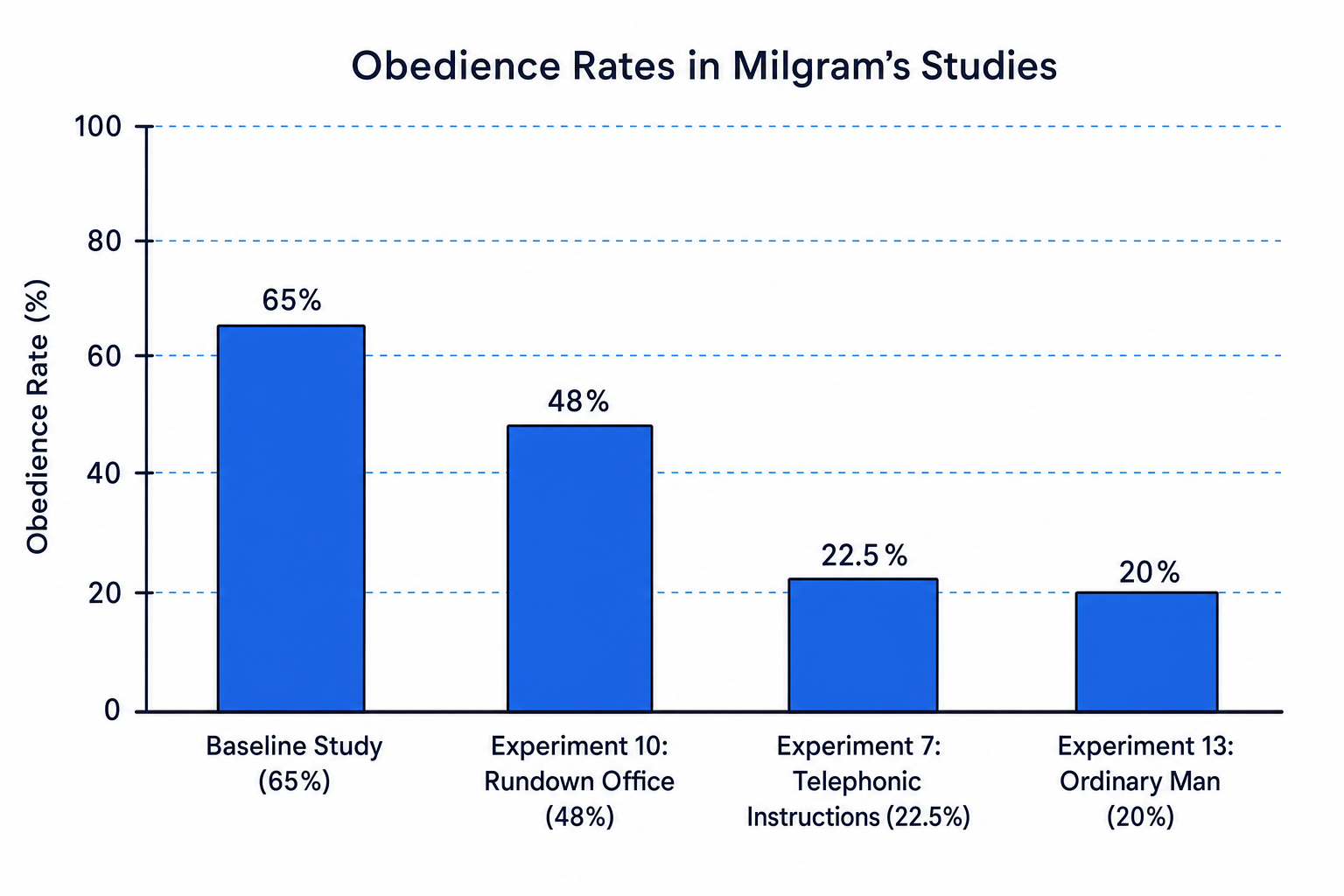
- The Results: Obedience dropped sharply from 65% in the baseline study to 22.5%.
- Dissent and Deception: Interestingly, many participants did not openly defy the experimenter. Instead, they engaged in passive resistance: they pretended to obey by administering the lowest shock level (15V) while telling the experimenter over the phone that they were increasing the shocks as instructed.
- Psychological Explanation: When the authority figure is physically distant, the immediate psychological pressure (or "strength" in terms of Social Impact Theory) is reduced, making it easier for the participant to slip back into an autonomous state where they feel personally responsible for their actions.
The Proximity Effect
Physical proximity increases the impact of social pressure. When an authority figure is physically distant, the psychological cost of dissent drops, allowing participants to disobey or subvert instructions.
2. Experiment 10: Rundown Office Block (Legitimacy of Location)
In the baseline study, participants frequently mentioned that the prestige of Yale University gave them confidence in the safety and integrity of the experiment. Milgram wanted to see if the "status" of the institution acted as a source of legitimacy.
- The Setup: Milgram moved the laboratory setup to a sparse, slightly rundown office block in Bridgeport, Connecticut. The study was presented as being conducted by "Research Associates of Bridgeport," a fictional private commercial research firm. There was no visible connection to Yale University.
- The Results: Obedience dropped to 48%.
- Psychological Explanation: While 48% is still a very high proportion of participants administering maximum shocks, the reduction from 65% shows that a prestigious setting lends institutional authority and scientific legitimacy to the researcher. In a rundown office block, the legitimacy of the situation is diminished, which encourages cognitive conflict and dissent.
Confusing 'No Authority' with 'Low Legitimacy'
Do not assume that moving to a rundown office block eliminated obedience completely. At 48%, nearly half of the participants still obeyed. This shows that the experimental setup itself (the "demand characteristics" of a laboratory environment) still carries a high level of scientific authority, even if the location is unimpressive.
3. Experiment 13: Ordinary Man Gives Orders (Authority Status)
To determine whether obedience is driven by the content of the commands or the status of the person giving them, Milgram removed the legitimate authority figure.
- The Setup: This variation required a complex staging process. The legitimate experimenter (in a lab coat) explained the task as usual but was then called away by an orchestrated phone call. Before leaving, he instructed the participant and a second "participant" (actually a confederate) to continue recording the learner's responses. Crucially, the experimenter did not tell them what shock levels to use. Once the experimenter left, the accomplice/confederate (the "ordinary man") suggested a system of increasing the shock level by one step each time the learner made a mistake.
- The Results: Obedience dropped drastically to 20%.
- Psychological Explanation: Because the person giving the orders had no legitimate authority (no scientific credentials, no uniform, and no institutional backing), participants did not make an agentic shift. They perceived the "ordinary man" as a peer, meaning they did not feel obliged to surrender their moral autonomy to his commands.
Quantitative Analysis in Research Methods
Your Edexcel exam will regularly test your ability to work with quantitative data and perform research methods calculations based on key studies.
Comparing the mathematical differences between these conditions helps us evaluate the relative strength of different situational factors.
Calculating percentage decrease in obedience rates
In the Edexcel specification, you must be comfortable calculating percentage changes. Let us calculate the percentage decrease in obedience rates when shifting from the Baseline Yale study to Experiment 7 (Telephonic instructions).
-
Identify the two values:
- Baseline obedience rate (RbaselineR_{\text{baseline}}Rbaseline) = 65%
- Telephonic instructions obedience rate (RvariationR_{\text{variation}}Rvariation) = 22.5%
-
Calculate the absolute decrease: Subtract the variation rate from the baseline rate:
Absolute Decrease=65−22.5=42.5 \text{Absolute Decrease} = 65 - 22.5 = 42.5 Absolute Decrease=65−22.5=42.5 -
Calculate the percentage decrease: Divide the absolute decrease by the original baseline value, then multiply by 100 to convert to a percentage:
Percentage Decrease=42.565×100 \text{Percentage Decrease} = \frac{42.5}{65} \times 100 Percentage Decrease=6542.5×100 Percentage Decrease≈65.38% \text{Percentage Decrease} \approx 65.38\% Percentage Decrease≈65.38% -
State the final answer: The obedience rate decreased by approximately 65.38% when the physical presence of the experimenter was removed. This quantitative drop mathematically highlights the immense power of physical proximity as a situational factor.
Evaluating the Variations (AO3)
When writing essays on Milgram's variations, you need to balance descriptive detail (AO1) with rigorous critical evaluation (AO3).
Strengths
- High Internal Validity (Control of Variables): Milgram altered only one variable at a time (e.g., changing only the location or only the proximity of the experimenter) while keeping the standardized procedures, the cover story, and the "learner's" recorded protests identical. This allows for a confident establishment of cause-and-effect relationships between the situational variable and the level of dissent.
- Cross-Cultural Replication: These situational variables have been replicated across different cultures. For example, Miranda et al. (1981) found high levels of obedience in Spanish students, suggesting Milgram's findings on situational variables are not limited to American men.
Weaknesses
- Lack of Internal Validity (Deception & Suspicion): In Experiment 13 (Ordinary Man), the staging was highly artificial. Milgram himself admitted that many participants in this condition likely suspected that the situation was a setup, as the sudden departure of the main experimenter and the sudden suggestions of the "ordinary man" lacked realism. If they guessed the aim, their behavior may have been due to demand characteristics.
- Ethical Violations: Although the variations aimed to look at dissent, they still subjected participants to severe psychological distress (protection from harm). In Experiment 13, some participants had to watch the "ordinary man" take over the shock machine directly, which caused intense physical tension and ethical conflict.
Linking to Theories
Always link these variations back to the core social theories. Experiment 13 (Ordinary Man) directly supports Agency Theory because the lack of status symbols prevented an agentic shift. Experiment 7 (Telephonic) supports Social Impact Theory by proving that reducing the "immediacy" of the social source reduces their overall impact.
In the exam
- Be specific with numbers: When discussing variations, memorize the exact percentages (65% baseline, 22.5% Exp 7, 48% Exp 10, 20% Exp 13). Citing these exact figures is the easiest way to secure top-band AO1 marks.
- Focus on "dissent": The Edexcel specification explicitly highlights how these studies demonstrate situational factors that encourage dissent. Frame your essays around how changing these variables freed the participants to rebel, rather than just focusing on why they obeyed.
- Use the BPS Ethical Guidelines: If evaluating ethics, don't just say "it was unethical." Explicitly reference the modern British Psychological Society (BPS) principles (specifically protection from harm and deception) and discuss how Milgram attempted to manage this through comprehensive debriefing.
Check yourself
- Which variation yielded the absolute lowest rate of obedience, and why does this happen from a psychological perspective?
- What was the percentage of obedience when the study was moved to the rundown office block in Bridgeport?
- Why might Experiment 13 (Ordinary Man Gives Orders) suffer from lower internal validity than the baseline study?