Worked Example: AO2 Application
In the Edexcel exam, you will frequently be given a scenario and asked to apply your knowledge of psychological factors to explain the behaviors described.
Analyzing factors affecting obedience in a novel scenario
Scenario: At a busy airport in the UK, a trainee security guard named Maya is instructed by a senior security manager over a two-way radio to confiscate a bottle of medicine from an elderly passenger. Maya feels extremely uncomfortable doing this and hesitates. However, her colleague, David, is standing right next to her and immediately tells the passenger: "You have to hand it over, those are the rules." Maya then proceeds to take the medicine. Later, when interviewed, Maya explains that she always does what she is told by bosses because 'rules are rules and must never be broken', whereas David remarks that he only did it because he knew he would be blamed if anything went wrong.
Question: Using your knowledge of the factors affecting obedience, explain the behavior of Maya and David in this scenario (4 marks).
Step-by-Step Analysis:
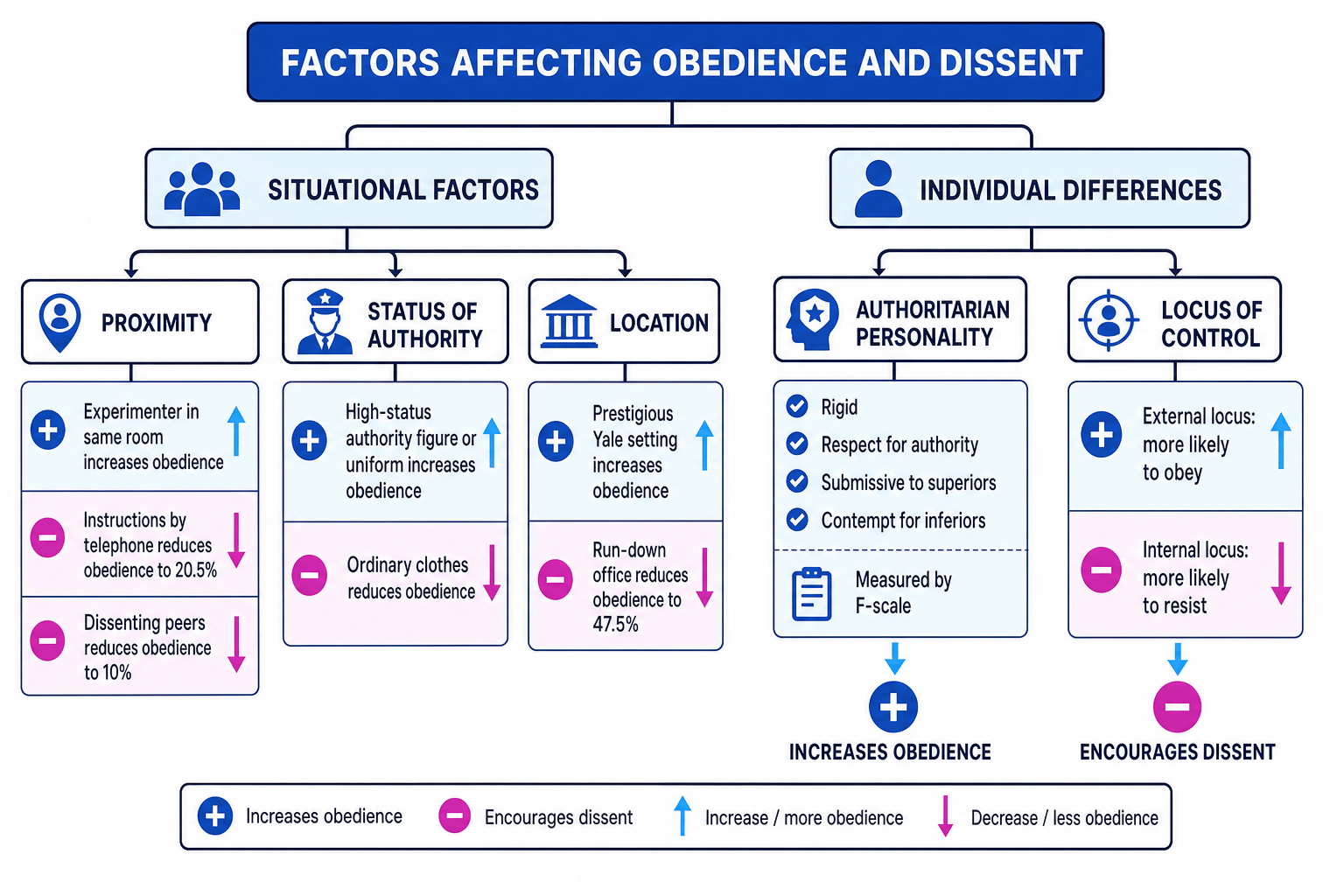
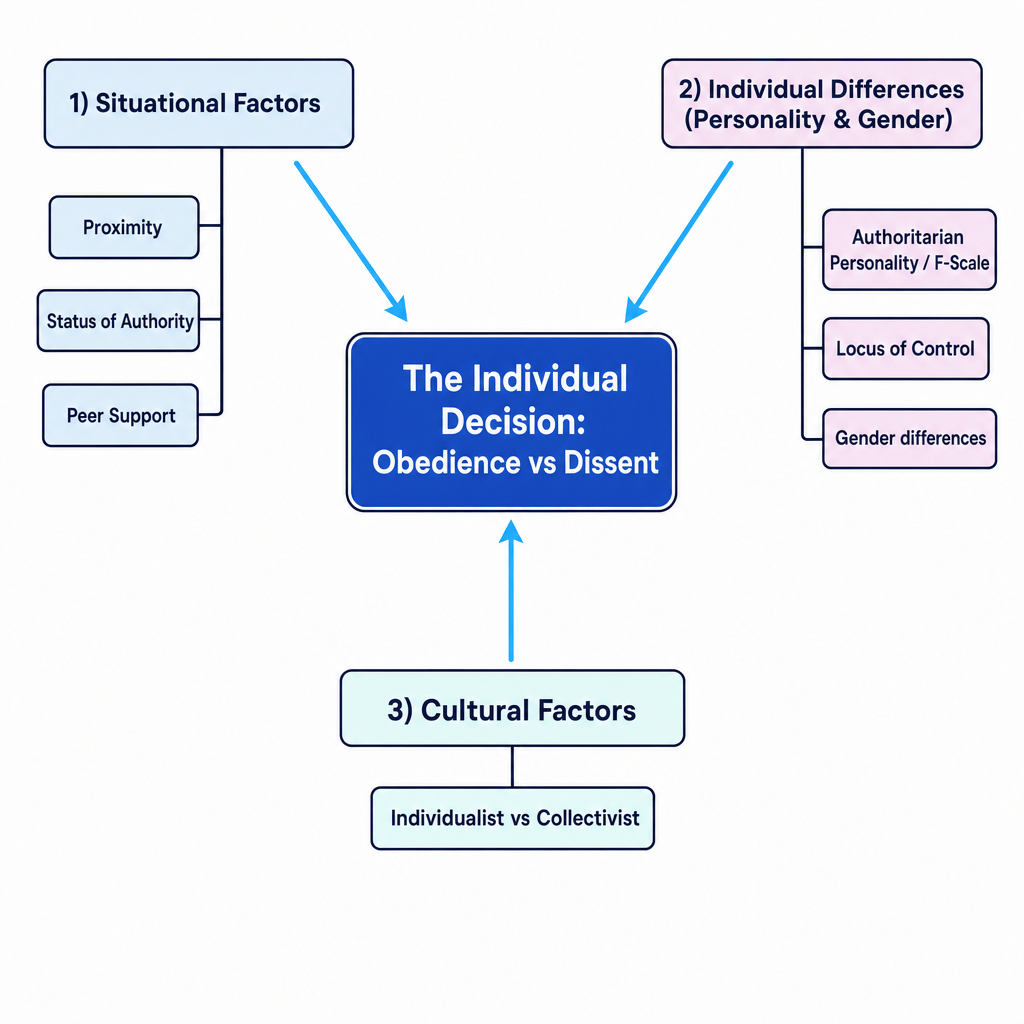
- Identify Maya’s individual factors (Personality): Look closely at Maya’s quote: "rules are rules and must never be broken". This rigid, hierarchical thinking is highly characteristic of an Authoritarian Personality. You should state this clearly, link it to her submissive behavior, and reference Adorno et al. (1950) or the F-Scale.
- Identify David’s individual factors (Locus of Control): David says he only complied because "he knew he would be blamed if anything went wrong." This shows he is highly focused on external consequences and personal liability, which indicates an External Locus of Control (Rotter, 1966). Because he attributes control to external factors (his boss blaming him), he enters the agentic state and obeys.
- Identify the situational factors at play: The senior manager is issuing commands over a "two-way radio" (which is a form of remote proximity). According to Milgram's Variation 7 (telephonic instructions), physical distance usually decreases obedience. However, Maya has a peer (David) standing "right next to her" who immediately models obedience. This acts as a powerful situational force overriding the remote authority distance.
- Synthesize into a structured, applied answer: Combine these elements directly, ensuring you use the names from the scenario (Maya, David) and do not just write a generic essay about Milgram.
Evaluation of Factors (AO3)
When evaluating these factors in an essay-style question, you must weigh their strengths, weaknesses, and real-world usefulness.
Strengths of Situational Explanations
- Extensive Empirical Support: Milgram's variations provide highly controlled, quantitative evidence for the impact of proximity, status, and peer support.
- Real-World Application: Situational factors help explain historical atrocities. For example, during the Holocaust, soldiers in police battalions were often placed in situations with high peer compliance and remote victims, making obedience more likely.
Weaknesses of Situational Explanations
- Overly Deterministic: Situational explanations often ignore free will. They struggle to explain why, even in Milgram's high-pressure baseline, 35% of participants resisted the situation and refused to obey.
- Methodological Criticisms: Milgram’s lab experiments lacked ecological validity (mundane realism) because giving electric shocks to a stranger in a lab is not a task people encounter in everyday life.
Strengths of Individual Explanations
- Fills the Gaps: Personality and cognitive factors (like Locus of Control) explain the individual variations that situational theories miss.
- Research Support: Elms and Milgram (1966) showed a clear, statistically significant correlation between high obedience and high scores on the F-scale.
Weaknesses of Individual Explanations
- Correlational Evidence: The link between personality (Authoritarianism) and obedience is correlational. We cannot definitively say that an authoritarian personality causes obedience; a third factor, such as lower levels of education, might cause both.
- F-Scale Biases: The F-Scale suffers from response bias (all questions are phrased in the same direction, meaning "yes-men" score highly regardless of their actual beliefs) and is politically biased toward the right wing.
Confusing Locus of Control with Agency Theory
Students often confuse "Internal Locus of Control" with the "Autonomous State." While they sound similar, they come from different theories!
- Locus of Control is a stable, cognitive personality trait (Rotter, 1966).
- Agency Theory (Milgram, 1974) is a situational/social explanation describing temporary behavioral states (Autonomous vs. Agentic). Make sure you do not mix up your terminology when writing about individual differences.
In the exam
- Highlight the "Command" Word: If the question asks you to "Discuss situational and individual factors...", you must split your essay roughly 50/50. Focusing entirely on Milgram's situational variations will prevent you from reaching the top mark bands.
- Signpost Your Factors: Start paragraphs clearly: "One individual difference that affects obedience is..." or "A key situational factor affecting obedience is...". This signals to the examiner that you are directly addressing the prompt.
- Use the "PEEL" Structure: State your Point, Explain the psychological theory (AO1), support it with Evidence (e.g., Elms & Milgram, 1966, or Rotter, 1966), and Link it back to the question by evaluating its strengths or limitations (AO3).
Check yourself
- Can you explain how the percentage of obedient participants changed when the experimenter gave orders via telephone compared to face-to-face?
- What are the defining characteristics of an individual with an Authoritarian Personality, and how is this measured?
- Why must we be cautious when comparing cross-cultural studies of obedience (such as comparing Milgram's US study to Shanab & Yahya's study in Jordan)?