Prejudice is one of the most significant social challenges we face. In A-Level Psychology, we look at prejudice not as an individual "personality flaw", but as a product of group dynamics. This topic explores two dominant social explanations: Social Identity Theory (SIT), which focuses on the psychological need for self-esteem, and Realistic Conflict Theory (RCT), which focuses on competition for tangible resources.
What you'll learn
- How categorising ourselves into groups automatically creates an "us versus them" mentality.
- How competition over scarce resources drives hostility and discrimination.
- How to evaluate and apply these theories to real-world prejudice and conflict resolution.
Core Definitions
Before diving into the theories, we must distinguish between three concepts that are often used interchangeably in everyday speech but have very precise meanings in psychology.
Prejudice, Stereotypes, and Discrimination
- Prejudice: A cognitive and affective attitude. It is a predefined, usually negative, judgment or opinion about an individual based solely on their membership in a specific social group.
- Stereotype: A cognitive schema. It is a fixed, oversimplified, and generalised belief about the characteristics, traits, or behaviours of a particular group of people.
- Discrimination: A behavioural action. It is the unfair or unequal treatment of an individual or group based on prejudice.
1. Social Identity Theory (Tajfel and Turner, 1979, 1986)
Social Identity Theory (SIT) proposes that a person’s sense of who they are is heavily constructed from their group memberships. Tajfel and Turner argued that mere categorisation—simply sorting people into groups—is enough to trigger prejudice. We do not need historical conflict, competition, or personal grievance to dislike an "out-group".
The Self-Esteem Hypothesis
The driving force behind Social Identity Theory is our basic psychological need for a positive self-concept. Because our personal identity is bound up with our social identity, we can boost our own self-esteem by making our group look better than other groups.
SIT explains this process through three distinct, consecutive mental stages:
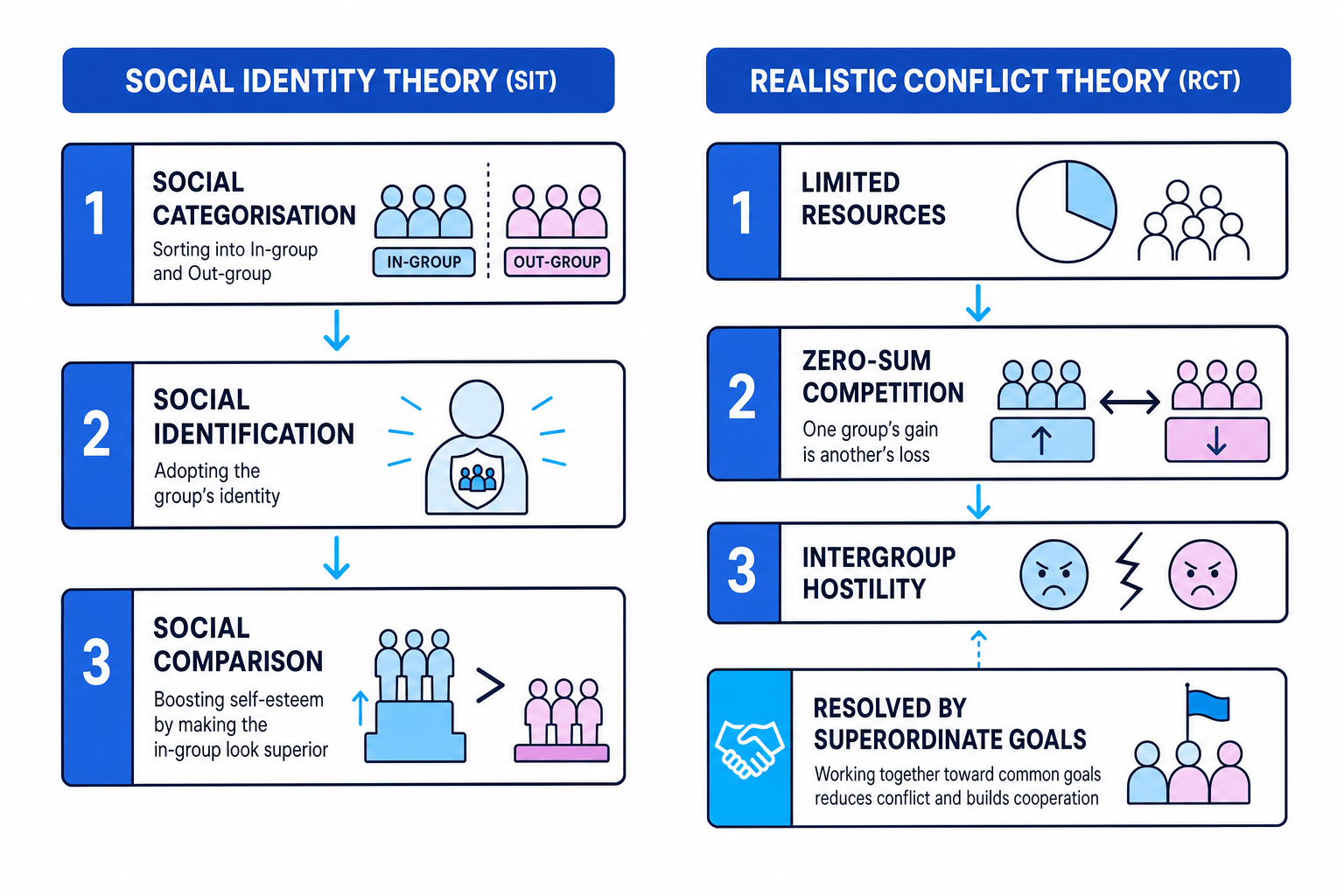
Stage 1: Social Categorisation
We automatically categorise ourselves and others into social groups to make sense of our complex social world. This divides the environment into:
- In-group ("Us"): The group to which we belong and identify with (e.g., your school, your nationality, your favourite football team).
- Out-group ("Them"): Any group to which we do not belong, perceived as different.
Stage 2: Social Identification
We adopt the identity of the in-group we have categorised ourselves into. We internalise the norms, values, and behaviours of this group. Our self-esteem becomes directly tied to the status and successes of the group. If the group does well, we feel proud; if the group is insulted, we feel personally attacked.
Stage 3: Social Comparison
To secure and maintain our self-esteem, we compare our in-group favourably against the out-group. This leads to two systematic biases:
- In-group favouritism: Viewing members of our own group as unique, positive, and deserving of praise or resources.
- Out-group denigration (or derogation): Viewing members of the out-group as all the same (out-group homogeneity), untrustworthy, and inferior.
By devaluing the out-group and elevating the in-group, we establish positive distinctiveness—the feeling that our group is both different from and superior to others, which directly inflates our personal self-esteem.
2. Realistic Conflict Theory (Sherif, 1966)
While SIT suggests that prejudice is purely cognitive and psychological, Muzafer Sherif argued that prejudice is rooted in real-world situational factors.
Realistic Conflict Theory (RCT)
Realistic Conflict Theory states that intergroup hostility and prejudice arise when two or more groups are in direct competition for scarce, valuable resources.
These resources could be physical and economic (such as land, jobs, money, or food) or social (such as status, political power, or prestige).
Negative Interdependence (Zero-Sum Games)
When resources are finite, a situation of negative interdependence occurs. This means that the groups are dependent on one another, but in a negative way: one group's gain is automatically another group's loss.
Musical Chairs
Think of Realistic Conflict Theory like a game of musical chairs. When there are ten players and ten chairs, everyone is relaxed. But the moment there are nine chairs for ten players, competition begins. The other players are no longer just "other people"—they are obstacles to your survival. In the same way, when jobs or university places are scarce, out-groups are perceived as threats, triggering hostility and prejudice.
Positive Interdependence and Superordinate Goals
Sherif did not just explain how prejudice starts; he explained how to fix it. If negative interdependence breeds conflict, then positive interdependence resolves it.
To reduce prejudice, groups must be placed in situations where they must work together to succeed. This is achieved through superordinate goals—tasks that are highly desirable to both groups but cannot be completed by one group alone.
Visualising the Two Theories
The diagram below compares how Social Identity Theory and Realistic Conflict Theory explain the development and resolution of prejudice.
Applying the Theories
In your exam, you will often face AO2 application questions where you must explain a real-world scenario using these theories.
Applying SIT and RCT to a school merger
Scenario: "East High School" and "West High School" are being merged into a single new school, "Academy One". On the first day, students from East High sit on one side of the common room, and students from West High sit on the other. Within a week, insults are being traded, and conflict erupts over who gets to use the single pool table in the common room.
Task: Apply both Social Identity Theory and Realistic Conflict Theory to explain the conflict and suggest how the headteacher can resolve it.
Step-by-step Application:
- Apply SIT's Social Categorisation and Identification: Explain that the students have automatically categorised themselves into distinct groups: the in-group ("East High") and the out-group ("West High"). They have strongly identified with their original schools, tying their self-esteem to these identities.
- Apply SIT's Social Comparison: Show how this psychological division leads to "in-group favouritism" (East High students seeing their peers as friendly and superior) and "out-group denigration" (viewing West High students as hostile and inferior) to boost their own group's status, resulting in the trading of insults.
- Apply RCT's Negative Interdependence: Identify the scarce resource in the scenario—the single pool table. Explain that this creates a zero-sum game (negative interdependence), where one group occupying the pool table means the other group loses out. This real-world competition escalates the cognitive prejudice into active conflict and discrimination.
- Formulate a solution using RCT's Superordinate Goals: To resolve the conflict, the headteacher must introduce positive interdependence. For example, they could organise an inter-school charity fundraiser where the students must work together in mixed teams to raise £1,000 for a local hospital. Because the goal is highly valued by both and impossible to achieve without joint effort, the boundary between "East" and "West" will dissolve into a single, cooperative "Academy One" identity.
Confusing the core triggers
A very common exam error is to write that Social Identity Theory involves competition for resources. It does not!
- In SIT, the only "competition" is a mental one for self-esteem.
- In RCT, the competition is physical and situational, fought over tangible resources. Keep these drivers strictly separate in your essays.
Evaluation (AO3)
To score top marks in your 8-mark or 12-mark essay questions, you must systematically evaluate the strengths and weaknesses of both explanations.
Evaluating Social Identity Theory
Strengths
- Empirical Support from Minimal Group Studies: Tajfel (1970) conducted laboratory experiments with schoolboys. He placed them into groups based on trivial criteria (such as whether they overestimated or underestimated dots on a screen, or whether they preferred paintings by Klee or Kandinsky). When asked to distribute points (convertible to cash) to other boys, they consistently awarded more points to members of their own in-group, even though they had never met them and gained no personal financial benefit. This strongly supports the claim that mere categorisation is sufficient to trigger in-group favouritism.
- Practical Application: Understanding that categorization leads to prejudice has helped psychologists design interventions. For example, the Common Ingroup Identity Model suggests that if we can get people to categorise themselves at a broader level (e.g., viewing themselves not as "British" vs "French" but as "Europeans" or simply "Humans"), prejudice will drop.
Weaknesses
- Low Ecological Validity in Supporting Research: Tajfel’s studies took place in highly controlled laboratory settings. Assigning points to anonymous strangers on a matrix paper is highly artificial and does not reflect the real-life hostility, violence, and deep-seated historical prejudice seen in the real world.
- Reductionist Approach: SIT reduces complex social and historical prejudices down to basic cognitive processes. It completely ignores individual differences, such as personality. For instance, individuals with an Authoritarian Personality are far more likely to display out-group prejudice than others, regardless of whether categorisation has occurred.
Evaluating Realistic Conflict Theory
Strengths
- High Ecological Validity in Supporting Research: RCT is strongly supported by Sherif’s (1954/1961) classic Robbers Cave Experiment. Because the study was conducted in a naturalistic summer camp setting with boys who believed they were attending a normal camp, their behaviour was natural. The introduction of competitive games (like tug-of-war for a brass trophy) directly led to severe in-group solidarity and aggressive out-group hostility (such as burning the other group's flag), validating RCT's core claims.
- Real-World Utility (Superordinate Goals): The theory offers a highly effective, practical mechanism for resolving conflict. This has been applied successfully in classrooms using Aronson’s Jigsaw Classroom technique, where students of different ethnic backgrounds are given unique pieces of a topic and must cooperate to pass their exams. This has been shown to reduce racial prejudice and improve academic performance.
Weaknesses
- Methodological Issues with Sherif’s Study: The boys in the Robbers Cave study were carefully selected to be white, middle-class, 11-year-old Protestants from stable, two-parent homes. This means the sample lacks population validity; we cannot easily generalise these findings to females, different cultures, or adult groups who may respond to competition differently.
- Cannot Explain Prejudice in the Absence of Competition: RCT fails to explain why prejudice exists against minority groups who do not pose any economic or social threat. In these instances, there is no realistic competition for resources, meaning Social Identity Theory (the psychological need for distinctiveness) provides a much more complete explanation.
Essay Structure Hint
When writing a comparative essay, use "conjunctions of contrast" (e.g., In contrast, On the other hand, Conversely) to explicitly link your paragraphs. For instance: "While Social Identity Theory argues that cognitive categorisation alone is enough to spark prejudice, Realistic Conflict Theory conversely argues that physical, competitive circumstances must be present." This secures high marks for structure and coherence.
In the exam
- Define your terms immediately: If an essay question asks you to discuss or evaluate explanations of prejudice, start by briefly defining what prejudice actually is (an attitude) and how it differs from discrimination (a behaviour). This shows the examiner you have excellent psychological clarity.
- Be specific with Tajfel and Sherif: When using their studies as AO3 evidence, make sure you state the year (Tajfel, 1970; Sherif, 1954/1961) and clearly explain how the findings support or challenge the theory. Do not just describe the study; link it directly back to the concept.
- Use the correct terminology for statistics and research methods: If you evaluate Sheris's study, mention that it was a field experiment. If you discuss the reliability of Tajfel's laboratory study, refer to its standardised procedures.
- Balance your essay: If the question is a broad "Discuss explanations of prejudice" (usually 12 marks in the full A-Level), aim to split your time and detail 50/50 between SIT and RCT, evaluating both.
Check yourself
- Can you explain the difference between Social Identification and Social Comparison?
- What is the difference between negative interdependence and positive interdependence in Realistic Conflict Theory?
- Why does Tajfel's "minimal group" paradigm support Social Identity Theory rather than Realistic Conflict Theory?
