What you'll learn
- How memory span develops from childhood into adolescence, including Sebastián and Hernández-Gil (2012).
- How dyslexia can affect working memory and learning.
- How Alzheimer’s disease affects memory in older adulthood.
- How to turn developmental memory content into AO1, AO2 and AO3 for essays.
Why developmental psychology matters in memory
Developmental psychology is the study of how people change across the lifespan. In this sub-topic, you are looking at how memory is not fixed: it changes with age, education, brain development, learning differences and neurodegenerative illness.
For Edexcel 9PS0, the specification says developmental psychology in memory can include issues such as childhood memory span, dyslexia and Alzheimer’s disease. Your teacher may focus more on one, but understanding all three gives you flexible examples for AO2 and AO3.
The basic memory ideas you need first
Memory span
Memory span
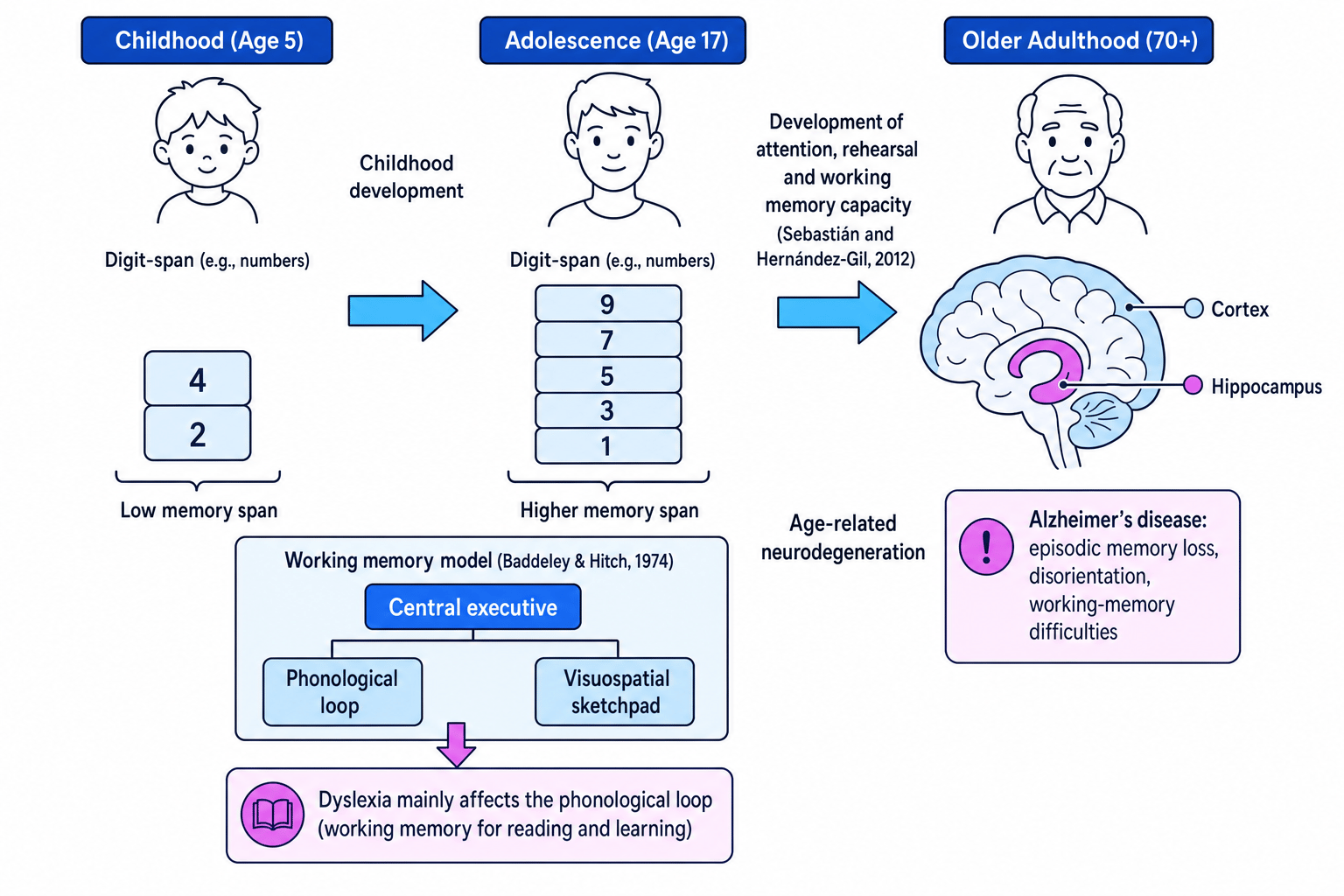
Memory span is the amount of information a person can hold in short-term or working memory at one time, often measured using tasks such as digit span, where someone repeats back a sequence of numbers.
A young child might manage a short sequence such as “4, 2”, while an older child or adolescent may manage a longer sequence. Memory span is useful because it gives psychologists a fairly simple way to compare memory capacity across ages.
However, memory span is not just about “storage space”. It is also affected by attention, rehearsal, language ability, processing speed and confidence.
Working memory
Working memory
Working memory is an active memory system that temporarily holds and manipulates information while you are thinking, learning or solving a problem.
Baddeley and Hitch’s working memory model (1974) is especially useful here. It includes:
- The central executive, which controls attention and allocates mental resources.
- The phonological loop, which deals with speech-based and sound-based information.
- The visuospatial sketchpad, which deals with visual and spatial information.
- The episodic buffer, added by Baddeley in 2000, which integrates information from different sources.
This matters because developmental issues often affect particular parts of working memory rather than “memory” as one single thing.
Memory is not one ability
For essays, avoid treating memory as one simple store. Developmental psychology shows that different memory systems can develop, struggle or decline in different ways.
Childhood memory span: Sebastián and Hernández-Gil (2012)
Sebastián and Hernández-Gil (2012) discussed developmental issues in memory span development. Their key point for this specification is that memory span is relatively low at around 5 years old, then develops across childhood and adolescence, up to around 17 years old.
This means that a 5-year-old and a 17-year-old should not be expected to process the same amount of information in the same way. The older adolescent is likely to have better attention control, more effective rehearsal strategies and greater working memory capacity.
Why memory span improves with age
Memory span may increase because children become better at:
- Rehearsal: repeating information mentally to keep it active.
- Chunking: grouping separate pieces of information into meaningful units.
- Selective attention: focusing on relevant information and ignoring distractions.
- Processing speed: dealing with information more quickly.
- Language development: using verbal labels to support memory.
For example, a younger child may hear “Put your book away, collect your coat, line up by the door and remember your lunchbox” as four separate demands. An older child may organise this as one routine: “get ready to leave”.
Adapting instructions for a younger child
A teacher wants a 5-year-old to complete four classroom actions: close the book, put it in the tray, collect a coat and stand by the door.
-
Compare the task demand with the child’s likely memory span: four separate verbal instructions may exceed the working memory capacity of a young child.
-
Identify the memory process being overloaded: the phonological loop must hold the spoken instructions, while the central executive must control the order of actions.
-
Reduce the load by chunking the task: give two instructions first, then the next two, or use visual prompts so the child does not have to hold everything verbally.
AO3 evaluation of childhood memory-span research
A strength is that memory span can be measured using controlled tasks such as digit span. This makes age comparisons more objective and replicable.
A weakness is that many memory-span tasks are artificial. Repeating digits is not the same as remembering a story, a route through school or instructions during a noisy lesson. This reduces ecological validity.
Another issue is that age differences may not be caused only by biological development. Schooling, language background, motivation, anxiety and cultural expectations may also affect performance.
There are also ethical considerations. When researching children, psychologists must follow the BPS Code of Ethics and Conduct, including parental consent, the child’s assent, protection from harm, the right to withdraw, confidentiality and debriefing in age-appropriate language.
Assuming younger children have no memory
Younger children do have memory. The developmental issue is that their memory span and control strategies are usually less developed than those of older children and adolescents.
Dyslexia, memory span and working memory
Dyslexia
Dyslexia is a neurodevelopmental learning difference that mainly affects accurate and fluent word reading and spelling. It is often linked to difficulties with phonological processing, which means processing the sounds of language.
Dyslexia is not a sign of low intelligence. Many dyslexic children have strong reasoning, creativity and problem-solving skills. The issue is that particular memory and language processes can make reading and writing more effortful.
How dyslexia affects working memory
Dyslexia can affect children’s memory span and working memory, especially verbal working memory. In terms of Baddeley and Hitch’s working memory model, the phonological loop is particularly relevant because it temporarily holds sound-based information.
This can affect learning because reading often requires a child to:
- Hold letter sounds in mind.
- Blend sounds into words.
- Remember the start of a sentence while reading the end.
- Follow multi-step spoken instructions.
- Hold spellings in mind while writing.
- Keep track of meaning while decoding words.
If decoding takes up too much working memory capacity, there is less capacity left for comprehension.
Explaining why reading comprehension drops
A dyslexic child can understand a story when it is read aloud, but struggles to answer questions after reading it independently.
-
Identify the memory demand: independent reading requires the child to decode words, hold sounds in the phonological loop and maintain sentence meaning in working memory.
-
Apply working memory theory: if decoding is effortful, the central executive must allocate more attention to word recognition rather than comprehension.
-
Explain the outcome: the child may read the words but have reduced working memory capacity left to integrate ideas, so comprehension appears weaker than their actual understanding.
Learning implications
In school, dyslexia-related working memory difficulties may affect:
- Reading fluency.
- Spelling accuracy.
- Copying from the board.
- Mental arithmetic.
- Note-taking.
- Remembering homework instructions.
- Timed assessments.
Useful support can include phonics teaching, overlearning, assistive technology, extra time, written instructions, coloured overlays if helpful for that individual, and breaking tasks into smaller steps.
AO3 evaluation of dyslexia explanations
A strength is that the working memory explanation has strong practical value. It helps teachers understand why dyslexic pupils may need reduced verbal load, extra time or multisensory teaching.
A weakness is that dyslexia is heterogeneous, meaning it does not look the same in every child. Some children may have more difficulty with rapid naming, visual stress, attention or processing speed. So it is too simplistic to explain every case only through the phonological loop.
There is also a risk of labelling. If a child is described only in terms of “deficits”, this may harm self-esteem. Ethical practice in schools should protect confidentiality, avoid stigma and focus on reasonable adjustments.
Calling dyslexia a memory disorder
Dyslexia is not simply a memory disorder. It is a learning difference often linked to phonological processing and working memory, but its effects vary between individuals.
Alzheimer’s disease and memory in older adulthood
Alzheimer’s disease
Alzheimer’s disease is a progressive neurodegenerative disorder and a common cause of dementia. It involves gradual deterioration in brain functioning, especially affecting areas important for memory such as the hippocampus and cortex.
Dementia is a broader syndrome involving decline in cognitive functioning that interferes with everyday life. Alzheimer’s disease is one cause of dementia.
How Alzheimer’s affects memory
Alzheimer’s often affects episodic memory early on. Episodic memory is memory for personally experienced events, such as what you had for breakfast or where you went yesterday. Tulving (1972) distinguished episodic memory from semantic memory, which is memory for facts and general knowledge.
The hippocampus is important for forming new episodic memories. If this system deteriorates, a person may struggle to lay down new memories, even if older memories are initially more accessible.
Common memory effects include:
- Forgetting recent conversations or appointments.
- Repeating questions.
- Misplacing objects.
- Becoming disoriented in familiar places.
- Difficulty learning new information.
- Later difficulties with language, semantic knowledge and recognition of people.
Working memory may also be affected, making it harder to follow conversations, make decisions or complete everyday tasks in sequence.
Distinguishing Alzheimer’s from everyday forgetting
An older adult occasionally forgets where they put their glasses, but another older adult repeatedly forgets recent meals, gets lost near home and struggles to follow familiar routines.
-
Compare the pattern of forgetting: occasional misplaced objects can happen in normal ageing, but repeated recent-memory failure and disorientation suggest a more serious impairment.
-
Consider functional impact: Alzheimer’s is more likely when memory problems interfere with independence, safety and everyday routines.
-
Link to memory systems: difficulty forming new episodic memories is consistent with damage to brain systems such as the hippocampus, which are affected in Alzheimer’s disease.
Real-world impact
Alzheimer’s can have major effects on the individual and their family. Memory loss may reduce independence, increase vulnerability and create emotional distress. Carers may need to manage medication, appointments, finances, meals and safety.
Psychological support can include memory aids, routines, labelled environments, reminiscence work, cognitive stimulation and carer education. These applications show why developmental memory research matters beyond the classroom.
AO3 evaluation of Alzheimer’s explanations
A strength is that Alzheimer’s has clear biological support. Brain imaging and clinical research show deterioration in areas involved in memory, especially medial temporal structures such as the hippocampus.
A weakness is that memory decline varies between individuals. Education, cognitive reserve, physical health, social support and co-existing conditions can affect how symptoms appear and progress.
Another limitation is that lab-based memory tests may not fully capture the everyday experience of living with Alzheimer’s. Remembering a word list is different from remembering whether you have taken medication or how to get home.
Ethically, research with people who have Alzheimer’s requires extra care. Psychologists must consider informed consent, capacity to consent, right to withdraw, distress, confidentiality, protection from harm and debriefing. If capacity is reduced, researchers may need appropriate consultee or family involvement, while still respecting the person’s dignity.
A useful lifespan comparison
Childhood memory span generally develops upwards, dyslexia can create specific working-memory barriers during learning, and Alzheimer’s can cause memory decline in older adulthood. That gives you a clear lifespan structure for essays.
Pulling it together for essay answers
AO1: describe clearly
For AO1, define the developmental issue and link it to memory systems. For example:
- Sebastián and Hernández-Gil (2012): memory span is low at 5 years old and develops up to around 17 years old.
- Dyslexia: can affect phonological processing, memory span and working memory, especially learning through reading and writing.
- Alzheimer’s disease: damages memory in older adulthood, especially episodic memory and the formation of new memories.
AO2: apply to scenarios
AO2 usually means using the theory to explain a person’s behaviour. Look for the age and the memory demand.
A 5-year-old forgetting a long instruction is different from a dyslexic 12-year-old struggling to decode text, and different again from an older adult repeatedly forgetting recent events.
AO3: evaluate thoughtfully
Strong evaluation goes beyond “strength” and “weakness”. You can discuss:
- Evidence quality: controlled memory tasks are objective but may lack ecological validity.
- Individual differences: not all children, dyslexic learners or older adults show the same pattern.
- Methodology: cross-sectional research can compare age groups quickly but cannot prove individual developmental change over time.
- Ethics: children and people with dementia require careful protection, consent procedures and debriefing.
- Application: findings can improve teaching, diagnosis, support plans and care.
In the exam
-
Use the wording of the question: if it asks about “developmental psychology in memory”, keep linking back to age-related change, learning differences or older-adult decline.
-
Build paragraphs with AO1 plus AO2 plus AO3: describe the issue, apply it to the scenario, then evaluate evidence, ethics or usefulness.
-
Avoid vague phrases like “memory gets worse”. Specify the memory system, such as memory span, phonological loop, working memory or episodic memory.
Check yourself
- How does memory span typically change between age 5 and age 17, according to Sebastián and Hernández-Gil (2012)?
- Why might dyslexia affect reading comprehension through working memory?
- What is the difference between normal everyday forgetting and memory impairment associated with Alzheimer’s disease?
