What you'll learn
- How cognitive psychologists design experiments, including lab and field experiments.
- How to choose hypotheses, designs, controls, descriptive statistics and graphs.
- How to make decisions using non-parametric inferential tests.
- How methods link to cognitive studies, key questions and your practical investigation.
Why research methods matter in cognitive psychology
Cognitive psychology studies internal mental processes such as memory, attention and thinking. Because these processes cannot be observed directly, psychologists use carefully designed tasks as measurable evidence.
For example, Baddeley (1966) used a laboratory experiment to test how acoustic similarity affected short-term memory. Bartlett (1932) used recall tasks to study reconstructive memory. Tulving (1972) distinguished episodic and semantic memory, while Scoville and Milner (1957) studied Henry Molaison, known as HM, after brain surgery affected his memory. Sebastián and Hernández-Gil (2012) used digit span tasks to investigate working memory development.
Methods support AO1, AO2 and AO3
In essays, methods help you describe research clearly, apply it to scenarios and practical work, and evaluate studies for control, validity, ethics and usefulness.
Experiments: testing cause and effect
Experiment
An experiment is a study where the researcher manipulates one variable to see whether it causes a change in another variable.
The independent variable, or IV, is the factor the researcher changes. The dependent variable, or DV, is the outcome the researcher measures.
A laboratory experiment takes place in a controlled setting, often using standardised tasks. This usually gives strong control and internal validity. A field experiment takes place in a more natural setting. This may improve ecological validity, but control is usually weaker.
Operationalising variables
To operationalise a variable means defining exactly how it will be manipulated or measured. “Memory” is too vague; “number of correctly recalled words from a 12-word list” is operationalised.
Hypotheses
An experimental hypothesis predicts that the IV will affect the DV. A null hypothesis predicts no significant effect or difference.
A directional hypothesis, also called one-tailed, predicts the direction of the effect. A non-directional hypothesis, also called two-tailed, predicts an effect but not the direction.
Writing hypotheses for an acoustic-similarity study
- Choose the IV: word-list type, operationalised as acoustically similar words compared with acoustically dissimilar words.
- Choose the DV: memory performance, operationalised as the number of words correctly recalled.
- Write a directional experimental hypothesis: participants will recall fewer acoustically similar words than acoustically dissimilar words.
- Write the null hypothesis: there will be no significant difference in the number of acoustically similar and acoustically dissimilar words recalled.
Experimental designs and control
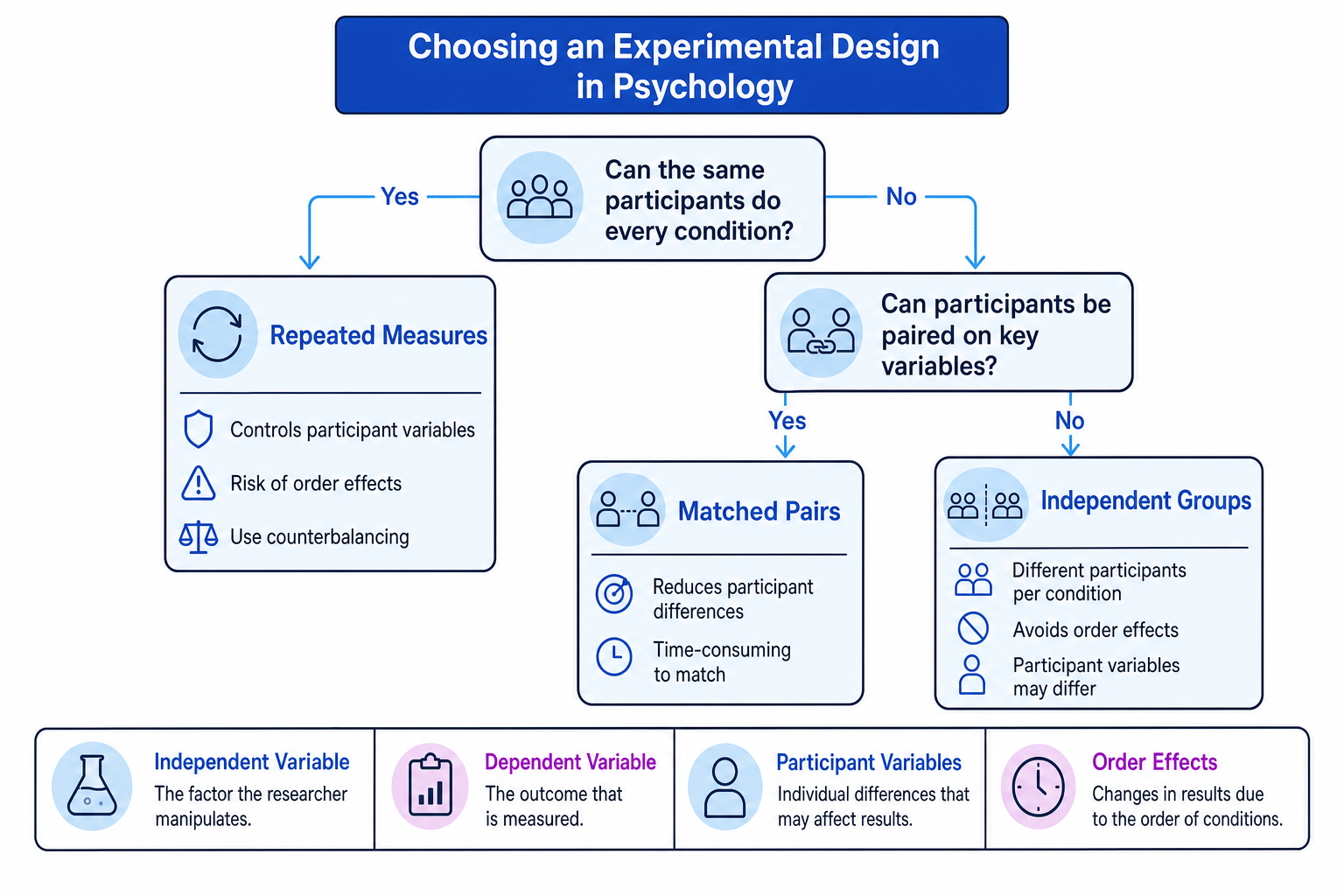
A repeated measures design uses the same participants in all conditions. This controls participant variables, but can create order effects, where performance changes because of practice, fatigue or boredom.
An independent groups design uses different participants in each condition. This avoids order effects, but participant variables may differ between groups.
A matched pairs design pairs participants on relevant characteristics, such as age or memory ability, then allocates one from each pair to each condition.
This decision tree summarises how to choose between the main experimental designs.
Randomisation, counterbalancing and variables
Randomisation means using chance to allocate participants, tasks or order of materials. Counterbalancing means varying the order of conditions, such as half doing condition A then B, and half doing B then A.
Situational variables are features of the environment, such as noise or lighting. Participant variables are individual differences, such as age, motivation or memory ability.
An extraneous variable is any unwanted variable that could affect the DV. A confounding variable is more serious: it changes systematically with the IV, so you cannot tell whether the IV caused the result.
Extraneous is not always confounding
A distracting noise during one participant’s trial is an extraneous variable. If all participants in one condition hear the noise and none in the other condition do, it becomes a confounding variable.
Objectivity, reliability and validity
Objectivity means results are not affected by the researcher’s personal opinion. Standardised instructions and clear scoring systems help.
Reliability means consistency. A reliable memory test should give similar results under similar conditions.
Validity means the study measures what it claims to measure. Internal validity asks whether the IV caused the DV. Ecological validity asks whether findings apply to real-life settings. Predictive validity asks whether a measure predicts future or relevant behaviour.
Demand characteristics are cues that reveal the study aim, causing participants to change behaviour. Experimenter effects occur when the researcher unintentionally influences participants. Controls include standardised instructions, blind procedures, randomisation and carefully matched materials.
Analysing quantitative data
Quantitative data are numerical data, such as recall scores. You can summarise them using:
- Mean: add scores and divide by number of scores.
- Median: middle score when ordered.
- Mode: most common score.
- Range: highest score minus lowest score.
- Standard deviation: how spread out scores are around the mean.
- Percentages: useful for comparing proportions.
A frequency table shows how often each score or category occurs. A bar chart is used for separate categories or conditions. A histogram is used for continuous data grouped into intervals, with bars touching.
Summarising recall scores
A participant group has recall scores of 4, 5, 5, 6 and 10.
- Calculate the mean: xˉ=4+5+5+6+105=6\bar{x}=\frac{4+5+5+6+10}{5}=6xˉ=54+5+5+6+10=6.
- Find the median by ordering the scores; the middle score is 5.
- Find the mode: 5 occurs most often.
- Calculate the range: 10−4=610-4=610−4=6.
- Interpret spread: the score of 10 increases the spread, so the standard deviation would be larger than for a tightly clustered set such as 5, 5, 6, 6, 6.
Inferential statistics: deciding significance
Inferential statistics help decide whether a result is likely to be genuine or due to chance. In Edexcel cognitive practical work, you normally use a non-parametric test of difference.
Non-parametric tests are used when data do not meet assumptions such as normal distribution, or when data are ordinal, skewed or from small samples.
Use:
- Mann-Whitney U for a difference between two unrelated groups.
- Wilcoxon signed-ranks for a difference between two related conditions.
- Spearman’s rho for a correlation between two ranked variables.
- Chi-square for an association between categories.
The usual significance level is p≤.05p \le .05p≤.05, meaning a 5 percent risk of accepting a chance result as significant. p≤.10p \le .10p≤.10 is more lenient. p≤.01p \le .01p≤.01 is stricter.
The observed value is calculated from your data. The critical value comes from a table, using sample size, significance level and whether the test is one-tailed or two-tailed. Always check the table rule: for Mann-Whitney U and Wilcoxon, significance often requires the observed value to be less than or equal to the critical value.
This diagram shows why one-tailed and two-tailed decisions affect the critical region.
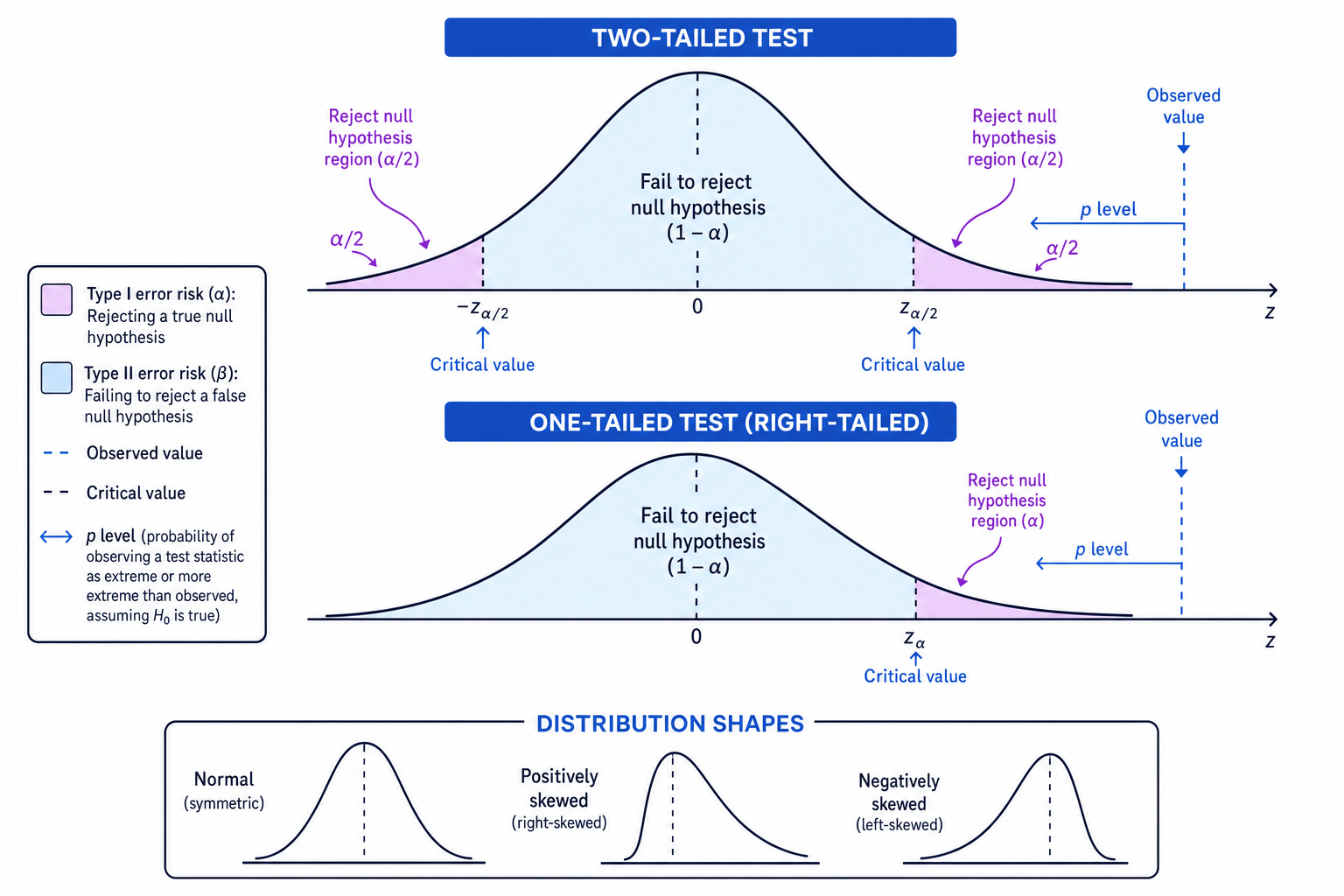
A Type I error is rejecting a true null hypothesis. This is more likely if the significance level is too lenient. A Type II error is failing to reject a false null hypothesis. This is more likely if the significance level is too strict or the sample is too small.
Interpreting a Wilcoxon result
A repeated measures memory study predicts that recall will be lower in a dual-task condition. The observed Wilcoxon value is 10. The critical value at p≤.05p \le .05p≤.05 for a one-tailed test is 14.
- Choose the test: the same participants completed both conditions, so Wilcoxon signed-ranks is appropriate.
- Choose the tail: the prediction is directional, so use a one-tailed critical value.
- Compare values using the table rule: 10≤1410 \le 1410≤14, so the result is significant.
- Check direction: if recall scores are lower in the dual-task condition, reject the null hypothesis.
Case studies and qualitative data: HM
Case study
A case study is an in-depth investigation of one person, group or unusual situation, often using several types of evidence.
Henry Molaison, HM, had surgery to reduce severe epilepsy. Scoville and Milner (1957) found that after removal of medial temporal lobe structures, including the hippocampus, HM had severe anterograde amnesia. He could not form many new long-term memories, although some procedural memory remained. This supported the idea that memory is not one single system.
Case studies can gather qualitative data, such as interviews, observations and descriptions of behaviour. Thematic analysis involves identifying patterns or themes in this data.
Strengths include rich detail and insight into rare brain damage. Weaknesses include low generalisability, difficulty replicating the exact case, and possible problems with retrospective evidence. Ethically, researchers must consider consent, protection from harm, confidentiality and capacity to consent.
Key question: memory and dementia
A suitable key question is: How can psychologists’ understanding of memory help patients with dementia?
Cognitive psychology can inform real-world support. Tulving’s (1972) distinction between episodic and semantic memory suggests that different memory systems may need different support. Bartlett’s (1932) work on reconstructive memory reminds us that recall can be shaped by expectations and cues. Research on working memory, such as Baddeley and Hitch’s model, can guide the use of memory aids, simplified instructions and reduced dual-task demands.
Practical applications include reminder apps, labelled environments, spaced retrieval, errorless learning and routines supported by carers. Evaluation should consider individual differences, dignity, cost, and whether interventions improve everyday functioning rather than only test scores.
Your practical investigation
Your cognitive practical should be a laboratory experiment collecting quantitative data. Suitable examples include:
- A dual-task experiment investigating components of working memory.
- An acoustic-similarity experiment based on Baddeley (1966).
You need to make design decisions: sampling method, experimental design, operationalised IV and DV, controls, hypotheses, ethics, demand characteristics and experimenter effects.
Follow BPS Code of Ethics and Conduct principles: informed consent, no unnecessary deception, right to withdraw, protection from harm, confidentiality and debrief.
In the write-up:
- Procedure: say exactly what participants did, so the study could be replicated.
- Results: include descriptive statistics, an appropriate graph, and Mann-Whitney U or Wilcoxon.
- Discussion: conclude whether the hypothesis was supported, then evaluate strengths, weaknesses and improvements.
In the exam
- Link every method point to the scenario: name the IV, DV, design and control issue directly.
- For inferential testing, justify the test using design and data type, then compare observed and critical values using the table rule.
- In AO3, balance control against validity: lab studies may show cause and effect, but real-life memory may be messier.
Check yourself
- When would you choose Mann-Whitney U rather than Wilcoxon?
- What is the difference between an extraneous variable and a confounding variable?
- Why might HM’s case study be both highly useful and difficult to generalise?
