What you'll learn
- Why memory is not a perfect recording, and why people remember the same event differently.
- How processing speed can affect encoding, storage, and retrieval.
- How schemas guide the reconstructive nature of memory.
- Why autobiographical memory is highly personal and shaped by identity, emotion, and life experience.
The starting point: memory is active
In earlier memory content, you meet the idea that memory involves encoding, storage, and retrieval. This topic adds a key point: people do not all remember in the same way.
Two people can witness the same event, revise the same material, or hear the same story, yet later recall different details. This is because memory is influenced by individual differences in how information is processed and by the knowledge structures people already have.
Individual differences
Individual differences are the ways people vary from one another, such as in processing speed, age, expertise, culture, emotion, personality, mental health, or prior experience. In memory, these differences can affect what is noticed, encoded, stored, and later retrieved.
Memory is therefore better understood as an active cognitive process, not a camera-like copy of the world.
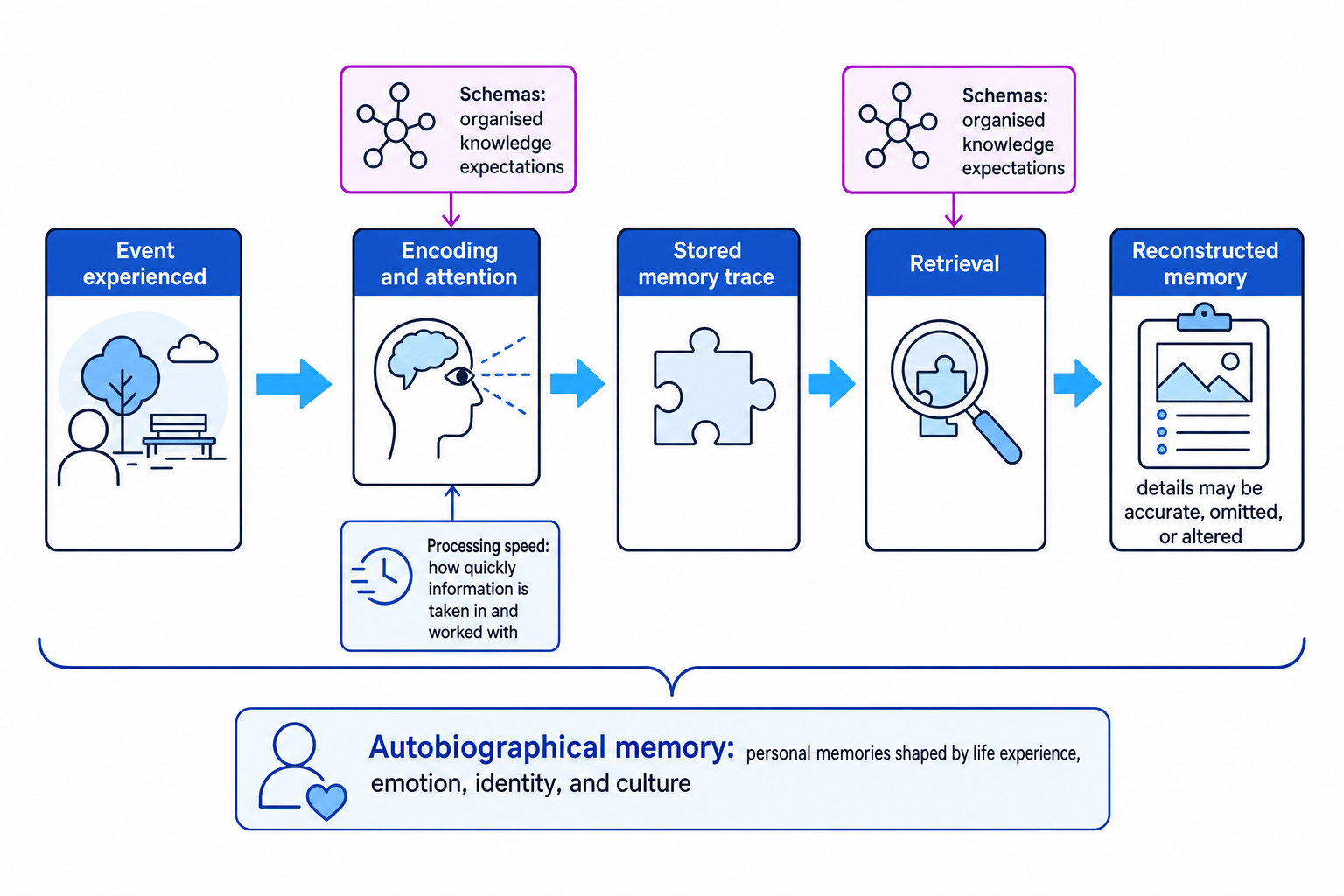
Processing speed and memory
Processing speed
Processing speed is how quickly a person can take in information, make sense of it, and carry out mental operations on it.
If processing speed is faster, a person may be able to encode more detail before the information disappears or changes. If processing speed is slower, the person may rely more on the overall meaning, or gist, rather than on precise details.
Processing speed matters especially when information is brief, complex, or fast-moving — for example, listening to rapid speech, watching a short event, or trying to remember several instructions at once.
How processing speed can affect memory
Processing speed may influence memory at several stages:
- Encoding: faster processing may allow more details to be registered.
- Working memory: faster mental operations may make it easier to hold and manipulate information.
- Retrieval: faster access to stored information may improve recall, especially under time pressure.
This links well to Baddeley and Hitch’s Working Memory Model, because active memory depends on mental processing, not just passive storage.
Processing speed affects what gets encoded
If information is presented quickly, people with slower processing speed may encode fewer details, meaning later recall may be less complete or more gist-based.
Applying processing speed to a memory scenario
Two students watch a short video of a classroom incident. The clip lasts only ten seconds. Later, one student recalls the sequence of actions accurately, while the other recalls only the general idea that “someone knocked something over”.
- The key condition is that the event was brief, so the students had limited time to encode details such as who moved first, where objects were, and what was said.
- A student with faster processing speed may register more of these details before the scene changes, creating a richer memory trace.
- A student with slower processing speed may encode the broad meaning of the event but miss specific details, so their later recall is more likely to be general or incomplete.
AO3: evaluating processing speed as an explanation
A strength of this explanation is that it helps explain why memory differences are not always due to “effort” or “motivation”. Someone may genuinely process information more slowly, especially under pressure.
However, processing speed is not the whole explanation. Poor recall might also be due to attention, anxiety, tiredness, lack of interest, or unfamiliarity with the material. This means psychologists must be careful not to assume that memory differences are caused by processing speed alone.
Overusing processing speed as a single cause
Do not write as if slower processing speed automatically means poor memory. It may increase the chance of weaker encoding, but memory is also affected by attention, rehearsal, schemas, emotion, and retrieval cues.
Schemas and reconstructive memory
Schema
A schema is an organised package of knowledge, expectations, and beliefs about a person, object, event, or situation.
For example, you may have a schema for a restaurant: being seated, reading a menu, ordering food, eating, paying, and leaving. This schema helps you understand what is happening without processing every detail from scratch.
Schemas are useful because they make thinking efficient. However, they can also distort memory because we may remember what we expected to happen, not exactly what happened.
Reconstructive memory
Reconstructive memory is the idea that recall involves actively rebuilding a memory using stored fragments, schemas, expectations, and current knowledge.
This means memory is not just retrieved; it is reconstructed. During recall, the brain may fill in gaps using what “usually” makes sense.
Bartlett’s research and schemas
A classic study linked to reconstructive memory is Bartlett (1932). He used a Native American folk story called The War of the Ghosts and asked British participants to recall it after delays.
Participants often changed the story to fit their own cultural expectations. Unfamiliar details were left out, altered, or made more familiar. For example, unusual supernatural elements were often rationalised.
Bartlett argued that memory is guided by schemas, so recall becomes a reconstruction rather than a perfect reproduction.
Common schema-based changes
There are three useful changes to know:
- Omission: leaving out unfamiliar or schema-inconsistent details.
- Rationalisation: changing strange details so they make more sense.
- Transformation: altering details to fit expectations or cultural knowledge.
Explaining a schema-based distortion
A participant sees a picture of an office containing a desk, chair, coffee mug, and a toy dinosaur. Later, they recall seeing books, even though no books were present.
- The participant likely has an office schema containing common items such as desks, chairs, computers, shelves, and books.
- At retrieval, the participant reconstructs the scene using both the actual memory trace and their office schema.
- Because books fit the office schema, the participant may falsely recall them, showing how schemas can create memory intrusions.
Schema evaluation shortcut
A balanced point is: schemas can distort memory, but they also help memory by organising information and making recall more efficient.
AO3: evaluating schema theory
A major strength is that schema theory explains everyday memory errors. People often remember the meaning of an event better than the exact wording or detail, which supports the idea of gist-based reconstruction.
Bartlett’s study also has good real-world relevance because stories, conversations, and cultural expectations are part of everyday memory. However, his method was less controlled than modern laboratory research. He did not use highly standardised procedures, and his sample was mainly British students, which limits generalisability.
There is also an important counterpoint: schemas do not only cause errors. Experts often remember information better because their schemas help them organise it. For example, a chess expert may remember a realistic chess board much better than a beginner because their chess schema gives the pieces meaning.
Autobiographical memory
Autobiographical memory
Autobiographical memory is memory for events and information from your own life. It includes personal experiences, facts about yourself, and memories linked to your identity.
Autobiographical memory is individual by nature because no two people have exactly the same life history. Even people who share an event may encode and interpret it differently.
For example, two siblings may remember the same family holiday in different ways. One may remember feeling excited and independent; the other may remember feeling anxious or left out. The event is shared, but the personal meaning is different.
Episodic and semantic parts
Autobiographical memory usually combines:
- Episodic memory: memory for specific events, including what happened, where, and when.
- Semantic memory: memory for facts and knowledge, including facts about yourself.
Tulving (1972) is useful here because he distinguished between episodic and semantic memory. Autobiographical memory often uses both: you may remember a specific birthday party, but also know general facts such as where you grew up or what school you attended.
Separating episodic and semantic autobiographical memory
A student says, “I remember walking into my first psychology lesson and sitting near the window. I also know I started A-Level Psychology in Year 12.”
- The memory of walking into the lesson and sitting near the window is episodic because it refers to a specific personal event.
- The knowledge that they started A-Level Psychology in Year 12 is semantic because it is factual self-knowledge.
- Together, these form autobiographical memory because both pieces of information relate to the student’s own life.
Why autobiographical memories differ between people
Autobiographical memory is shaped by:
- Emotion: emotional events may feel vivid and personally important.
- Identity: people remember events in ways that support their sense of self.
- Culture: some cultures encourage detailed personal storytelling more than others.
- Schemas: beliefs about family, school, success, failure, or relationships shape interpretation.
- Current mood: how you feel now can affect which memories are easier to retrieve.
A contemporary link is Conway and Pleydell-Pearce (2000), who proposed the self-memory system. This suggests autobiographical memory is connected to the self: we remember personal events partly in relation to goals, identity, and life themes.
Autobiographical memory is personal, not necessarily perfect
Autobiographical memories may feel vivid and important, but confidence does not guarantee accuracy. They can still be reconstructed and influenced by schemas.
Real-world applications
Understanding individual differences in memory is useful in several areas.
Education
Teachers can support memory by reducing cognitive overload, giving processing time, using retrieval practice, and linking new material to students’ existing schemas.
Eyewitness testimony
Witnesses may remember the same event differently because of processing speed, stress, prior expectations, and schemas. This is why police interviews should avoid leading questions and should allow witnesses time to recall freely.
Clinical psychology
Autobiographical memory can be affected in depression, trauma, and anxiety. Some people may recall overgeneral memories rather than specific events. This has practical importance for therapy and wellbeing.
Ethics when studying personal memory
Research into memory can raise ethical issues, especially when autobiographical memories are involved.
The British Psychological Society Code of Ethics and Conduct (2009) highlights key principles such as consent, right to withdraw, protection from harm, confidentiality, and debriefing.
Researchers must be careful when asking participants to recall emotional or traumatic events. Participants should know they can stop, their data should be kept confidential, and they should be debriefed afterwards.
Autobiographical memory can be sensitive
A memory task may seem harmless, but asking people to recall personal experiences can cause distress. Ethical protection is especially important when memories involve grief, trauma, embarrassment, or mental health.
Putting it together for essays
For AO1, describe the concepts clearly: processing speed, schemas, reconstructive memory, and autobiographical memory.
For AO2, apply these ideas to a scenario. If someone misremembers an event, explain whether the issue is likely to involve limited processing time, schema-based reconstruction, or personal autobiographical meaning.
For AO3, evaluate with balance. Use Bartlett (1932) for schemas, Tulving (1972) for episodic and semantic memory, and Conway and Pleydell-Pearce (2000) for autobiographical memory and the self. Then discuss strengths, limitations, alternative explanations, and ethical issues.
In the exam
- Define the key term first, then link it directly to memory: for example, “a schema is an organised knowledge framework that can guide reconstruction during recall.”
- For application questions, identify whether the scenario is mainly about speed, expectations, or personal life memories before explaining the effect on recall.
- For evaluation, avoid one-sided answers: schemas can distort memory, but they can also improve memory by organising information.
Check yourself
- How can slower processing speed affect encoding when information is presented quickly?
- Why did Bartlett’s War of the Ghosts study support reconstructive memory?
- Why can two people have different autobiographical memories of the same event?
