What you'll learn
- How acoustic similarity and semantic similarity were used to investigate memory coding.
- The aim, procedure, results and conclusion of Baddeley’s classic word-sequence study.
- How to evaluate the study for AO3, including methodology, ethics and application.
- How this study links to the working memory model and later memory research.
Why this study matters
Baddeley (1966b) is a classic cognitive psychology study because it helped psychologists understand how information is coded in memory.
The basic idea is simple: if people confuse words that sound alike, memory may be using a sound-based code. If people confuse words that mean similar things, memory may be using a meaning-based code.
This study is often used to support the distinction between short-term memory and long-term memory, and it fits especially well with Baddeley and Hitch’s later working memory model (1974), particularly the idea of a sound-based phonological loop.
Key prerequisites
Memory coding
Memory coding
Coding means the form in which information is stored in memory. For example, information may be coded acoustically, visually or semantically.
In this study, the two most important types of coding are:
- Acoustic coding: storing information according to how it sounds.
- Semantic coding: storing information according to what it means.
For example, the words “cat”, “mat” and “hat” are acoustically similar because they sound alike. The words “large”, “big” and “huge” are semantically similar because they have similar meanings.
The logic of similarity
If similar-sounding words are especially hard to remember, that suggests memory is relying on sound. If similar-meaning words are especially hard to remember, that suggests memory is relying on meaning.
Short-term memory and long-term memory
Short-term memory and long-term memory
Short-term memory, or STM, is the temporary store for information currently being held in mind. Long-term memory, or LTM, is the more durable store for information retained over longer periods.
Baddeley’s findings are usually summarised like this:
- STM tends to code information acoustically.
- LTM tends to code information semantically.
This is not the same as saying STM only uses sound or LTM only uses meaning. It means these are the dominant patterns found in this kind of task.
Do not overstate the conclusion
Avoid writing “STM is acoustic and LTM is semantic” as if there are no exceptions. A better exam phrase is: “The findings suggest STM tends to rely more on acoustic coding, whereas LTM tends to rely more on semantic coding.”
Predicting which list will be hardest
Suppose a participant is asked to recall two lists immediately after hearing them.
List A: “cat, mat, hat, bat, rat”
List B: “tree, lamp, river, shoe, cloud”
- Compare the type of similarity. List A contains words that sound alike, so it has high acoustic similarity. List B contains words that sound and mean different things, so it has low similarity.
- Apply the coding rule. Immediate recall mainly involves STM, and STM tends to use acoustic coding.
- Predict the effect. List A should be harder to recall accurately because the sound-based codes are more easily confused.
Aim of Baddeley (1966b)
Baddeley aimed to investigate whether acoustic similarity and semantic similarity affected memory for word sequences, especially over a longer delay.
In simpler terms, he wanted to see whether people made more mistakes when remembering:
- words that sounded alike,
- words that sounded different,
- words with similar meanings,
- words with different meanings.
This allowed him to infer whether memory was using sound-based or meaning-based coding.
Procedure
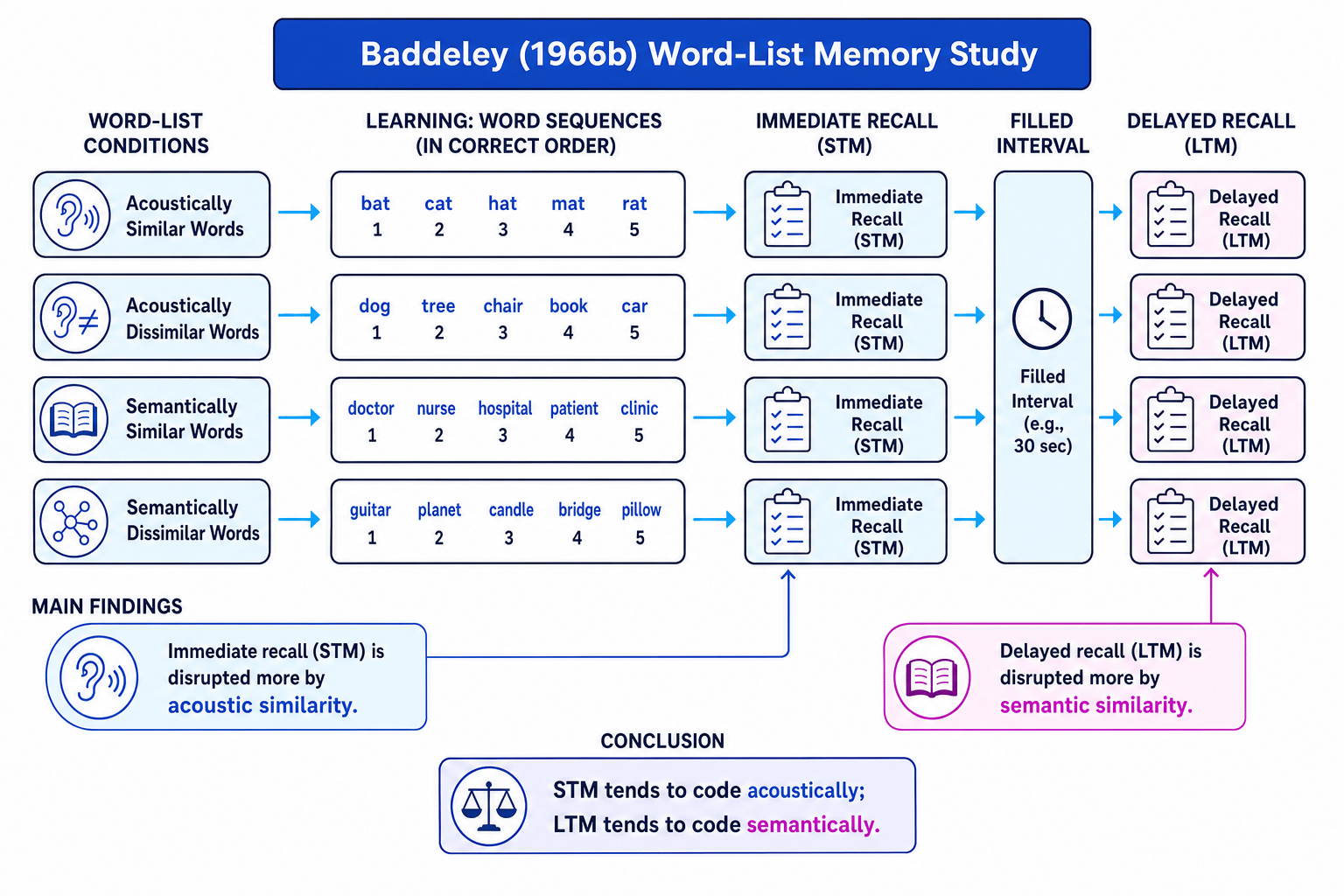
Baddeley carried out a controlled laboratory experiment using lists of words. Participants were asked to learn and recall word sequences in the correct order.
Serial recall
Serial recall means recalling items in the same order in which they were presented.
The word lists were designed to vary in similarity:
- Acoustically similar words: words that sounded alike.
- Acoustically dissimilar words: words that sounded different.
- Semantically similar words: words with similar meanings.
- Semantically dissimilar words: words with unrelated meanings.
Participants were shown or heard word lists and then asked to recall the words in order. After a delay filled with another task, they were tested again. The filled interval helped prevent simple rehearsal, so the later test was more relevant to long-term memory.
The main dependent variable was the accuracy of recall, especially whether the words were recalled in the correct serial order.
AO1 wording
For a clear study description, include the sample/task, the four word-list conditions, the recall task, and the measure of performance. You do not need to reproduce the exact word lists unless the question specifically gives you them.
Results
The key pattern was:
- In immediate recall, participants tended to do worse with acoustically similar words than acoustically dissimilar words.
- In delayed recall, participants tended to do worse with semantically similar words than semantically dissimilar words.
This suggests that sound-based confusion mattered more in short-term recall, while meaning-based confusion mattered more in long-term recall.
Main finding
Baddeley (1966b) found that acoustic similarity disrupted immediate recall, while semantic similarity was more disruptive after a delay. This supports the view that STM relies more on acoustic coding and LTM relies more on semantic coding.
Conclusion and link to the working memory model
Baddeley concluded that different memory systems may code information in different ways. STM appeared to be more sensitive to acoustic similarity, while LTM appeared to be more sensitive to semantic similarity.
This matters for the working memory model, proposed later by Baddeley and Hitch (1974). The working memory model argues that STM is not just one passive store. Instead, it is an active system with components such as:
- the central executive, which controls attention,
- the phonological loop, which deals with speech-based information,
- the visuospatial sketchpad, which deals with visual and spatial information,
- the episodic buffer, added later, which integrates information.
Baddeley (1966b) fits especially well with the phonological loop because it shows that short-term verbal memory is strongly affected by sound.
Do not say this study directly proves the WMM
Baddeley (1966b) was published before the working memory model. It supports ideas that later became important in the WMM, especially acoustic coding, but it does not test every part of the model.
AO3 evaluation
Strength: high control
A major strength is that Baddeley used a controlled laboratory method. The word lists could be carefully constructed so that they differed in acoustic or semantic similarity. This improves internal validity because differences in recall are more likely to be due to the word-list condition rather than random distractions.
The study also used a clear, measurable dependent variable: how accurately participants recalled the word sequences. This makes the procedure more objective and easier to replicate.
Weakness: artificial task
A limitation is that remembering lists of unrelated words in the correct order is not very realistic. In everyday life, memory often involves meaningful events, conversations, images, emotions and personal relevance.
This reduces ecological validity. The findings are still useful for understanding basic memory processes, but we should be careful when applying them directly to real-life memory, such as remembering a lesson or an eyewitness event.
Weakness: word-list confounds
A possible methodological issue is that words may differ in ways other than acoustic or semantic similarity. For example, some words may be more familiar, easier to visualise, or easier to rehearse.
If one word list is naturally easier than another, recall differences might not be caused purely by acoustic or semantic similarity.
Evaluation phrase
A strong AO3 point is: “Although the laboratory design increased control, the artificial word-list task may reduce ecological validity.”
Ethics
Baddeley’s study is relatively low risk, but ethical issues still matter. Under the BPS Code of Ethics and Conduct (2009), researchers should consider:
- Consent: participants should know they are taking part in a memory study.
- Deception: if the delayed recall test was unexpected, this should be justified and explained afterwards.
- Right to withdraw: participants should be free to leave the study.
- Protection from harm: the task should not cause distress.
- Confidentiality: individual recall scores should be kept private.
- Debrief: participants should be told the purpose of the study afterwards.
Overall, the study is ethically acceptable if participants were properly briefed, protected and debriefed.
AO2 application: recognising the study in scenarios
In an exam, you might be given a scenario where students are asked to learn different lists of words.
If one list contains words such as “man, map, mat, mad”, the key feature is acoustic similarity. If another list contains words such as “large, huge, big, vast”, the key feature is semantic similarity.
To apply Baddeley accurately, always link the type of similarity to the type of coding.
Applying Baddeley to a classroom memory task
A teacher gives one group a list of similar-sounding words and another group a list of similar-meaning words. Both groups recall the list immediately and again after a delay.
- Identify the memory stage. Immediate recall mainly reflects STM, while delayed recall is more relevant to LTM.
- Link STM to coding. Because STM tends to use acoustic coding, the similar-sounding list should be harder immediately.
- Link LTM to coding. Because LTM tends to use semantic coding, the similar-meaning list should be harder after the delay.
- State the conclusion. The predicted pattern supports Baddeley’s view that memory coding changes depending on whether recall is short-term or long-term.
Research methods link
Baddeley’s study is a laboratory experiment because the researcher manipulated the word-list condition and measured recall under controlled conditions.
The independent variable was the type of word list. The dependent variable was recall accuracy.
If you were analysing a similar practical investigation, the statistical test would depend on the design and data:
- Use Wilcoxon signed-ranks for a difference between two related conditions, such as the same participants recalling acoustically similar and acoustically dissimilar lists.
- Use Mann-Whitney U for a difference between two independent groups, such as one group recalling acoustic lists and another group recalling semantic lists.
- Use Spearman’s rho for a correlation, such as the relationship between rehearsal time and recall score.
- Use chi-square for an association between categories, such as word-list type and whether recall was correct or incorrect.
At A-Level, the default significance level is usually p≤.05p \le .05p≤.05. A stricter level such as p≤.01p \le .01p≤.01 reduces the risk of a Type I error, where a researcher falsely claims a significant effect. A more lenient level such as p≤.10p \le .10p≤.10 reduces the risk of a Type II error, where a real effect is missed.
For tests using critical-value tables, you compare the observed value from the data with the critical value from the table. You must also know whether the hypothesis is one-tailed or two-tailed. A one-tailed hypothesis predicts the direction of the effect; a two-tailed hypothesis predicts a difference or relationship but not its direction.
Choosing a statistical test
A researcher tests the same 20 participants twice: once with acoustically similar words and once with acoustically dissimilar words. The data are recall scores.
- Decide whether the study is testing a difference or a relationship. It is testing a difference between two conditions.
- Decide whether the data are related or independent. The same participants complete both conditions, so the data are related.
- Choose the appropriate test. The correct A-Level inferential test is Wilcoxon signed-ranks because it tests a difference using related data.
Real-world application
Baddeley’s findings can help students think about revision. If you are trying to remember key terms, similar-sounding material can become confused in the short term. Similar-meaning concepts can become confused later if you do not organise them clearly.
For example, in psychology you might confuse terms like validity and reliability if you only learn them as words. To strengthen long-term memory, you need to encode the meaning: validity is about whether a study measures what it claims to measure, while reliability is about consistency.
Sound versus meaning
Think of STM as more like briefly hearing a phrase in your head, while LTM is more like filing information by meaning. Baddeley’s study shows that the “filing system” changes depending on the memory task.
In the exam
- For AO1, describe the four word-list conditions and explain that recall accuracy was measured.
- For AO2, apply the rule: acoustic similarity disrupts immediate recall; semantic similarity disrupts delayed recall.
- For AO3, balance one methodological strength, such as high control, with one limitation, such as artificial word lists or low ecological validity.
Check yourself
- What is the difference between acoustic similarity and semantic similarity?
- Why does poorer recall for similar-sounding words suggest acoustic coding?
- Give one strength and one weakness of Baddeley’s laboratory method.
