What you'll learn
- What Schmolck et al. (2002) investigated about semantic memory in patient HM and other amnesic patients.
- How damage to the medial and lateral temporal lobes links to different patterns of memory impairment.
- How to describe the study for AO1 and evaluate it for AO3.
- How to apply the findings to unfamiliar scenarios about memory and brain damage.
Why this study matters
Schmolck et al. (2002) sits in the Cognitive Psychology topic because it helps answer a big question: are all long-term memories stored in the same way, or do different types of memory depend on different brain areas?
It builds on Tulving’s (1972) distinction between episodic memory and semantic memory, and on decades of research into patient HM, one of the most famous cases in memory research.
Semantic memory
Semantic memory is long-term memory for facts, concepts, word meanings, and general knowledge about the world, such as knowing that Paris is the capital of France or that a dog is an animal.
Episodic memory
Episodic memory is long-term memory for personally experienced events, including where and when something happened, such as remembering your last birthday.
The key issue is that HM had severe amnesia after surgery to remove parts of his medial temporal lobes, but his memory problems were not equally severe for every kind of memory. Schmolck et al. wanted to look more carefully at whether semantic knowledge was preserved or impaired.
The brain areas you need first
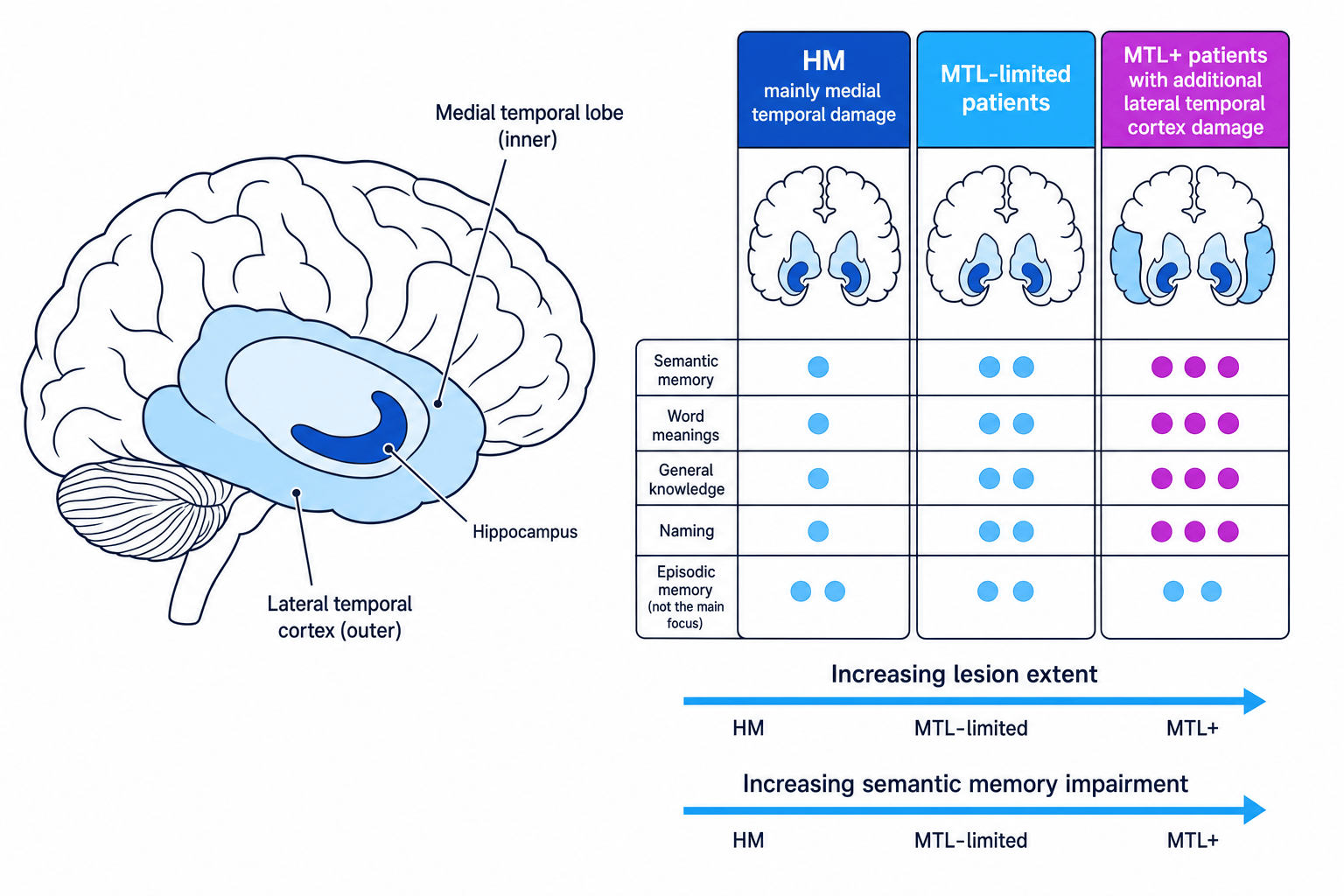
The temporal lobes are areas on the sides of the brain involved in memory, language, and recognition.
Medial temporal lobe
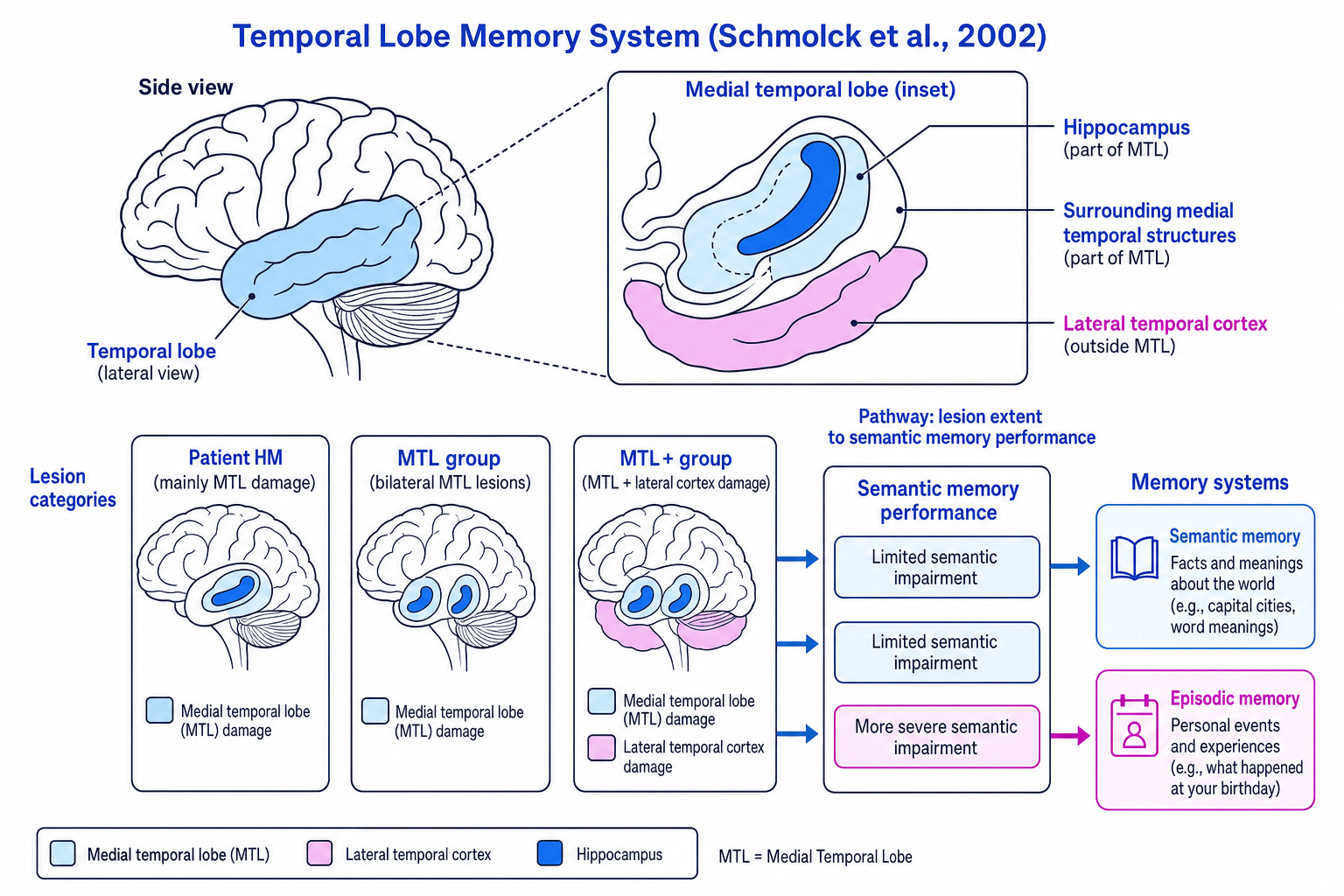
The medial temporal lobe, often shortened to MTL, is the inner part of the temporal lobe. It includes the hippocampus and nearby structures that are strongly linked to forming new declarative memories.
Lateral temporal cortex
The lateral temporal cortex is the outer side region of the temporal lobe. It is especially important for stored knowledge about words, objects, people, and meanings.
Schmolck et al. is easiest to understand if you picture a “lesion comparison”: different patients had damage in different parts of the temporal lobe, so the researchers compared their semantic memory performance.
Bilateral lesion
A bilateral lesion means damage on both sides of the brain. In this study, the important damage was in both left and right temporal lobes.
The core logic
If patients with wider temporal-lobe damage show worse semantic memory than patients with more limited medial temporal damage, this suggests semantic knowledge depends especially on areas beyond the hippocampus, including lateral temporal cortex.
Aim of Schmolck et al. (2002)
Schmolck et al. aimed to investigate semantic knowledge in patient HM and in other patients with bilateral temporal-lobe lesions.
More specifically, the researchers wanted to see whether semantic memory problems were linked to:
- damage mainly in the medial temporal lobe
- more extensive damage including the lateral temporal cortex
- the severity and location of brain damage, rather than just “having amnesia”
This is important because HM had already shown that the medial temporal lobe is crucial for forming new long-term memories. Schmolck et al. asked a more precise question: what happens to stored knowledge and word meanings?
Participants
The study used a small clinical sample, including patient HM and other amnesic patients with bilateral temporal-lobe damage. Participants were grouped according to the extent of their brain lesions, using neurological evidence such as brain scans and medical history.
A simplified version of the participant grouping is:
- HM: mainly medial temporal-lobe damage after surgery for epilepsy.
- MTL-only or MTL-limited patients: damage focused around the medial temporal region.
- MTL+ patients: damage to medial temporal areas plus additional lateral temporal cortex damage.
- Healthy comparison participants: used to judge whether patient scores were unusually low.
Quasi-experiment
A quasi-experiment is a study where the researcher compares naturally occurring groups rather than randomly allocating participants. Here, the “groups” were based on brain-damage patterns that already existed.
The independent variable was not manipulated by the researchers. It was the type or extent of temporal-lobe damage. The dependent variable was performance on semantic memory tasks.
Procedure
Participants completed a battery of semantic memory tests. These assessed knowledge of meanings, facts, words, objects, and famous people or events.
Examples of the kinds of tasks used include:
- defining words
- naming pictures or objects
- answering general knowledge questions
- recognising or naming famous people
- category fluency, such as naming as many animals as possible
- matching words, objects, or concepts by meaning
The tasks were designed to test stored semantic knowledge, not just short-term memory or the ability to learn something new during the study.
AO1 chain
A strong description follows this chain: brain lesion group → semantic memory tests → comparison with controls → conclusion about temporal-lobe involvement.
Findings
The general pattern was that semantic memory impairment increased as temporal-lobe damage became more extensive.
HM showed impairment on many semantic tasks compared with healthy controls, although his impairment was not as severe as the patients with wider lateral temporal-lobe damage.
Patients whose damage extended into the lateral temporal cortex tended to show the most severe problems with semantic knowledge. They struggled more with tasks involving names, facts, word meanings, and conceptual knowledge.
Patients with more limited medial temporal damage were generally less impaired than those with additional lateral temporal damage.
Main finding
Schmolck et al. found that severe semantic memory impairment was most strongly associated with damage extending beyond the medial temporal lobe into the lateral temporal cortex.
Conclusion
Schmolck et al. concluded that the medial temporal lobe is important for memory, but semantic knowledge is not stored only in the hippocampus.
Instead, semantic memory appears to depend on a wider network, especially areas of the lateral temporal cortex. This supports the idea that different types of long-term memory rely on different brain systems.
The study also suggests that patient HM’s memory profile was more complex than simply “he could not form long-term memories”. He had profound anterograde amnesia, but his semantic memory was only partly impaired compared with patients with more extensive temporal-lobe damage.
Applying the lesion logic
Interpreting a patient profile
A researcher compares two patients. Patient A has bilateral medial temporal-lobe damage and performs close to controls on vocabulary and category fluency. Patient B has medial temporal-lobe damage plus lateral temporal cortex damage and performs very poorly on naming, word definitions, and general knowledge.
-
Classify the memory tasks first: vocabulary, category fluency, naming, and definitions are mainly semantic memory tasks because they assess facts and meanings rather than personal events.
-
Compare the lesion patterns: Patient A has more limited medial temporal damage, while Patient B has damage that extends into the lateral temporal cortex.
-
Link the pattern to Schmolck et al.: the more severe semantic impairment in Patient B fits the finding that lateral temporal cortex damage is associated with poorer semantic knowledge.
-
Add a cautious conclusion: this supports a relationship between lateral temporal damage and semantic memory impairment, but it does not prove that one exact brain area alone “stores” all semantic memory.
AO3 evaluation: strengths
Strong scientific value
This study used rare neurological cases, including HM, to investigate memory in a way that would be impossible in ordinary laboratory participants. Because the patients had real brain damage, the research gives valuable evidence about the biological basis of memory.
Objective lesion evidence
The researchers used medical and neurological evidence to identify the location and extent of brain damage. This improves the scientific credibility of the study because the memory results could be linked to specific brain regions.
Supports theories of separate memory systems
The findings support Tulving’s (1972) idea that long-term memory is not one single store. Semantic and episodic memory can be affected differently, and different brain areas appear to contribute to different memory functions.
Real-world application
Understanding which brain areas are linked to semantic memory can help clinicians assess patients after brain injury, epilepsy surgery, encephalitis, or dementia. It can also guide rehabilitation by identifying preserved and impaired abilities.
AO3 evaluation: weaknesses
Small and unusual sample
The sample was necessarily small because patients like HM are rare. This reduces generalisability: we cannot assume that every person with temporal-lobe damage will show exactly the same pattern.
Individual differences are a problem
The patients differed in age, medical history, cause of brain damage, education, and possibly language ability. HM, for example, had a long history of epilepsy and brain surgery. These factors could affect semantic memory independently of lesion location.
Lesion studies are not perfectly controlled
The researchers did not create the lesions, so the study cannot control the independent variable in the way a laboratory experiment can. Damage may also affect connected brain networks, not just the visibly damaged area.
Localisation caution
Do not write that Schmolck et al. “proved” semantic memory is stored in one exact spot. The safer conclusion is that semantic memory depends on a distributed system, with important involvement of lateral temporal regions.
Task validity issues
Some semantic tasks may also require language production, attention, perception, or executive functioning. A poor score on naming famous people, for example, may reflect difficulty retrieving a name rather than complete loss of knowledge about the person.
No true pre-damage baseline
Researchers usually cannot know exactly how much semantic knowledge a patient had before brain damage. This makes it harder to measure the precise amount of decline.
Ethics
The study involved vulnerable participants with memory impairment, so ethical care was especially important. Under the BPS Code of Ethics and Conduct (2009), researchers should consider:
- consent: participants may need information repeated, and consent should be treated as ongoing
- right to withdraw: participants should be free to stop, even if they forget earlier agreement
- protection from harm: testing should avoid fatigue, frustration, or distress
- confidentiality: patient identities should be protected, although HM’s identity, Henry Molaison, became public after his death
- debrief: participants and carers should be told the purpose of the research in an accessible way
Deception was not a major issue because the tasks were straightforward memory tests, but researchers still needed to be sensitive and supportive.
Methods link: analysing similar data
If you designed a similar practical investigation, you might summarise semantic memory scores using a measure of central tendency, such as the mean or median, and a measure of dispersion, such as range or standard deviation. A bar chart could compare lesion groups.
Because clinical samples are often tiny and scores may be skewed rather than normally distributed, non-parametric tests are often more appropriate. For example, Mann–Whitney U could compare two independent groups, Wilcoxon signed-ranks could compare two related sets of scores, Spearman’s rho could test a correlation between lesion extent and semantic score, and chi-square could test an association between two categories. Decisions normally use observed and critical values from tables, with p≤.05p \leq .05p≤.05 as the default significance level, although p≤.10p \leq .10p≤.10 is more lenient and p≤.01p \leq .01p≤.01 is stricter.
Common exam pitfalls
Saying HM had no semantic memory
HM did have semantic knowledge, but Schmolck et al. found impairments compared with controls. The important point is the degree of impairment and how it compared with patients who had more extensive lateral temporal damage.
Confusing semantic and episodic memory
Semantic memory is general knowledge; episodic memory is personal events. If a scenario says a patient cannot remember their wedding day, that is episodic. If they cannot define “democracy”, that is semantic.
Best essay structure
For a 9PS0 answer on Schmolck et al., you can organise it like this:
- AO1 aim and background: semantic memory, HM, temporal-lobe lesions.
- AO1 method: quasi-experiment/case comparison, lesion groups, semantic tasks, controls.
- AO1 findings and conclusion: wider lateral temporal damage linked to greater semantic impairment.
- AO3 strengths: rare case evidence, objective brain evidence, supports separate memory systems.
- AO3 weaknesses: small sample, individual differences, lesion-study limitations, task validity.
- Ethics: consent, protection from harm, confidentiality, debrief.
In the exam
-
Use the full study name at least once: Schmolck et al. (2002), and link it to semantic memory and temporal-lobe lesions.
-
For AO3, avoid generic evaluation only. Make your points specific: small samples matter here because patients with HM-like lesions are rare and medically unusual.
-
When applying the study to a scenario, identify the memory type first, then the lesion location, then make the inference about semantic memory.
Check yourself
- What is the difference between semantic memory and episodic memory?
- Why were patients with lateral temporal cortex damage especially important in this study?
- Give one strength and one weakness of using HM and other brain-damaged patients as evidence.