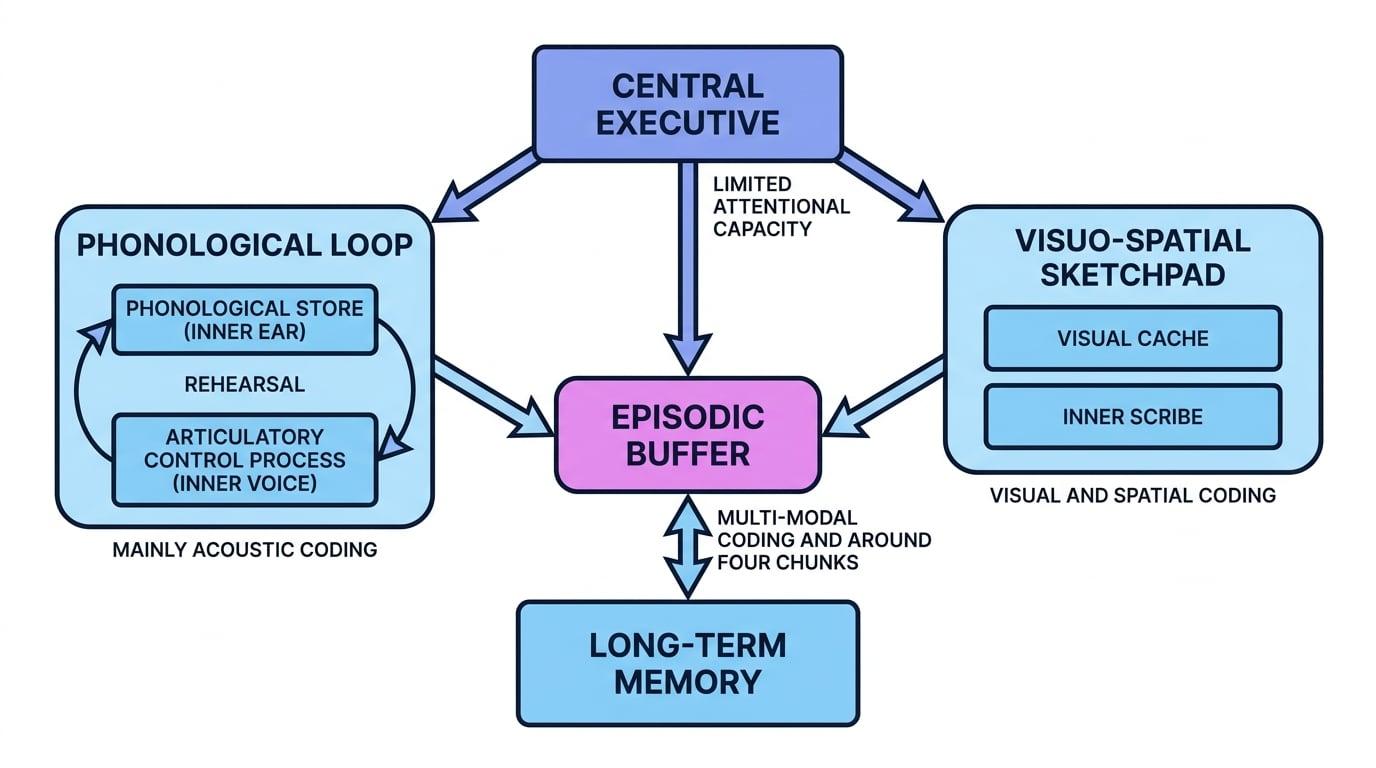
What you'll learn
- Why Baddeley and Hitch argued short-term memory is not one single store.
- The roles of the central executive, phonological loop, visuo-spatial sketchpad and episodic buffer.
- How coding and capacity differ across the parts of working memory.
- How to use AO1, AO2 and AO3 for essay-style answers on this model.
Starting point: what problem was the model trying to solve?
Earlier memory research often treated short-term memory, meaning a temporary store for information currently being held in mind, as a single “box”. For example, the multi-store model describes a short-term store that mainly holds information acoustically and has a limited capacity.
Baddeley and Hitch (1974) argued this was too simple. You can often do two short-term tasks at once, especially if they use different types of information — for example, holding a phone number in mind while looking for your keys. This suggests short-term memory is not one unitary store, but a set of interacting systems.
Working memory
Working memory is a temporary, active memory system that holds and manipulates information while you are thinking, reasoning, reading, problem-solving or following instructions.
Baddeley and Hitch proposed the working memory model in 1974. Baddeley later developed it further, especially in Baddeley (1986), and added the episodic buffer in Baddeley (2000).
Coding and capacity: two key features
Coding and capacity
Coding means the form in which information is represented in memory, such as sound, images, spatial layout or meaning. Capacity means how much information a memory system can hold at one time.
In the working memory model, different components code information in different ways. This is a major difference from a simple “one short-term store” view.
- The phonological loop mainly codes sound and speech.
- The visuo-spatial sketchpad codes visual and spatial information.
- The episodic buffer uses multi-modal coding, combining different types of information with meaning.
- The central executive controls attention rather than storing one specific type of information.
The main idea
Working memory is not just a passive store. It is an active system with different components for different mental jobs.
The model at a glance
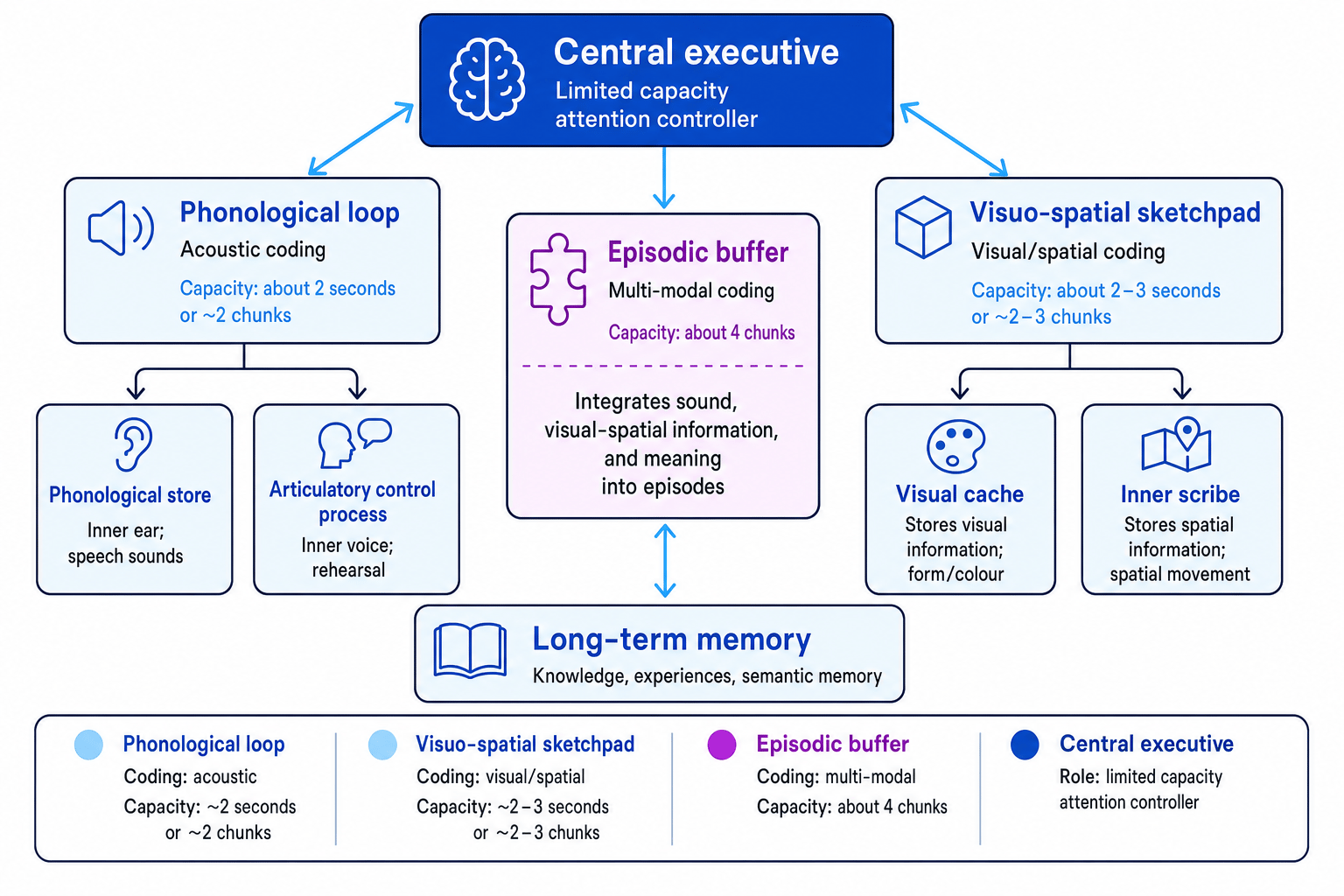
The simplest way to picture the model is as a control system: the central executive directs attention, while the other components temporarily hold different types of information.
The central executive
The central executive is the attention-control system. It decides what you focus on, coordinates the other components, switches attention between tasks, and helps inhibit irrelevant information.
It has limited capacity, meaning it can only handle a certain amount of attentional demand at once. If a task is very demanding, there is less central executive capacity left for another task.
The central executive does not have a single clear coding format because it is mainly a controller rather than a storage system.
A helpful way to picture it
Think of the central executive like a team leader. It does not do every specialist job itself, but it decides which “team member” should handle sound, visual information or integrated episodes.
The phonological loop
The phonological loop is the part of working memory that deals with speech-based and sound-based information. It is useful when you repeat a phone number, remember someone’s name, or rehearse a sentence in your head.
It has two parts:
- The phonological store, sometimes called the “inner ear”, holds spoken information for around 1.5 to 2 seconds.
- The articulatory control process, sometimes called the “inner voice”, rehearses information so it does not fade quickly.
The phonological loop mainly uses acoustic coding, meaning information is stored according to how it sounds.
Its capacity is limited by time: you can usually remember more short words than long words because short words can be rehearsed more quickly. This is called the word length effect, shown by Baddeley et al. (1975).
Phonological does not mean meaningful
Do not say the phonological loop stores information by meaning. In this model, it mainly deals with the sound of words and speech.
The visuo-spatial sketchpad
The visuo-spatial sketchpad is the part of working memory that temporarily stores and manipulates visual and spatial information.
- Visual information means what something looks like, such as shape, colour or pattern.
- Spatial information means where things are located or how they move in space.
For example, you use the visuo-spatial sketchpad when you mentally rotate a shape, imagine a route, or remember where a diagram’s labels are.
Logie (1995) suggested it can be divided further:
- The visual cache stores visual details such as form and colour.
- The inner scribe deals with spatial relationships and movement.
The visuo-spatial sketchpad has limited capacity, often described as only being able to hold a small number of visual or spatial items at once.
The episodic buffer
The episodic buffer was added by Baddeley (2000). It is a temporary storage system that integrates information from the phonological loop, visuo-spatial sketchpad and long-term memory into one coherent “episode”.
An episode is a combined memory event, such as remembering a sentence along with its meaning, the speaker’s voice and the situation in which you heard it.
The episodic buffer uses multi-modal coding, meaning it can combine different types of information, such as sound, images and meaning. Its capacity is limited, often described as around four chunks.
This component helped solve a weakness in the original model: the first version did not clearly explain how working memory links to long-term memory or how different types of information are bound together.
Applying the model to scenarios
AO2 questions often describe a person doing tasks and ask you to explain what is happening using the working memory model. The key skill is to identify which component each task uses.
Predicting dual-task interference
Alex is trying to remember a spoken postcode. At the same time, he either has to repeat a list of words or mentally rotate a shape. Which second task is more likely to disrupt remembering the postcode?
- The spoken postcode is verbal and sound-based, so it mainly uses the phonological loop.
- Repeating a list of words is also verbal and speech-based, so it competes for the same limited phonological loop capacity.
- Mentally rotating a shape mainly uses the visuo-spatial sketchpad, so it should cause less direct interference with the spoken postcode.
- The prediction is that repeating words will disrupt postcode recall more than mental rotation, although both tasks may still use some central executive attention.
AO2 shortcut
In a scenario, ask: “Is this mainly sound/verbal, visual/spatial, attention-control, or a mixture?” Then name the correct component.
Research evidence: AO3 evaluation
Dual-task evidence supports separate components
Baddeley and Hitch (1974) used dual-task studies where participants performed a reasoning task while also remembering digits. Performance became slower as the digit load increased, but participants could still do both tasks.
This suggests short-term memory is not a single store. If it were one simple store, two simultaneous tasks should cause much more severe interference. The findings fit the idea of a central executive coordinating separate systems.
However, these tasks were artificial. Remembering digits while doing reasoning tasks may not reflect everyday memory use, so ecological validity is limited.
Ethically, lab studies like this are usually low risk, but researchers still need informed consent, the right to withdraw, protection from stress or fatigue, confidentiality and a debrief, especially if the full purpose is not revealed immediately.
Word length evidence supports the phonological loop
Baddeley et al. (1975) found that people recall more short words than long words. This supports the idea that the phonological loop has a time-limited capacity: shorter words can be rehearsed more quickly using the articulatory control process.
A further supporting finding is articulatory suppression, where repeating an irrelevant sound such as “la, la, la” prevents rehearsal. This reduces the word length effect, supporting the role of the articulatory control process.
A limitation is that word lists are not very realistic. In real life, we usually remember meaningful sentences, conversations or instructions rather than random lists.
Case-study evidence supports separate stores
Shallice and Warrington (1970) studied patient KF, who had brain damage. KF had very poor verbal short-term memory, especially for information presented acoustically, but his visual short-term memory was less impaired.
This supports the working memory model because it suggests verbal and visual short-term memory can be damaged separately. That fits the idea of a phonological loop and visuo-spatial sketchpad.
However, case studies have limited generalisability. KF was one individual with a specific pattern of brain damage, so we cannot assume all memory works exactly the same way for everyone.
There are also important ethical issues in clinical case studies: researchers must protect confidentiality, gain valid consent where possible, avoid exploiting vulnerable patients, and debrief sensitively.
Brain evidence gives the model biological support
Brain-imaging research, such as Smith and Jonides (1997), suggests verbal and spatial working memory tasks activate different brain areas. This supports the idea that working memory has separate components rather than one general short-term store.
A limitation is that brain imaging is often correlational. If a brain area is active during a task, this does not prove it is the only area responsible for that function.
Limitations of the model
The central executive is vague
A common criticism is that the central executive is not fully explained. It is described as controlling attention and coordinating systems, but this can become a “catch-all” explanation for anything difficult.
This reduces the model’s testability. A strong scientific model should make clear predictions about exactly what each part does.
The episodic buffer was added later
The episodic buffer improved the model because it explained how information from different sources is integrated. However, because it was added later, some critics argue it may seem like a patch added to deal with weaknesses in the original model.
Still, it is useful because it explains everyday experiences better, such as understanding a story by combining words, images, context and long-term knowledge.
The model has real-world usefulness
Despite limitations, the model has practical applications. It helps explain why students may struggle when instructions overload working memory, such as when a teacher gives several verbal steps while also showing a complex diagram.
It also has relevance for understanding learning difficulties, brain injury and classroom strategies. For example, reducing unnecessary verbal information may help students focus their central executive capacity on the main task.
In the exam
- For AO1, name all four components and describe their roles: central executive, phonological loop, visuo-spatial sketchpad and episodic buffer.
- For AO2, link the scenario to the correct component by identifying the type of information being processed.
- For AO3, use evidence such as Baddeley and Hitch (1974), Baddeley et al. (1975), KF, and brain-imaging research, then add a clear limitation.
Check yourself
- Why does the working memory model challenge the idea of one single short-term memory store?
- What is the difference between the phonological store and articulatory control process?
- How could you use KF as both a strength and a limitation in an evaluation paragraph?