What you'll learn
- How psychologists define forgetting and why “not remembering” does not always mean a memory has disappeared.
- The difference between proactive interference and retroactive interference.
- How retrieval failure happens when useful cues are absent.
- How to evaluate key studies using AO1, AO2 and AO3 for AQA essays.
Starting point: what does “forgetting” mean?
Before you learn the explanations, you need three core memory terms.
Encoding means putting information into a form that can be stored in memory. Storage means keeping that information over time. Retrieval means getting stored information back out when you need it.
Long-term memory (LTM) is the memory store for information kept for a long period of time, potentially from minutes to a lifetime.
Forgetting
Forgetting is when information that has been encoded cannot be recalled or recognised when it is needed. Sometimes the information may be genuinely unavailable, but often it is still stored and just temporarily inaccessible.
A key distinction is availability versus accessibility. If a memory is available, it still exists in storage. If it is accessible, you can retrieve it at that moment. Retrieval failure is mainly about accessibility.
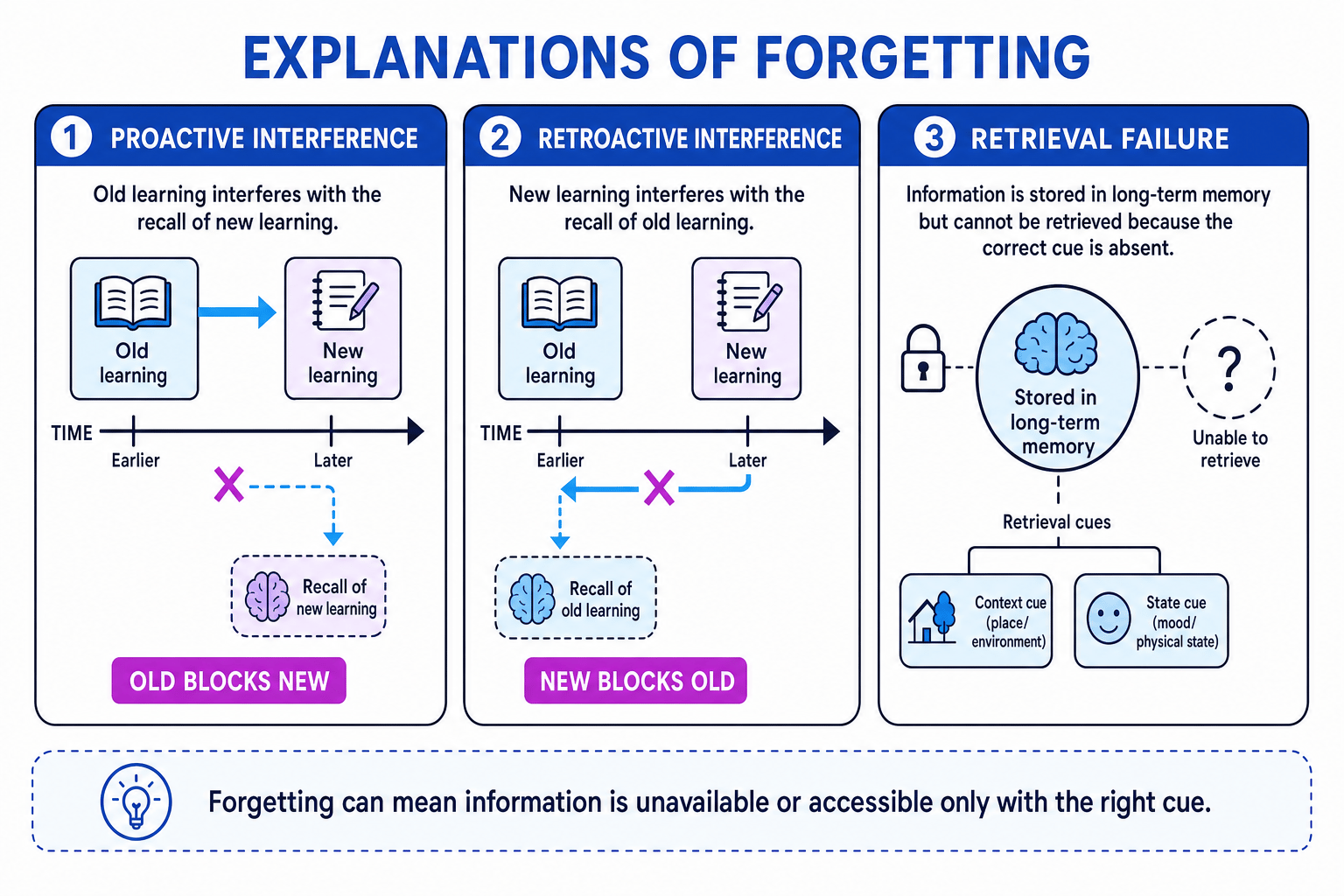
The diagram below shows the three explanations in this topic: proactive interference, retroactive interference and retrieval failure due to missing cues.
The big idea
Forgetting can happen because memories compete with each other, or because the correct trigger for accessing the memory is missing.
Explanation 1: interference
Interference
Interference is an explanation for forgetting where two sets of information become confused in memory, so one memory disrupts the recall of another.
Interference is most likely when the two memories are similar. For example, two similar passwords, two similar phone numbers, or vocabulary from two similar languages are more likely to compete than two completely different types of information.
There are two types: proactive interference and retroactive interference.
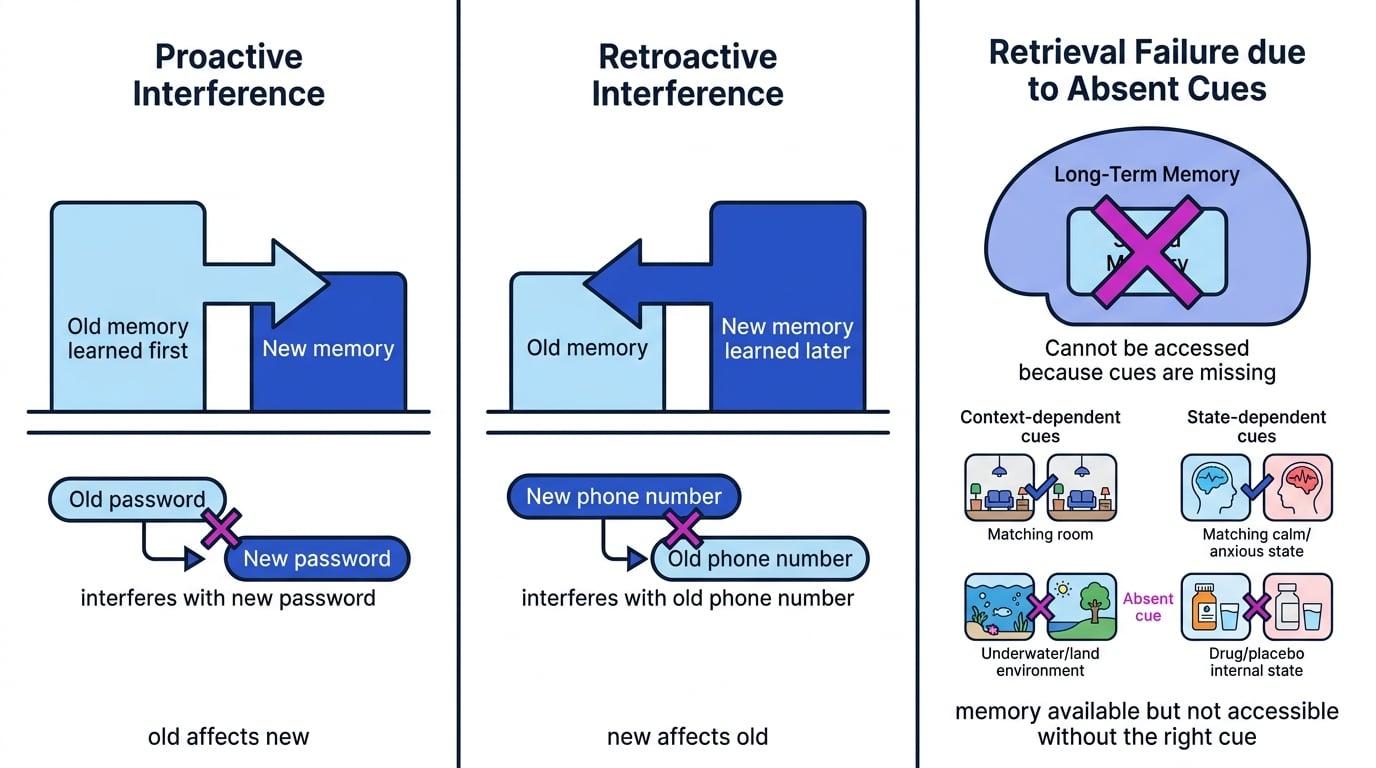
Proactive interference: old blocks new
Proactive interference
Proactive interference happens when older learning disrupts the recall of newer learning.
“Proactive” means acting forwards. The old information was learned first, but it affects your ability to remember something learned later.
For example, if you had one school login password for years and then it changes, you may keep typing the old password. The older memory is interfering with the newer one.
Remembering proactive interference
Proactive = previous pushes forward. Old information gets in the way of new information.
Identifying proactive interference
A student moves house and gets a new postcode, but keeps writing their old postcode on forms.
- The old postcode was learned first, so it is the earlier memory.
- The new postcode is the information the student is trying to recall now.
- Because the earlier memory is disrupting recall of the later memory, this is proactive interference.
Retroactive interference: new blocks old
Retroactive interference
Retroactive interference happens when newer learning disrupts the recall of older learning.
“Retroactive” means acting backwards. The new information was learned later, but it affects your ability to remember something learned earlier.
For example, after learning a new mobile number, you may struggle to remember your old one. The newer memory is interfering with the older memory.
Remembering retroactive interference
Retroactive = recent reaches back. New information gets in the way of old information.
Identifying retroactive interference
A learner studies Italian vocabulary after previously studying Spanish. In the Spanish test, they accidentally write Italian words instead.
- Spanish was learned first, so it is the older learning.
- Italian was learned later, so it is the newer learning.
- The learner is trying to recall Spanish, but Italian disrupts this recall, so this is retroactive interference.
Mixing up the direction
Do not decide the type of interference just by asking “which memory is stronger?” Decide it by looking at the timeline: old affects new = proactive, while new affects old = retroactive.
Research evidence for interference
McGeoch and McDonald (1931)
McGeoch and McDonald asked participants to learn a list of words until they could recall it accurately. Participants then learned a second list. The second list varied in similarity to the original list, such as synonyms, antonyms, unrelated words, nonsense syllables or numbers.
Recall of the original list was worst when the second list was most similar, especially when it contained synonyms. This supports the idea that forgetting is more likely when memories are similar and compete with each other.
Underwood (1957)
Underwood reviewed studies on forgetting and found that participants who had learned many previous word lists recalled less after a delay than participants who had learned only one list. This supports proactive interference, because older learning disrupted later recall.
Baddeley and Hitch (1977)
Baddeley and Hitch studied rugby players recalling the teams they had played earlier in the season. Some players had missed games, so the researchers could separate the effect of time from the effect of the number of intervening games.
Recall depended more on the number of matches played since the target game than on how long ago the game happened. This supports retroactive interference, because newer games interfered with recall of older games.
Evaluating interference explanations
A strength of interference research is that many studies use controlled procedures. In laboratory studies, researchers can control the similarity of the material and the time between learning and recall. This makes it easier to establish a cause-and-effect relationship between interference and forgetting.
However, a limitation is that many lab tasks use artificial word lists. Remembering lists of adjectives is not the same as remembering meaningful personal experiences, so the findings may have limited ecological validity, meaning they may not fully apply to real-life memory.
Baddeley and Hitch’s rugby study is useful because it used a more realistic memory task. The players were recalling actual matches, not artificial lists. This gives the interference explanation stronger real-world support.
Another limitation is that interference may only explain some types of forgetting. It works best when memories are similar. If you forget something completely unrelated, such as where you left your keys after revising psychology, interference may not be the best explanation.
AO3 summary for interference
Interference is strongly supported by research, especially when memories are similar, but some evidence comes from artificial tasks that may not represent everyday forgetting.
Ethically, most interference studies involve low risk because participants usually complete memory tasks with words or everyday material. Still, researchers should gain informed consent, allow the right to withdraw, protect participants from stress or embarrassment, keep data confidential and debrief participants afterwards.
Explanation 2: retrieval failure due to absence of cues
Retrieval failure
Retrieval failure is an explanation for forgetting where information is stored in long-term memory but cannot be accessed because the right retrieval cue is absent.
A cue is a trigger that helps you access a memory. Cues can be external, such as a room, smell or sound, or internal, such as mood or physical state.
This explanation is based on the encoding specificity principle, proposed by Tulving and Thomson (1973). This principle says that a cue will help retrieval if it was present when the memory was encoded and is also present when the memory is retrieved.
Encoding specificity principle
The encoding specificity principle states that memory is most effective when information available at encoding is also available at retrieval.
For example, if you learned a joke in a particular classroom, returning to that classroom may help you remember it. The room acts as a cue.
Context-dependent forgetting
Context-dependent forgetting
Context-dependent forgetting happens when recall is worse because the external environment at retrieval is different from the environment at encoding.
The context is the surrounding environment, such as the room, location, background noise or smell.
Godden and Baddeley (1975) tested context-dependent forgetting with deep-sea divers. Divers learned word lists either on land or underwater, and then recalled them either in the same environment or a different one. Recall was better when learning and recall took place in the same context: land-land or underwater-underwater.
This supports retrieval failure because the original context helped act as a cue.
State-dependent forgetting
State-dependent forgetting
State-dependent forgetting happens when recall is worse because the internal physical or psychological state at retrieval is different from the state at encoding.
A state could include mood, tiredness, anxiety, drug effects or level of arousal.
Carter and Cassaday (1998) gave participants an antihistamine drug or a placebo before learning and recall. Antihistamines can create a slightly drowsy internal state. Participants recalled less when their internal state at recall did not match their state at learning. This supports state-dependent retrieval failure.
Applying retrieval failure to a revision scenario
A student revises psychology in a quiet bedroom while calm, but in the exam hall they feel anxious and cannot remember a study.
- The student encoded the information in one internal state: calm and relaxed.
- At retrieval, their internal state is different: anxious and under pressure.
- Because the mismatch is internal rather than environmental, this is best explained as state-dependent retrieval failure.
- A useful solution would be to practise retrieving the study under mild timed conditions, so exam-like cues become linked to the memory.
Confusing context and state
Context means the external surroundings. State means the person’s internal condition. A noisy classroom is context; feeling tired or anxious is state.
Evaluating retrieval failure
A strength of retrieval failure is that it is supported by research. Godden and Baddeley’s diving study showed that recall was better when context matched. Carter and Cassaday’s drug-state study showed that internal state can also affect recall.
Another strength is real-world application. Retrieval cues are used in the cognitive interview, a police interviewing technique that encourages witnesses to mentally reinstate the context of the crime. This can improve eyewitness recall by recreating cues from encoding.
However, context effects may be less powerful in everyday life than in research settings. In real exams, there are many different cues available, and students often revise in several places. This means the absence of one context cue may not completely prevent recall.
A further limitation is that some retrieval failure research uses artificial tasks, such as learning word lists. This may not reflect how people remember meaningful material, such as events, conversations or emotional experiences.
There is also an ethical issue in state-dependent research. Carter and Cassaday used a drug to change participants’ internal state. Researchers must ensure informed consent, protection from harm, the right to withdraw, confidentiality and a full debrief. Even mild drug effects need careful ethical control.
Cue-dependent forgetting is not the whole story
Retrieval failure explains forgetting when the memory is still stored but inaccessible. It does not prove that all forgotten information is still in memory; some memories may decay, be distorted, or never have been encoded properly in the first place.
Bringing the explanations together
Interference and retrieval failure are both explanations for why recall can fail, but they focus on different mechanisms.
Interference says forgetting happens because memories compete. Retrieval failure says forgetting happens because the right cues are missing.
For AO2 scenario questions, ask yourself: is the problem caused by confusion between similar memories, or by a missing trigger that would help access the memory?
Choosing the right explanation
If two memories are clashing, think interference. If the memory seems “on the tip of your tongue” and returns when the situation, mood or cue changes, think retrieval failure.
In the exam
- Define the key explanation clearly before evaluating it: for interference, name proactive or retroactive; for retrieval failure, mention cues and the encoding specificity principle.
- Use studies precisely: McGeoch and McDonald for similarity, Underwood for proactive interference, Baddeley and Hitch for retroactive interference, Godden and Baddeley for context, and Carter and Cassaday for state.
- For AO3, avoid simply saying “lab study = bad”. Explain why artificial tasks may reduce ecological validity, then balance this with controlled evidence or real-world applications.
Check yourself
- Can you explain the difference between proactive and retroactive interference using your own example?
- Why does the encoding specificity principle support retrieval failure?
- What is one strength and one limitation of Godden and Baddeley’s diving study?