What you'll learn:
- How Bowlby's concept of the "Internal Working Model" acts as a blueprint for later life.
- The link between infant attachment types and childhood friendships (including bullying).
- How early attachment predicts adult romantic relationships and parenting styles.
- The key strengths and methodological flaws of research in this area.
The Internal Working Model
Have you ever wondered why some people find it easy to trust their romantic partners, while others constantly fear being abandoned? John Bowlby (1969) argued that the answer lies in our very first relationship.
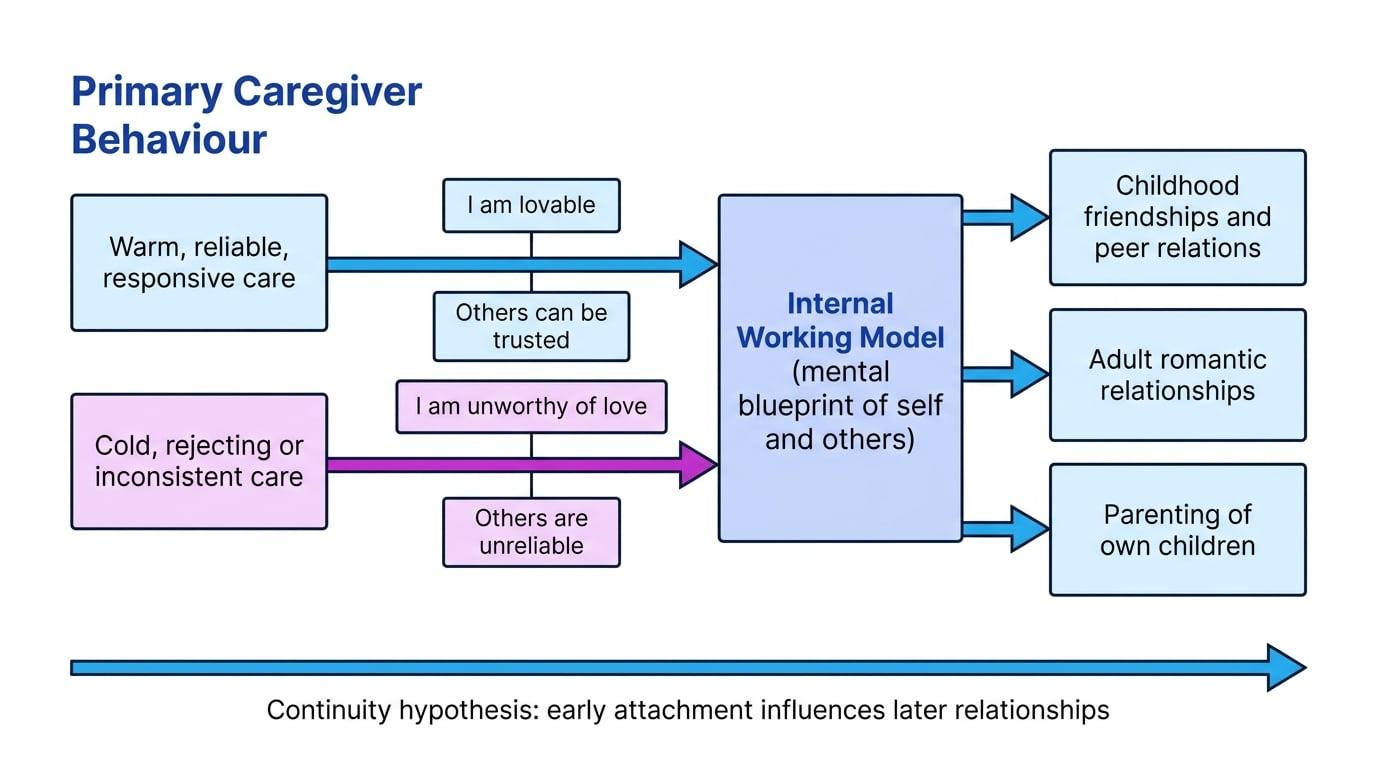
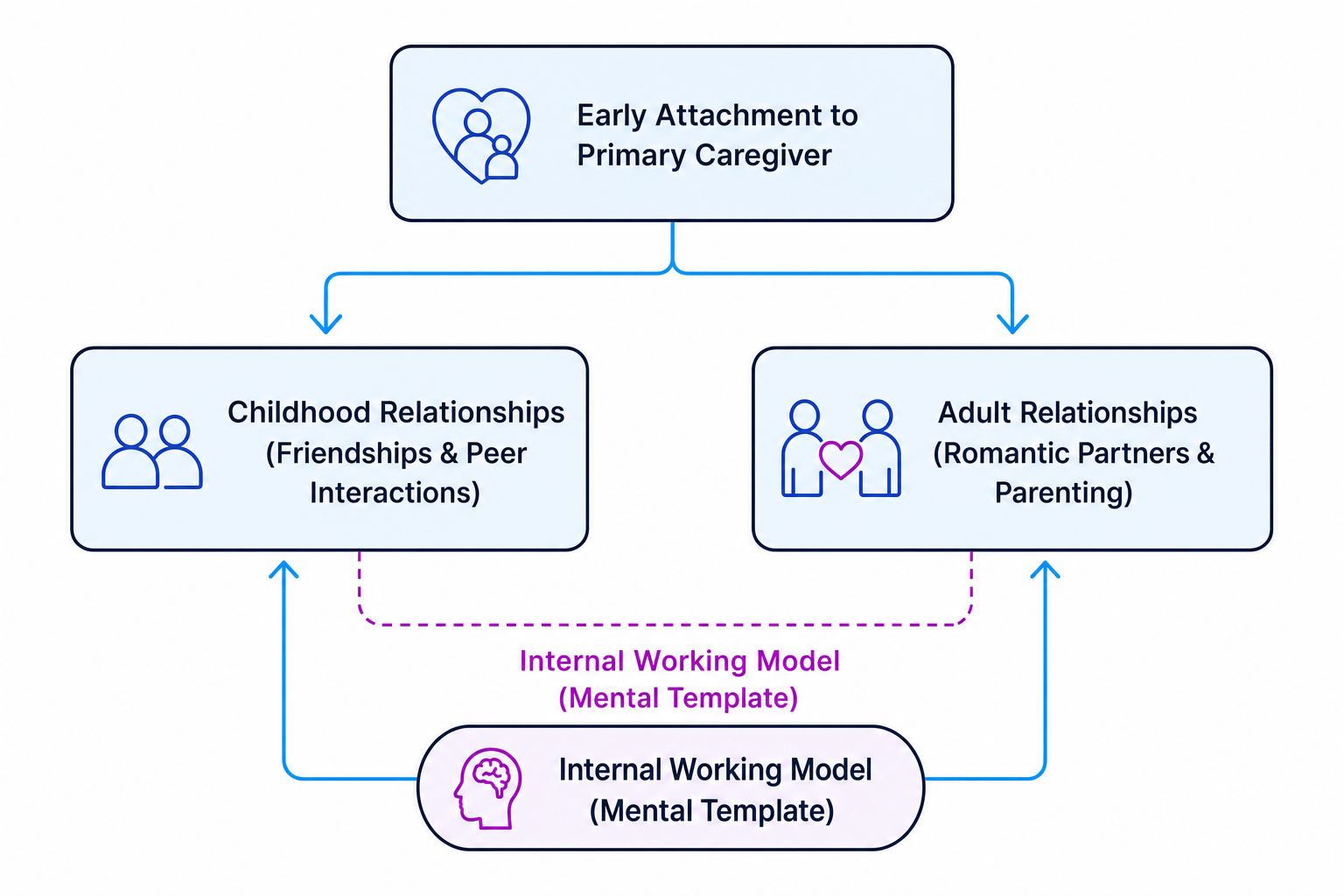
According to Bowlby, a baby's first relationship with their primary attachment figure provides a crucial mental template for all future relationships.
Internal Working Model
A mental representation (or "blueprint") of our relationship with our primary caregiver that becomes a template for what relationships are like and how people behave within them.
If a child experiences a warm, reliable caregiver, their Internal Working Model (IWM) will dictate that they are lovable and that other people can be trusted. Conversely, if a child experiences a cold or rejecting caregiver, their IWM will suggest that they are unworthy of love and that others are unreliable.
The Continuity Hypothesis
This is the idea that there is consistency between early emotional experiences and later relationships. Your attachment type as an infant is expected to carry forward and dictate your behaviour in childhood and adulthood.
Influence on Childhood Relationships
The Internal Working Model starts shaping social behaviour as soon as a child begins interacting with peers.
Research by Kerns (1994) found that securely attached infants go on to form the best quality childhood friendships, whereas insecurely attached infants later struggle with peer relations.
Attachment type can also predict a child's likelihood of being involved in bullying. Myron-Wilson and Smith (1998) assessed attachment type and bullying involvement using standard questionnaires in 196 children aged 7–11 from London. They found a striking pattern:
- Secure children were very unlikely to be involved in bullying.
- Insecure-avoidant children were the most likely to be victims of bullying.
- Insecure-resistant children were the most likely to be the bullies themselves.
Influence on Adult Romantic Relationships
The most famous investigation into how early attachment affects adult romantic love was conducted by Hazan and Shaver (1987).
They designed a study called the "Love Quiz", which they published in an American local newspaper (The Rocky Mountain News). They received and analysed 620 replies. The quiz had three sections assessing:
- The participant's current or most important romantic relationship.
- Their general love experiences (e.g., how many partners they had been with).
- Their early attachment type (by asking them to choose which of three statements best described their feelings).
The Findings of the Love Quiz
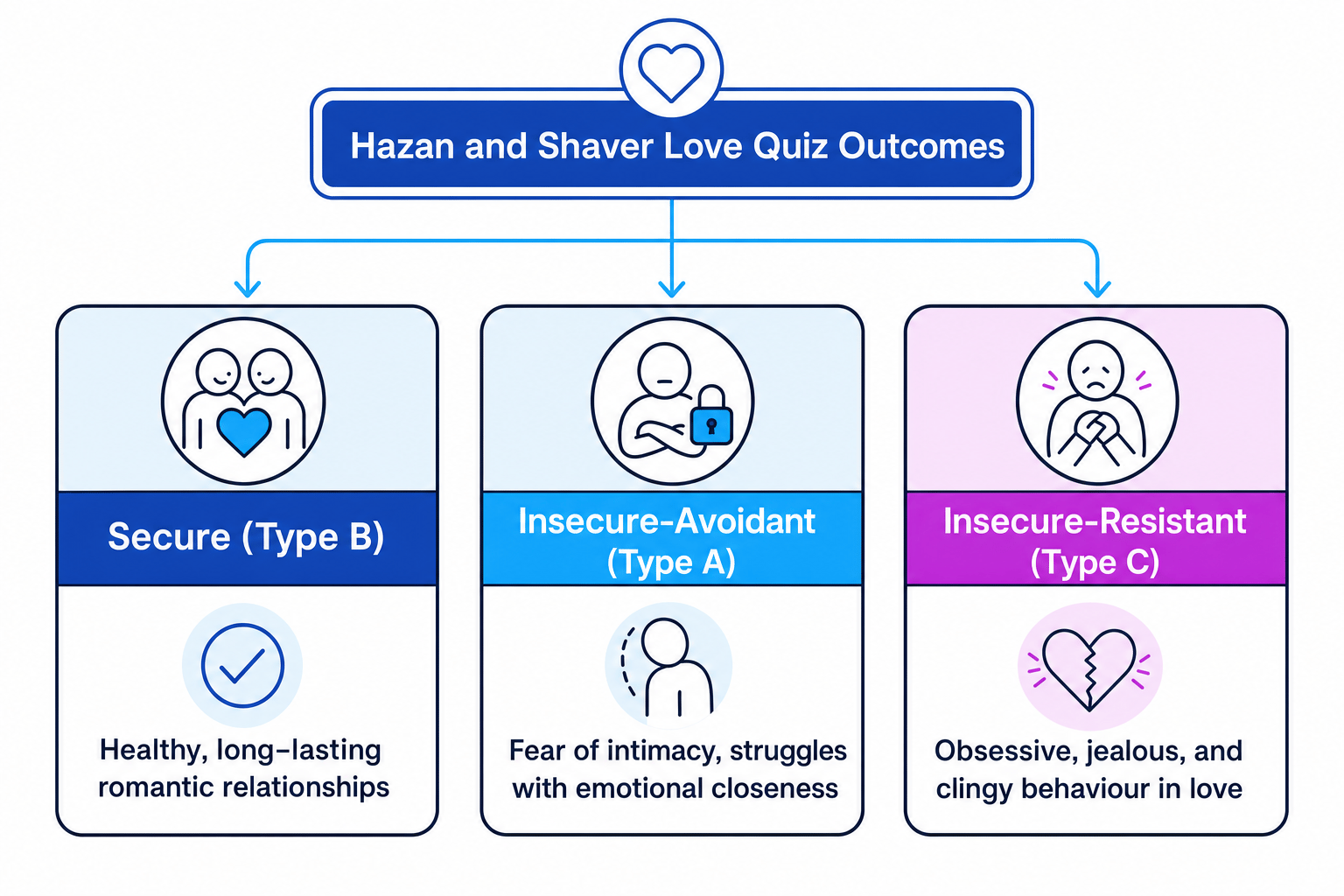
Hazan and Shaver found that the distribution of attachment types in their adult sample closely matched what Ainsworth found in infants (roughly 56% secure, 25% insecure-avoidant, 19% insecure-resistant). More importantly, there was a strong correlation between adult attachment type and their romantic experiences.
Influence on Adult Parenting
The Internal Working Model doesn't just affect how we treat our romantic partners; it also affects how we parent our own children. Because the IWM acts as a template, people tend to base their parenting style on their own experiences of being parented.
Bailey et al. (2007) tested this idea of intergenerational transmission. They assessed 99 mothers with their one-year-old babies using the Strange Situation. They also interviewed the mothers about their own early attachment to their mothers using an adult attachment interview. They found that the majority of women had the same attachment classification both to their babies and to their own mothers.
Tracing relationship patterns
Imagine you are given an AO2 scenario: David has just broken up with his partner. He admits he was constantly checking her phone and felt intensely jealous whenever she went out without him. He often felt she didn't love him as much as he loved her.
Here is how you would systematically apply attachment theory to David's behaviour:
- Identify the adult attachment style from the behavioural clues: David's intense jealousy, clinginess, and fear of unreciprocated love align perfectly with Hazan and Shaver's description of an insecure-resistant adult.
- Trace this back to the likely infant attachment type: According to the continuity hypothesis, David was likely an insecure-resistant (Type C) infant.
- Explain the mechanism using the Internal Working Model: State that David's primary caregiver was likely inconsistent (sometimes responsive, sometimes ignoring him). This created an Internal Working Model—a mental blueprint—that relationships are unpredictable and that he must fight for attention. He is now applying this same template to his adult romantic partners.
Evaluating the Influence of Early Attachment (AO3)
When writing an essay on this topic, it is crucial to evaluate the quality of the evidence and the assumptions underlying the theory.
Methodological Issues: Retrospective Data
Most research in this area (like Hazan and Shaver's Love Quiz) relies on adults recalling their early childhood experiences. This is called retrospective data. Human memory is highly reconstructive and often flawed; people might simply misremember how their parents treated them, or their current relationship status might colour their memories of the past (e.g., someone going through a bitter divorce might suddenly view their childhood more negatively). This lack of validity weakens the supporting evidence for the Internal Working Model.
Correlation vs. Causation
Just because there is a link between early attachment and later relationships does not mean that early attachment causes the later behaviour.
Assuming early attachment is the only cause
In an exam, do not state that a bad early attachment definitively causes a bad adult relationship. You must use tentative language (e.g., "suggests", "correlates with", "increases the risk of") and acknowledge third variables.
An alternative explanation is the Temperament Hypothesis. Jerome Kagan argued that an infant's innate biological personality (e.g., being naturally anxious or naturally easy-going) causes both their infant attachment classification and their later relationship quality. In this view, the infant's temperament is the true cause of both, meaning the Internal Working Model may not be as central as Bowlby claimed.
Is the theory too deterministic?
Bowlby's theory suggests that your early experiences heavily dictate your future. If you had a poor early attachment, the theory implies you are somewhat doomed to have bad relationships in the future.
However, many psychologists argue this is overly pessimistic and deterministic. Zimmerman (2000) assessed infant attachment type and adolescent attachment to parents, finding very little relationship between the two. Furthermore, Clarke and Clarke (1998) describe the influence of early attachment as probabilistic. People with insecure attachments have a greater risk of relationship problems, but they are not strictly doomed to them. By being aware of their patterns, individuals can consciously forge highly successful adult relationships.
In the exam
- When outlining the influence of early attachment, always anchor your answer to the Internal Working Model. It is the theoretical "glue" that links infancy to adulthood.
- If asked to describe research, be ready to summarise the method and findings of one key study (Hazan and Shaver is usually the easiest to remember).
- For top AO3 marks, introduce the "Temperament Hypothesis" as a competing explanation to challenge Bowlby's continuity hypothesis.
Check yourself
- Can you define what the Internal Working Model is in your own words?
- According to Myron-Wilson and Smith, which attachment type is most likely to be a victim of bullying, and which is most likely to be the bully?
- What were the three attachment types identified in the Hazan and Shaver Love Quiz, and what were their romantic outcomes?
- Why is the use of retrospective data a significant weakness in this area of psychology?