What you'll learn:
- The difference between short-term separation and long-term maternal deprivation.
- Bowlby's theory of maternal deprivation and his famous 44 thieves study.
- The effects of institutionalisation, focusing on Rutter's English and Romanian Adoptees project.
- How to evaluate these concepts using counter-evidence, methodological critiques, and real-world applications.
Bowlby's Theory of Maternal Deprivation
John Bowlby (1951) believed that continuous emotional care from a mother (or mother-substitute) is essential for a child's normal psychological development. Before we look at the effects, we need to distinguish between two easily confused terms.
Separation vs. Deprivation
Separation means the child is simply not in the presence of the primary attachment figure (e.g., the mother goes to work). This only becomes an issue if the child is deprived of emotional care. Deprivation occurs when a child loses an element of the mother's emotional care. Extended separations can lead to deprivation, which causes harm.
The Critical Period
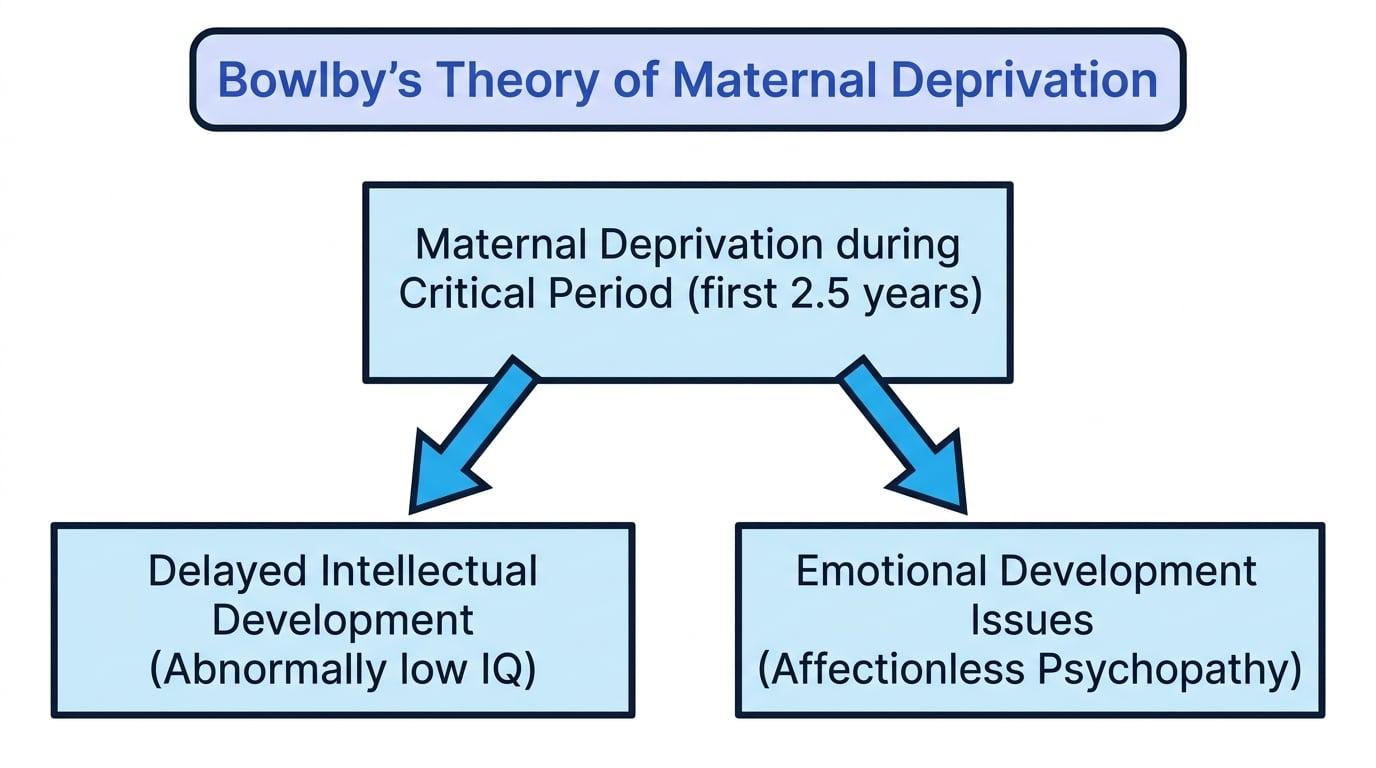
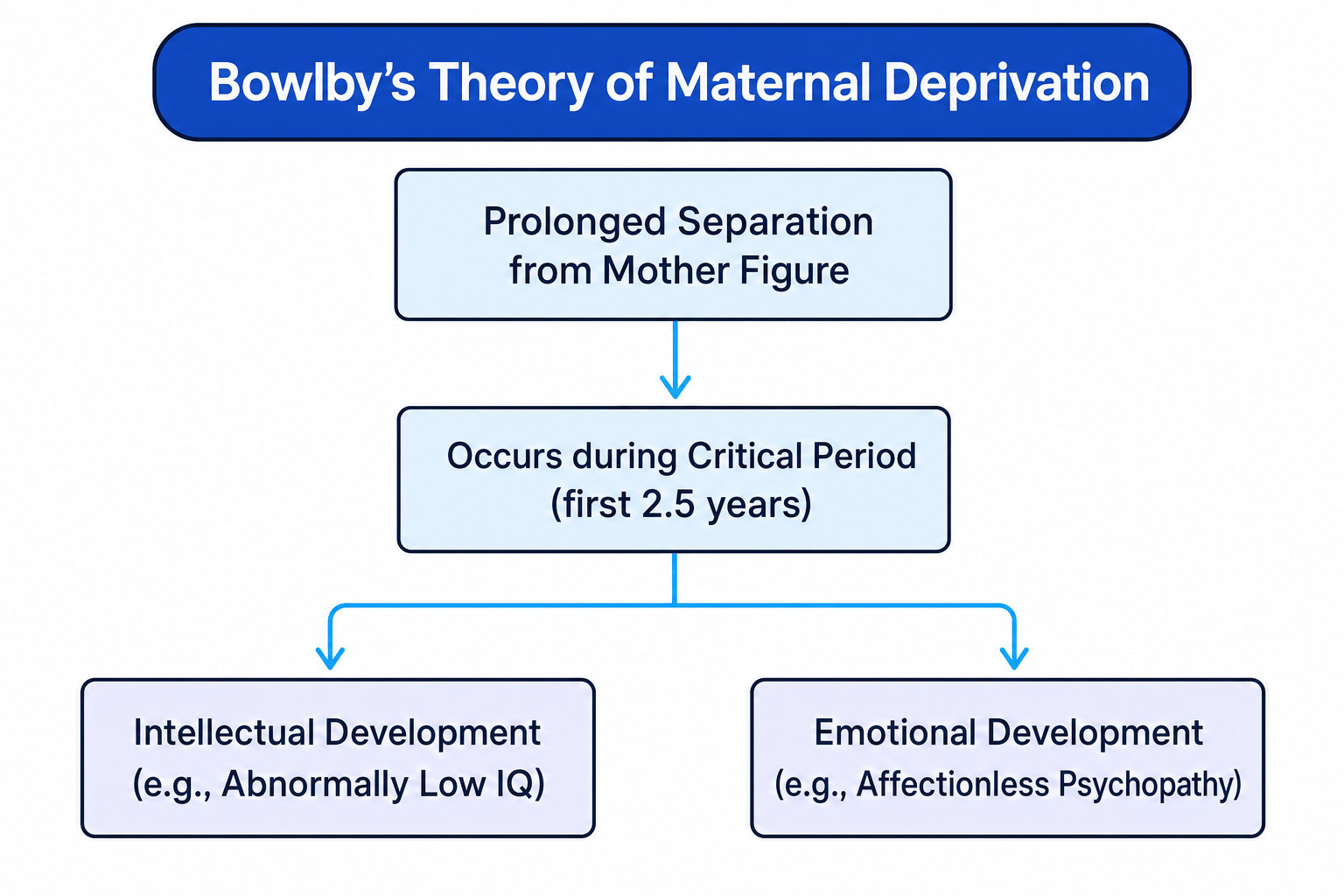
Bowlby argued that the first two and a half years of life are a critical period for psychological development. If a child is separated from their mother (without a suitable substitute) for an extended time during this period, psychological damage is inevitable. Bowlby believed there was a continuing risk up to the age of five.
Effects on Development
If maternal deprivation occurs during the critical period, Bowlby predicted two main areas of damage:
- Intellectual development: Children may experience delayed intellectual development, characterised by an abnormally low IQ.
- Emotional development: Children may develop a condition Bowlby called affectionless psychopathy.
Affectionless psychopathy
The inability to experience guilt or strong emotion towards others. This prevents the person from developing normal relationships and is associated with criminality, as affectionless psychopaths cannot appreciate the feelings of their victims.
Key Study: Bowlby's 44 Thieves (1944)
To test his theory, Bowlby investigated the link between affectionless psychopathy and maternal deprivation.
He studied a sample of 44 teenagers accused of stealing. They were interviewed for signs of affectionless psychopathy. Their families were also interviewed to establish whether the 'thieves' had experienced prolonged early separations from their mothers. A control group of 44 non-criminal but emotionally disturbed young people was used for comparison.
Findings:
- 14 of the 44 thieves could be described as affectionless psychopaths.
- Of these 14, 12 had experienced prolonged separation from their mothers in the first two years of their lives.
- In contrast, only 5 of the remaining 30 'thieves' had experienced separations.
- In the control group, only 2 out of 44 had experienced prolonged separations.
Bowlby concluded that prolonged early separation/deprivation caused affectionless psychopathy.
Correlation vs. Causation
Bowlby concluded that deprivation caused affectionless psychopathy. However, he only found a relationship (correlation) between the two variables. Other factors, such as extreme poverty, family conflict, or an inherited genetic vulnerability, could have caused both the early separations and the later psychopathy. Always point this out in an AO3 evaluation!
Evaluating Bowlby's Theory (AO3)
Flawed evidence: Bowlby carried out the assessments for affectionless psychopathy and the family interviews himself. This leaves the study wide open to researcher bias; he knew in advance which teenagers he expected to show signs of psychopathy. Furthermore, the retrospective recall of the parents (asking them to remember separations from over a decade ago) may have been inaccurate.
Counter-evidence: Hilda Lewis (1954) partially replicated the 44 thieves study on a much larger scale, looking at 500 young people. In her sample, a history of prolonged separation from the mother did not predict criminality or difficulty forming close relationships. This suggests other factors may affect the outcome of early maternal deprivation.
Critical vs. Sensitive Period: Later research has shown that damage is not inevitable if a child experiences deprivation during the critical period. If a child receives good aftercare, the damage can be reversed. For example, the Koluchová twins (1976) were kept locked in a cupboard from 18 months to seven years old (extreme deprivation). However, they were then adopted by two loving adults and appeared to recover fully. Therefore, it is better to call the first two and a half years a sensitive period rather than a critical one.
Institutionalisation
While maternal deprivation looks at the loss of a mother figure, institutionalisation looks at the effects of growing up in an orphanage or hospital where children live for long, continuous periods. In these places, there is often very little emotional care provided.
A tragic opportunity to study institutionalisation arose in the 1990s in Romania. The former political regime had required women to have five children, but many parents could not afford to keep them. The children ended up in huge, severely overcrowded orphanages with terrible conditions. When the regime collapsed in 1989, many of these children were adopted by families in the West.
Rutter's English and Romanian Adoptees (ERA) Project (2011)
Michael Rutter and colleagues followed a group of 165 Romanian orphans adopted in Britain to test to what extent good care could make up for poor early experiences.
Physical, cognitive, and emotional development was assessed at ages 4, 6, 11, 15, and 22–25 years. A group of 52 British children adopted around the same time served as a control group.
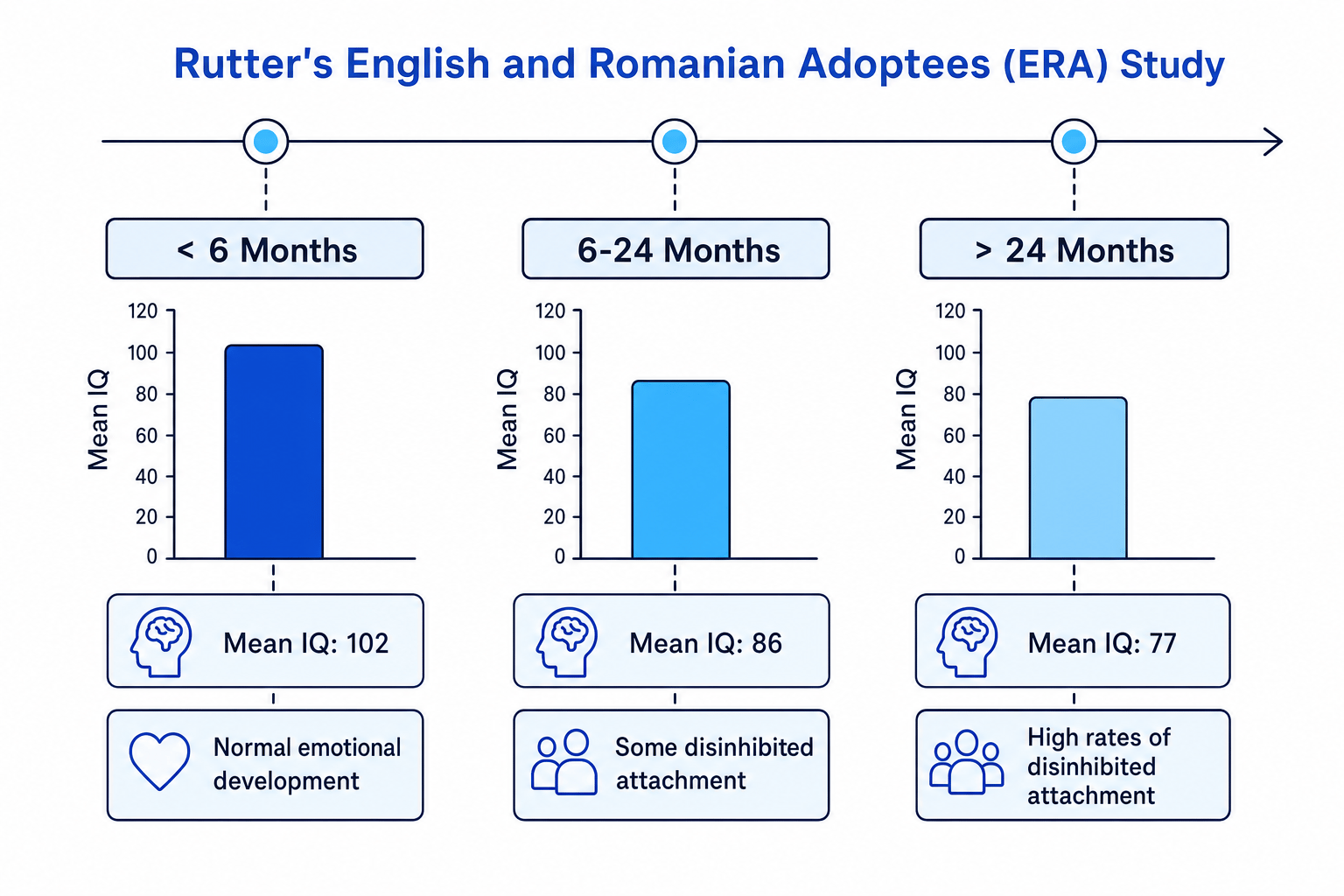
Findings: When they first arrived in the UK, half the adoptees showed signs of delayed intellectual development and the majority were severely undernourished. At age 11, the adopted children showed differing rates of recovery that were directly linked to their age of adoption:
- Adopted before 6 months: Mean IQ was 102 (normal range).
- Adopted between 6 and 24 months: Mean IQ was 86.
- Adopted after 24 months: Mean IQ was 77.
These differences remained at age 16.
In terms of attachment, children adopted after six months showed signs of a particular attachment style called disinhibited attachment. Symptoms include attention-seeking, clinginess, and social behaviours directed indiscriminately towards all adults (both familiar and strangers). Children adopted before the age of six months rarely displayed this attachment type.
Applying Rutter's findings to a scenario
In the exam, you might get an AO2 scenario like this: Toby spent the first three years of his life in an overcrowded orphanage with a high turnover of staff. He has recently been adopted by a British family. Using research into institutionalisation, explain what developmental outcomes Toby's adoptive parents might expect to see.
To secure full marks, you need to systematically apply the findings of Rutter's study to Toby:
- Identify the key variable in the scenario: Toby's age of adoption is three years old (> 24 months).
- Apply the intellectual outcome: According to Rutter's ERA study, children adopted after 24 months had a lower mean IQ (around 77) compared to those adopted earlier. Therefore, Toby's parents might expect him to show delayed intellectual development or struggle cognitively.
- Apply the emotional outcome: Toby was adopted long after the six-month mark, meaning he is at high risk of displaying disinhibited attachment.
- Describe the specific behaviours expected: Toby's parents might notice him being highly clingy, attention-seeking, and showing indiscriminate affection even to strangers, treating them the same as his adoptive parents.
Zeanah et al.'s Bucharest Early Intervention Project (2005)
Zeanah assessed attachment in 95 children aged 12–31 months who had spent most of their lives in institutional care. They were compared to a control group of 50 children who had never lived in an institution. Their attachment type was measured using the Strange Situation. Furthermore, carers were asked about unusual social behaviours (symptoms of disinhibited attachment).
Findings:
- 74% of the control group were classed as securely attached.
- Only 19% of the institutionalised group were securely attached.
- 65% of the institutionalised group were classified as having a disorganised attachment (a mix of resistant and avoidant behaviours).
- 44% of the institutionalised children fit the description of disinhibited attachment, compared to just 20% of the controls.
Disinhibited Attachment Explained
Why do institutionalised children develop disinhibited attachment? Rutter (2006) explained it as an adaptation to living with multiple caregivers during the sensitive period. In poor quality institutions, a child might have 50 different carers but doesn't spend enough time with any one of them to form a secure attachment. Therefore, they treat all adults indiscriminately.
Evaluating the Romanian Orphan Studies (AO3)
Real-world application: Studying the Romanian orphans has enhanced our understanding of the effects of institutionalisation. This has led to major improvements in the way children are cared for in institutions. For example, orphanages and children's homes now avoid having large numbers of caregivers for each child. Instead, they ensure that one or two people (a 'key worker') play a central role for the child. This gives the child a chance to develop normal attachments.
Fewer extraneous variables: There were many orphan studies before the Romanian orphans became available to study (e.g., children orphaned during WWII). However, those children often experienced trauma, bereavement, or abuse before being institutionalised. It was hard to separate the effects of institutionalisation from the effects of their previous trauma (these acted as confounding participant variables). In the case of the Romanian orphans, most were handed over by loving parents simply because they could not afford to keep them. This means the findings have higher internal validity.
Lack of adult data: The latest data from the ERA study looked at the children in their early-to-mid twenties. We do not yet have data on the long-term effects of early institutional care. We do not know if these individuals will experience late-onset mental health issues or struggle to form romantic relationships and parent their own children. It will take a long time to gather this data because of the longitudinal design.
Ethical issues in the BEIP study
In Zeanah's Bucharest Early Intervention Project, the researchers randomly allocated the institutionalised children to either remain in the institution or be placed in foster care. While this is methodologically excellent (it removes confounding variables), it raises serious ethical issues. Some children were deliberately left to suffer in a poor-quality institution when foster care was available.
In the exam
- Be precise with terminology: Do not use 'separation' and 'deprivation' interchangeably. Deprivation refers to the loss of emotional care; separation is just physical absence.
- Keep the studies distinct: Bowlby's 44 thieves study is evidence for maternal deprivation. Rutter's ERA study and Zeanah's BEIP study are evidence for the effects of institutionalisation. Do not mix them up in an essay.
- Use the specific IQ numbers: If an essay asks you to outline the effects of institutionalisation, quoting Rutter's specific mean IQ scores (102, 86, 77) shows excellent AO1 detail.
- Structure AO3 paragraphs clearly: If evaluating Bowlby with the Koluchová twins, make sure you explain why it is a limitation (it challenges the idea of a strict 'critical period' and suggests a 'sensitive period' instead).
Check yourself
- Can you define affectionless psychopathy and name the key study Bowlby used to investigate it?
- According to Rutter's ERA study, what is the crucial age cut-off for adoption that determines whether a child is likely to develop disinhibited attachment?
- How does the concept of a 'sensitive period' challenge Bowlby's original idea of a 'critical period'?
- What is one major real-world application that has come from the Romanian orphan studies?