Before psychologists can diagnose or treat mental health conditions, they face a fundamental problem: how do we actually define what is "abnormal"? What separates a quirky personality trait from a clinical psychological disorder?
In this topic, you will learn:
- The four main definitions psychologists use to classify abnormality.
- How to apply these definitions to real-world clinical examples.
- The strengths and limitations of each approach (AO3 evaluation), particularly regarding cultural bias and subjectivity.
Let's walk through the four definitions one by one.
1. Statistical Infrequency
The most objective way to define abnormality is simply to look at the numbers.
Statistical Infrequency
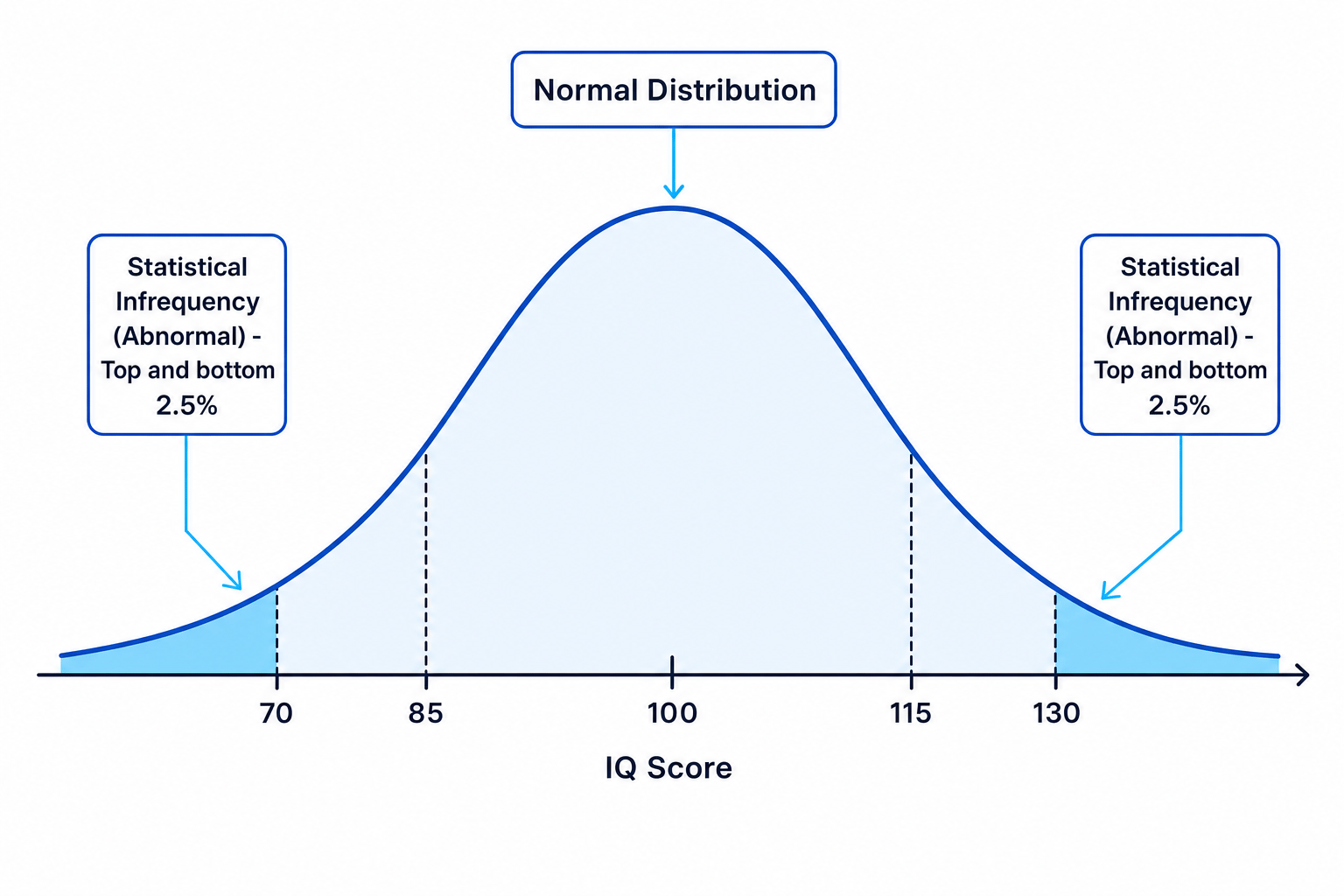
This definition states that any behaviour or characteristic that is mathematically rare in the general population is considered abnormal. If the vast majority of people behave in a certain way, that is "normal". Anyone falling outside that statistical cluster is "abnormal".
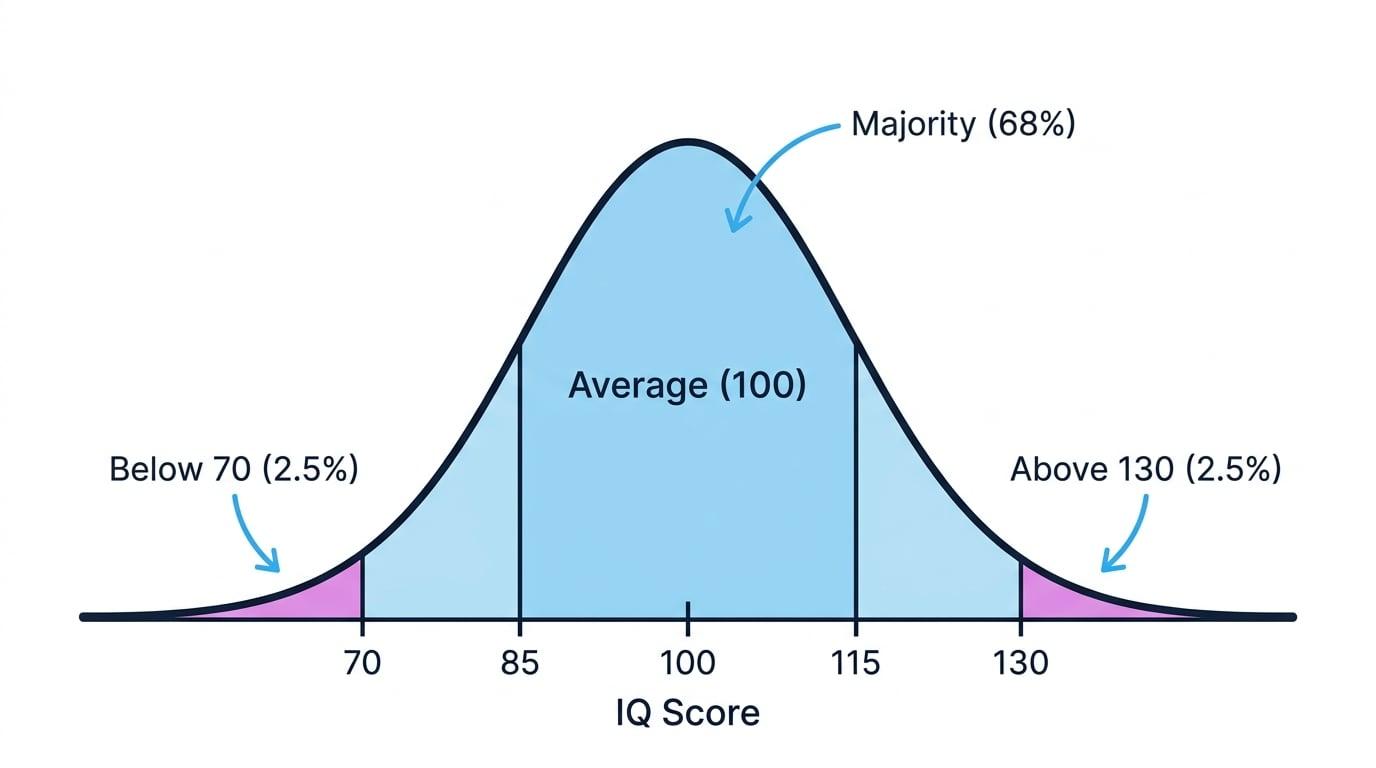
The classic example of statistical infrequency is intelligence. Human intelligence is spread across the population in a pattern called a normal distribution. The average IQ is 100. Most people (around 68%) have a score somewhere between 85 and 115.
However, about 2.5% of the population score below 70, and another 2.5% score above 130. According to the statistical infrequency definition, the scores in these extreme tails of the curve are statistically abnormal. In clinical practice, an individual with an IQ score where IQ<70IQ < 70IQ<70 might be diagnosed with intellectual disability disorder (previously known as mental retardation), provided they also show a failure to function adequately.
Evaluating Statistical Infrequency (AO3)
Strength: Real-world application. This definition is highly useful in clinical practice. All assessments of patients with mental disorders involve some comparison to statistical norms (e.g., using a standardised scale for depression to see how severe the patient's symptoms are compared to the baseline population).
Weakness: Unusual traits can be positive. Just because a behaviour is rare doesn't mean it requires treatment. An IQ over 130 is statistically abnormal, but we do not view super-intelligence as an undesirable trait that needs curing. Therefore, statistical infrequency cannot be used alone to make a clinical diagnosis.
Weakness: Where do we draw the line? The cut-off points are entirely arbitrary. If a diagnosis of intellectual disability disorder requires an IQ below 70, a person with an IQ of 69 is classified as abnormal, while someone with an IQ of 70 is completely normal.
2. Deviation from Social Norms
Instead of looking at maths, this definition looks at society.
Every society establishes unwritten rules for acceptable behaviour. These rules are known as social norms.
Deviation from Social Norms
This definition suggests that behaviour is abnormal if it violates the unwritten rules and expectations of the society or culture the person belongs to.
For example, Antisocial Personality Disorder (psychopathy) is characterised by impulsive, aggressive, and irresponsible behaviour. A core symptom is the absence of prosocial internal standards—meaning they fail to conform to culturally expected ethical behaviour.
Confusing rules and laws
Don't just write about criminals breaking the law. Deviation from social norms is about unwritten social rules. Standing far too close to a stranger in an empty lift isn't illegal, but it severely deviates from the social norm of personal space.
Evaluating Deviation from Social Norms (AO3)
Weakness: Cultural relativism. Social norms vary wildly from one generation to the next and from one community to another. For example, hearing voices is considered a sign of mental illness (like schizophrenia) in the UK, but in some indigenous cultures, it is viewed as a socially acceptable, positive spiritual experience. This means there is no universal, objective standard for abnormality.
Weakness: Human rights abuses. Relying on social norms to dictate mental health can be dangerous. In the past, this definition was used to control minority groups. For example, in the 19th century, enslaved people who tried to run away were diagnosed with "drapetomania". Historically, homosexuality was classified as a mental disorder simply because it deviated from the social norms of the time.
3. Failure to Function Adequately
Sometimes, being a bit unusual or breaking a social rule isn't actually a problem. It only becomes a clinical issue when the person can no longer cope with the demands of everyday life.
Failure to Function Adequately
A person is considered abnormal if they are unable to cope with the ordinary demands of day-to-day living, such as maintaining basic hygiene, eating properly, or holding down a job.
Psychologists Rosenhan and Seligman (1989) proposed several signs that indicate a person is failing to function adequately:
- They experience severe personal distress.
- Their behaviour is irrational or dangerous to themselves or others.
- Their behaviour causes observer discomfort (they make the people around them feel uncomfortable).
Applying Rosenhan and Seligman's criteria
Imagine an exam question describes "Sarah", who has stopped leaving her house, hasn't washed in two weeks, and cries when her friends try to visit her. To apply the failure to function adequately definition, you must systematically match her behaviour to the criteria:
- Identify the inability to cope with daily life: Sarah is no longer washing (failing to maintain basic personal hygiene).
- Identify personal distress: Sarah is crying frequently, showing severe emotional distress.
- Identify observer discomfort: Her friends are trying to visit but her behaviour is likely making it distressing and uncomfortable for them to interact with her.
Evaluating Failure to Function Adequately (AO3)
Strength: Represents the patient's perspective. Unlike statistical infrequency, this definition acknowledges the subjective experience of the patient. It captures the very real distress that prompts people to seek psychiatric help in the first place.
Weakness: Subjective judgements. Who decides what is "adequate"? A patient might feel they are coping fine, but a psychiatrist might disagree. The concept of observer discomfort is highly subjective—someone living an eccentric alternative lifestyle (e.g., living entirely off-grid without running water) might make observers uncomfortable, but they are not necessarily mentally ill.
4. Deviation from Ideal Mental Health
The first three definitions try to define what makes someone "abnormal". Marie Jahoda (1958) took a completely different approach. She argued that instead of looking for signs of sickness, we should define what makes someone perfectly psychologically healthy. Anyone who deviates from this ideal state of health is therefore abnormal.
Deviation from Ideal Mental Health
This definition identifies specific criteria for psychological wellness. If an individual does not meet these criteria, their behaviour is classified as abnormal.
Jahoda proposed six criteria for optimal mental health:
- Positive self-attitude: Having high self-esteem and a strong sense of identity.
- Self-actualisation: Reaching your full potential in life.
- Resistance to stress: Having good coping mechanisms for everyday anxieties.
- Autonomy: Being independent and self-regulating.
- Accurate perception of reality: Seeing the world without distortion.
- Environmental mastery: Being able to adapt to new situations and succeed in work, love, and friendships.
Remembering Jahoda's Criteria
Use the mnemonic PRAISE: Personal growth (Self-actualisation) Reality perception Autonomy Integration (Resistance to stress) Self-attitude Environmental mastery
Evaluating Deviation from Ideal Mental Health (AO3)
Strength: A comprehensive approach. This definition covers a broad range of criteria for mental health. It gives patients a very clear, positive set of goals to work towards during therapy, rather than just focusing on their negative symptoms.
Weakness: Unrealistically high standards. Very few people achieve all of Jahoda's criteria at the same time. For example, most people struggle to resist stress from time to time, and achieving true "self-actualisation" is incredibly rare. Under this definition, almost everyone would be classified as abnormal.
Weakness: Cultural bias (Ethnocentrism). Jahoda's criteria are heavily rooted in Western, individualist cultures (like the USA and UK). Concepts like "autonomy" and "self-actualisation" prioritise the individual. In collectivist cultures (like many in Asia), independence is less highly valued than community success, meaning this definition cannot be universally applied.
In the exam
- Spot the trigger words: If an AO2 scenario mentions someone being "in the bottom 5%", apply statistical infrequency. If it mentions them "quitting their job and not getting dressed", apply failure to function.
- Combine for full marks: Remember that no single definition works perfectly in isolation. A strong essay conclusion points out that clinical diagnosis usually requires a combination of definitions (e.g., a statistically rare symptom that also causes a failure to function).
- Use the 'Cultural Bias' shortcut: Cultural relativism is a valid evaluation point for Deviation from Social Norms, Failure to Function Adequately, and Deviation from Ideal Mental Health. Learn it well, as it is highly versatile in a 16-mark essay!
Check yourself
- Which definition relies on identifying behaviour that is mathematically rare?
- What are two of Jahoda's criteria for ideal mental health?
- Why might relying purely on 'deviation from social norms' lead to human rights abuses?