What you'll learn
- What the fight or flight response is and why it is useful for survival.
- How the sympathetic branch of the autonomic nervous system activates the body.
- The role of adrenaline in producing physical changes like a racing heart and faster breathing.
- How to apply and evaluate this explanation in AQA A-Level Psychology answers.
The big idea: a biological emergency response
A stressor is anything that is perceived as threatening or demanding. It can be physical, like seeing a dangerous animal, or psychological, like being called on unexpectedly in class.
The fight or flight response is the body’s rapid reaction to an acute stressor, meaning a short-term, immediate threat. It prepares you either to confront the threat, which is fight, or escape it, which is flight.
Fight or flight response
The fight or flight response is an automatic physiological reaction to perceived danger, involving activation of the sympathetic nervous system and release of adrenaline to prepare the body for action.
Walter Cannon is usually credited with describing the fight or flight response in the early 20th century. The key idea is that the body changes very quickly so that energy is directed towards survival.
Prerequisite: the autonomic nervous system
The nervous system is the body’s communication network. It uses electrical and chemical signals to send information between the brain, spinal cord and body.
For this topic, the important part is the autonomic nervous system, often shortened to ANS.
Autonomic nervous system
The autonomic nervous system is the part of the nervous system that controls involuntary bodily functions, such as heart rate, breathing, digestion and pupil size.
The ANS has two main branches:
- The sympathetic branch, which arouses the body and prepares it for action.
- The parasympathetic branch, which calms the body back down after the threat has passed.
Two branches, opposite jobs
The sympathetic branch is like the body’s accelerator; the parasympathetic branch is like the brake that helps restore normal functioning.
Sympathetic does not mean kind
In biopsychology, sympathetic does not mean caring or emotionally sympathetic. It means the branch of the ANS that increases physiological arousal.
Prerequisite: the endocrine system
The endocrine system is a second communication system in the body. Instead of using nerve impulses, it uses hormones, which are chemical messengers carried in the bloodstream.
A gland is an organ that releases substances. In this topic, the key glands are the adrenal glands, which sit above the kidneys. The inner part of each adrenal gland is called the adrenal medulla.
Adrenaline
Adrenaline is a hormone released by the adrenal medulla during sympathetic arousal. It travels in the bloodstream and produces body-wide changes that prepare the organism for fight or flight.
Nerve signals are very fast and targeted. Hormones are usually slower but can have widespread effects because they travel through the blood. The fight or flight response uses both systems together.
The fight or flight sequence
The main pathway involved in the immediate fight or flight response is sometimes called the sympathomedullary pathway, or SAM pathway. This means the sympathetic nervous system activates the adrenal medulla.
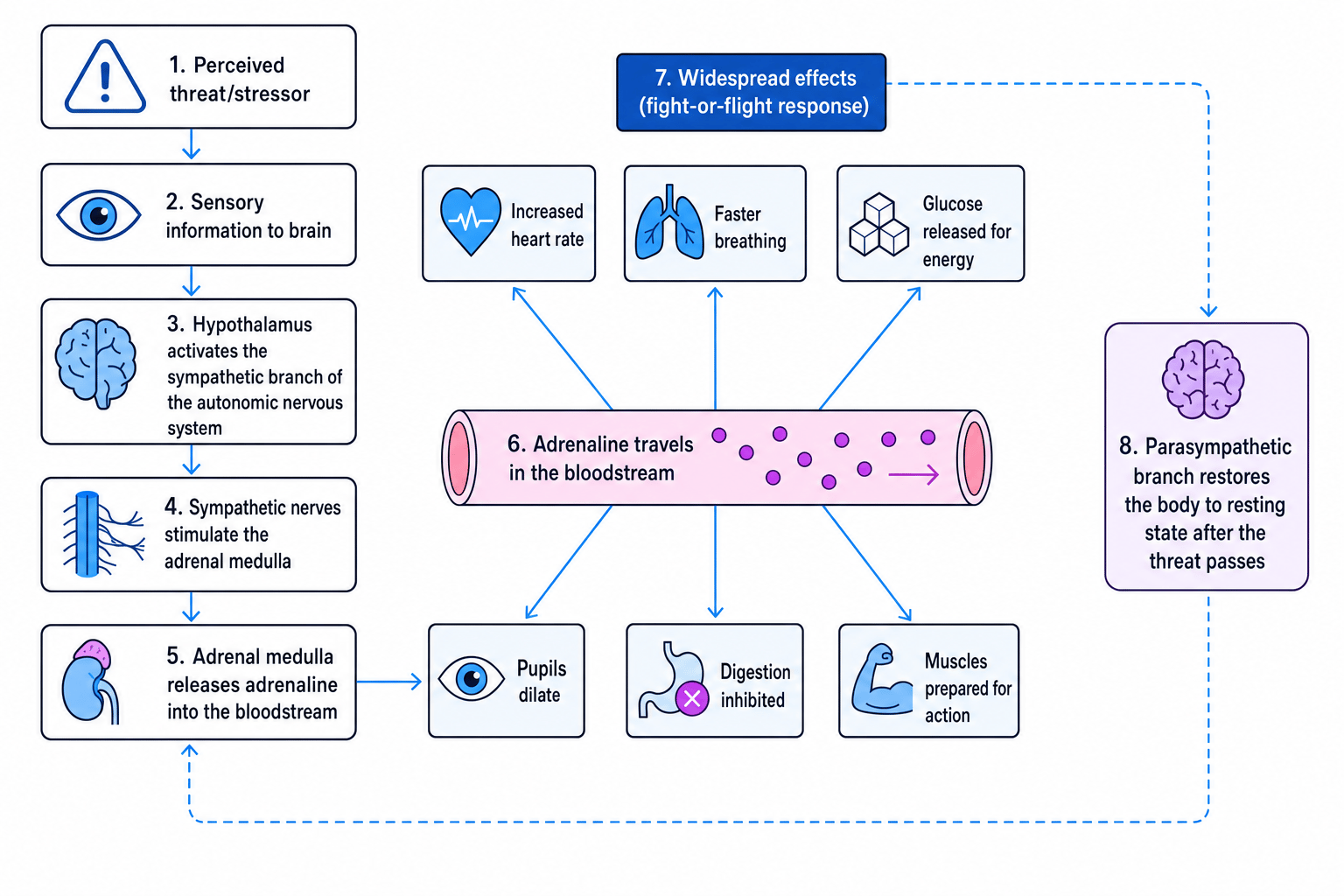
The sequence below shows how a perceived threat becomes a body-wide response.
Step-by-step AO1 description
- A threat is perceived by the brain. Sensory information enters the brain and is interpreted as potentially dangerous.
- The hypothalamus, a small brain area involved in regulating bodily states, activates the sympathetic branch of the ANS.
- Sympathetic nerves stimulate the adrenal medulla.
- The adrenal medulla releases adrenaline into the bloodstream.
- Adrenaline affects target organs, such as the heart, lungs and liver.
- The body becomes physiologically aroused and ready for action.
- When the threat passes, the parasympathetic branch helps return the body to its resting state.
The chain to remember
Threat → hypothalamus → sympathetic ANS → adrenal medulla → adrenaline → physical changes → fight or flight.
Explaining a sudden-threat scenario
Imagine you hear a loud crash downstairs at night. Your heart pounds, your breathing speeds up, and you feel ready to run or investigate.
- Identify the situation as an acute stressor because it is sudden and potentially threatening.
- Link the threat to the hypothalamus, which activates the sympathetic branch of the autonomic nervous system.
- Explain that sympathetic nerves stimulate the adrenal medulla, causing adrenaline to be released into the bloodstream.
- Match the symptoms to adrenaline: a pounding heart increases blood flow, faster breathing increases oxygen intake, and energy is made available for muscles.
- Conclude that these changes prepare the person for fight by investigating the threat or flight by escaping.
What adrenaline does to the body
Adrenaline prepares the body for rapid, energetic action. It does this by changing how key organs work.
| Body change | Why it helps in fight or flight |
|---|---|
| Heart rate increases | More blood can be pumped to working muscles. |
| Breathing rate increases | More oxygen enters the body for energy release. |
| Blood glucose increases | Muscles have more immediately available energy. |
| Pupils dilate | More light enters the eyes, improving visual awareness. |
| Digestion is inhibited | Energy is not wasted on non-urgent processes. |
| Sweating may increase | Helps cool the body during physical effort. |
| Alertness increases | Attention is focused on the threat. |
A target organ is an organ affected by a hormone. For adrenaline, target organs include the heart, lungs, liver and blood vessels.
AO2 symptom links
If a scenario mentions a racing heart, rapid breathing, shaking, dry mouth, sweating or feeling sick, link these symptoms to adrenaline and sympathetic arousal preparing the body for action.
Recovery: returning to normal
The body cannot stay in fight or flight forever. Once the threat has passed, the parasympathetic branch of the ANS helps restore homeostasis, which means maintaining a stable internal state.
This is sometimes described as “rest and digest”. Heart rate and breathing slow down, digestion resumes, and adrenaline is gradually broken down.
Adrenaline is not the whole stress response
For this AQA sub-topic, focus on adrenaline and the sympathetic nervous system. Cortisol is more strongly linked to the slower hypothalamic-pituitary-adrenal axis, especially in longer-term stress.
Applying the response to everyday stress
In modern life, many stressors are psychological rather than physical. For example, before a driving test or a presentation, your body may respond as if you need to run or fight, even though the best response is to stay calm and think clearly.
This is why the fight or flight response can feel unpleasant. A racing heart and shaky hands are not necessarily signs that something is “wrong”; they can be normal effects of adrenaline.
Evaluation: strengths and limitations
Strength: survival value
The fight or flight response has clear evolutionary value. For our ancestors, rapid physical preparation would have increased the chance of surviving predators, attacks or other immediate dangers.
This makes the explanation biologically plausible: the bodily changes fit the demands of action. Faster breathing, increased heart rate and extra glucose are exactly the kinds of changes needed for physical effort.
Strength: scientific support
The fight or flight response can be studied using objective biological measures, such as heart rate, blood pressure and adrenaline levels. This supports psychology’s scientific status because researchers are not relying only on self-report.
Cannon’s early work helped identify bodily changes during threat, although some of his research involved animals and invasive methods. By modern ethical standards, animal research must consider harm, necessity and whether benefits justify costs.
Limitation: not everyone fights or flees
The phrase “fight or flight” can oversimplify behaviour. Some people and animals show freezing, where they become still and highly alert. Freezing may reduce detection and allow time to assess the danger.
Taylor et al. (2000) also argued that females may sometimes show a tend-and-befriend response. This means protecting offspring and seeking social support rather than fighting or escaping. This challenges the idea that fight or flight is the universal human stress response.
Limitation: possible gender bias
Much early stress research used male animals or male participants, partly to avoid hormonal variation. Taylor et al. (2000) argued that this may have led psychologists to overemphasise male-typical responses to stress.
This matters because an explanation that claims to apply to all humans should be based on evidence from a range of people.
Limitation: modern stressors are different
The fight or flight response is most useful for short-term physical danger. However, modern stressors often include exams, work deadlines, social judgement or financial worries. Running away or fighting is usually not helpful.
Repeated sympathetic arousal may also be harmful if stress is frequent. For example, regularly increased heart rate and blood pressure can place strain on the cardiovascular system. However, be careful not to blame all long-term stress effects on adrenaline alone, because other systems such as the HPA axis are also involved.
Research methods and ethics
Laboratory stress studies can control variables carefully, but artificial tasks may lack ecological validity. Real-life stress research may be more realistic, but it is harder to control extraneous variables.
When humans are placed under stress in research, psychologists must consider informed consent, right to withdraw, protection from harm, confidentiality and debriefing. Researchers should not expose participants to excessive distress simply to observe a stress response.
In the exam
- For AO1, write the sequence clearly: threat, hypothalamus, sympathetic ANS, adrenal medulla, adrenaline, physiological changes.
- For AO2, link scenario symptoms directly to adrenaline, such as increased heart rate, faster breathing, glucose release or inhibited digestion.
- For AO3, evaluate by discussing survival value, scientific support, freezing, tend-and-befriend, gender bias, modern stressors and ethical issues in stress research.
Check yourself
- Can you explain how the sympathetic nervous system and adrenal medulla work together?
- What are three physical effects of adrenaline, and why are they useful?
- Why might “fight or flight” be an incomplete explanation of human stress responses?
