Revision notes for Edexcel AS Level Maths Quantities and Units. Open the guide for explanations and worked examples. Written against the Edexcel AS Level Maths (8MA0) specification, so the content matches what's examinable rather than general Maths background.
Quantities and Units
What you'll learn
- Recognise the SI units used in AS Mechanics.
- Distinguish between related quantities such as distance and displacement.
- Convert common units into metres, seconds and kilograms before calculating.
- Use units to check constant-acceleration answers.
Why units matter in Mechanics
In Mechanics, the numbers you calculate are only meaningful if you know what they measure. Saying a car travels “20” is incomplete: 20 m, 20 km, 20 m s⁻¹ and 20 seconds are completely different things.
Definition
Quantity, unit and SI unit
- A quantity is something measurable, such as mass, time, velocity or force.
- A unit tells you the scale used to measure the quantity, such as metres or seconds.
- An SI unit is a standard unit from the International System of Units, used so that calculations are consistent.
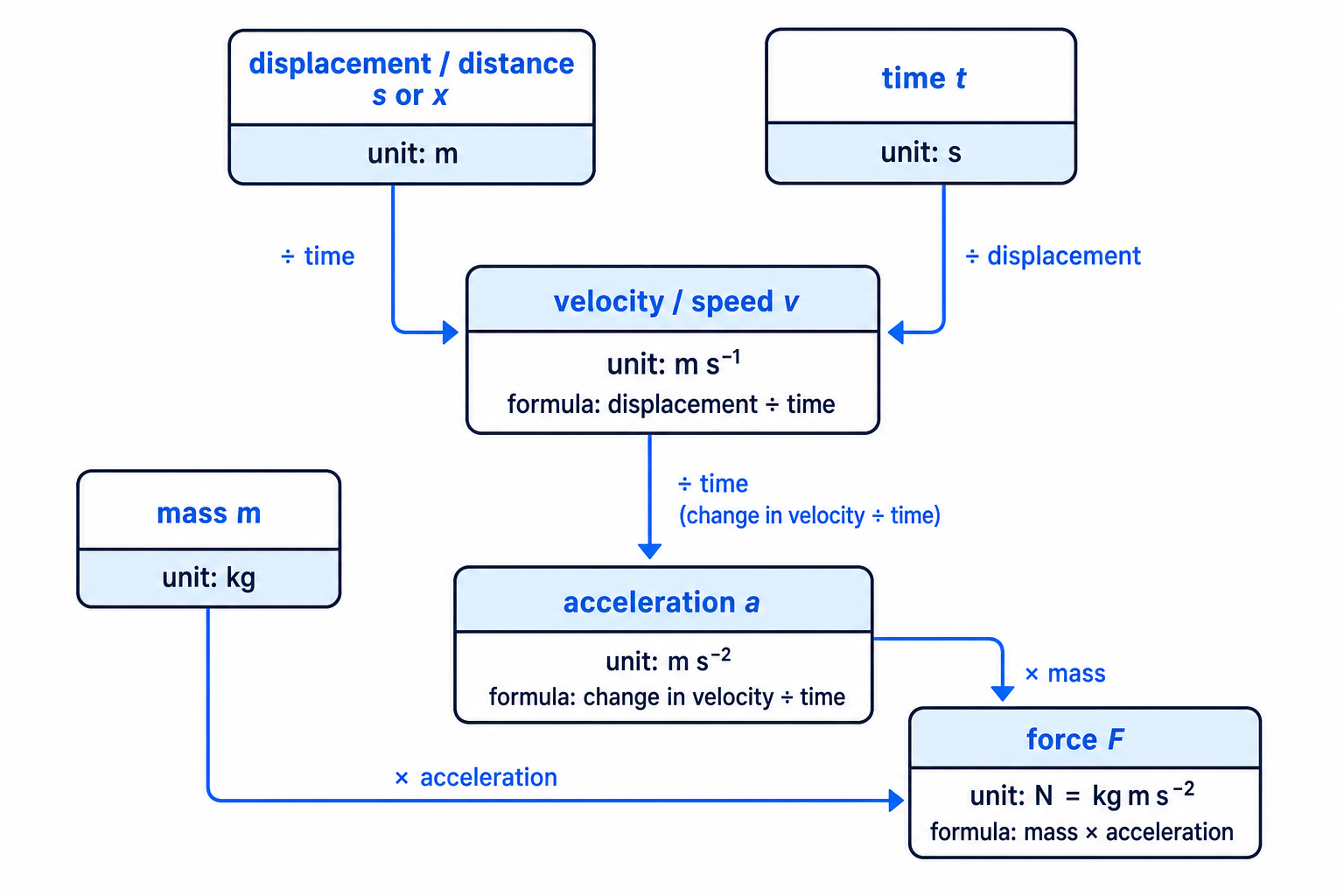
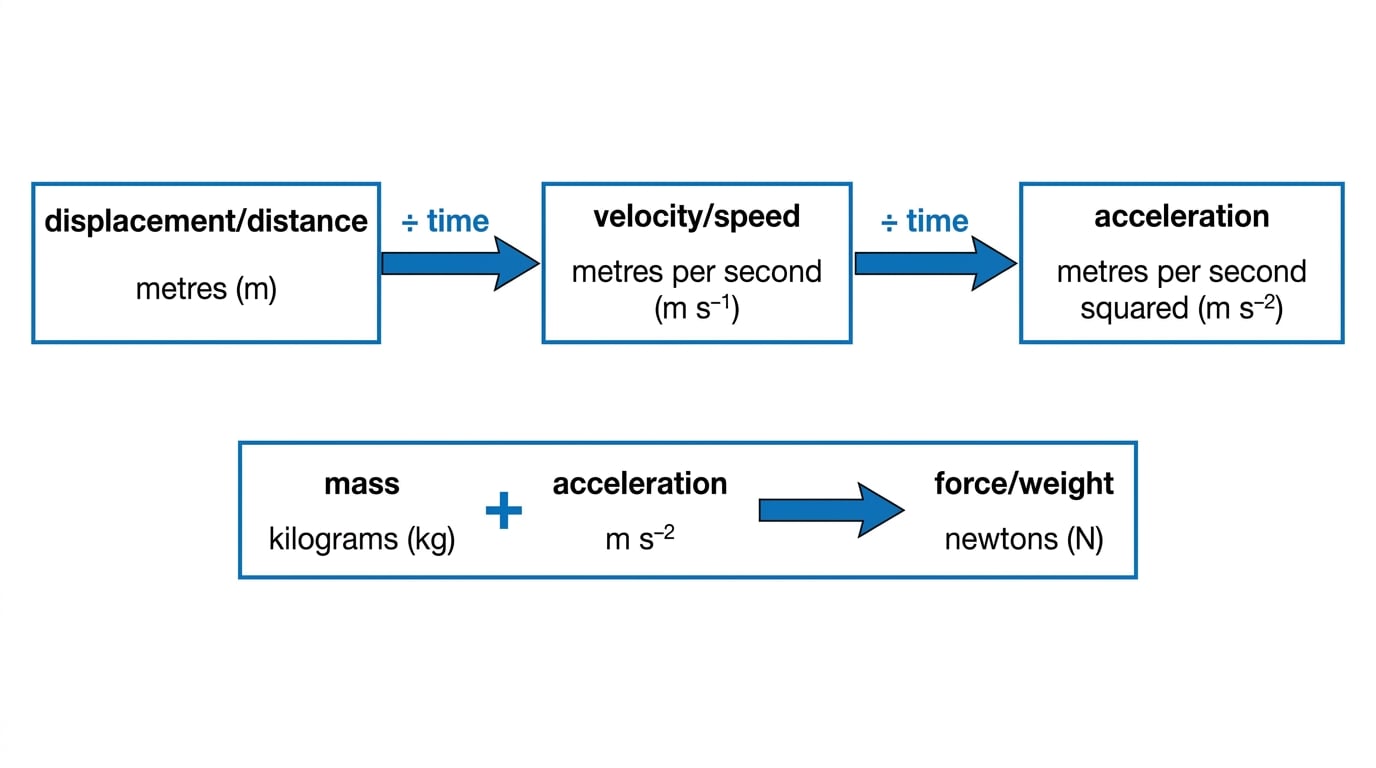
The most important SI units in this topic are metres, seconds and kilograms. Units such as m s⁻¹ and m s⁻² are built from these.
Example
Identifying mechanics quantities and units
A short mechanics description says: “A trolley of mass 4 kg moves 12 m in 3 seconds. Its acceleration is 2 m s⁻².” Identify the quantity measured by each unit.
-
The unit kg measures mass, so 4 kg is the trolley’s mass.
-
The unit m measures distance or displacement, so 12 m is a length-type quantity.
-
The unit seconds measures time, so 3 seconds is the time taken.
-
The unit m s⁻² measures acceleration, because acceleration means change in velocity per second.
-
If a force were mentioned, its SI unit would be newtons, written N.
Distance, displacement, speed and velocity
Some words in Mechanics look similar but mean different things.
Definition
Distance and displacement
- Distance is the total length travelled. It is a scalar, so it has size only.
- Displacement is the change in position from the starting point. It is a vector, so it has size and direction.
Definition
Speed and velocity
- Speed is the rate of change of distance. It is a scalar.
- Velocity is the rate of change of displacement. It is a vector, so direction matters.
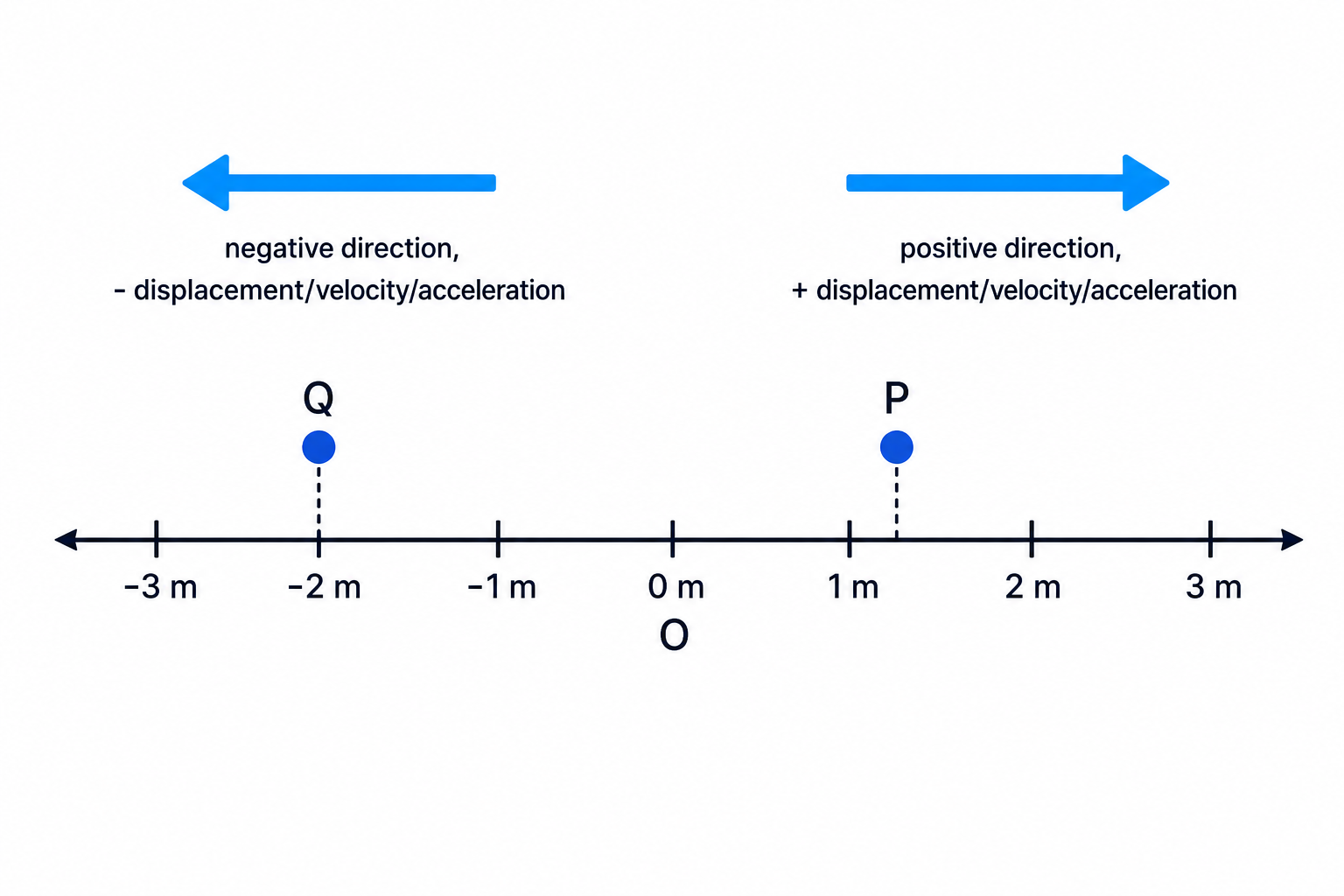
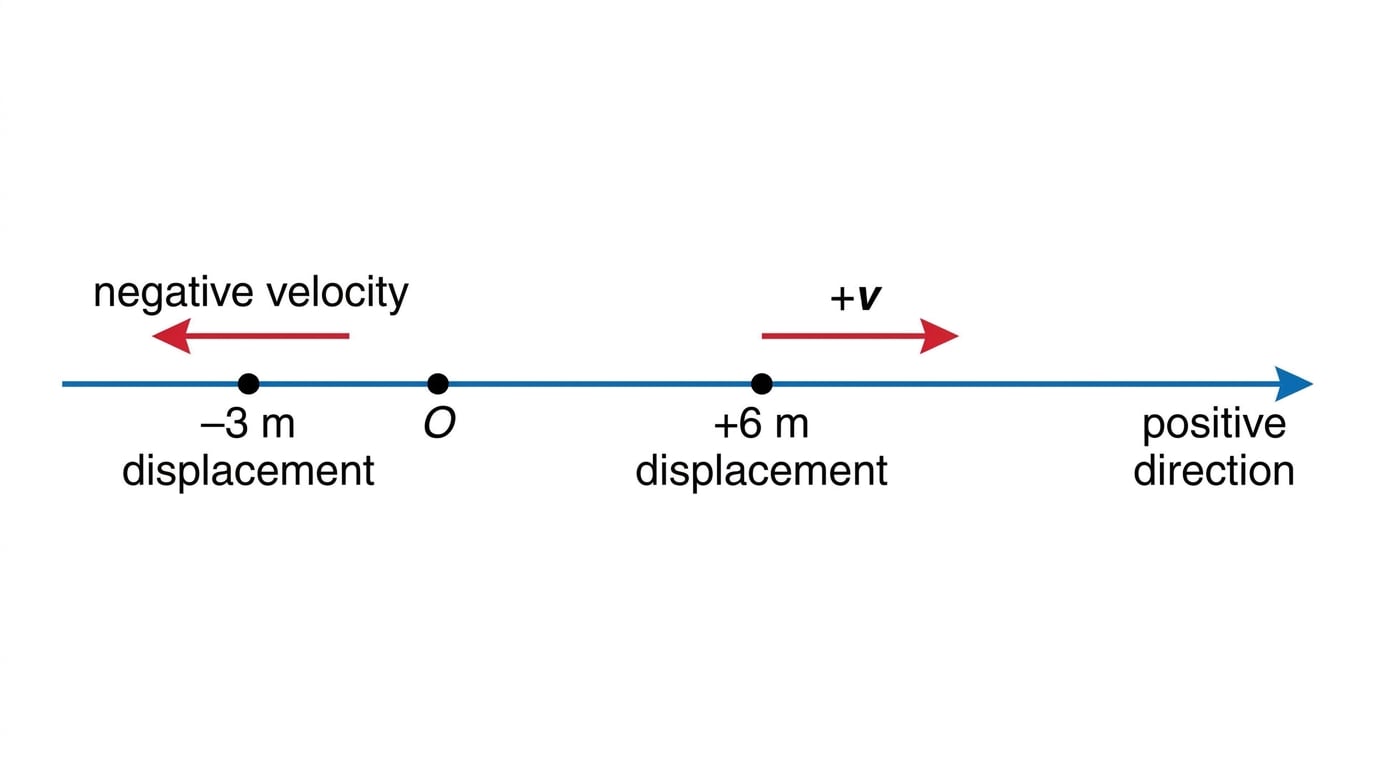
For motion in a straight line, you usually choose one direction as positive. Motion in the opposite direction is then negative.
Key Idea
Direction matters
In constant-acceleration questions, displacement, velocity and acceleration can be positive or negative depending on the chosen direction.
Example
Distance, displacement, speed and velocity
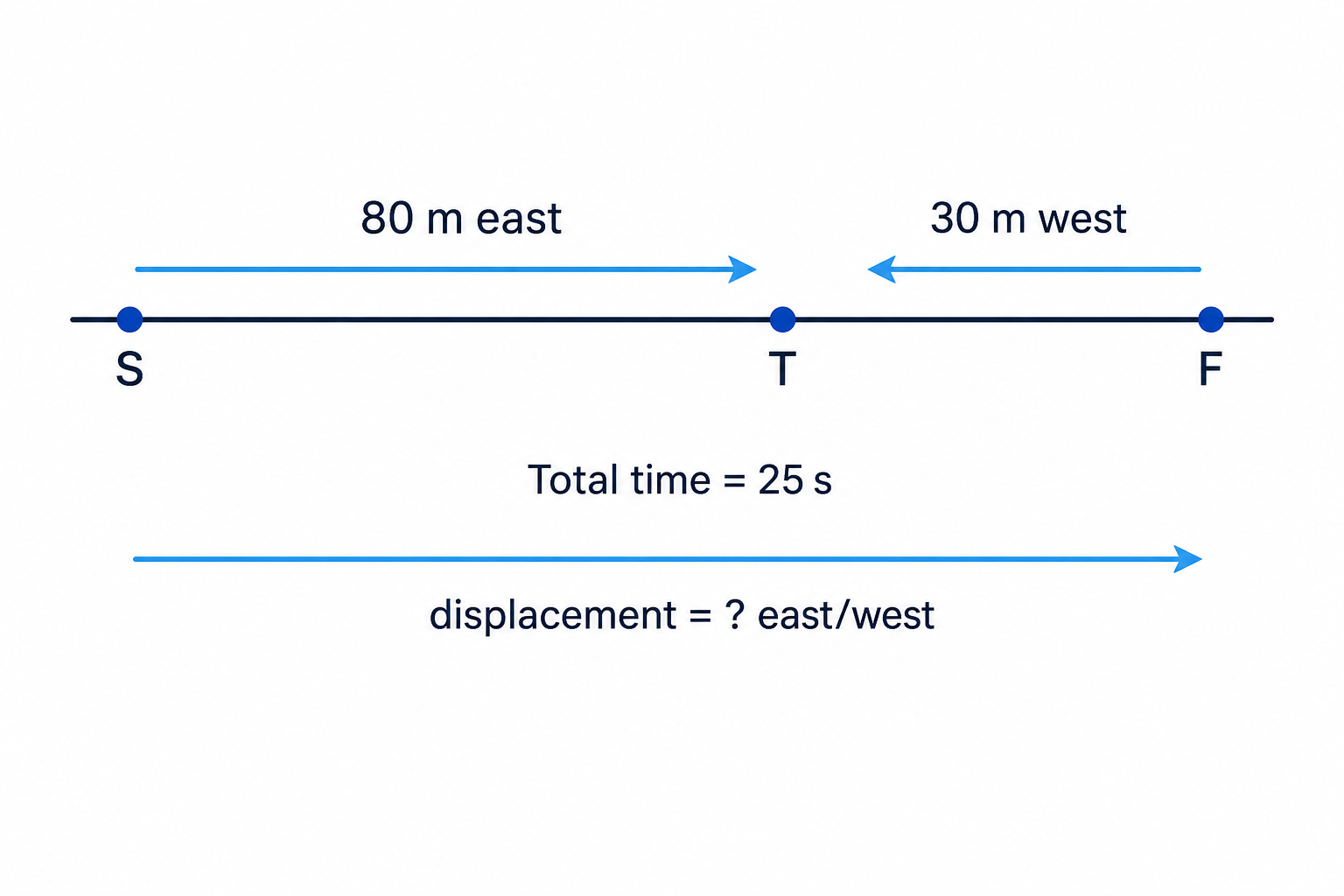
A cyclist travels 80 m east, then 30 m west. The journey takes 25 seconds. Find the distance, displacement, average speed and average velocity.
-
Distance is the total length travelled, regardless of direction:
80+30=11080 + 30 = 11080+30=110 -
The distance travelled is 110 m.
-
Take east as positive. Displacement is final position relative to the start:
80−30=5080 - 30 = 5080−30=50 -
The displacement is 50 m east.
-
Average speed uses distance divided by time:
11025=4.4\frac{110}{25} = 4.425110=4.4 -
The average speed is 4.4 m s⁻¹.
-
Average velocity uses displacement divided by time:
5025=2\frac{50}{25} = 22550=2 -
The average velocity is 2 m s⁻¹ east.
Common Mistake
Using distance when the question asks for displacement
If an object goes forwards and then backwards, do not just add all the lengths unless the question asks for distance or speed. For displacement or velocity, include direction.
Derived units
Some units are made by combining other units. These are called derived units.
Velocity is displacement divided by time, so its unit is metres per second, written m s⁻¹.
Acceleration is change in velocity divided by time, so its unit is metres per second per second, written m s⁻².
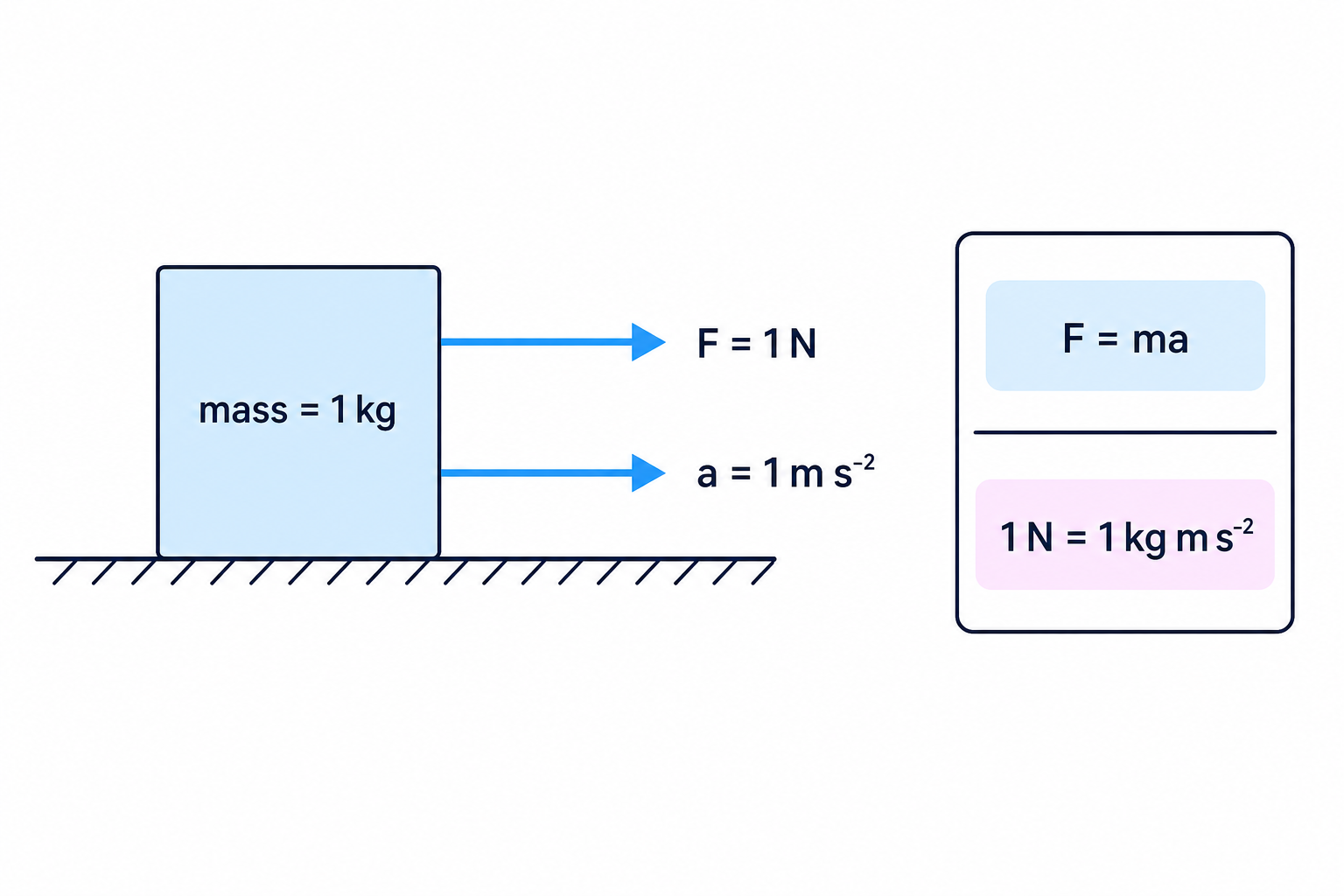
Force is measured in newtons, written N.
Definition
The newton
One newton is the force needed to give a mass of 1 kg an acceleration of 1 m s⁻². So 1 N is equivalent to 1 kg m s⁻².
Example
Finding the unit of acceleration
A particle’s velocity changes from 3 m s⁻¹ to 15 m s⁻¹ in 4 seconds. Find its acceleration and give the correct unit.
-
Acceleration is change in velocity divided by time:
a=v−uta = \frac{v - u}{t}a=tv−u -
Substitute the values:
a=15−34a = \frac{15 - 3}{4}a=415−3 -
Calculate the acceleration:
a=3a = 3a=3 -
The answer is 3 m s⁻² because acceleration is measured in metres per second squared.
Converting to SI units
Before using a Mechanics formula, convert quantities into SI units unless the question clearly says otherwise.
Useful conversions:
- 1 km = 1000 m
- 1 cm = 0.01 m
- 1 minute = 60 seconds
- 1 hour = 3600 seconds
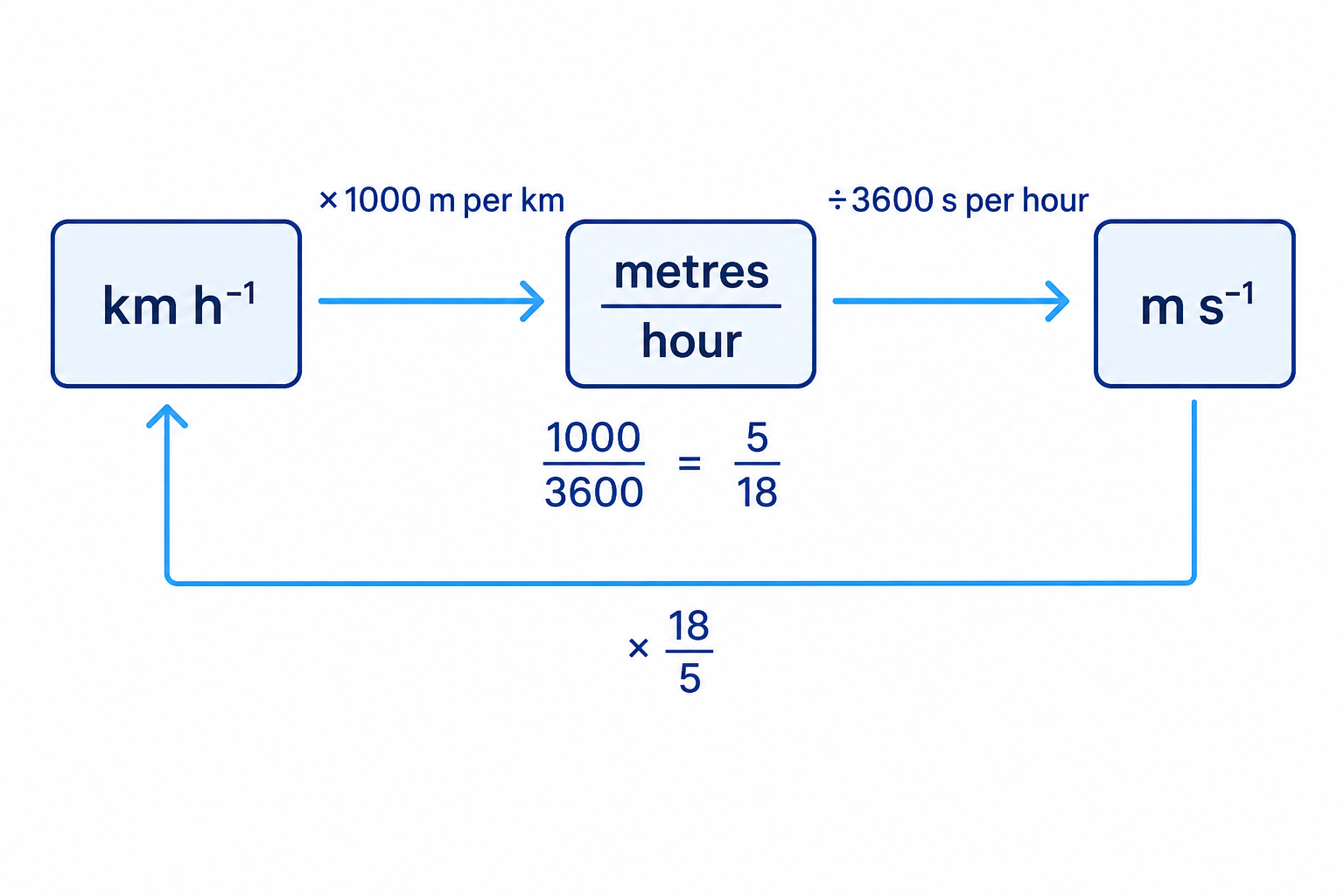
- To convert km h⁻¹ to m s⁻¹, multiply by 518\frac{5}{18}185.
Tip
Quick speed conversion
For speeds, 18 km h⁻¹ is the same as 5 m s⁻¹. So 54 km h⁻¹ is 15 m s⁻¹.
Example
Converting before calculating
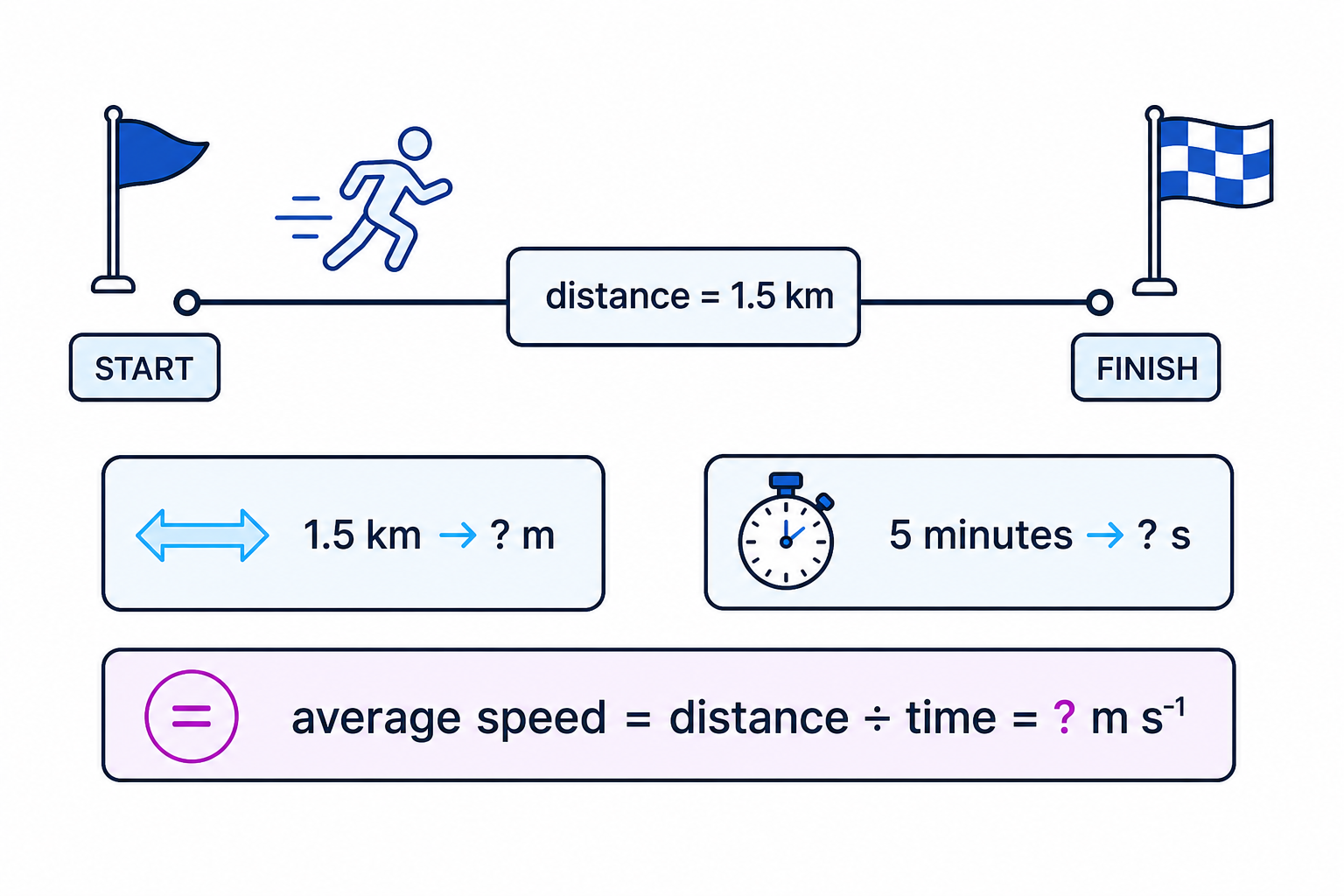
A runner covers 1.5 km in 5 minutes. Find the average speed in m s⁻¹.
-
Convert the distance into metres:
1.5×1000=15001.5 \times 1000 = 15001.5×1000=1500 -
Convert the time into seconds:
5×60=3005 \times 60 = 3005×60=300 -
Use average speed equals distance divided by time:
1500300=5\frac{1500}{300} = 53001500=5 -
The average speed is 5 m s⁻¹.
Common Mistake
Mixing kilometres and seconds
Do not calculate with 1.5 km and 300 seconds together. The number you get would not be in m s⁻¹, so it would not match the standard Mechanics units.
Units in constant acceleration formulae
Definition
Constant acceleration
Constant acceleration means the acceleration stays the same throughout the motion. In straight-line motion, this allows you to use the standard constant-acceleration formulae.
The common symbols are:
- uuu: initial velocity, in m s⁻¹
- vvv: final velocity, in m s⁻¹
- aaa: acceleration, in m s⁻²
- ttt: time, in seconds
- sss: displacement, in metres
Common Mistake
The two meanings of s
The symbol sss often means displacement, but the unit symbol s means seconds. Read the context carefully.
One useful formula is:
v=u+atv = u + atv=u+atThis makes sense in units: atatat has units m s⁻² multiplied by seconds, giving m s⁻¹, so it can be added to velocity.
Example
Using units in a constant-acceleration calculation
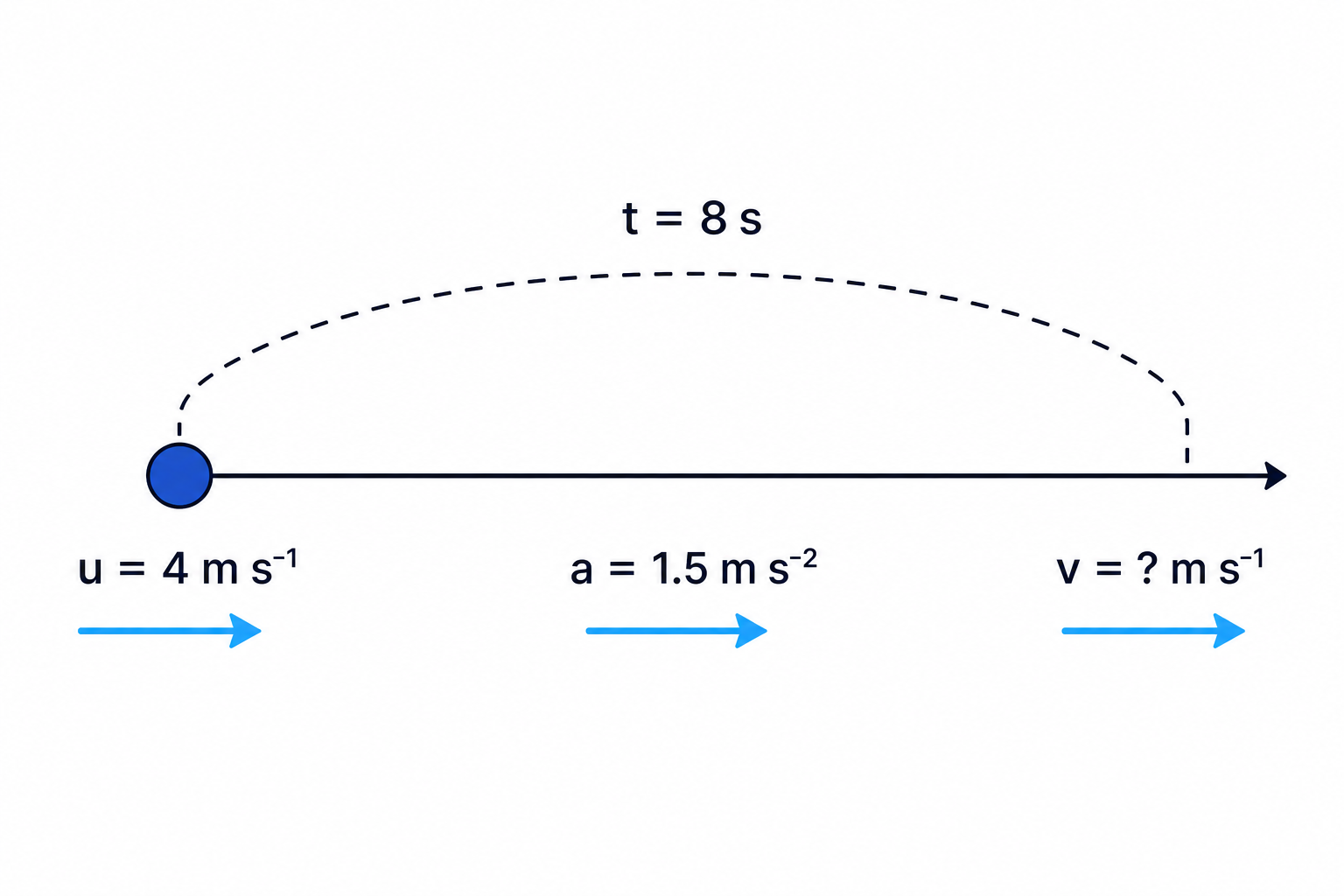
A particle has initial velocity 4 m s⁻¹ and accelerates uniformly at 1.5 m s⁻² for 8 seconds. Find its final velocity.
-
Identify the quantities:
u=4,a=1.5,t=8u = 4,\quad a = 1.5,\quad t = 8u=4,a=1.5,t=8 -
Use the formula for final velocity:
v=u+atv = u + atv=u+at -
Substitute the values:
v=4+1.5×8v = 4 + 1.5 \times 8v=4+1.5×8 -
Calculate:
v=16v = 16v=16 -
The final velocity is 16 m s⁻¹.
Checking formulae using units
Unit checking is a powerful way to spot mistakes. You can only add or subtract quantities with the same units.
For example, in the formula
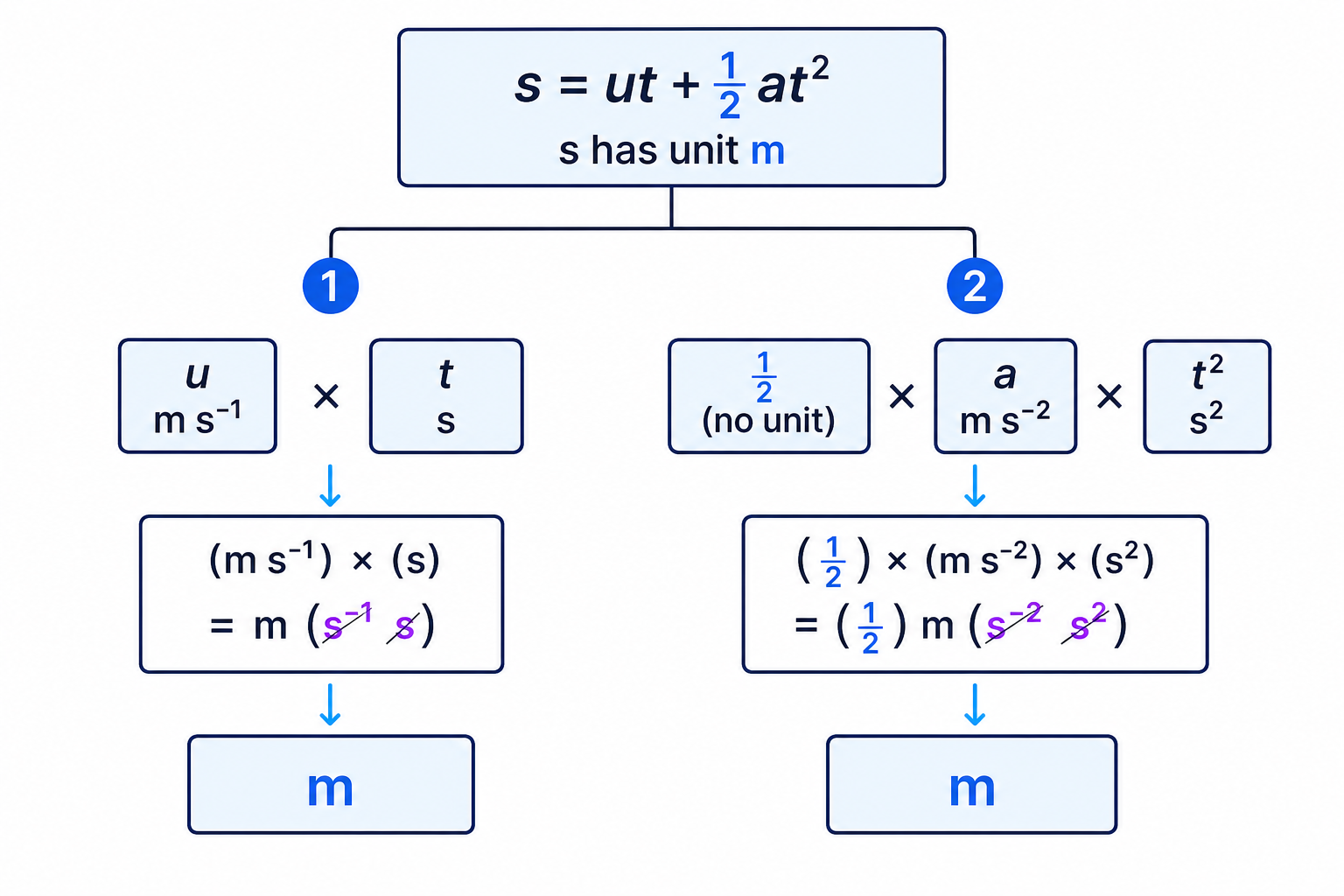
s=ut+12at2s = ut + \frac{1}{2}at^2s=ut+21at2both terms on the right must have units of metres, because sss is displacement.
Example
Checking the units in a displacement formula
Show that s=ut+12at2s = ut + \frac{1}{2}at^2s=ut+21at2 is consistent with SI units.
-
The unit of uuu is m s⁻¹ and the unit of ttt is seconds.
-
So ututut has units of metres:
m s−1×s=m\text{m s}^{-1} \times \text{s} = \text{m}m s−1×s=m -
The unit of aaa is m s⁻². The unit of t2t^2t2 is s².
-
So at2at^2at2 also has units of metres:
m s−2×s2=m\text{m s}^{-2} \times \text{s}^2 = \text{m}m s−2×s2=m -
Since both terms have units of metres, the formula is consistent.
Exam technique
In the exam
-
Write down units whenever you calculate a physical quantity, especially final answers.
-
Convert to SI units before using constant-acceleration formulae: metres, seconds, kilograms, m s⁻¹ and m s⁻².
-
Use direction signs carefully: choose a positive direction and keep it consistent.
-
Check whether your answer’s unit matches the quantity asked for.
Self review
Check yourself
-
What is the difference between distance and displacement?
-
Why is acceleration measured in m s⁻² rather than m s⁻¹?
-
If a speed is given in km h⁻¹, what should you do before using it in a Mechanics formula?

Recap questions
Test yourself with 5 quick questions on this guide. Answer them all correctly to complete it.
You've reached the end
Test yourself on this topic, or move on to the next guide.
How was this guide?