Revision notes for OCR AS Level Law Torts connected to land. Open the guide for explanations and worked examples. Written against the OCR AS Level Law specification, so the content matches what's examinable rather than general Law background.
Torts connected to land
What you'll learn
- How private nuisance protects a person’s use and enjoyment of land.
- Who can claim, who can be sued, and how courts decide whether interference is unreasonable.
- How the rule in Rylands v Fletcher works when something dangerous escapes from land.
- How to apply both torts to problem questions and evaluate their fairness and usefulness.
Big picture: land-based torts
A tort is a civil wrong: one person sues another for a legal remedy, usually damages or an injunction. In this topic, the torts are connected to land because they protect interests in land rather than general personal rights.
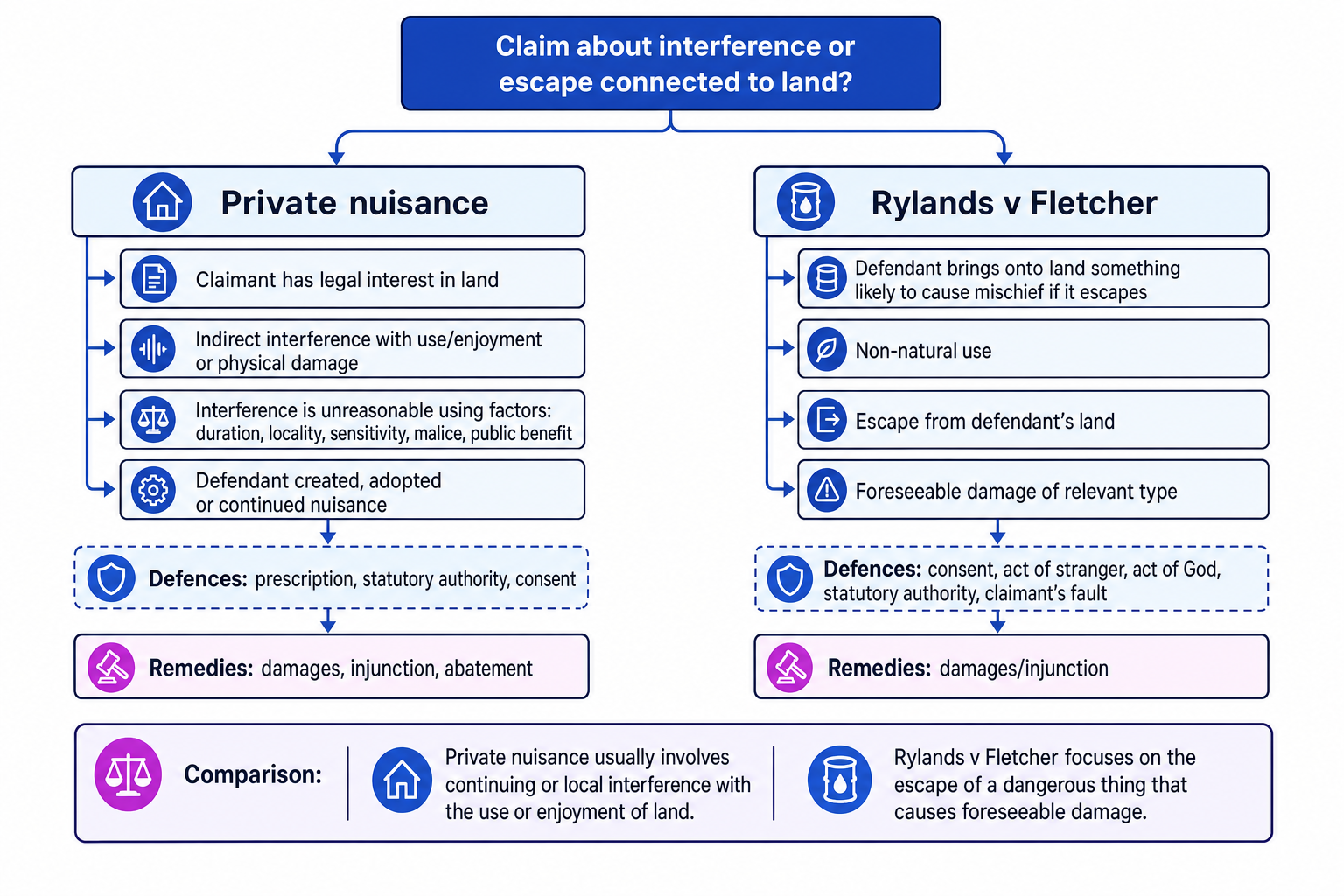
The diagram gives you the core structure before we build the details.
Definition
Damages and injunctions
Damages are money awarded to compensate the claimant. An injunction is a court order telling the defendant to stop doing something, or occasionally to take positive action.
Private nuisance
Definition
Private nuisance
Private nuisance is an unlawful indirect interference with a claimant’s use or enjoyment of land, or with rights connected to that land.
The word indirect matters. If the defendant directly walks onto the claimant’s land, that is usually trespass to land. Private nuisance is more often about things crossing over or affecting land indirectly: noise, smells, smoke, vibrations, flooding, tree roots or dust.
Who can claim?
The claimant must have a legal interest in land. This means they must own, lease, or have exclusive possession of the land.
In Hunter v Canary Wharf (1997), residents complained that a tall building interfered with television signals. The House of Lords held that private nuisance protects interests in land, so only people with a proprietary or possessory interest could claim; mere family members or licensees could not.
Common Mistake
Not everyone affected can sue
Do not write “anyone who is annoyed can claim.” Private nuisance is not a general tort of annoyance. The claimant needs a legal interest in the affected land.
What amounts to a nuisance?
Private nuisance can involve:
- Physical damage to land or property, such as smoke damaging plants or vibrations cracking walls.
- Interference with comfort or enjoyment, such as excessive noise, smells or fumes.
- Encroachment, such as tree roots spreading and damaging foundations.
In St Helen’s Smelting Co v Tipping (1865), fumes from a copper smelting works damaged trees. The court treated physical damage seriously: where land is physically damaged, the character of the area is less important.
In Halsey v Esso Petroleum (1961), noise, smell and acid smuts from an oil depot affected nearby residents. The case shows that discomfort and inconvenience can be actionable if they interfere with ordinary enjoyment of land.
When is the interference unreasonable?
Not every interference is unlawful. The court balances the claimant’s right to enjoy their land against the defendant’s right to use theirs.
Relevant factors include:
- Locality: what is unreasonable in a quiet residential area may be acceptable in an industrial area. In Sturges v Bridgman (1879), noisy confectionery machinery became a nuisance when it affected a doctor’s consulting room; “what would be a nuisance in Belgrave Square would not necessarily be so in Bermondsey.”
- Duration and timing: a short daytime disturbance may be reasonable, while repeated night-time noise may not be.
- Sensitivity of the claimant: in Robinson v Kilvert (1889), unusually sensitive paper was damaged by heat, but ordinary paper would not have been. The claim failed because the interference only affected an unusually sensitive use.
- Malice: in Christie v Davey (1893), a neighbour deliberately made noise to annoy music teachers. Malice made the conduct unreasonable.
- Public benefit: socially useful activities may be considered, but they are not an automatic defence. In Miller v Jackson (1977), cricket balls entering neighbouring land were a nuisance, although the public interest in cricket affected the remedy.
Tip
A good nuisance sentence
Private nuisance is about reasonable use of land by both sides. Your answer should sound like a balancing exercise, not a simple “the claimant was annoyed, so they win.”
Who may be sued?
The defendant may be:
- The person who created the nuisance.
- The occupier who continued or adopted it after becoming aware of it.
- Sometimes a landlord, if they authorised the nuisance or it was virtually certain to result from the letting.
In Sedleigh-Denfield v O’Callaghan (1940), a council placed a drainage pipe in a ditch, which later became blocked and caused flooding. The occupier knew or ought to have known of the danger and failed to act, so they were liable for continuing the nuisance.
In Leakey v National Trust (1980), natural soil movement caused damage to neighbouring land. The defendant occupier could be liable once they knew or ought to have known of the hazard and failed to take reasonable steps.
Defences to private nuisance
A defence is a legal argument that may defeat or reduce the claim.
The main defences are:
- Prescription: if the nuisance has continued openly for at least 20 years as a nuisance, the defendant may gain a right to continue it.
- Statutory authority: if Parliament has authorised the activity and the nuisance is an inevitable result, there may be a defence. Allen v Gulf Oil Refining (1981) involved an oil refinery authorised by statute.
- Consent, sometimes expressed using volenti non fit injuria, meaning “to a willing person, no injury is done”. This is rare and requires genuine agreement to the interference.
Common Mistake
Coming to the nuisance
It is usually not a defence to say “the claimant moved there after the activity had already started.” Sturges v Bridgman (1879) and Coventry v Lawrence (2014) confirm that “coming to the nuisance” is not normally a complete defence.
Remedies for private nuisance
The court may award:
- Damages for loss of amenity, discomfort or physical damage.
- An injunction to stop or limit the nuisance.
- Abatement, where the claimant takes reasonable steps to stop the nuisance themselves, although this can be risky and should be done carefully.
In Kennaway v Thompson (1981), noise from powerboat racing was a nuisance. The court granted an injunction but tailored it, showing that remedies can balance both parties’ interests.
In Coventry v Lawrence (2014), noise from a speedway track was a nuisance. The Supreme Court confirmed that damages may sometimes be awarded instead of an injunction, depending on fairness.
Example
Assessing private nuisance
A bakery operates loud extractor fans through the night. Priya owns the neighbouring flat. The noise keeps ordinary residents awake, and fumes mark her window frames. The bakery says the area is mixed commercial and residential, and Priya moved in after the bakery opened.
-
Identify the issue: Priya may claim private nuisance because the noise and fumes indirectly interfere with her use and enjoyment of her flat.
-
Apply who can claim: Priya owns the flat, so she has a legal interest in land under Hunter v Canary Wharf (1997).
-
Classify the interference: Night-time noise affects comfort and enjoyment, while fumes marking window frames may be physical damage. Halsey v Esso Petroleum (1961) supports nuisance through noise and fumes.
-
Assess reasonableness: The mixed locality helps the bakery, but repeated night-time disturbance is more serious. Physical damage is also harder to justify, following St Helen’s Smelting Co v Tipping (1865).
-
Consider defences and remedy: “Priya came to the nuisance” is not normally a defence. The likely conclusion is that Priya has a strong claim, with damages and possibly a limited injunction controlling night-time fan use.
Rylands v Fletcher
Definition
The rule in Rylands v Fletcher
Under Rylands v Fletcher (1868), a defendant may be strictly liable if they bring onto their land something likely to cause mischief if it escapes, make a non-natural use of land, and it escapes causing foreseeable damage.
In Rylands v Fletcher (1868), the defendant built a reservoir. Water escaped through old mine shafts and flooded the claimant’s mine. The principle is sometimes described as strict liability, meaning the claimant does not need to prove negligence.
But it is not absolute liability. The claimant must still prove the requirements, and defences may apply.
Requirement 1: bringing something onto land
The defendant must accumulate or keep something on their land for their own purposes. It must not simply be naturally present.
Examples could include large quantities of water, chemicals, gas, oil, explosives or electricity.
Requirement 2: something likely to do mischief if it escapes
The thing does not have to be dangerous in every situation. Water in a glass is harmless; water in a large reservoir may cause serious damage if it escapes.
Requirement 3: non-natural use of land
A non-natural use is a special or unusual use of land that creates an increased danger to others.
In Rickards v Lothian (1913), ordinary domestic water pipes were not a non-natural use. In Transco v Stockport MBC (2003), a water pipe serving flats leaked and damaged a gas main. The House of Lords held that ordinary water supply was not a non-natural use; the use must be extraordinary or unusual.
Requirement 4: escape
There must be an escape from land controlled by the defendant to somewhere outside that control.
In Read v Lyons (1947), an explosion occurred inside a munitions factory and injured a worker. There was no escape from the defendant’s land, so Rylands v Fletcher did not apply.
Requirement 5: foreseeable damage
In Cambridge Water Co v Eastern Counties Leather (1994), chemicals seeped into the ground and contaminated water supplies. The damage was not reasonably foreseeable at the time, so the claim failed. This case added the requirement that the type of damage must be foreseeable.
Key Idea
Modern Rylands is narrow
After Cambridge Water (1994) and Transco (2003), Rylands v Fletcher is a limited tort. It mainly covers unusual, dangerous accumulations that escape and cause foreseeable damage to land.
Defences to Rylands v Fletcher
The main defences are:
- Consent: the claimant agreed to the accumulation or it was for their common benefit.
- Act of a stranger: an unforeseeable third party caused the escape, as in Rickards v Lothian (1913).
- Act of God: an exceptional natural event caused the escape. In Nichols v Marsland (1876), extraordinary rainfall caused artificial lakes to overflow.
- Statutory authority: the defendant was authorised by statute, and the escape was an inevitable consequence.
- Claimant’s fault: the claimant’s own actions caused or contributed to the escape.
Example
Applying Rylands v Fletcher
A factory stores large drums of industrial solvent on its land. A drum leaks through a cracked surface, and solvent escapes into Noor’s neighbouring garden, killing plants and contaminating soil.
-
Identify the issue: Noor may sue under Rylands v Fletcher because a substance escaped from the defendant’s land and damaged her land.
-
Apply accumulation and danger: The factory brought and stored industrial solvent on its land. Solvent is likely to cause mischief if it escapes.
-
Apply non-natural use: Storing large quantities of industrial solvent is likely to be a special use creating increased danger, unlike ordinary domestic water in Transco v Stockport MBC (2003).
-
Apply escape and damage: The solvent moved from the factory’s land into Noor’s garden, so there is an escape. Damage to soil and plants is property damage.
-
Apply foreseeability and defences: It is foreseeable that leaking solvent could contaminate neighbouring land, following Cambridge Water (1994). Unless a defence such as an unforeseeable act of a stranger applies, Noor is likely to succeed.
Comparing and evaluating the torts
Private nuisance and Rylands v Fletcher both protect interests in land, but they do it differently.
Private nuisance is broader and more flexible. It can deal with ongoing neighbour disputes involving noise, smells, fumes or vibrations. Its advantage is fairness: courts can weigh locality, timing, sensitivity and social usefulness. Its disadvantage is uncertainty, because “unreasonable” is a matter of judgment.
Rylands v Fletcher is more focused. It targets dangerous escapes from land and can be fair to claimants because they do not need to prove negligence. However, after Transco (2003) it is quite narrow. The requirement of non-natural use, escape, and foreseeable damage means many claims fail.
From an AO3 perspective, the key debate is balancing competing interests. Claimants need protection from serious interference with their land, but defendants must be allowed to use their land productively. Remedies also show this balance: an injunction strongly protects the claimant, while damages may be fairer where stopping the activity would be disproportionate.
Exam technique
In the exam
-
Start with the correct tort: private nuisance for indirect interference with use or enjoyment of land; Rylands v Fletcher for escape of a dangerous thing from land.
-
Use IRAC: identify the issue, state the rule with authority, apply the facts closely, then reach a clear conclusion.
-
Do not forget standing and defences: check whether the claimant has a legal interest in land, then consider prescription, statutory authority, consent, act of a stranger, act of God or claimant’s fault where relevant.
Self review
Check yourself
- Why could the residents in Hunter v Canary Wharf (1997) not all claim in private nuisance?
- What factors help a court decide whether interference is unreasonable?
- Why did Transco v Stockport MBC (2003) make Rylands v Fletcher harder to use?

Keep learning
Make a free account to read the full revision notes and worked examples.