Revision notes for OCR AS Level Law Vicarious liability. Open the guide for explanations and worked examples. Written against the OCR AS Level Law specification, so the content matches what's examinable rather than general Law background.
Vicarious liability
What you'll learn
- What vicarious liability means and why tort law uses it.
- How to decide whether the tortfeasor is an employee or “akin to an employee”.
- How to apply the Salmond test and the modern close connection test.
- How to evaluate the fairness and policy reasons behind vicarious liability.
The basic idea
Definition
Vicarious liability
Vicarious liability means the defendant is made legally liable for a tort committed by another person, usually because of their relationship with that person and the connection between the tort and the work.
The person who actually commits the tort is called the tortfeasor. In vicarious liability, the tortfeasor remains personally liable, but the claimant can also sue a more financially reliable defendant, often an employer.
This is a form of strict liability in the sense that the employer does not need to be personally at fault. The focus is on the relationship and the connection with the work.
Key Idea
The two-stage test
To establish vicarious liability, ask: 1. Is there a relevant relationship between the defendant and the tortfeasor? 2. Is the tort sufficiently connected to that relationship or work?
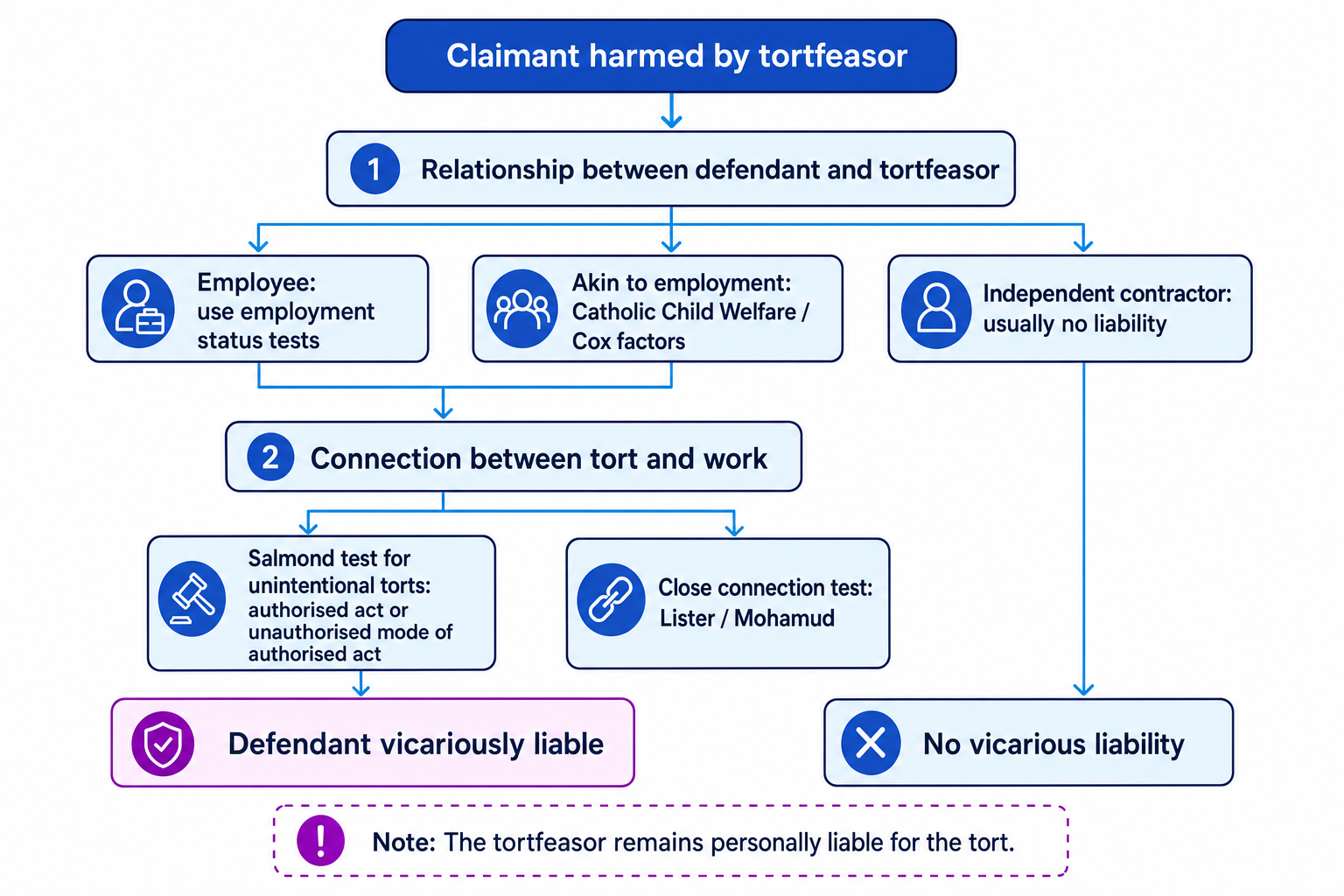
Why does vicarious liability exist?
The main purpose is to make tort law practical and fair for claimants. Employers are often better able to pay damages, usually through insurance. It also encourages organisations to train, supervise and manage risk properly.
Courts often justify vicarious liability using the idea of enterprise risk: if a business benefits from an activity, it should also bear the risks created by that activity.
Tip
Policy reasons to remember
Use three ideas: compensation, loss-spreading through insurance, and risk created by the enterprise.
Stage 1: Is the tortfeasor an employee?
The traditional starting point is whether the tortfeasor is an employee rather than an independent contractor.
Definition
Employee and independent contractor
An employee works under a contract of service. An independent contractor works under a contract for services and is usually running their own business.
This matters because employers are usually vicariously liable for employees, but they are not usually liable for independent contractors.
The traditional tests of employment status
There is no single perfect test. The courts use several overlapping tests.
The control test
The control test asks whether the employer has the right to control what the worker does and how they do it. This older approach appears in cases such as Yewens v Noakes (1880), where a servant was described as someone subject to another’s command as to how work should be done.
This test is less useful for skilled professionals, because an employer may not control the precise technical method of their work.
The integration test
The integration test asks whether the worker is integrated into the organisation or merely accessory to it. In Stevenson, Jordan and Harrison Ltd v MacDonald and Evans (1952), the court distinguished between someone employed as part of the business and someone only providing services to it.
The multiple / economic reality test
The modern approach is the multiple test, also called the economic reality test. In Ready Mixed Concrete v Minister of Pensions (1968), the court said a contract of service requires three key features:
- the worker agrees to provide work or skill in return for payment;
- the worker agrees to be subject to a sufficient degree of control;
- the other terms of the contract are consistent with employment.
Courts may also look at who provides tools, whether tax is paid through PAYE, whether the worker can send a substitute, whether they take financial risk, and whether they work for multiple clients.
Example
Deciding whether a courier is an employee
A courier wears the company uniform, uses the company app, must accept jobs during fixed shifts, and can be disciplined by the company. The written contract calls him “self-employed”.
-
Identify the issue: the question is whether the courier is truly an employee or an independent contractor. The label in the contract is relevant, but not decisive.
-
Apply control: the company controls his shifts, job allocation and discipline. That points towards employment.
-
Apply integration: the uniform and app make him look like part of the business, not an outside supplier. That also points towards employment.
-
Apply economic reality: if he has little financial risk and cannot freely send someone else to do the work, the reality is closer to a contract of service.
-
Conclude: a court may find he is an employee despite the “self-employed” label, so stage 1 of vicarious liability is likely satisfied.
Common Mistake
Trusting the contract label too much
Do not simply say “the contract says self-employed, so there is no vicarious liability”. Courts look at the reality of the relationship, not just the wording.
Stage 1 extended: relationships “akin to employment”
Modern cases recognise that vicarious liability can apply even where there is no classic employer-employee contract. The relationship may be akin to employment, meaning it is sufficiently similar to employment to justify imposing liability.
The major case is Various Claimants v Catholic Child Welfare Society (2012). Members of a religious institute abused children at a school. The Supreme Court held that the institute could be vicariously liable even though the relationship was not a normal employment contract.
The court considered factors including:
- the defendant is more likely to have the means to compensate the claimant;
- the tort was committed as a result of activity undertaken on behalf of the defendant;
- the activity was part of the defendant’s business or mission;
- the defendant created or increased the risk of the tort;
- the tortfeasor was under the defendant’s control.
In Cox v Ministry of Justice (2016), a prisoner working in a prison kitchen negligently injured a catering manager. The Ministry of Justice was vicariously liable because the prisoner’s work was integrated into the prison’s operation and created a risk managed by the prison.
However, the courts have also placed limits on this expansion. In Barclays Bank v Various Claimants (2020), a doctor carried out medical examinations for Barclays as an independent contractor and allegedly sexually assaulted claimants. Barclays was not vicariously liable because the doctor was genuinely in business on his own account.
Key Idea
Akin to employment is not unlimited
The modern approach expands liability beyond formal employees, but it does not make organisations liable for every independent contractor.
Stage 2: Was the tort committed in the course of employment?
Once stage 1 is satisfied, you must decide whether the tort was sufficiently connected with the employment.
Older cases used the phrase in the course of employment. If the tort was outside employment, sometimes described as outwith the course of employment, the employer is not liable.
The Salmond test
Definition
The Salmond test
Under the Salmond test, an employer is liable for either: an authorised act, or an unauthorised way of doing an authorised act.
This test is especially useful for unintentional torts, such as negligence.
For example, if a delivery driver negligently crashes while making deliveries, driving is an authorised act and the careless driving is an unauthorised way of doing it. The employer is likely liable.
But if the driver takes the van on a personal trip unrelated to work and injures someone, that is likely outside the course of employment.
Example
Applying the Salmond test to negligent driving
A supermarket driver is told to deliver groceries. While checking the sat nav, she negligently drives into a cyclist.
-
Identify the tort: the driver may have committed negligence by failing to take reasonable care on the road.
-
Ask whether the act was authorised: delivering groceries was part of her authorised work.
-
Classify the wrongdoing: checking the sat nav carelessly was an unauthorised and negligent way of doing the authorised delivery job.
-
Conclude: under the Salmond test, the supermarket is likely vicariously liable.
Frolics and prohibited acts
A frolic of one’s own means the employee has stepped away from their work for personal reasons. In that situation, the employer is less likely to be liable.
In Hilton v Thomas Burton (Rhodes) Ltd (1961), employees took an unauthorised break and drove to a café. There was an accident. The employer was not liable because they were on a frolic of their own.
But merely doing work in a prohibited way does not automatically remove liability. In Rose v Plenty (1976), a milkman was told not to allow children to help on his round, but he did so and a child was injured. The employer was liable because the milkman was still carrying out his delivery work, although in a prohibited way.
Common Mistake
Assuming prohibition always protects the employer
If the employee is still doing their job, just in a forbidden or careless way, vicarious liability may still apply.
The close connection test
The Salmond test struggled with intentional torts, especially assaults and abuse. The modern test asks whether the tort is so closely connected with the employment that it is fair and just to impose liability.
In Lister v Hesley Hall Ltd (2001), a boarding school warden sexually abused children in his care. The employer was vicariously liable because the abuse was closely connected with the duties entrusted to him.
In Dubai Aluminium v Salaam (2002), a partner in a law firm committed dishonest acts connected to legal work. The firm was liable because the wrongdoing was closely connected with the ordinary course of the firm’s business.
In Mohamud v WM Morrison Supermarkets (2016), a petrol station employee racially abused and assaulted a customer. The Supreme Court held Morrisons liable because the employee’s job involved interacting with customers, and the assault was treated as an unbroken sequence from that interaction.
However, Various Claimants v Morrisons Supermarkets (2020) shows the limit. An employee maliciously leaked payroll data as revenge against Morrisons. The Supreme Court held Morrisons was not vicariously liable because the employee was pursuing a personal vendetta; the job merely gave him the opportunity.
Common Mistake
Opportunity is not enough
It is not enough that employment gave the tortfeasor the chance to commit the tort. The tort must be closely connected with the work or field of activities assigned to them.
Example
Applying close connection to an employee assault
A nightclub employs a bouncer to remove disruptive customers. After an argument inside the club, the bouncer follows a customer outside and punches him.
-
Identify the relationship: the bouncer is likely an employee, so stage 1 is satisfied.
-
Identify the field of activities: his role includes controlling entry, managing disorder and using reasonable force where lawful.
-
Apply close connection: the assault grew out of the very confrontation he was employed to handle, even though punching the customer was unlawful.
-
Use authority: this is similar to Mattis v Pollock (2003), where a nightclub owner was liable after a bouncer stabbed a customer following an earlier work-related confrontation.
-
Conclude: the employer is likely vicariously liable because the tort is closely connected with the bouncer’s duties.
Putting the full answer into IRAC
For problem questions, keep your structure simple.
Issue
Has the claimant suffered a tort, and can they make the defendant liable for the tortfeasor’s act?
Rule
State the two-stage test: relevant relationship, then connection with employment. Use authorities such as Ready Mixed Concrete (1968), Catholic Child Welfare (2012), Cox (2016), Lister (2001), Mohamud (2016) and Morrisons (2020).
Application
Apply the facts carefully. Consider control, integration, economic reality, whether the role is akin to employment, and whether the tort was part of the work risk or a personal frolic.
Conclusion
Reach a clear likely outcome: “The defendant is likely / unlikely to be vicariously liable.”
AO3: evaluating vicarious liability
Vicarious liability has strong advantages. It helps injured claimants obtain compensation, especially where the individual tortfeasor has little money. It also spreads losses through insurance and encourages employers to reduce risks through training and supervision.
However, it can appear unfair because liability may be imposed without personal fault. An employer may have taken reasonable care but still be liable for an employee’s wrongful act. This is particularly controversial in intentional tort cases.
The modern “akin to employment” and “close connection” tests are flexible, which helps courts reach fair outcomes in unusual situations. But flexibility can reduce certainty. Cases such as Mohamud (2016) and Morrisons (2020) show how difficult it can be to draw the line between work-related wrongdoing and a purely personal act.
Overall, vicarious liability balances competing interests: the claimant’s need for compensation, the employer’s responsibility for enterprise risk, and the need not to make defendants insurers for every wrong connected only loosely to work.
Exam technique
In the exam
-
Use the two-stage structure: first relationship, then connection with employment. Do not jump straight to close connection.
-
Support each stage with authority: use Ready Mixed Concrete for employment status, Catholic Child Welfare / Cox for akin to employment, and Lister / Mohamud / Morrisons for close connection.
-
Argue both sides where facts are borderline: especially where there is a prohibited act, a frolic, an independent contractor, or a personal motive.
Self review
Check yourself
- What is the difference between an employee and an independent contractor?
- When might a relationship be “akin to employment”?
- Why was the employer liable in Mohamud, but not in Morrisons?

Keep learning
Make a free account to read the full revision notes and worked examples.