Revision notes for OCR AS Level Law Occupiers' liability. Open the guide for explanations and worked examples. Written against the OCR AS Level Law specification, so the content matches what's examinable rather than general Law background.
Occupiers' liability
What you'll learn
- How to decide whether the Occupiers’ Liability Act 1957 or Occupiers’ Liability Act 1984 applies.
- The duty owed to lawful visitors and when that duty is breached.
- The narrower duty owed to trespassers and the key statutory conditions.
- The main defences and evaluation points for AO3.
The big idea
Occupiers’ liability is a tort about injuries caused by the condition of premises, or things done or omitted on premises. The first question is not “was the occupier careless?” but what was the claimant’s legal status when they were injured?
If the claimant was a lawful visitor, use the Occupiers’ Liability Act 1957. If the claimant was a trespasser, use the Occupiers’ Liability Act 1984.
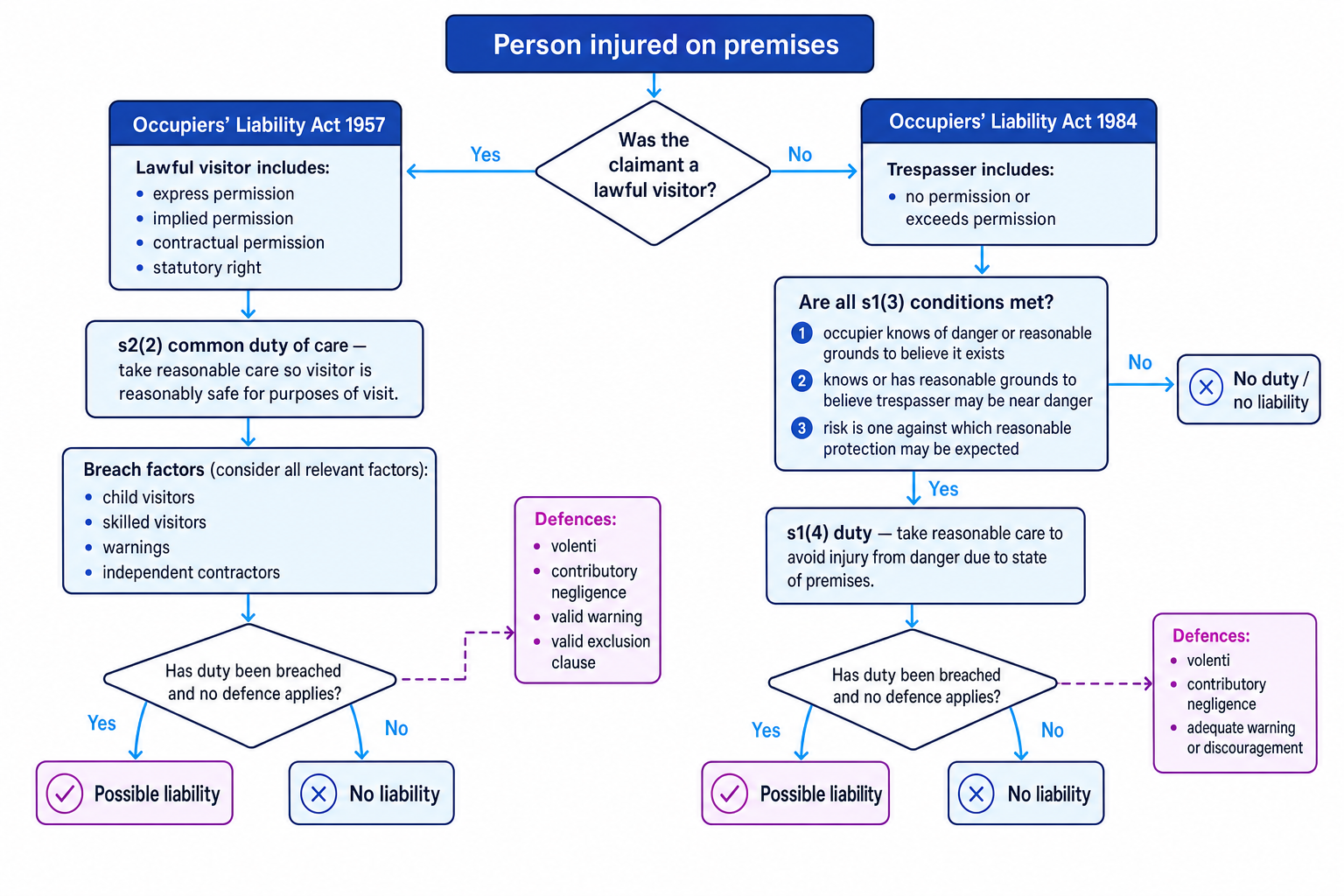
Prerequisites: occupier, premises, visitor
Who is an occupier?
Definition
Occupier
An occupier is someone who has a sufficient degree of control over premises. They do not have to own the premises.
In Wheat v Lacon (1966), a paying guest fell on an unlit staircase at a pub. Both the brewery owner and the manager could be occupiers because both had some control. The principle is that control, not ownership, is the key test.
In Harris v Birkenhead Corporation (1976), a child was injured in an empty house that the council had taken steps to acquire. The council had sufficient control and was treated as the occupier, even though formal possession was incomplete.
What are premises?
“Premises” is broad. It includes land, buildings, fixed structures and movable structures such as vehicles, vessels and aircraft under s1(3)(a) Occupiers’ Liability Act 1957.
Lawful visitors under the 1957 Act
Definition
Lawful visitor
A lawful visitor is someone who has permission or a legal right to be on the premises. Permission may be express, implied, contractual, or given by statute.
Examples include a customer in a shop, a guest invited into a house, a ticket-holder at a cinema, or a police officer entering under lawful authority.
Permission can be limited by time, place or purpose. If someone goes beyond that permission, they may become a trespasser. In The Calgarth (1927), Scrutton LJ gave the famous idea that permission to use stairs does not include permission to slide down the banisters.
Example
Choosing the correct Act
A supermarket customer enters during opening hours. They walk through a clearly marked “Staff Only — No Entry” door and are injured in a stockroom.
- The customer begins as a lawful visitor because the supermarket has impliedly invited customers into the public shopping area.
- The permission is limited by place and purpose: it covers shopping in public areas, not entering staff-only storage areas.
- Once the customer enters the stockroom without permission, they are likely to have exceeded their permission and become a trespasser.
- The injury in the public shop would be analysed under the 1957 Act; the stockroom injury is more likely to fall under the 1984 Act.
The 1957 Act: duty owed to lawful visitors
Under s2(2) Occupiers’ Liability Act 1957, an occupier owes the common duty of care.
Definition
Common duty of care
The common duty of care is a duty to take such care as is reasonable in all the circumstances to see that the visitor will be reasonably safe in using the premises for the purpose for which they are invited or permitted to be there.
This does not mean the occupier must make the premises completely safe. The visitor must be reasonably safe.
In Laverton v Kiapasha Takeaway Supreme (2002), a customer slipped on a wet takeaway floor during rainy weather. The occupier had used mats and a cleaning system, so there was no breach. The principle is that the occupier must take reasonable care, not guarantee perfect safety.
Key Idea
Reasonable safety, not absolute safety
The 1957 Act asks whether the visitor was reasonably safe for the permitted purpose of the visit. A dangerous accident does not automatically prove a breach.
Breach under the 1957 Act
Whether the occupier has breached the duty depends on all the circumstances. The Act gives specific guidance.
Children: s2(3)(a)
Under s2(3)(a), an occupier must be prepared for children to be less careful than adults.
In Glasgow Corporation v Taylor (1922), a child ate poisonous berries in a park and died. The berries were attractive to children, so the occupier should have guarded against the danger. This is often called an allurement, meaning something tempting to children.
However, in Phipps v Rochester Corporation (1955), a young child fell into a trench on open land. The occupier was not liable because it was reasonable to expect very young children to be accompanied by a responsible adult.
Skilled visitors: s2(3)(b)
Under s2(3)(b), an occupier may expect a person exercising a particular skill or calling to guard against risks ordinarily linked to that work.
In Roles v Nathan (1963), chimney sweeps were warned about carbon monoxide but continued working and died. The occupier was not liable because the risk was an ordinary risk of their specialist work.
Warnings: s2(4)(a)
A warning is only enough if, in all the circumstances, it enables the visitor to be reasonably safe.
In Staples v West Dorset District Council (1995), a harbour wall was obviously slippery when wet. No warning was required because the danger was obvious. By contrast, if a danger is hidden or unusually serious, a warning may need to be clearer and more specific.
Independent contractors: s2(4)(b)
An occupier is not automatically liable for dangers caused by an independent contractor. The occupier may avoid liability if it was reasonable to entrust the work to the contractor and the occupier took reasonable steps to check the contractor’s competence and, where possible, the work done.
In Haseldine v Daw (1941), a lift was negligently repaired by specialist engineers. The occupier was not liable because it was reasonable to rely on specialists. In Woodward v Mayor of Hastings (1945), a school was liable after icy steps were badly cleaned by a cleaner, because checking the work was straightforward.
Example
Applying the 1957 Act
A café customer slips on a freshly mopped floor. There is no warning sign, and staff knew the floor was very slippery.
- The issue is under the 1957 Act because the customer is a lawful visitor: the café impliedly invites customers in during opening hours.
- The rule is s2(2): the café must take reasonable care to make the customer reasonably safe for the purpose of visiting the café.
- The wet floor is a danger on the premises. Unlike Laverton, where mats and cleaning made the floor reasonably safe, here there is no warning and staff know the floor is very slippery.
- The likely conclusion is breach of the common duty of care, unless the café can show reasonable precautions were taken.
Common Mistake
Treating every accident as a breach
Do not say “C was injured, therefore D is liable.” Occupiers’ liability is about whether the occupier took reasonable care, not whether the premises were risk-free.
Defences under the 1957 Act
Consent: s2(5)
Volenti non fit injuria means “to a willing person, no injury is done”. Under s2(5), an occupier is not liable for risks willingly accepted by the visitor.
In Geary v JD Wetherspoon plc (2011), a customer was injured sliding down a banister. The risk was obvious and voluntarily accepted, so the occupier was not liable.
Contributory negligence
Under the Law Reform (Contributory Negligence) Act 1945, damages may be reduced where the claimant failed to take reasonable care for their own safety.
Exclusion of liability
Under s2(1) Occupiers’ Liability Act 1957, an occupier may restrict or exclude the duty, but this is limited by statute. The Unfair Contract Terms Act 1977 restricts exclusion of liability for personal injury caused by negligence, and the Consumer Rights Act 2015 protects consumers against unfair terms and notices.
Tip
Defences checklist for visitors
For a lawful visitor, consider: warning, independent contractor, volenti, contributory negligence, and any attempted exclusion clause.
Trespassers under the 1984 Act
Definition
Trespasser
A trespasser is someone who enters premises without permission, or who has permission but goes beyond its limits.
Historically, trespassers had very little protection. In British Railways Board v Herrington (1972), a child trespasser was injured on an electrified railway line. The House of Lords recognised a limited duty of “common humanity”, which helped lead to the Occupiers’ Liability Act 1984.
The 1984 Act: when is a duty owed?
The 1984 Act does not automatically impose a duty to every trespasser. Under s1(3), a duty arises only if three conditions are met:
- The occupier is aware of the danger or has reasonable grounds to believe it exists.
- The occupier knows or has reasonable grounds to believe that the trespasser is in the vicinity of the danger, or may come into that vicinity.
- The risk is one against which, in all the circumstances, the occupier may reasonably be expected to offer some protection.
If these conditions are met, s1(4) says the occupier must take such care as is reasonable in all the circumstances to see that the trespasser does not suffer injury on the premises because of the danger concerned.
Common Mistake
1984 Act covers injury, not property
The 1984 Act protects trespassers against personal injury. It does not impose a duty for damage to the trespasser’s property.
Key cases on the 1984 Act
In Rhind v Astbury Water Park (2004), a trespasser dived into a lake and hit a submerged container. The occupier did not know, and had no reasonable grounds to know, about the container. There was no duty under s1(3).
In Donoghue v Folkestone Properties (2003), a trespasser dived into a harbour at midnight in winter. The occupier had no reason to expect trespassers at that time, so no duty arose.
In Ratcliff v McConnell (1999), a student trespassed into an outdoor swimming pool at night and was injured diving. The danger was obvious, and no duty was owed.
In Tomlinson v Congleton Borough Council (2003), the claimant ignored warnings and injured himself diving into a lake. The risk came from his own dangerous activity rather than the state of the premises. The House of Lords stressed personal responsibility.
Example
Applying the 1984 Act
A teenager climbs over a locked fence into a derelict factory. The occupier knows local teenagers often enter. The teenager falls through a hidden rotten floor.
- The issue is under the 1984 Act because the teenager has entered without permission and is a trespasser.
- The s1(3) conditions are likely satisfied: the occupier knows the floor is rotten, knows teenagers may enter, and a hidden rotten floor is a risk against which reasonable protection may be expected.
- Under s1(4), the occupier must take reasonable care to prevent injury from that danger. A locked fence may help, but if trespassing is known and the danger is hidden and serious, more may be required, such as repairs, boarding, or clear warnings.
- The likely conclusion is possible liability, subject to defences such as contributory negligence for climbing over the fence.
Defences under the 1984 Act
The main defences are similar, but the trespasser’s position is weaker.
Under s1(5), a duty may be discharged by taking reasonable steps to give a warning of the danger or to discourage people from taking the risk. The warning must still be reasonable in the circumstances.
Under s1(6), no duty is owed for risks willingly accepted by the trespasser, so volenti non fit injuria may apply.
Contributory negligence can also reduce damages. In Revill v Newbery (1996), a burglar was shot by the occupier while trespassing. The occupier was liable, but damages were reduced for the claimant’s own fault.
Common Mistake
Assuming trespassers can never claim
Trespassers can sometimes claim under the 1984 Act, but only if the s1(3) conditions are satisfied and the occupier has failed to take reasonable care under s1(4).
AO3 evaluation: how fair and effective is the law?
The law tries to balance two competing interests: the claimant’s need for compensation after injury, and the occupier’s interest in not being treated as an insurer of everyone’s safety.
A key advantage is flexibility. Both Acts use reasonableness, allowing courts to consider the danger, the claimant’s age, the cost of precautions, warnings, and personal responsibility. This helps tort law achieve compensation and deterrence without demanding perfect safety.
A disadvantage is uncertainty. Because the test is fact-sensitive, it can be hard to predict outcomes. Similar accidents may be decided differently depending on small factual details, such as whether the danger was obvious or whether trespassers were expected at that time.
The distinction between visitors and trespassers is broadly fair. Lawful visitors are owed a stronger duty because they are invited or permitted to be there. Trespassers receive narrower protection because they are on the premises without permission. However, the 1984 Act also recognises that serious injury may still be preventable, especially where the occupier knows about a hidden danger.
Key Idea
Balance of interests
Occupiers’ liability does not make occupiers insurers. It asks whether reasonable precautions were needed, while also expecting claimants to take responsibility for obvious risks.
Exam technique
In the exam
- Start by classifying the claimant: lawful visitor under the 1957 Act or trespasser under the 1984 Act.
- State the statutory duty precisely: s2(2) for visitors; s1(3) and s1(4) for trespassers.
- Apply the facts to breach and defences using authority, especially warnings, children, skilled visitors, obvious risks, and personal responsibility.
Self review
Check yourself
- What makes someone an “occupier” if they do not own the premises?
- Why did the claimant fail in Tomlinson v Congleton Borough Council (2003)?
- How does the duty owed to a lawful visitor differ from the duty owed to a trespasser?

Keep learning
Make a free account to read the full revision notes and worked examples.