Revision notes for OCR AS Level Law Liability in negligence. Open the guide for explanations and worked examples. Written against the OCR AS Level Law specification, so the content matches what's examinable rather than general Law background.
Liability in negligence
What you'll learn
- How to recognise a possible negligence claim for personal injury or property damage.
- The three core elements: duty of care, breach of duty, and damage.
- How factual causation, legal causation, defences and damages fit into a problem answer.
- How to add AO3 evaluation about fairness, limits and the aims of tort law.
The basic idea
Negligence is a tort, meaning a civil wrong. It happens where the defendant carelessly causes legally recognised harm to the claimant.
Definition
Negligence
Negligence is liability for failing to take reasonable care where the law requires care, and that failure causes actionable damage.
For this topic, focus first on injury to people and damage to property. OCR also expects you to recognise related areas: pure economic loss through negligent misstatement, psychiatric injury, and defective products.
The claimant usually has the burden of proof, meaning they must prove the claim. The civil standard of proof is the balance of probabilities, meaning “more likely than not”: Miller v Minister of Pensions (1947) explained this standard.
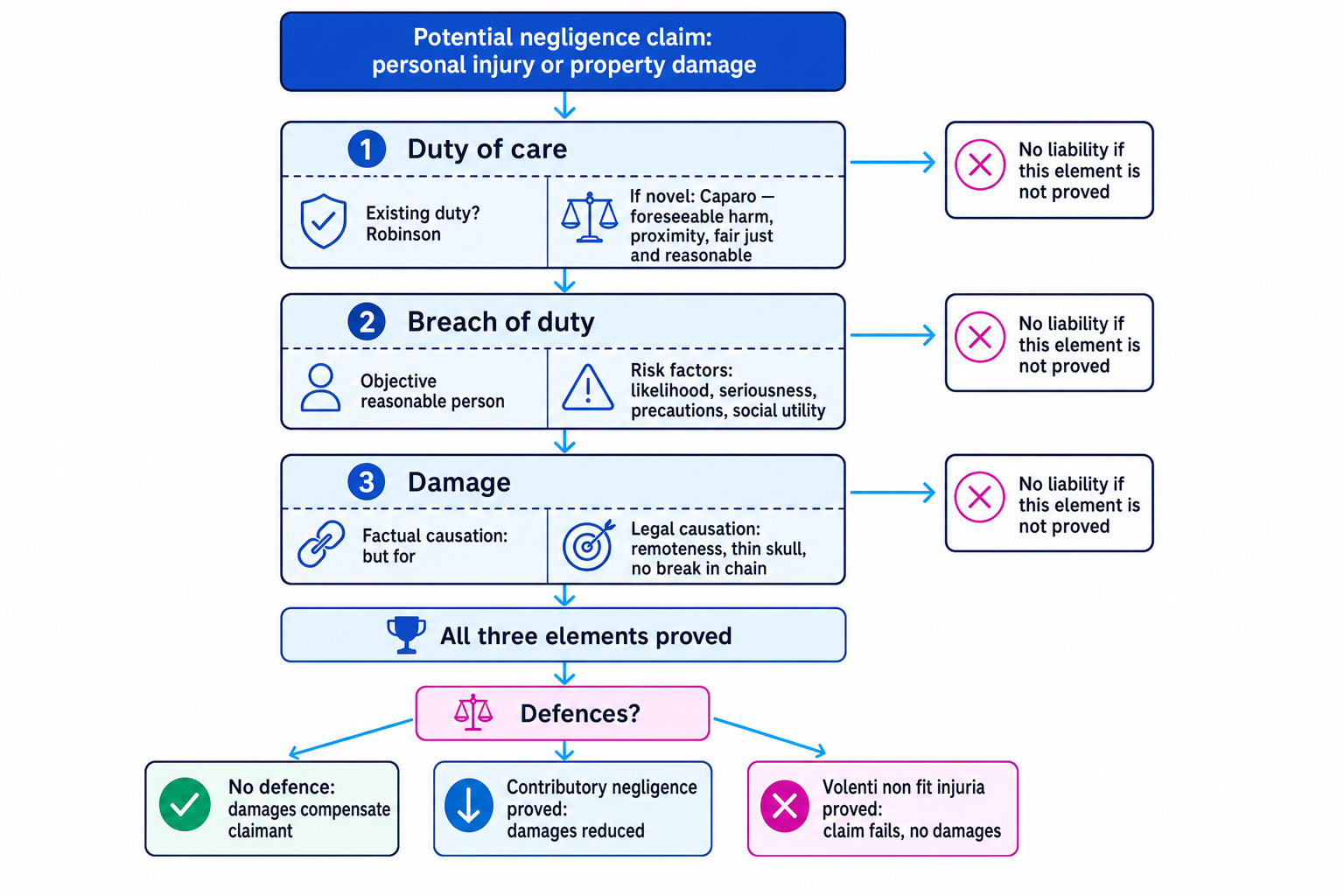
Here is the route you should follow in most negligence problem questions:
Key Idea
The negligence structure
A claimant must prove duty of care → breach of duty → damage caused by the breach. Then consider any defences and the remedy of damages.
Example
Recognising a negligence claim
A delivery driver texts while driving, mounts the pavement, breaks Maya’s wrist and smashes her phone.
- The broken wrist is personal injury, and the smashed phone is property damage, so the losses are the kind negligence can cover.
- Maya would be the claimant and the driver the defendant. She must prove duty, breach and damage on the balance of probabilities.
- If all elements are proved and no complete defence applies, the court can award damages, meaning money compensation.
Duty of care
A duty of care is a legal obligation to take reasonable care to avoid causing harm to another person.
Donoghue and the neighbour principle
In Donoghue v Stevenson (1932), Mrs Donoghue became ill after drinking ginger beer containing a decomposed snail. She could not sue in contract because her friend bought the drink. The House of Lords held that a manufacturer can owe a duty to the ultimate consumer.
This created the neighbour principle: you must take reasonable care to avoid acts or omissions likely to injure people who are so closely and directly affected by your actions that you ought reasonably to have them in mind.
Caparo and novel duties
In Caparo v Dickman (1990), investors relied on audited accounts to buy shares. The court held the auditors did not owe them a duty for that investment loss.
For novel situations, the Caparo test asks:
- Was harm reasonably foreseeable?
- Was there sufficient proximity, meaning closeness in relationship, time, space or reliance?
- Is it fair, just and reasonable to impose a duty?
Robinson: Caparo is not always the starting point
In Robinson v Chief Constable of West Yorkshire (2018), police officers knocked over an elderly pedestrian while arresting a suspect. The Supreme Court held the police owed a duty under ordinary negligence principles.
The key point: do not use Caparo mechanically for every case. First ask whether there is an established duty category, such as road users to other road users, doctors to patients, employers to employees, or manufacturers to consumers. Use Caparo mainly where the duty is genuinely new.
OCR does not require detailed rules on special public bodies such as police, fire services, local authorities or social services.
Example
Establishing a duty of care
Ana is taking a paid climbing lesson. Her instructor tells her to use a visibly frayed rope. The rope snaps and Ana is injured.
- Injury from unsafe climbing equipment is reasonably foreseeable because a rope failure can easily cause physical harm.
- There is proximity: Ana is directly relying on the instructor’s guidance during the lesson.
- It is fair, just and reasonable to impose a duty because instructors are expected to take care for students’ safety. A duty of care is likely.
Breach of duty
Breach of duty means the defendant fell below the standard of care required by law.
The test is objective: what would the reasonable person have done? Older cases often say the “reasonable man”, but you should write “reasonable person” unless quoting the phrase.
- Blyth v Birmingham Waterworks (1856): pipes burst in extreme frost; negligence means failing to do what a reasonable person would do.
- Nettleship v Weston (1971): a learner driver was judged by the standard of a competent driver; inexperience did not lower the standard.
Risk factors for breach
Courts weigh several factors:
- Likelihood of harm: in Bolton v Stone (1951), cricket balls almost never left the ground, so the small risk meant no breach.
- Seriousness of harm: in Paris v Stepney Borough Council (1951), a one-eyed worker should have been given goggles because injury to his remaining eye would be especially serious.
- Cost and practicality of precautions: in Latimer v AEC (1953), a factory used sawdust after flooding; it did not have to close completely because reasonable precautions had been taken.
- Social utility: in Watt v Hertfordshire CC (1954), emergency fire service work justified taking greater risks.
Common Mistake
Duty is not the same as breach
A duty asks whether the defendant had a legal obligation to take care. Breach asks whether the defendant’s behaviour fell below the required standard.
Example
Deciding breach using risk factors
A garage leaves an oil spill across the customer walkway for two hours, despite having warning cones nearby. A customer slips and breaks her arm.
- The objective standard is the reasonable garage owner, not this particular garage’s usual habits.
- Harm is likely because customers must walk through the area, and the possible injury is serious enough to require action.
- Precautions were cheap and practical: cones or cleaning would have reduced the risk. There is no emergency or social benefit justifying the danger, so breach is likely.
Damage: factual and legal causation
Damage is the legally recognised harm suffered by the claimant. The claimant must prove the defendant’s breach caused it.
Factual causation
Factual causation asks whether the damage would have happened “but for” the defendant’s breach.
In Barnett v Chelsea and Kensington Hospital Management Committee (1969), a hospital negligently failed to examine a patient who later died from arsenic poisoning. The hospital was not liable for the death because he would have died even with proper treatment.
Legal causation
Legal causation limits liability even where factual causation exists.
Key rules:
- Remoteness: the type of damage must be reasonably foreseeable. In The Wagon Mound (No 1) (1961), fire damage from an oil spill was too remote because it was not foreseeable at the time.
- Exact manner need not be foreseeable: in Hughes v Lord Advocate (1963), burns were foreseeable, even though the precise explosion was unusual.
- Thin skull rule: take the claimant as you find them. In Smith v Leech Brain (1962), a burn triggered cancer; the defendant was liable for the full extent.
- A novus actus interveniens, meaning a new intervening act, can break the chain of causation. In McKew v Holland (1969), the claimant’s unreasonable attempt to descend steep stairs broke the chain for later injury.
Example
Testing causation and remoteness
A builder leaves an unguarded hole. Priya falls in, breaks her ankle, and her rare bone condition makes the injury much worse. Later, against medical advice, she goes skiing and suffers a separate injury.
- Factual causation is satisfied for the fall: but for the unguarded hole, Priya would not have fallen.
- A broken ankle is a foreseeable type of physical injury, so it is not too remote. The rare severity is covered by the thin skull rule.
- The skiing injury may be a novus actus interveniens because Priya acted unreasonably against medical advice. The builder may be liable for the fall injury but not the separate skiing injury.
Special types of damage to recognise
Pure economic loss and negligent misstatement
Pure economic loss is financial loss not resulting from personal injury or property damage. It is usually difficult to recover.
An exception is negligent misstatement, meaning careless advice or information causing financial loss. In Hedley Byrne v Heller (1964), a bank gave a negligent credit reference; there was no liability because of a disclaimer, but the case established that a duty can arise where there is a special relationship and reasonable reliance.
Caparo v Dickman (1990) also limits liability for economic loss: auditors did not owe a duty to potential investors generally.
Psychiatric injury
Psychiatric injury means a medically recognised mental illness, not ordinary grief or upset. In Page v Smith (1996), a primary victim in the zone of physical danger could recover where physical injury was foreseeable. In Alcock v Chief Constable of South Yorkshire (1992), relatives affected by the Hillsborough disaster faced strict control mechanisms for secondary victim claims.
Defective products
A defective product can create negligence liability, especially following Donoghue v Stevenson (1932), where a manufacturer owed a duty to the consumer.
There is also statutory protection. Under s2(1) Consumer Protection Act 1987, a producer can be liable for damage caused by a defective product. Under s3 Consumer Protection Act 1987, a product is defective if its safety is not what people are generally entitled to expect. This is strict liability, meaning the claimant does not need to prove fault.
Common Mistake
Calling every financial loss negligence
If the claimant only lost money, do not assume ordinary negligence applies. Ask whether it is pure economic loss and whether negligent misstatement rules are needed.
Defences and damages
A defence is a legal reason why the defendant should not be fully liable even if the claimant proves the elements of negligence. The defendant normally proves the defence on the balance of probabilities.
Contributory negligence
Under s1(1) Law Reform (Contributory Negligence) Act 1945, damages can be reduced where the claimant failed to take reasonable care for their own safety and contributed to the damage.
In Froom v Butcher (1976), a claimant who failed to wear a seatbelt had damages reduced because the injury would have been less serious.
Volenti
Volenti non fit injuria means “no wrong is done to a willing person”. It is a complete defence where the claimant freely and knowingly accepted the risk. In Morris v Murray (1991), the claimant accepted an obvious risk by flying with a drunk pilot.
Damages
Damages are money compensation. The aim is to put the claimant, so far as money can, in the position they would have been in if the tort had not happened: Livingstone v Rawyards Coal (1880).
Damages are compensatory, not usually punitive. They can cover pain, suffering, lost earnings, medical costs and property repair.
Example
Applying contributory negligence
A driver carelessly crashes into Zara. Zara was not wearing a seatbelt, and medical evidence shows the injuries would have been less serious if she had worn one.
- The driver remains liable if duty, breach and causation are proved.
- Zara’s failure to wear a seatbelt may be contributory negligence because it contributed to the extent of the harm.
- Under s1(1) Law Reform (Contributory Negligence) Act 1945, the court can reduce damages to a just and equitable extent rather than dismissing the whole claim.
AO3: evaluating negligence
Negligence has clear advantages. It compensates injured claimants, encourages safer behaviour, and uses flexible tests that can adapt to new risks.
But there are disadvantages. The tests for duty and legal causation can be uncertain, especially with psychiatric injury and pure economic loss. Some limits may seem unfair to claimants who suffer real harm but fall outside strict rules.
The law tries to balance competing interests: claimants need compensation, but defendants should not face unlimited liability. Product liability shows a contrast: negligence requires proof of fault, while the Consumer Protection Act 1987 can be fairer for consumers because it avoids the difficulty of proving exactly how the producer was careless.
Tip
Use IRAC
For each element, structure your answer as Issue, Rule, Application, Conclusion. The application is where most AO2 marks are gained: keep linking the legal rule to the exact facts.
Exam technique
In the exam
- Start with the three elements: duty, breach, damage. Do not jump straight to damages or defences.
- Use authority briefly: case name, year, key fact pattern, and principle.
- Apply risk factors and causation carefully before concluding whether liability is likely.
Self review
Check yourself
- When should you use Caparo, and when should you start with an established duty category?
- What is the difference between factual causation and legal causation?
- Why is contributory negligence only a partial defence?

Keep learning
Make a free account to read the full revision notes and worked examples.