Revision notes for OCR AS Level Law Rules and theory of the law of tort. Open the guide for explanations and worked examples. Written against the OCR AS Level Law specification, so the content matches what's examinable rather than general Law background.
Rules and theory of the law of tort
What you'll learn
- What tort law is trying to achieve, especially compensation and deterrence.
- How to identify the claimant, defendant, protected interest, and possible remedy.
- When tort liability depends on fault, and when it can be closer to strict liability.
- How tort differs from contract and crime, and how to discuss “compensation culture”.
What is tort law?
Definition
Tort
A tort is a civil wrong, other than breach of contract, for which the law provides a remedy. The injured party usually brings a claim for damages, meaning financial compensation, or sometimes an injunction, meaning a court order to do or stop doing something.
Tort law is mainly about private parties taking civil action. It asks: has one person or organisation interfered with a protected interest of another in a way the law recognises as wrongful?
A key starting point is Donoghue v Stevenson (1932): Mrs Donoghue became ill after allegedly finding a decomposed snail in a bottle of ginger beer; the House of Lords held that a manufacturer could owe a duty of care to the ultimate consumer. This case helped develop modern negligence and the idea that the law can impose duties even where there is no contract.
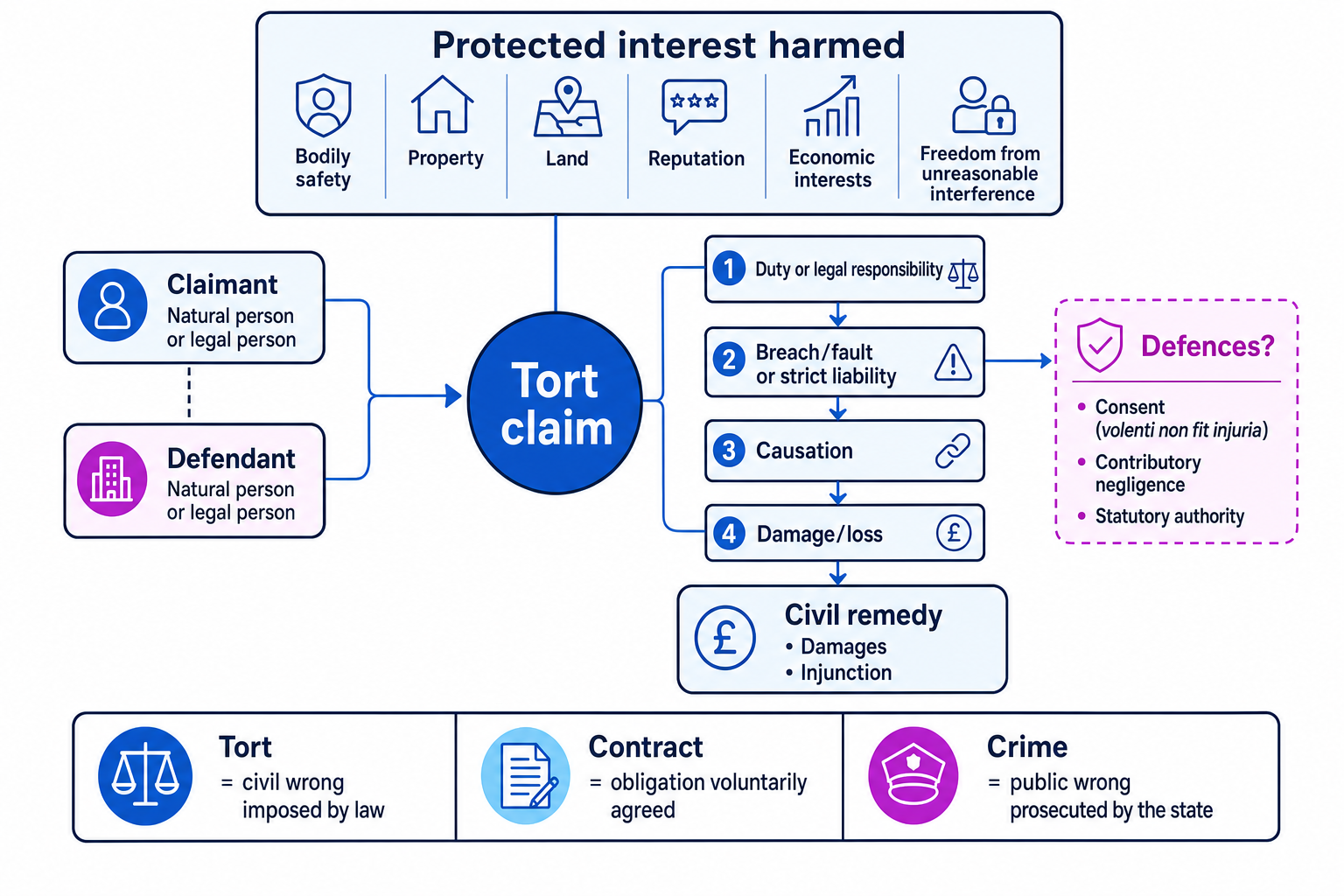
The diagram below gives you the basic “anatomy” of a tort claim: who sues, what interest has been harmed, what must be proved, and what remedy is sought.
The aims of tort law
Tort law has several overlapping aims. You should not treat these as separate boxes; a single claim may serve more than one aim.
Compensation
The main aim is to compensate the claimant for loss suffered. In personal injury, this might include pain, suffering, loss of earnings, and medical costs. In property damage, it might cover repair or replacement.
Corrective justice
Corrective justice means putting right a wrong between the parties. If the defendant has wrongfully harmed the claimant, the law tries to correct that imbalance.
Deterrence
Tort law can deter unsafe behaviour. If businesses know they may have to pay damages for careless systems, they have a financial reason to improve safety.
Loss distribution
Sometimes tort spreads loss through insurance. For example, a negligent driver’s insurer may pay compensation, meaning the loss is not borne entirely by the injured claimant.
Key Idea
Core aim
The usual aim of a tort action is not to punish the defendant. It is to give the claimant a civil remedy, usually compensation, for a legally recognised harm.
Example
Choosing a tort remedy
A factory’s fumes repeatedly drift onto Leila’s land, damaging her plants and making her garden unpleasant to use.
- The protected interest is Leila’s use and enjoyment of land, so a tort such as private nuisance may be relevant.
- Damages could compensate for the damaged plants and loss of amenity already suffered.
- If the fumes are continuing, an injunction may be more useful than damages alone because it aims to prevent future interference.
- A balanced conclusion would mention that the court may also consider the factory’s activities and the impact of stopping them.
Tortious liability: who is suing whom?
Definition
Tortious liability
Tortious liability means legal responsibility in tort. If the defendant is liable, the court can order a civil remedy for the claimant.
The claimant is the party bringing the civil action. The defendant is the party being sued.
Both can be natural persons or legal persons.
Definition
Natural and legal persons
A natural person is a human being. A legal person is an organisation recognised by law as capable of rights and duties, such as a company, local authority, NHS trust, school, or charity.
So a tort claim could be:
- an individual suing another individual;
- an individual suing a company;
- a company suing an individual;
- one organisation suing another organisation.
Definition
Burden and standard of proof
In a civil tort claim, the claimant normally has the burden of proof, meaning they must prove the claim. The standard of proof is the balance of probabilities, meaning the claimant must show the facts are more likely than not.
Example
Mapping the parties and interest harmed
A delivery company’s driver reverses carelessly into Priya’s garden wall while making deliveries.
- Priya is the claimant because her property has been damaged.
- The driver may be a defendant as the person who directly caused the damage; the delivery company may also be relevant because employers can sometimes be liable for employees’ torts.
- The protected interest is property or land, because the garden wall has been damaged.
- Priya’s likely remedy is damages covering the reasonable cost of repair.
Protected interests in tort
Tort does not compensate every disappointment or inconvenience. It protects certain recognised interests, including:
- bodily safety, especially through negligence;
- property, such as damage to goods;
- land, including interference with use or enjoyment;
- reputation, in torts such as defamation;
- economic interests, though these are often more restricted;
- freedom from unreasonable interference, for example through nuisance.
Definition
Cause of action
A cause of action is a legally recognised claim with elements the claimant must prove. “Negligence”, “private nuisance”, and “Rylands v Fletcher liability” are examples of tort causes of action.
Common Mistake
Not every loss is actionable
A claimant must fit the facts into a recognised tort and prove its elements. Tort law is not a general insurance scheme for every harm suffered in life.
Fault, strict liability and defences
Many torts require proof of fault. Fault means the defendant’s conduct falls below the legal standard required, or involves an intentional or unreasonable interference.
In negligence, the usual structure is:
- the defendant owed the claimant a duty of care;
- the defendant breached that duty;
- the breach caused damage;
- the damage was not too remote.
Later negligence cases refine the duty question. Caparo v Dickman (1990) involved investors relying on company accounts; it is associated with foreseeability, proximity, and whether it is fair, just and reasonable to impose a duty in novel situations. Robinson v Chief Constable of West Yorkshire (2018) involved an elderly woman injured during an arrest; the Supreme Court stressed that courts should usually apply established duty categories rather than treating Caparo as a universal checklist.
Not all torts are based on ordinary fault. Rylands v Fletcher (1868) involved water escaping from a reservoir and flooding a mine; it established liability for escape of a dangerous thing accumulated on land in the course of a non-natural use, subject to limits and defences. It is often described as a form of strict liability because the claimant may not need to prove carelessness in the same way as negligence.
Definition
Defence
A defence is an argument raised by the defendant which, if successful, can defeat the claim completely or reduce the remedy.
Important examples include:
- volenti non fit injuria, meaning “to a willing person no injury is done”: the claimant consented to the risk;
- contributory negligence under s1 Law Reform (Contributory Negligence) Act 1945: the claimant partly caused their own damage, so damages may be reduced;
- statutory authority: the defendant was authorised by statute to act in a way that would otherwise be tortious.
Common Mistake
Assuming all torts require carelessness
Negligence is fault-based, but tort law is wider than negligence. Always ask what particular tort is being argued and what that tort requires.
Example
Considering fault and defences
Maya slips on oil in a supermarket aisle. Staff knew about the spill but left it for twenty minutes. Maya was walking while looking at her phone and suffers a fractured wrist.
- The likely tort is negligence: the supermarket owes customers a duty to take reasonable care for their safety.
- Leaving known oil on the floor for twenty minutes is likely to be a breach because a reasonable supermarket would clean it or warn customers promptly.
- Causation is likely satisfied if the oil caused Maya’s fall and the fall caused the fractured wrist.
- The phone use may support contributory negligence under s1 Law Reform (Contributory Negligence) Act 1945, reducing damages if Maya failed to take reasonable care for her own safety.
- The likely conclusion is that Maya has a claim, but her damages may be reduced.
Tort, contract and crime
Tort, contract, and crime can overlap, but they are legally different.
| Feature | Tort | Contract | Crime |
|---|---|---|---|
| Basic idea | Civil wrong imposed by law | Obligation voluntarily agreed | Public wrong against society |
| Who brings the case? | Claimant sues defendant | Contracting party sues another contracting party | State prosecutes defendant |
| Main aim | Compensation or civil remedy | Enforce bargain or compensate expectation loss | Punishment, deterrence, public protection |
| Standard of proof | Balance of probabilities | Balance of probabilities | Beyond reasonable doubt |
| Example | Negligent driver injures pedestrian | Builder fails to complete agreed work | Assault, theft, dangerous driving |
A single event can create more than one legal issue. If a driver crashes into a pedestrian, the driver may commit a crime and also be sued in tort. The criminal case and civil claim are separate.
Example
Classifying one incident in three ways
A taxi driver drives dangerously, hits Sam, and also breaks a promise to take Sam to the airport on time.
- The dangerous driving may be criminal because it is a public wrong prosecuted by the state.
- Sam may have a tort claim in negligence for personal injury because the driver arguably breached a duty of care owed to road users.
- There may also be a contract issue if Sam had agreed and paid for the taxi service, but the injury claim itself does not depend on contract.
- In an answer, you would keep the issues separate: crime may punish the driver; tort aims to compensate Sam; contract concerns the broken agreement.
“Compensation culture”
Definition
Compensation culture
“Compensation culture” is the idea that society has become too willing to claim damages for accidents, encouraging blame, defensive behaviour, and excessive litigation.
This is an AO3 evaluation area. You should discuss it carefully rather than simply saying it exists.
Arguments supporting the concern include:
- fear of claims may make schools, councils, doctors, or businesses overly cautious;
- insurance costs may rise if claims increase;
- defendants may settle weak claims to avoid legal costs;
- socially useful activities may be discouraged.
Arguments against the concern include:
- claimants still have to prove duty, breach, causation, damage, and overcome defences;
- many injured people need compensation to restore independence and dignity;
- tort law can improve safety standards;
- the phrase “compensation culture” may be exaggerated by media stories.
Parliament has responded to some of these concerns. For example, s1 Compensation Act 2006 allows a court, when considering breach of duty, to consider whether finding liability might prevent or discourage a desirable activity.
Tip
AO3 balance
For tort evaluation, use the right lenses: advantages and disadvantages, fairness or unfairness, balancing competing interests, whether tort achieves its aims, and comparisons between similar torts where relevant.
Pulling the theory together
When you see a tort problem, think in layers:
- AO1: state the relevant legal rule and authority.
- AO2: apply the rule to the exact facts.
- AO3: evaluate whether the law is fair, effective, balanced, or achieving the aims of tort law.
The strongest answers avoid vague statements like “the defendant is responsible”. Instead, they identify the tort, the protected interest, the parties, the fault requirement, any defence, and the remedy.
Exam technique
In the exam
- Start by identifying the claimant, defendant, and protected interest before discussing liability.
- Ask whether the tort requires fault, strict liability, or a specific form of unreasonable conduct.
- Always consider defences before reaching your conclusion, especially consent and contributory negligence.
- For evaluation, balance claimant compensation against defendant fairness, social cost, deterrence, and the risk of over-deterrence.
Self review
Check yourself
- What is the difference between a natural person and a legal person in a tort claim?
- Why is it inaccurate to say that all tort liability is based on carelessness?
- How can one incident give rise to both a criminal prosecution and a tort claim?

Keep learning
Make a free account to read the full revision notes and worked examples.