Revision notes for OCR AS Level Law Introduction to the nature of law. Open the guide for explanations and worked examples. Written against the OCR AS Level Law specification, so the content matches what's examinable rather than general Law background.
Introduction to the nature of law
What you'll learn
- How legal rules differ from social, moral, religious, school, or club rules.
- How law connects with morality and justice, without being exactly the same thing.
- The key differences between civil law and criminal law, including courts, procedure, purpose, and outcomes.
- How English law developed through custom, common law, and statute — and why the rule of law matters.
The big picture
The “nature of law” is about the foundations: what law is, where it comes from, why it is obeyed, and how it should be judged. Keep this map in mind as you work through the topic.
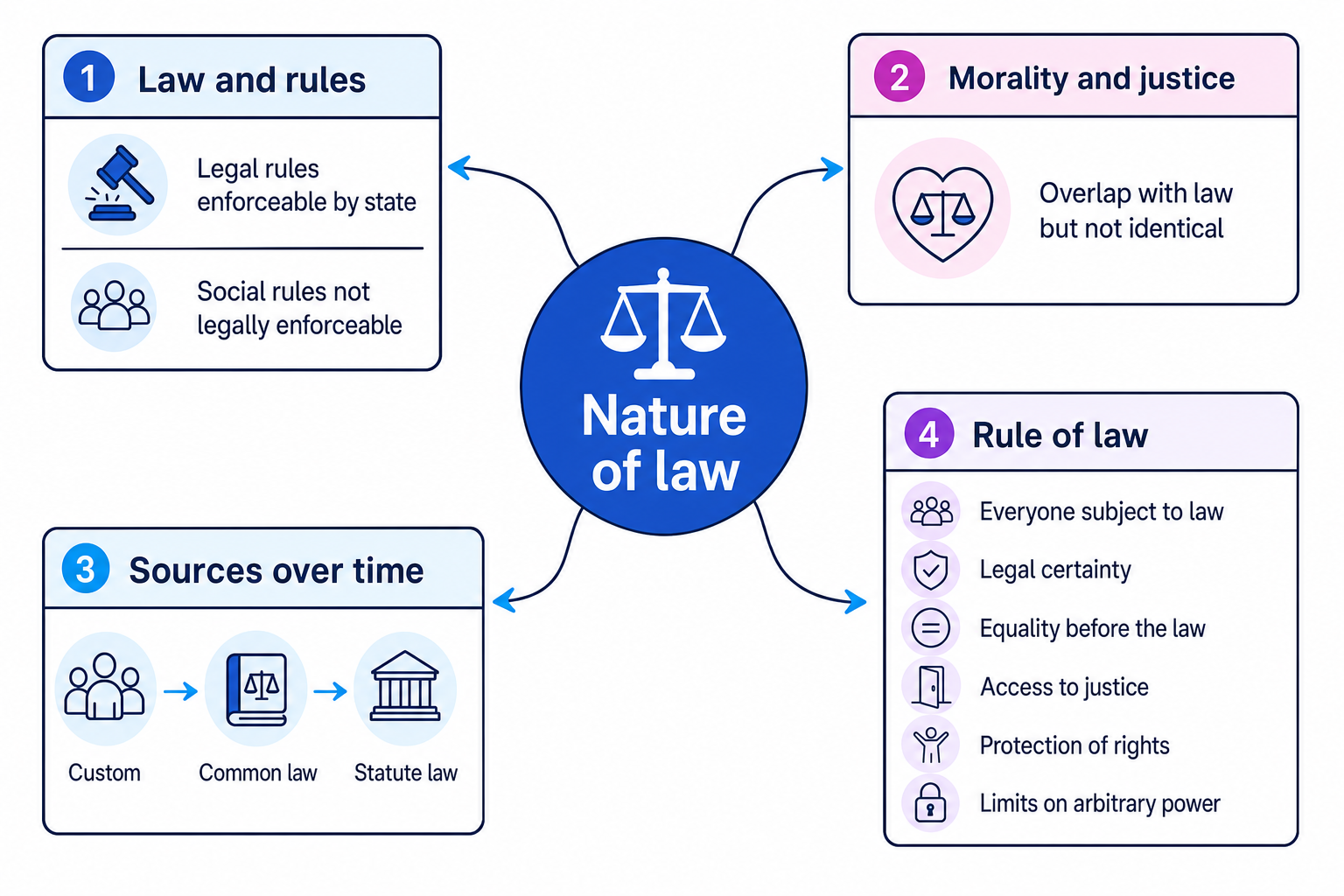
Law and rules
A rule is a standard telling people what they must, must not, or may do. Not every rule is a law. For example, “do not talk in the cinema” is a social rule; “do not steal” is a legal rule.
A legal rule is enforceable through the state, usually by courts, tribunals, police, or other public authorities. A legal principle is a broader legal idea that guides many rules, such as equality before the law or the presumption of innocence.
A norm is an expected pattern of behaviour in society. Norms may be powerful, but they are not automatically legally enforceable.
Definition
Law, rules and norms
- Law: rules and principles recognised and enforceable by the state.
- Legal sanction: a consequence imposed through law, such as imprisonment, a fine, damages, or an injunction.
- Social or moral rule: a standard of behaviour that may affect reputation or relationships, but is not automatically enforced by courts.
Example
Deciding whether a rule is legally enforceable
- A school rule saying “no phones in lessons” is a rule, but the usual consequences are internal school sanctions. It is not normally a criminal offence or a civil claim by itself.
- A bus rule saying “pay before travel” can become legal because using the bus may create a contract, and non-payment may also fall under specific transport offences.
- A rule saying “do not assault people” is legal because the state can prosecute an offender, and the victim may also bring a civil claim for compensation.
Common Mistake
Not every serious rule is law
A rule can feel important without being legally enforceable. In an answer, always ask: who enforces it, through what legal process, and with what legal consequence?
Law, morality and justice
Morality means beliefs about right and wrong. Justice means fairness in both process and outcome. Law often reflects morality, but it does not simply copy it.
Law, morality, and justice can connect in several ways:
- Some laws clearly reflect moral views, such as laws against violence and theft.
- Some moral wrongs are not legal wrongs, such as being rude to a friend.
- Some laws may be legally valid but morally controversial.
- Justice asks whether the law is applied fairly, equally, and with proper safeguards.
In Shaw v DPP (1962), the defendant published a directory advertising prostitutes; the House of Lords upheld the offence of conspiracy to corrupt public morals, showing that criminal law has sometimes enforced shared morality. This is controversial because vague morality-based offences can threaten certainty.
Human rights also link law and justice. The Human Rights Act 1998 gives domestic effect to Convention rights, such as Article 5 ECHR protecting liberty and Article 10 ECHR protecting freedom of expression.
Key Idea
Law, morality and justice overlap
A good answer should not say “law equals morality”. Instead, explain that law may reflect, shape, or conflict with moral views, and justice is used to assess whether law is fair.
Example
Balancing speech, morality and justice
- If a council bans a peaceful but offensive protest, the legal issue is whether it has lawful authority and whether the restriction is compatible with Article 10 ECHR.
- The moral issue is whether the speech is harmful, offensive, or socially unacceptable; moral dislike alone does not automatically justify legal punishment.
- The justice issue is whether the restriction is clear, proportionate, and open to challenge, so that both public order and individual rights are treated fairly.
Civil law and criminal law
Criminal law deals with conduct treated as an offence against society. Cases are usually brought by the state, often through the Crown Prosecution Service, against the defendant.
Civil law deals with disputes between individuals, businesses, or public bodies. The person bringing the claim is the claimant; the person defending it is the defendant.
This diagram helps you keep the two court systems separate.
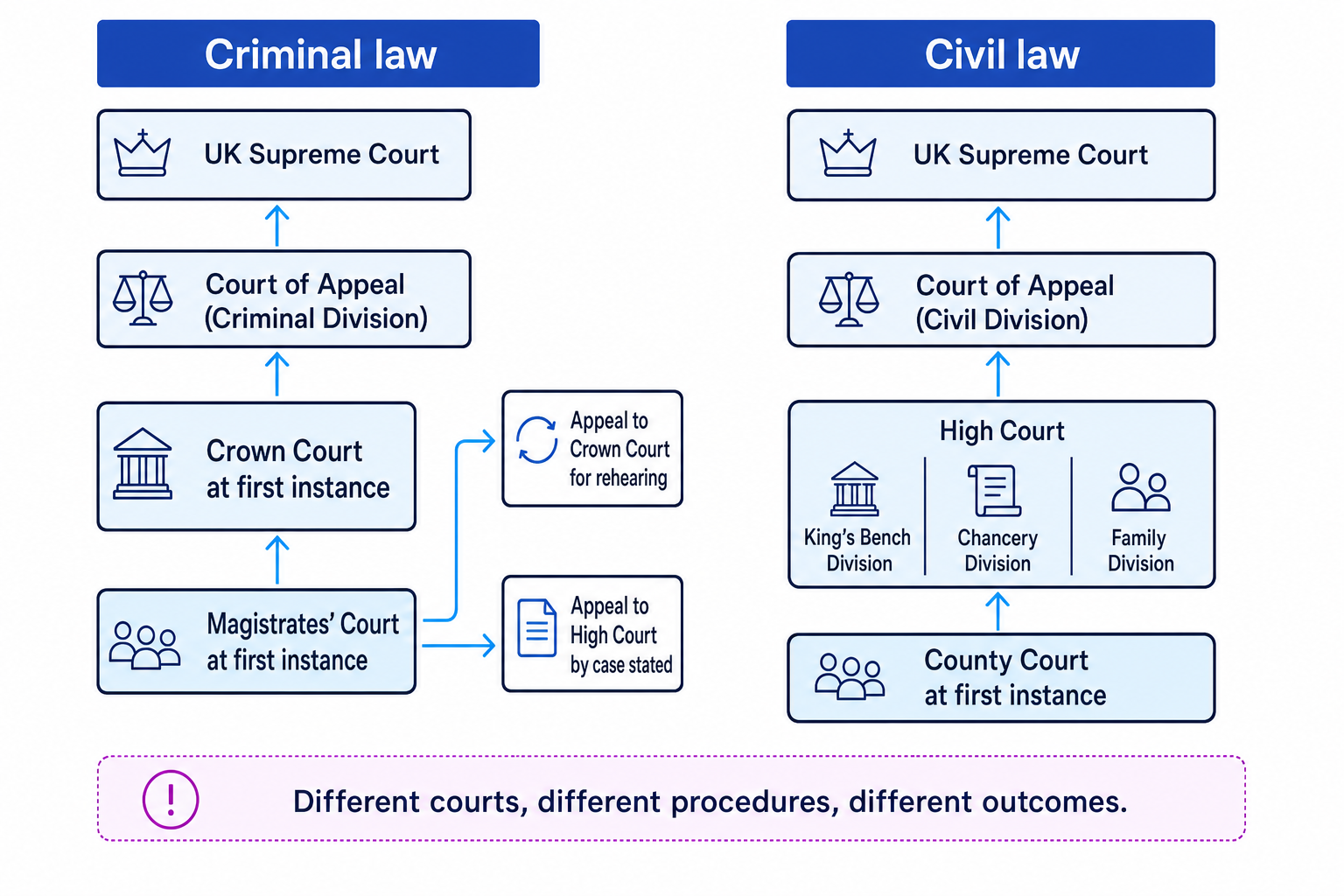
Key differences
In criminal law:
- The aim is to prove guilt and, if appropriate, sentence the offender.
- The prosecution must prove the case beyond reasonable doubt.
- Outcomes include conviction, acquittal, imprisonment, community orders, fines, or discharge.
- s142 Criminal Justice Act 2003 lists purposes of sentencing, including punishment, crime reduction, reform and rehabilitation, public protection, and reparation.
- Substantive offences often require actus reus meaning “guilty act” and mens rea meaning “guilty mind”.
In civil law:
- The aim is usually to resolve a dispute or remedy a wrong.
- The claimant must prove the case on the balance of probabilities.
- Outcomes include damages, injunctions, declarations, or specific performance.
- Civil law includes areas such as tort, contract, family, and property.
Civil and criminal law also develop differently. Criminal law is often statutory, such as s1 Theft Act 1968, which defines theft. Civil law has major common law foundations, such as Donoghue v Stevenson (1932), where a consumer allegedly found a snail in ginger beer; the case established the neighbour principle in negligence.
Example
Classifying civil and criminal consequences
- If Dan drives dangerously and injures Priya, the criminal issue is whether Dan has committed an offence. The prosecution would need to prove guilt beyond reasonable doubt.
- Priya may also bring a civil negligence claim for compensation. She would need to prove liability on the balance of probabilities.
- The same facts can therefore lead to two legal processes: criminal law focuses on punishment and public protection; civil law focuses on remedying Priya’s loss.
Common Mistake
Civil does not mean minor
Civil and criminal law are not ranked by seriousness. A civil claim can be financially huge, and a criminal offence can be relatively minor. The real difference is purpose, parties, procedure, and outcome.
Development of English law
English law has developed through three main sources: custom, common law, and statute law.
Custom
Custom means long-established practices accepted as binding in a community. Historically, local customs helped form early English law. Today, custom is much less important than statute and common law, but it reminds us that law often grows from social practice.
Common law
Common law is judge-made law developed through court decisions. It is linked to the doctrine of precedent: earlier decisions guide later cases.
Stare decisis means “stand by decided matters”. The ratio decidendi is the binding legal reason for a decision. Obiter dicta are comments made by judges that are not binding but may be persuasive.
In Young v Bristol Aeroplane (1944), the Court of Appeal confirmed that it is generally bound by its own previous decisions, subject to limited exceptions. This supports consistency and predictability.
Common law can develop over time. In R v R (1991), the House of Lords held that a husband could be guilty of raping his wife, removing the old marital exemption and showing common law adapting to modern values.
Statute law
Statute law means law made by Parliament in Acts of Parliament. Statutes can create new law, clarify law, or change common law.
For example, s1 Theft Act 1968 sets out the elements of theft. If a statute clearly covers the issue, courts must apply it, even if older common law points in a different direction.
Key Idea
Statute can change common law
Common law develops through cases, but Parliament can override or reform it by statute. In problem-solving, always check whether a statutory rule applies before relying on older case law.
The rule of law
The rule of law is a central principle of the English legal system. It means law should control power, including government power.
Definition
The rule of law
The rule of law is the principle that everyone, including public officials and government, is subject to clear, public, and fairly applied law, with access to independent courts.
Core elements include:
- Legality: state power needs legal authority.
- Certainty: laws should be clear and accessible.
- Equality before the law: no one is above the law.
- Access to justice: people must be able to use courts to enforce rights.
- Protection of rights: rights should not depend on arbitrary power.
- Limits on executive power: public bodies must not act ultra vires, meaning beyond their legal powers.
In Entick v Carrington (1765), government messengers entered Entick’s home and seized papers without lawful authority; the court held that state officials need legal justification for their actions.
In R (UNISON) v Lord Chancellor (2017), employment tribunal fees were unlawful because they prevented access to justice; the Supreme Court treated court access as essential to the rule of law.
In R (Miller) v Prime Minister (2019), the Supreme Court held that the Prime Minister’s advice to prorogue Parliament was unlawful because it frustrated Parliament’s constitutional role.
Example
Testing government action against the rule of law
- If a minister orders a newspaper to close because it criticised the government, first ask whether there is a clear legal power allowing that action. Without legal authority, Entick v Carrington (1765) supports the view that it is unlawful.
- Next consider rights. Closing a newspaper interferes with Article 10 ECHR, so any restriction would need proper legal basis and strong justification.
- Then consider access to justice. If the newspaper cannot realistically challenge the order, UNISON (2017) supports the argument that the rule of law is weakened.
- A strong conclusion is that the action offends legality, rights protection, and accountability unless clearly authorised and justified.
Evaluating the rule of law
The rule of law has major strengths. It restrains arbitrary government, protects individual liberty, supports human rights, and makes legal consequences more predictable. It also gives legitimacy to criminal punishment, because people should only be punished under known legal rules.
However, there are limits. A “thin” version of the rule of law may only require clear procedures, even if the law itself is unjust. Access to justice can also be weakened by cost, delay, complexity, or lack of legal advice. Finally, there can be tension between judges enforcing rule-of-law principles and Parliament’s democratic law-making role.
Tip
A simple AO3 balance
A strong evaluation says: the rule of law is essential, but it only works properly if laws are clear, rights-respecting, fairly enforced, and practically accessible.
Exam technique
In the exam
- Start with precise definitions: law, norm, morality, justice, civil law, criminal law, common law, statute, and rule of law.
- For civil versus criminal law, compare parties, purpose, procedure, standard of proof, outcomes, and courts.
- Use authorities briefly but meaningfully: give the fact pattern and the principle, not just the case name.
- For AO3, evaluate the rule of law by balancing its importance against practical problems such as cost, delay, vague law, or unjust law.
Self review
Check yourself
- How would you distinguish a legal rule from a moral rule or social norm?
- How can one incident create both a criminal prosecution and a civil claim?
- Why is access to justice considered part of the rule of law?

Keep learning
Make a free account to read the full revision notes and worked examples.