Revision notes for OCR AS Level Law Law and morality. Open the guide for explanations and worked examples. Written against the OCR AS Level Law specification, so the content matches what's examinable rather than general Law background.
Law and morality
What you'll learn
- How law differs from morality, and why the distinction matters.
- Why a pluralist society makes moral agreement difficult.
- The key theories: natural law, legal positivism, and the Devlin-Hart debate.
- How to evaluate whether the law should enforce moral values.
Starting point: law and morality are not the same thing
People often say “that should be illegal” when they really mean “that is wrong”. In law, you must separate those ideas.
Definition
Law
Law is a system of rules recognised and enforced by the state, usually through courts, police, tribunals, and official sanctions such as imprisonment, fines, damages, or injunctions.
Definition
Morality
Morality means beliefs about what is right and wrong. These beliefs may come from religion, culture, philosophy, family, personal conscience, or community expectations.
Law and morality both guide behaviour, but they work differently.
| Point of comparison | Law | Morality |
|---|---|---|
| Source | Parliament, courts, delegated legislation, legal institutions | Conscience, religion, culture, social values |
| Enforcement | State sanctions, courts, police | Guilt, shame, criticism, social disapproval |
| Certainty | Usually written or identifiable | Often debated and flexible |
| Change | Can change through legislation or case law | Changes gradually as society changes |
The function of law is to create order, settle disputes, protect rights, punish wrongdoing, and regulate society. The function of morality is to guide choices and shape ideas of what a good life or good society should be.
Key Idea
Core distinction
Law is about what the state can enforce. Morality is about what people believe ought to be right or wrong. They often overlap, but they are not identical.
Overlap and difference between immoral and illegal acts
Some acts are both immoral and illegal. Murder, theft, and rape are clear examples: society strongly condemns them, and criminal law punishes them.
But not all immoral acts are illegal. Lying to a friend, being unkind, or breaking a promise in a personal relationship may be morally wrong but not usually legally actionable.
Equally, some illegal acts may not seem deeply immoral. Parking slightly over the time limit or breaching a technical regulation may be unlawful, but many people would not treat it as serious moral wrongdoing.
Common Mistake
Immoral does not always mean illegal
Do not write as if law simply “is” morality. A strong answer explains the overlap, then shows where law and morality separate.
Example
Classifying conduct as legal, moral, or both
-
Ben steals a phone. Theft is criminalised by s1 Theft Act 1968, which requires dishonestly appropriating property belonging to another with intention permanently to deprive. This is both illegal and widely seen as immoral because it violates property rights and trust.
-
Cara cheats on her partner. Many people may regard this as immoral, but it is not a criminal offence. The state generally does not punish private relationship betrayal unless another legal issue arises.
-
Dan parks in a restricted bay. This may be illegal because it breaches parking regulations, but it may not attract serious moral blame. The law is being used to organise public space, not necessarily to condemn wickedness.
Pluralism: why morality is contested
Definition
Pluralist society
A pluralist society is one where people hold many different religious, cultural, political, and moral views, rather than sharing one single moral code.
Pluralism is crucial in modern UK law. It means Parliament and courts must be cautious before turning one group’s moral view into binding law for everyone.
For example, people disagree deeply about abortion, assisted dying, pornography, sexual behaviour, religious expression, and medical treatment. In these areas, law is not just applying a shared moral rule; it is balancing competing views.
Key Idea
Pluralism and restraint
The more society disagrees about a moral issue, the stronger the argument that criminal law should focus on preventing harm, protecting rights, and safeguarding the vulnerable — rather than enforcing morality for its own sake.
Theories linking law and morality
Natural law
Definition
Natural law
Natural law is the theory that law and morality are connected: human law should reflect higher moral principles, such as justice, human dignity, or fairness.
A natural lawyer would argue that an unjust rule may lack true moral authority as “law”. This approach helps explain why law often condemns acts such as murder or torture: they are not merely prohibited by the state; they are treated as morally wrong in themselves.
Legal positivism
Definition
Legal positivism
Legal positivism is the theory that the validity of law depends on its recognised legal source, not on whether it is morally good.
A positivist can say: “This is a valid law because Parliament enacted it or a court recognised it, even if I think it is morally wrong.” Legal positivism separates what the law is from what the law ought to be.
Tip
Theory shortcut
Natural law asks: “Is this rule morally justified?” Legal positivism asks: “Was this rule made by a valid legal authority?”
Example
Using theory to analyse an unjust rule
-
Identify the legal status. If Parliament passes an Act using the correct procedure, a legal positivist would usually treat it as valid law because it comes from a recognised law-making source.
-
Assess the moral quality. A natural law argument would ask whether the Act respects justice, dignity, and basic moral principles. If it seriously violates them, its moral authority is weakened.
-
Reach a balanced conclusion. In an exam, you can say the rule may be legally valid in a positivist sense, but still open to moral criticism from a natural law perspective.
Legal enforcement of moral values
The big question is: when should law enforce morality?
Sometimes the answer seems easy. Criminal law enforces moral values against violence, dishonesty, and exploitation. But difficult cases arise where the conduct is private, consensual, or morally controversial.
Courts have faced this problem repeatedly:
| Case | Moral issue | Legal principle |
|---|---|---|
| Shaw v DPP (1962) | Publication of a “Ladies’ Directory” advertising prostitution | The House of Lords recognised conspiracy to corrupt public morals, showing willingness to protect public morality. |
| Knuller v DPP (1973) | Magazine adverts for homosexual encounters | The offence of conspiracy to corrupt public morals was confirmed, though the court was cautious about extending it. |
| R v Brown (1993) | Consensual sadomasochistic injuries between adults | Consent was not a defence to ABH/wounding in this context; public policy and moral concern justified criminal liability. |
| R v Wilson (1996) | Husband branded initials on wife’s body with her consent | Treated more like tattooing; consent was effective, showing limits to Brown. |
| R v R (1991) | Marital rape exemption | The House of Lords abolished the old exemption, reflecting modern morality of equality and sexual autonomy. |
| Airedale NHS Trust v Bland (1993) | Withdrawal of treatment from patient in persistent vegetative state | Withdrawal could be lawful, balancing sanctity of life against best interests and dignity. |
| Pretty v UK (2002) | Assisted dying | Article 2 ECHR did not include a right to die; interference with Article 8 ECHR was justified. |
| R (Nicklinson) v Ministry of Justice (2014) | Assisted dying ban under s2 Suicide Act 1961 | The Supreme Court treated the issue as morally complex and better suited to Parliament. |
The Devlin-Hart debate
The most important debate for OCR is between Lord Devlin and H L A Hart.
It followed the Wolfenden Report (1957), which argued that law should not intervene in private immorality unless there is harm, exploitation, or public nuisance. This influenced the partial decriminalisation of male homosexual acts by the Sexual Offences Act 1967.
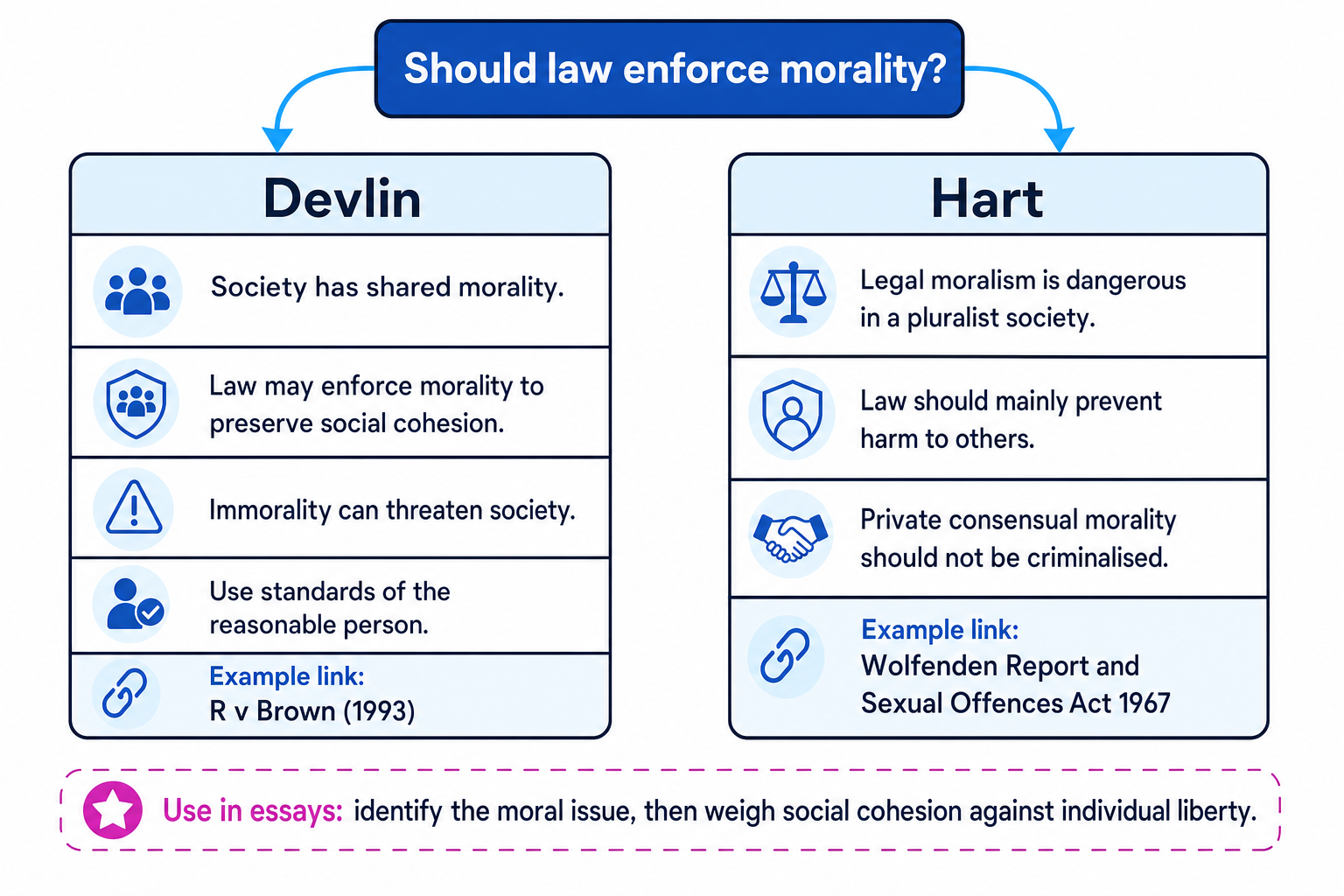
Devlin disagreed with a narrow harm-based approach. He argued that society depends on a shared morality, so serious immorality can threaten social cohesion. Hart replied that using criminal law to enforce moral disapproval is dangerous in a pluralist society.
The debate is easiest to revise as a contrast between social cohesion and individual liberty.
Devlin’s argument
Devlin’s view is often called legal moralism: the idea that law may enforce moral standards because immorality itself can damage society.
He argued that society has the right to defend its moral structure, just as it defends itself from political attack. If the “reasonable person” feels strong intolerance, indignation, or disgust, criminal law may be justified.
Hart’s argument
Hart was influenced by the harm principle, associated with John Stuart Mill: law should mainly prevent harm to others, not punish private choices simply because others dislike them.
Hart argued that Devlin exaggerated the idea of a shared morality. In a pluralist society, moral disagreement is normal. Criminalising private consensual behaviour risks oppressing minorities.
Example
Applying Devlin and Hart to consensual injury
-
Identify the issue. In R v Brown (1993), the issue was whether adults could consent to sadomasochistic injuries causing actual bodily harm or worse.
-
Apply Devlin. Devlin would support criminalisation because the conduct could be viewed as seriously immoral and harmful to society’s moral fabric, even if done in private.
-
Apply Hart. Hart would ask whether the conduct harmed others beyond the consenting adults. If not, criminal punishment may be an unjustified invasion of private autonomy.
-
Conclude with the law. The House of Lords took a more Devlin-like approach in Brown, but R v Wilson (1996) shows the courts may limit that approach where private bodily autonomy is seen as less socially harmful.
Evaluation of law and morality
A strong AO3 answer does not simply choose “law should enforce morality” or “law should never enforce morality”. You need a balanced judgement.
Arguments for enforcing morality
Law gains legitimacy when it reflects widely held moral values. Murder, theft, and serious violence are not just technical wrongs; they violate basic moral expectations. If law ignored morality completely, it would lose public confidence.
Law can also protect vulnerable people. For example, restrictions on assisted dying under s2 Suicide Act 1961 may be defended as protecting elderly, disabled, or pressured individuals from abuse.
Arguments against enforcing morality
The main danger is majority oppression. In a pluralist society, “public morality” may simply mean the morality of the most powerful group. Cases such as Shaw v DPP (1962) and Knuller v DPP (1973) are often criticised because judges appeared to enforce conservative sexual morality.
There is also a rule of law concern. Moral language such as “corrupting public morals” can be vague. Citizens should know in advance what is criminal.
Law can follow or lead morality
Sometimes law follows changing morality. R v R (1991) rejected the marital rape exemption because modern society no longer accepted the idea that marriage implied permanent consent.
Sometimes law leads morality by setting standards, for example anti-discrimination legislation and recognition of same-sex marriage under the Marriage (Same Sex Couples) Act 2013.
Courts or Parliament?
Courts can respond to individual cases, but moral controversy often involves broad social policy. That is why in Nicklinson (2014), the Supreme Court was cautious about changing assisted dying law and indicated that Parliament was better placed to decide.
Key Idea
Best evaluative conclusion
Law cannot avoid morality altogether, but in a pluralist society it should be slow to criminalise private consensual conduct unless there is clear harm, exploitation, or a need to protect rights.
Exam technique
In the exam
-
Define the terms first. Start by separating law, morality, pluralism, natural law, and legal positivism.
-
Use authorities precisely. Brown, Wilson, Shaw, Knuller, R v R, Bland, Pretty, and Nicklinson are useful because each shows law and morality clashing in practice.
-
Evaluate with a balance. Weigh Devlin’s social cohesion argument against Hart’s liberty and pluralism argument, then reach a reasoned conclusion.
Self review
Check yourself
- Can you explain why an act may be immoral but not illegal?
- How would Devlin and Hart disagree about R v Brown (1993)?
- Why does pluralism make legal enforcement of morality more difficult?

Keep learning
Make a free account to read the full revision notes and worked examples.