Revision notes for OCR AS Level Law Evaluation of the law of tort. Open the guide for explanations and worked examples. Written against the OCR AS Level Law specification, so the content matches what's examinable rather than general Law background.
Evaluation of the law of tort
What you'll learn
- How to critically evaluate negligence, occupiers’ liability and vicarious liability.
- The five OCR tort evaluation lenses: advantages/disadvantages, fairness, competing interests, aims of tort law, and comparison.
- How to turn AO1 case knowledge into AO3 judgement.
- How to structure short evaluative paragraphs using legal authority.
The starting point: tort, liability and evaluation
Definition
Tort and liability
A tort is a civil wrong where the law may require the defendant to compensate the claimant. Liability means legal responsibility for that wrong, usually leading to damages.
In this topic, you are not learning a brand-new tort. You are learning how to judge the torts you already know: are they fair, effective, balanced and useful?
OCR expects you to evaluate:
- liability in negligence
- occupiers’ liability
- vicarious liability
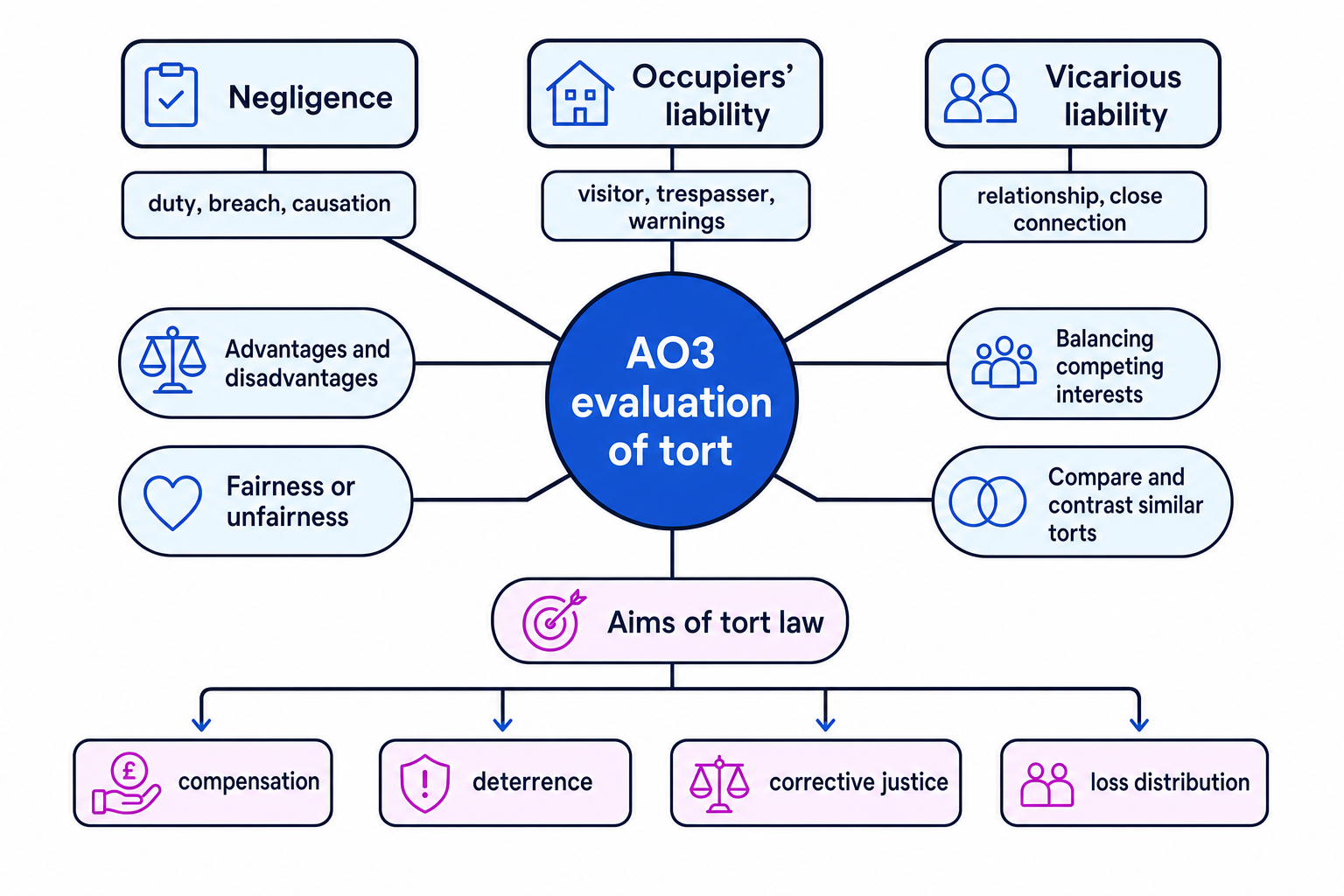
This study map shows how to organise AO3 evaluation of tort law.
Key Idea
AO3 is more than opinion
Strong evaluation means making a reasoned judgement supported by legal authority. Do not just say “this is unfair”; explain who it is unfair to, why, and whether the law has a good reason for that result.
The aims of tort law
You can evaluate torts by asking whether they achieve the aims of tort law:
- Compensation: putting the claimant, as far as money can, in the position they would have been in before the tort.
- Deterrence: encouraging people and organisations to take reasonable care.
- Corrective justice: making the wrongdoer repair the wrong they caused.
- Loss distribution: spreading the cost of accidents, often through insurance or employers.
These aims can conflict. A rule may compensate claimants well but feel harsh on defendants.
OCR’s five evaluation lenses
For this topic, use the specific tort evaluation frameworks:
- Advantages and disadvantages — what works well and what causes problems?
- Fairness or unfairness — is the result fair to claimants, defendants and wider society?
- Balancing competing interests — does the law balance safety, personal responsibility, freedom and cost?
- Aims of tort law — does the tort achieve compensation, deterrence, corrective justice or loss distribution?
- Comparing and contrasting similar torts — does one tort handle a similar problem more fairly or effectively than another?
Tip
One paragraph, one lens
A clear AO3 paragraph usually needs one evaluation lens, one or two authorities, and a mini-judgement. Trying to cover every possible criticism in one paragraph often becomes vague.
Common Mistake
Case dumping
Do not list cases without evaluation. A case only earns strong AO3 when you use it to prove a point about fairness, certainty, policy or the aims of tort law.
Evaluating liability in negligence
Definition
Negligence
Negligence is a tort where the defendant breaches a duty of care owed to the claimant, causing foreseeable damage.
The basic structure is: duty of care → breach → damage caused by the breach.
Key AO1 anchors:
- Donoghue v Stevenson (1932): decomposed snail in a ginger beer bottle; established the neighbour principle and modern duty of care.
- Caparo v Dickman (1990): investors relied on company accounts; duty depends on foreseeability, proximity and whether it is fair, just and reasonable.
- Robinson v Chief Constable of West Yorkshire (2018): elderly pedestrian injured during an arrest; courts should usually apply established duty categories rather than treat Caparo as a universal test.
- Nettleship v Weston (1971): learner driver injured instructor; learner judged by the standard of the competent driver.
- Barnett v Chelsea and Kensington HMC (1969): hospital sent poisoned patient home; no factual causation because he would have died anyway.
- The Wagon Mound (No 1) (1961): oil spill caused fire damage; defendant liable only for reasonably foreseeable types of damage.
Strengths of negligence
Negligence is flexible. The courts can adapt it to new situations, especially through duty of care and breach. This helps claimants where harm is genuinely caused by careless behaviour.
It also supports deterrence. If drivers, doctors, employers and businesses know they may be liable, they have a reason to take care.
Weaknesses of negligence
The same flexibility can create uncertainty. The phrase “fair, just and reasonable” gives judges room to make policy choices, which may be hard to predict.
Causation can also be harsh for claimants. In Barnett, the hospital behaved badly, but the claimant failed because the breach did not cause the death.
Fairness and competing interests
Negligence tries to balance compensation for injured claimants against the risk of making defendants insurers for every accident. This is why foreseeability, proximity and policy limits matter.
Example
Evaluating a learner-driver negligence claim
- A learner driver crashes and injures her instructor, so the issue is whether the standard of care should be lowered for inexperience.
- Nettleship v Weston (1971) applies: the learner is judged against the competent driver, not the careful learner.
- This is fair to the injured claimant because road users should receive the same protection whoever is driving.
- The disadvantage is harshness to inexperienced defendants, but the law can justify this through insurance and the need for consistent road safety standards.
Evaluating occupiers’ liability
Definition
Occupiers’ liability
Occupiers’ liability concerns the duty owed by someone with control over premises to people injured because of the state of those premises.
The law is mainly statutory:
- Occupiers’ Liability Act 1957 protects lawful visitors.
- Occupiers’ Liability Act 1984 gives more limited protection to trespassers.
Under s2(2) Occupiers’ Liability Act 1957, an occupier must take reasonable care to keep visitors reasonably safe. Under s1(3) Occupiers’ Liability Act 1984, a duty to trespassers arises only if the occupier knows of the danger, knows or has reason to believe the trespasser may be near it, and it is reasonable to offer protection.
Useful authorities:
- Wheat v Lacon (1966): pub manager and brewery both had control; more than one occupier can exist.
- Glasgow Corporation v Taylor (1922): child ate poisonous berries in a park; occupiers must take greater care for children.
- Phipps v Rochester Corporation (1955): child fell into trench; occupiers may expect parents to supervise young children.
- Tomlinson v Congleton BC (2003): adult injured diving into lake; no duty to protect against obvious risks freely chosen.
- Revill v Newbery (1996): burglar shot by occupier; even trespassers may sometimes recover damages.
Strengths of occupiers’ liability
The law recognises that occupiers control premises and are often best placed to prevent dangers. The 1957 Act is especially protective of lawful visitors, including children.
The 1984 Act also avoids a completely harsh rule against trespassers. It reflects basic humanity: even someone entering without permission should not be exposed to serious hidden dangers unnecessarily.
Weaknesses of occupiers’ liability
The visitor/trespasser divide can feel artificial. A person’s legal status may change quickly, affecting the duty owed.
The law also risks overburdening landowners if they must guard against obvious risks. Tomlinson shows the courts protecting personal responsibility and public freedom to use land without excessive defensive precautions.
Example
Evaluating a diving-injury occupiers’ claim
- An adult ignores warning signs and dives into a lake, so the likely comparison is with Tomlinson v Congleton BC (2003).
- The occupier may argue the danger was obvious and the claimant freely chose the risk.
- This is fair to occupiers and the public because land should not have to be closed every time an adult might take an obvious risk.
- The claimant may argue compensation is needed for serious injury, but the stronger evaluation is that occupiers’ liability balances safety with personal responsibility.
Evaluating vicarious liability
Definition
Vicarious liability
Vicarious liability is where one person, usually an employer, is held liable for a tort committed by another person, usually an employee.
The modern test asks:
- Is the relationship employment or akin to employment?
- Is there a sufficiently close connection between that relationship and the tort?
Key authorities:
- Various Claimants v Catholic Child Welfare Society (2012): abuse by brothers at a school; relationships akin to employment can trigger liability.
- Cox v Ministry of Justice (2016): prisoner injured catering manager; prison service liable because the work was part of its enterprise.
- Barclays Bank v Various Claimants (2020): doctor was an independent contractor; bank not vicariously liable.
- Lister v Hesley Hall (2001): warden abused children in boarding house; close connection test developed.
- Mohamud v WM Morrison Supermarkets (2016): employee assaulted customer after workplace interaction; employer liable.
- WM Morrison Supermarkets v Various Claimants (2020): employee leaked payroll data for revenge; employer not liable because he was on a personal vendetta.
Strengths of vicarious liability
It strongly supports compensation and loss distribution. Employers are more likely than individual employees to have insurance and resources.
It also encourages deterrence. Organisations have incentives to train, supervise and manage risks created by their enterprise.
Weaknesses of vicarious liability
It can seem unfair because the employer may not be personally at fault. The doctrine shifts loss because of policy, not because the employer directly committed the tort.
The close connection test can also be uncertain. Mohamud expanded liability, while WM Morrison (2020) pulled it back where the employee acted for purely personal revenge.
Common Mistake
Not everything at work is covered
Do not say employers are liable for every wrong committed by employees. The tort must be closely connected to the employment relationship, and personal vendettas may fall outside liability.
Example
Evaluating an employee assault claim
- A petrol station employee assaults a customer during an argument about service, so the relationship is employment and the issue is close connection.
- Mohamud v WM Morrison Supermarkets (2016) supports liability because the assault grew out of the employee’s interaction with a customer.
- This helps compensation and loss distribution because the employer is more likely to be insured than the employee.
- The unfairness is that the employer did not personally assault anyone, but the law justifies liability because the risk arose from the business’s enterprise.
Comparing and contrasting similar torts
Comparison is powerful AO3 because it shows judgement rather than memorisation.
- Negligence and occupiers’ liability both use reasonableness, but occupiers’ liability is more specific because it focuses on premises and visitor status.
- Negligence and vicarious liability both compensate claimants, but negligence is based on the defendant’s own fault, while vicarious liability can impose liability without personal fault.
- Occupiers’ liability and vicarious liability both look at control: control of premises in one, control of enterprise risk in the other.
Example
Comparing negligence and occupiers’ liability
- Both torts aim to compensate claimants injured by unreasonable risk, so they share a protective function.
- Occupiers’ liability gives more structured statutory duties under the 1957 and 1984 Acts, while negligence relies more heavily on common law tests such as Caparo and Robinson.
- This means occupiers’ liability may be clearer in premises cases, but negligence is more flexible for new types of harm.
Exam technique
In the exam
- Start each evaluative paragraph with a clear judgement: “A strength of negligence is…” or “This is arguably unfair because…”.
- Support the judgement with precise authority, such as Tomlinson (2003) for personal responsibility or Mohamud (2016) for enterprise risk.
- End by linking back to one OCR lens: fairness, competing interests, aims of tort law, advantages/disadvantages, or comparison.
Self review
Check yourself
- Why might vicarious liability be fair to claimants but unfair to employers?
- How does Tomlinson v Congleton BC (2003) show a balance between safety and personal responsibility?
- What is one advantage and one disadvantage of negligence being flexible?

Keep learning
Make a free account to read the full revision notes and worked examples.