Revision notes for OCR AS Level Law Remedies in tort. Open the guide for explanations and worked examples. Written against the OCR AS Level Law specification, so the content matches what's examinable rather than general Law background.
Remedies in tort
What you'll learn
- How compensatory damages are used to put the claimant back, as far as money can.
- What mitigation of loss means and why a claimant cannot let losses build up unreasonably.
- What an injunction is, and when a court may order one instead of just awarding money.
- How to apply remedies in problem questions and evaluate whether they are fair and effective.
The purpose of remedies in tort
A remedy is the legal response given by the court after a tort has been proved. In tort, the main aim is usually compensation, not punishment. The claimant has already shown that the defendant committed a tort, such as negligence, nuisance or trespass; the remedy stage asks: what should the court do about it?
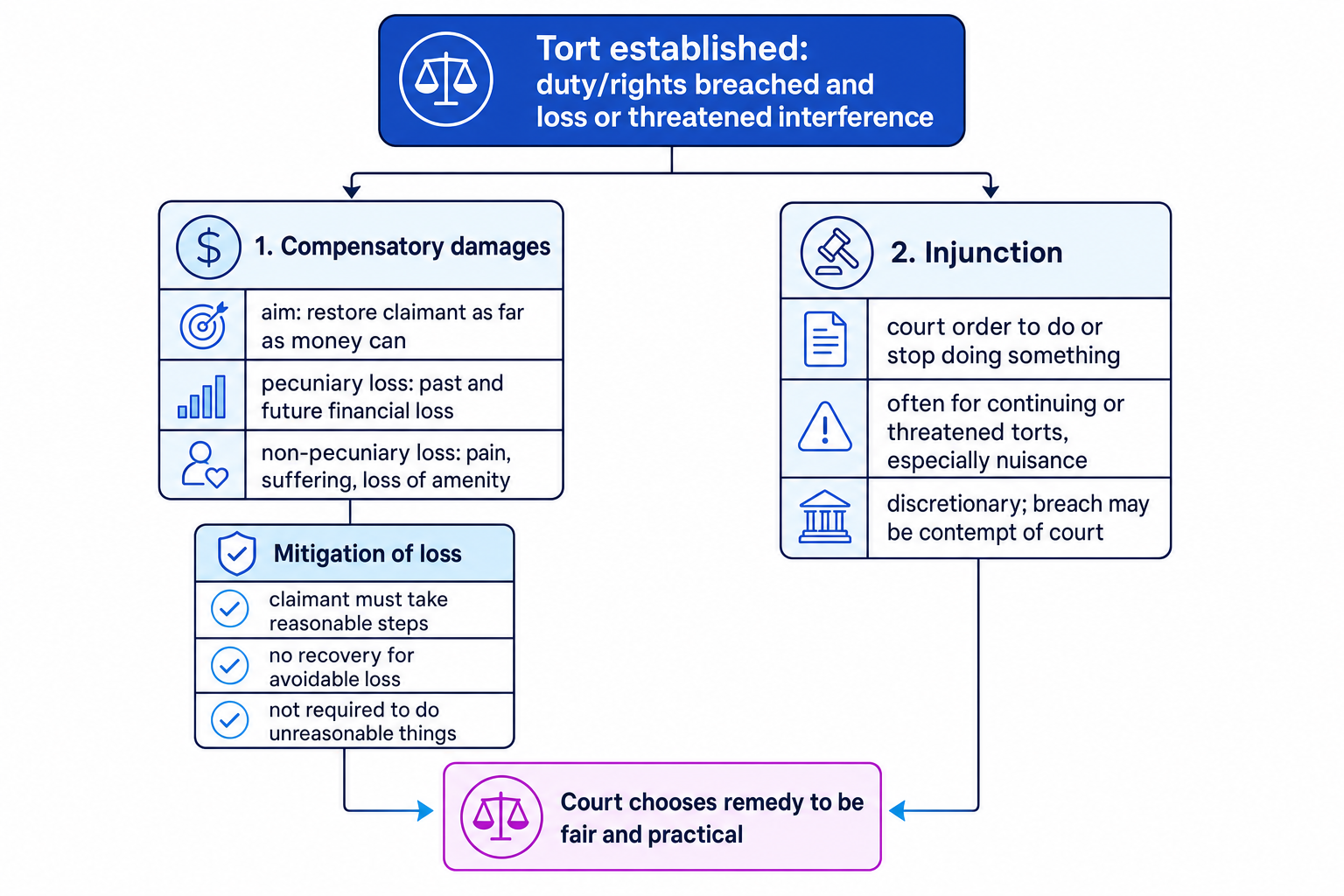
The big picture is that tort remedies either repair past loss with money or control future behaviour with a court order.
Definition
Remedy
A remedy is the order or award made by a court to respond to a legal wrong. In tort, the key remedies for OCR are compensatory damages, mitigation of loss, and injunctions.
Compensatory damages
Definition
Compensatory damages
Compensatory damages are a money award designed to compensate the claimant for loss caused by the defendant’s tort. The aim is to place the claimant, so far as money can, in the position they would have been in if the tort had not occurred.
The classic basis of damages comes from Livingstone v Rawyards Coal Co (1880): the claimant should receive the sum of money that puts them in the same position as if the wrong had not been done. This is sometimes called restitutio in integrum, meaning “restoration to the original position”.
In West v Shephard (1964), a claimant was seriously injured in a road accident. The House of Lords stressed that money cannot truly restore a damaged body, but the court must still make a fair financial assessment.
Types of loss
Compensatory damages can cover different kinds of loss.
Pecuniary loss means financial loss, such as medical expenses, repair costs, lost earnings, travel costs or care costs.
Non-pecuniary loss means non-financial harm, such as pain, suffering and loss of amenity. Loss of amenity means reduced ability to enjoy life, hobbies or everyday activities.
You may also see:
- Special damages: financial losses that can be calculated up to the date of trial, such as wage slips, invoices or repair bills.
- General damages: losses assessed by the court, such as future loss of earnings or pain and suffering.
Key Idea
The basis of damages
The court is not trying to give the claimant a bonus. It is trying to give full but not excessive compensation for loss caused by the tort.
Example
Assessing compensatory damages
Amira is injured when Ben negligently drives into her bicycle. She misses two weeks of work, pays for physiotherapy, and can no longer play tennis for three months.
-
Identify the issue: Ben has committed negligence, so the remedy issue is what compensation Amira should receive for losses caused by the accident.
-
State the rule: Under Livingstone v Rawyards Coal Co (1880), damages aim to put Amira in the position she would have been in if the tort had not occurred, as far as money can.
-
Apply pecuniary loss: Amira can claim financial losses such as lost earnings for two weeks and the cost of physiotherapy, provided they are proved with evidence such as payslips and receipts.
-
Apply non-pecuniary loss: She may also claim for pain, suffering and loss of amenity because the injury affected her ability to enjoy tennis and ordinary life.
-
Conclude: Amira’s award should compensate both financial losses and the non-financial impact of the injury, without overcompensating her.
Common Mistake
Thinking damages always punish the defendant
In tort, damages are usually compensatory, not punitive. Focus on the claimant’s loss, not on how badly the defendant behaved.
Mitigation of loss
Definition
Mitigation of loss
Mitigation of loss means the claimant must take reasonable steps to reduce their loss after the tort. The claimant cannot recover losses that they could reasonably have avoided.
Mitigation is not a separate tort and it is not a “duty” owed to the defendant in the ordinary sense. Instead, it is a limit on damages. If the claimant acts unreasonably after the tort, the court may reduce the compensation.
The basic principle is linked to British Westinghouse Electric v Underground Electric Railways (1912). Defective turbines were supplied, but the claimant bought replacements that were actually more efficient. The principle is that a claimant must take reasonable steps to reduce loss, and benefits from mitigation may be taken into account.
In a tort context, Lagden v O’Connor (2003) is useful. A claimant whose car was damaged used credit hire because he could not afford an ordinary hire car. The House of Lords held that the claimant’s financial position was relevant when deciding whether his mitigation was reasonable.
What counts as reasonable?
The claimant does not have to do the cheapest thing imaginable. They must act as a reasonable person in their circumstances would act.
So the court may consider:
- the claimant’s health and personal circumstances;
- whether they had the money to pay upfront;
- how urgent the situation was;
- whether the proposed step was risky or burdensome;
- whether the extra loss was genuinely caused by the tort.
Tip
Mitigation shortcut
Ask: Was the extra loss avoidable by reasonable action? If yes, it may not be recoverable. If no, the claimant can usually claim it.
Example
Deciding whether loss was mitigated
Cara’s car is damaged by Dan’s negligent driving. The garage says repairs will take two weeks. Cara has enough money to authorise repairs immediately, but she waits six weeks and hires a replacement car throughout.
-
Identify the issue: Cara can claim losses caused by Dan’s negligence, but Dan may argue that some hire charges were avoidable.
-
State the rule: A claimant must take reasonable steps to reduce loss. Under the mitigation principle, avoidable losses are not recoverable.
-
Apply the facts: Two weeks of hire is likely reasonable because Cara needed transport while repairs were carried out. The extra four weeks resulted from Cara’s unnecessary delay, not from the accident itself.
-
Compare with claimant circumstances: Unlike Lagden v O’Connor (2003), Cara had the money to act immediately, so her delay is less likely to be reasonable.
-
Conclude: Cara can probably recover repair costs and two weeks of hire charges, but not the extra four weeks.
Common Mistake
Mitigation is fact-sensitive
Do not assume a claimant failed to mitigate just because there was a cheaper option. The court asks what was reasonable, not what was perfect.
Injunctions
Definition
Injunction
An injunction is a court order requiring a person either to do something or to stop doing something. It is an equitable remedy, meaning it is discretionary and awarded when the court thinks it is just.
Injunctions are especially important where the tort is continuing or threatened. For example, money may not be enough if a neighbour continues creating excessive noise every night.
There are two basic types:
- A prohibitory injunction orders the defendant to stop doing something.
- A mandatory injunction orders the defendant to take positive action.
An injunction may be interim, meaning temporary before the final trial, or final, meaning granted after the court has decided the case.
If a defendant breaches an injunction, they may be in contempt of court, which can lead to serious consequences such as a fine or imprisonment.
Injunctions in nuisance
Injunctions often appear in private nuisance cases because the problem is ongoing interference with land.
In Kennaway v Thompson (1981), noisy powerboat racing interfered with the claimant’s enjoyment of her home. The court granted an injunction restricting the racing rather than allowing the nuisance to continue freely.
In Miller v Jackson (1977), cricket balls were repeatedly hit into neighbouring property. The court recognised the nuisance but refused an injunction because of the social value of the cricket club, awarding damages instead.
In Coventry v Lawrence (2014), noise from motorsport activities caused nuisance. The Supreme Court confirmed that courts may choose between injunctions and damages, balancing private rights against wider practical consequences.
Key Idea
Damages or injunction?
Damages deal mainly with past loss. Injunctions are strongest where the claimant needs protection from future or continuing interference.
Example
Choosing between injunction and damages
A factory next to Priya’s house creates loud noise every night, making sleep impossible. The noise has continued for months and is likely to continue.
-
Identify the issue: Priya may have a private nuisance claim, and the remedy issue is whether money alone is enough or whether an injunction is needed.
-
State the rule: An injunction may be granted to stop continuing tortious behaviour. Kennaway v Thompson (1981) shows that courts can restrict noisy activities where damages are inadequate.
-
Apply the facts: Because the noise happens every night, damages for past inconvenience would not solve the ongoing problem. Priya needs future protection.
-
Balance interests: The court may avoid shutting the factory completely if a narrower order would work, such as limiting night-time operations.
-
Conclude: A tailored prohibitory injunction restricting night noise is likely to be appropriate, possibly with damages for past loss.
AO3: evaluating remedies in tort
Remedies in tort have clear advantages. Compensatory damages support the main aim of tort law: compensating people for harm caused by civil wrongs. They are flexible because they can cover financial loss, future loss and non-financial harm.
However, damages can be imperfect. Money cannot truly undo serious injury, grief, pain or loss of enjoyment. Future losses are also difficult to assess because courts must predict what would have happened.
Mitigation is generally fair because it balances competing interests. Claimants should be compensated, but defendants should not pay for losses that the claimant unreasonably allowed to increase. The disadvantage is that it can seem harsh if an injured or vulnerable claimant is judged too strictly. Cases like Lagden v O’Connor (2003) help by making the test sensitive to the claimant’s real circumstances.
Injunctions are powerful because they can prevent harm continuing. This can be more effective than repeatedly paying damages. But they may also be severe, especially if they stop socially useful activities or harm third parties. The courts therefore balance the claimant’s rights against the defendant’s interests and the wider public impact.
Exam technique
In the exam
-
Start with the remedy requested: damages for past loss, an injunction for future harm, or both.
-
Anchor your rule in authority: use Livingstone v Rawyards Coal Co (1880) for the basis of damages, Lagden v O’Connor (2003) for reasonable mitigation, and Kennaway v Thompson (1981) for injunctions in continuing nuisance.
-
Apply, then evaluate: explain what the claimant can recover, whether any loss was avoidable, and whether the remedy fairly balances the parties’ interests.
Self review
Check yourself
- What is the aim of compensatory damages in tort?
- When might a claimant fail to mitigate their loss?
- Why might a court grant an injunction instead of simply awarding damages?

Keep learning
Make a free account to read the full revision notes and worked examples.