Revision notes for OCR AS Level Law Delegated legislation. Open the guide for explanations and worked examples. Written against the OCR AS Level Law specification, so the content matches what's examinable rather than general Law background.
Delegated legislation
What you'll learn
- What delegated legislation is, and why Parliament uses it.
- The three main types: Orders in Council, Statutory Instruments and by-laws.
- How Parliament and the courts control delegated legislation.
- How to evaluate whether those controls are effective.
The starting point: Parliament cannot do everything itself
Parliament makes primary legislation, meaning Acts of Parliament passed through the full legislative process. But Acts often set out broad principles rather than every detailed rule needed in daily life.
So Parliament sometimes gives law-making power to another person or body. This produces delegated legislation, also called secondary legislation.
Definition
Delegated legislation
Delegated legislation is law made by a person or body other than Parliament, using powers given by Parliament in a Parent Act or enabling Act.
A Parent Act is the Act of Parliament that creates the power to make delegated legislation. It should say who can make the rules, what they can make rules about, and what procedure must be followed.
Delegated legislation is still law. The key point is that its authority comes from Parliament.
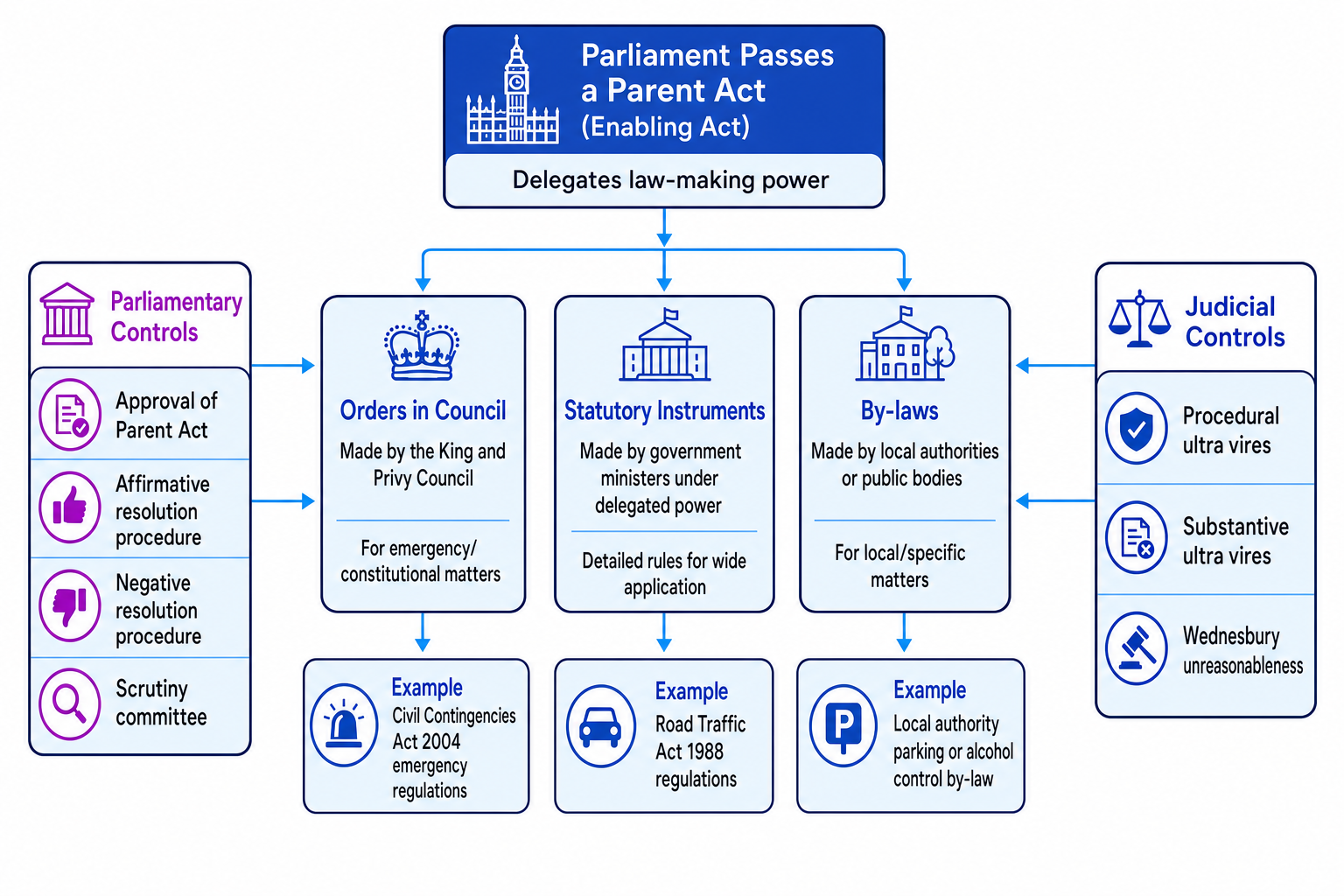
Here is the big picture before we break it down.
Why delegated legislation is used
Parliament uses delegated legislation because modern government needs a huge amount of detailed rule-making.
Saving parliamentary time
Parliament does not have time to debate every technical rule in full. Delegated legislation lets Parliament focus on the main policy in the Parent Act while leaving detailed implementation to ministers or other bodies.
Technical expertise
Some rules are highly technical. For example, road safety regulations may require knowledge from transport specialists, engineers and civil servants. Ministers and departments are often better placed to deal with this detail than the whole House of Commons.
Flexibility and speed
Delegated legislation can usually be made and updated more quickly than an Act of Parliament. This is useful where rules need to respond to new technology, public health issues, emergencies, or changing social conditions.
Local knowledge
By-laws allow local authorities and public bodies to make rules for particular places. A rule needed in one town centre, park, or transport network may not be suitable nationwide.
Key Idea
Why it matters
Delegated legislation is a practical necessity: Parliament keeps overall authority, but detailed law-making is carried out by bodies closer to the issue.
Types of delegated legislation
OCR expects you to know three types: Orders in Council, Statutory Instruments and by-laws.
Orders in Council
An Order in Council is delegated legislation formally made by the King and the Privy Council. The Privy Council is a formal body made up largely of senior politicians and advisers.
Orders in Council are often used for constitutional matters, emergency powers, or matters that need formal approval at the highest level.
Example: the Misuse of Drugs Act 1971 (Amendment) Order 2008 was made by Order in Council and reclassified cannabis from Class C to Class B.
Common Mistake
Do not mix up the names
OCR requires Orders in Council. You do not need to cover Orders of Council, Legislative Reform Orders or Henry VIII powers for this topic.
Statutory Instruments
A Statutory Instrument is delegated legislation usually made by a government minister under powers in a Parent Act. Statutory Instruments are the most common type of delegated legislation.
Example: the Motor Vehicles (Wearing of Seat Belts) Regulations 1993 were made under powers connected with the Road Traffic Act 1988 and set detailed rules about seat belt use.
By-laws
A by-law is delegated legislation made by a local authority or certain public bodies to deal with local or specific matters.
Example: a local council may make a by-law under s235 Local Government Act 1972 regulating behaviour in local parks, such as restricting cycling in particular areas.
Public bodies can also make by-laws. For example, railway by-laws regulate behaviour on railway and underground networks.
Example
Classifying delegated legislation
A new rule is made in three different ways: a minister signs national road safety regulations, a council bans cycling in a local park, and the King in Council approves a change to drug classification.
-
The national road safety regulations are made by a government minister under a Parent Act, so they are likely to be a Statutory Instrument.
-
The rule about cycling in a local park is made by a local authority for a local area, so it is a by-law.
-
The drug classification change is formally approved by the King and Privy Council, so it is an Order in Council.
Parliamentary controls
Parliament controls delegated legislation because the power to make it ultimately comes from Parliament.
Approval of the Parent Act
The first control is that Parliament must pass the Parent Act. This is important because Parliament can decide:
- who receives delegated power;
- what topics the power covers;
- what procedure must be followed;
- whether consultation or other limits are required.
This is a strong control in theory because Parliament creates the power. However, it may be weak in practice if the enabling powers are drafted broadly or MPs do not spend much time debating the future delegated legislation.
Negative Resolution Procedure
Under the Negative Resolution Procedure, delegated legislation becomes law unless Parliament objects within a set period, usually 40 days.
This is efficient because most Statutory Instruments are uncontroversial. But it is also weak as a control because many instruments are never debated.
Affirmative Resolution Procedure
Under the Affirmative Resolution Procedure, delegated legislation must be actively approved by Parliament, usually before it comes into force.
This gives more parliamentary control than the negative procedure because there must be a positive vote. However, Parliament normally cannot amend the instrument. It can usually only approve or reject it.
Scrutiny by committee
Parliamentary committees examine delegated legislation. The Joint Committee on Statutory Instruments checks technical matters, such as whether the minister appears to have used the power correctly or whether the drafting is defective.
The House of Lords Secondary Legislation Scrutiny Committee may draw attention to instruments of political or public importance.
Key Idea
Committee scrutiny
Committees are useful because they specialise in delegated legislation, but they usually report problems rather than directly changing the law.
Judicial controls
The courts control delegated legislation through judicial review, which means judges check whether a public body has acted lawfully. For this OCR topic, you only need the legal grounds below. You do not need judicial review procedure, locus standi or remedies.
Definition
Ultra vires
Ultra vires means “beyond the powers”. Delegated legislation is invalid if the person or body making it goes beyond the powers given by the Parent Act.
Procedural ultra vires
Procedural ultra vires happens when the correct procedure has not been followed.
In Agricultural, Horticultural and Forestry Industry Training Board v Aylesbury Mushrooms Ltd (1972), the minister had to consult relevant organisations before making an order. Mushroom growers were not properly consulted, so the order was ineffective against them. The principle is that required procedures must be followed.
Substantive ultra vires
Substantive ultra vires happens when the content of the delegated legislation goes beyond what the Parent Act allows.
In Commissioners of Customs and Excise v Cure and Deeley Ltd (1962), regulations allowed tax officials to decide the amount of tax due in a way that went beyond the Act. The regulations were held invalid.
In R v Secretary of State for Social Security, ex parte Joint Council for the Welfare of Immigrants (1996), regulations restricting asylum seekers’ benefits went beyond the purpose of the statutory power. The principle is that delegated powers must be used for the purpose Parliament authorised.
Wednesbury unreasonableness
Wednesbury unreasonableness means a decision is so unreasonable that no reasonable public body could have made it.
The test comes from Associated Provincial Picture Houses Ltd v Wednesbury Corporation (1948). A cinema challenged a condition imposed by the local authority banning children under 15 from Sunday performances. The challenge failed, but the case established the high threshold for irrationality.
Example
Challenging a regulation as ultra vires
A Parent Act lets the Transport Secretary make taxi safety regulations after consulting taxi operators’ associations. The minister consults only the police, then makes a Statutory Instrument imposing a £50 nightly environmental levy on taxi drivers.
-
The rule is a Statutory Instrument because it is made by a minister under powers granted by a Parent Act.
-
There may be procedural ultra vires because the Act required consultation with taxi operators’ associations, but the minister did not do this. This is similar to Aylesbury Mushrooms (1972).
-
There may also be substantive ultra vires because a nightly environmental levy is not obviously about taxi safety. The minister may have used the power for a purpose outside the Parent Act, as in Cure and Deeley (1962) and JCWI (1996).
-
A Wednesbury argument would be harder. The court would ask whether the measure was so irrational that no reasonable minister could impose it. Harshness alone is not enough.
Advantages of delegated legislation
Delegated legislation has clear benefits.
It saves parliamentary time because detailed rules do not need a full Act of Parliament.
It allows expert input, especially where rules are technical or specialised.
It is flexible because it can be made, updated and replaced more quickly than primary legislation.
It supports local democracy because local authorities can make rules suited to local needs.
It is useful in emergencies because urgent rules can be introduced without waiting for the full parliamentary process.
Disadvantages of delegated legislation
The main criticism is the democratic deficit. Many rules are made by ministers, civil servants, local authorities or public bodies rather than being fully debated by elected MPs.
There is also a problem of volume. Thousands of Statutory Instruments may be made, making the law difficult for ordinary people to find and understand.
Parliamentary scrutiny can be limited. Under the negative procedure, many instruments become law without debate. Under the affirmative procedure, Parliament usually cannot amend the instrument.
Delegated powers may also be misused. This is why judicial review and the doctrine of ultra vires are important.
How effective are the controls?
Parliamentary controls are strongest at the Parent Act stage because Parliament can set the boundaries of the delegated power. But once broad powers have been granted, later scrutiny may be limited.
The affirmative procedure is more effective than the negative procedure because it requires active approval. However, both are weakened by party control, limited debating time, and the inability to amend most delegated legislation.
Committees improve technical scrutiny, but they are not a complete safeguard because they cannot rewrite instruments and may not examine the full policy merits.
Judicial controls are important because independent courts can stop delegated legislation that exceeds legal powers. Cases such as Aylesbury Mushrooms (1972) and Cure and Deeley (1962) show the courts can be effective.
However, judicial review is reactive. Someone must bring a challenge after the rule is made. It can also be expensive and slow. Courts usually focus on legality, not whether the policy is wise or fair. The Wednesbury test is especially difficult to satisfy.
Tip
Balanced evaluation
A strong essay usually says delegated legislation is necessary, but the real issue is whether the controls are strong enough to prevent abuse.
Exam technique
In the exam
-
Start with AO1: define delegated legislation, identify the type, and give a precise example such as an Order in Council, Statutory Instrument or by-law.
-
For controls, separate Parliamentary controls from judicial controls and use the correct terminology: negative procedure, affirmative procedure, scrutiny committee, procedural ultra vires, substantive ultra vires and Wednesbury unreasonableness.
-
For AO3 evaluation, avoid one-sided answers. Explain both effectiveness and weakness: Parliament authorises and scrutinises, but debate is limited; courts can invalidate unlawful rules, but only if someone challenges them.
Self review
Check yourself
-
What is the difference between a Statutory Instrument and a by-law?
-
How do procedural ultra vires and substantive ultra vires differ?
-
Why might the affirmative resolution procedure be stronger than the negative resolution procedure, but still not fully effective?

Keep learning
Make a free account to read the full revision notes and worked examples.