Revision notes for OCR AS Level Law Statutory interpretation. Open the guide for explanations and worked examples. Written against the OCR AS Level Law specification, so the content matches what's examinable rather than general Law background.
Statutory interpretation
What you'll learn
- Why Acts of Parliament sometimes need judges to explain their meaning.
- How the literal rule, golden rule, mischief rule and purposive approach operate.
- How intrinsic aids and extrinsic aids help courts interpret statutes.
- How EU law influence and the Human Rights Act 1998 affect interpretation, plus key evaluation points.
Why statutory interpretation is needed
A statute is an Act of Parliament. Parliament tries to draft laws clearly, but words can be uncertain, outdated or too general for the exact facts of a case.
Definition
Statutory interpretation
Statutory interpretation is the process by which judges decide the meaning of words in an Act of Parliament so they can apply the Act to a real dispute.
Judges may need to interpret a statute because:
- a word has more than one possible meaning, such as “use”, “vehicle” or “public place”;
- the Act contains a drafting error;
- the Act uses broad language to cover many situations;
- new technology or social changes arise after the Act was passed;
- applying the words literally would create an unfair or absurd result.
Key Idea
The core tension
Statutory interpretation balances legal certainty — applying the words Parliament used — against fairness and purpose — making the Act work sensibly in real cases.
Example
Spotting why interpretation is needed
A by-law says “no vehicles in the park”. A person rides an electric scooter through the park.
- The issue is whether an electric scooter counts as a “vehicle”.
- A narrow meaning might include only cars and vans, but a wider meaning could include anything used for transport.
- Because both meanings are possible, the court must interpret the statute before deciding whether the by-law has been broken.
The main rules and approaches
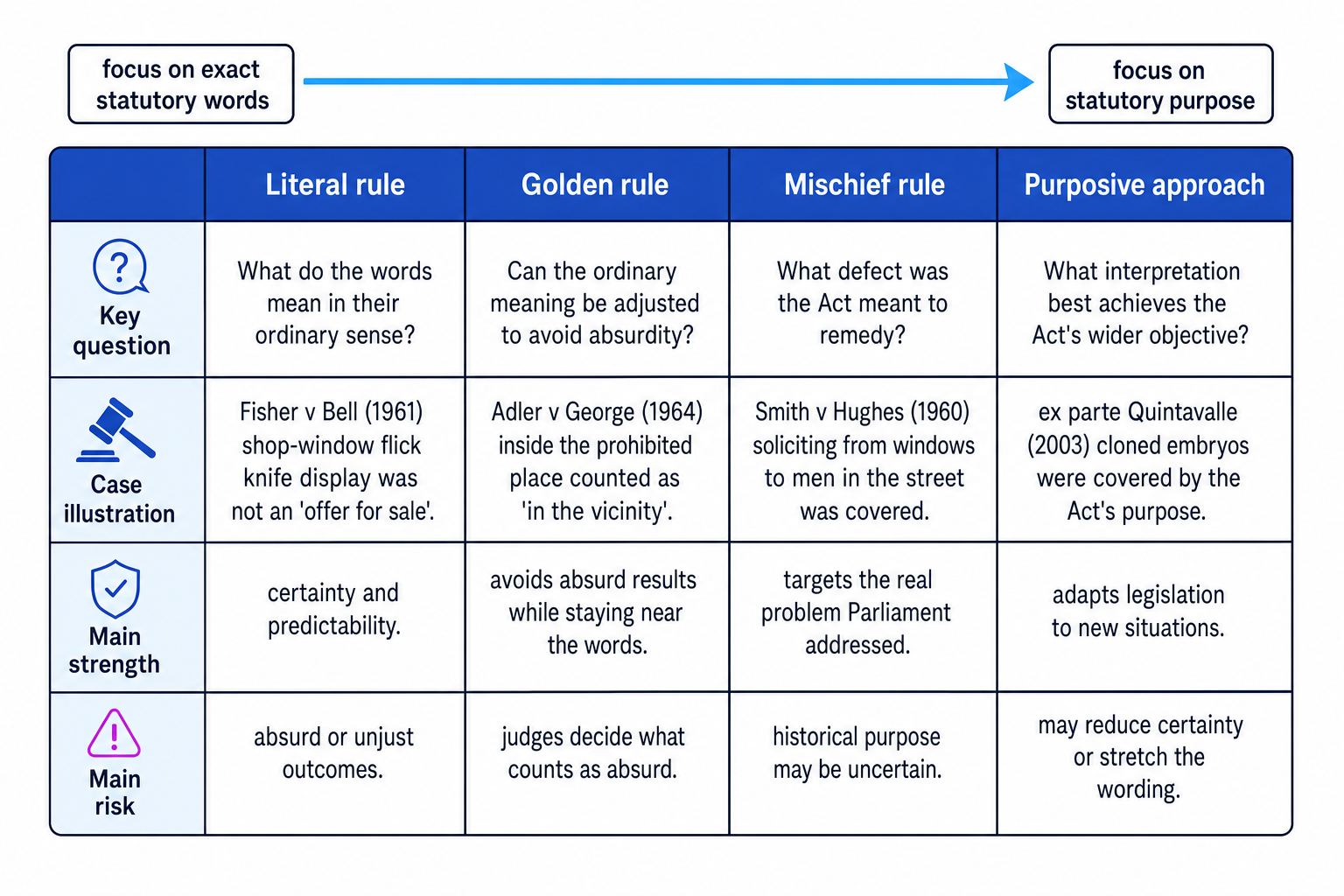
The three traditional rules are the literal rule, golden rule and mischief rule. The purposive approach is a broader modern approach. Think of them as moving along a spectrum: from focusing closely on the exact words to focusing more on Parliament’s purpose.
The literal rule
Definition
Literal rule
The literal rule means judges give words their ordinary, plain meaning, even if the result seems harsh, inconvenient or unlikely to reflect what Parliament wanted.
Key cases:
- Fisher v Bell (1961) — a flick knife in a shop window was not an “offer for sale” because, in contract law, a display is an invitation to treat; the literal meaning meant the shopkeeper was not guilty.
- Whiteley v Chappell (1868) — a defendant impersonated a dead voter, but a dead person was not “entitled to vote”; the literal rule produced an absurd acquittal.
Example
Applying the literal rule to a shop display
In Fisher v Bell (1961), legislation made it an offence to “offer” certain knives for sale.
- The court identified the key statutory word: “offer”.
- Using the ordinary legal meaning from contract law, goods displayed in a shop window are usually an invitation to treat, not an offer.
- Because there was no legal “offer for sale”, the defendant was not guilty under the statute.
Common Mistake
Literal does not mean sensible
Do not say the literal rule chooses the “best” or “fairest” meaning. It chooses the ordinary meaning, even if that creates an awkward result.
The golden rule
Definition
Golden rule
The golden rule allows judges to modify the literal meaning where applying it would create an absurd or repugnant result.
There are two versions:
- The narrow approach chooses between possible meanings of a word.
- The broad approach changes the ordinary meaning more openly to avoid a serious absurdity.
Key cases:
- Adler v George (1964) — the defendant was inside a prohibited RAF base; “in the vicinity of” was interpreted to include being inside the place, avoiding an absurd loophole.
- Re Sigsworth (1935) — a son murdered his mother and would have inherited under the literal wording; the court prevented him benefiting from his crime.
Example
Avoiding an absurd result inside a prohibited place
In Adler v George (1964), the statute criminalised obstruction “in the vicinity of” a prohibited place.
- A strict literal reading could suggest “near” the place, not actually inside it.
- That would be absurd because someone inside the prohibited place is an even greater security concern.
- The court applied the golden rule and treated “in the vicinity” as covering the defendant’s conduct.
The mischief rule
Definition
Mischief rule
The mischief rule asks what “mischief” — meaning the problem or defect in the old law — Parliament was trying to fix, and interprets the Act to suppress that problem.
The rule comes from Heydon’s Case (1584). Judges consider:
- What was the common law before the Act?
- What problem did the old law fail to deal with?
- What remedy did Parliament provide?
- What interpretation will advance that remedy?
Key cases:
- Smith v Hughes (1960) — prostitutes solicited men from windows and balconies; although not physically “in a street”, they were targeting men in the street, so the Act applied.
- Royal College of Nursing v DHSS (1981) — nurses helped with abortions using modern medical methods; the court interpreted the Abortion Act to promote the purpose of safe, lawful abortions.
Example
Applying the mischief rule to soliciting from windows
In Smith v Hughes (1960), the statute targeted soliciting “in a street”.
- The court identified the mischief: people in public streets being approached for prostitution.
- The defendants were not standing in the street, but their conduct was directed at men in the street.
- The court interpreted the Act to cover the defendants because that suppressed the mischief Parliament aimed to stop.
The purposive approach
Definition
Purposive approach
The purposive approach asks what broader purpose or objective the Act was designed to achieve, then chooses the interpretation that best fulfils that purpose.
It is similar to the mischief rule but usually wider. The mischief rule looks closely at the defect in the previous law; the purposive approach focuses on the overall aim of the legislation.
Key cases:
- R v Secretary of State for Health, ex parte Quintavalle (2003) — cloned embryos were not specifically imagined when the Act was drafted, but they fell within the Act’s purpose of regulating embryo creation.
- Jones v Tower Boot Co (1997) — racist workplace abuse by employees was treated as done “in the course of employment” to fulfil the anti-discrimination purpose of the legislation.
Example
Using purpose for new scientific developments
In ex parte Quintavalle (2003), the issue was whether embryos created by cell nuclear replacement were covered by legislation.
- The literal wording had been drafted before that technology was clearly anticipated.
- The court identified the Act’s purpose: regulating human embryos created outside the body.
- The court interpreted the Act purposively so the new scientific method was included.
Intrinsic and extrinsic aids
Definition
Aids to interpretation
Intrinsic aids are materials inside the Act itself. Extrinsic aids are materials outside the Act that may help explain its meaning.
Intrinsic aids
Intrinsic aids include:
- the long title, which gives the Act’s broad purpose;
- any preamble, which explains background aims, though modern Acts rarely have one;
- section headings and schedules, which help show structure;
- definition sections, where Parliament gives a word a special statutory meaning.
For example, s4 Theft Act 1968 defines “property” for theft, including money and things in action. A judge should use that statutory definition rather than inventing a general meaning.
Extrinsic aids
Extrinsic aids include:
- dictionaries;
- Law Commission reports;
- explanatory notes;
- previous Acts;
- international treaties;
- Hansard, the official record of Parliamentary debates.
The key case is Pepper v Hart (1993) — teachers at a private school were taxed on a benefit; the House of Lords allowed reference to Hansard where legislation was ambiguous, obscure or absurd and the ministerial statement was clear.
Tip
Hansard conditions
For A-Level, remember: Pepper v Hart (1993) does not mean judges can always read Parliamentary debates. Hansard is mainly allowed where the wording is unclear and the minister’s statement helps resolve it.
Impact of EU law
European Union law means law made by EU institutions. Before Brexit, UK courts often interpreted domestic law in a purposive way to comply with EU obligations.
A useful example is Pickstone v Freemans (1989) — equal pay legislation was interpreted broadly to comply with EU equal pay law; the case shows EU law encouraged purposive, rights-protecting interpretation.
Common Mistake
After Brexit
Do not simply say “EU law overrides UK law” as a current general rule. The safer A-Level point is that EU law historically pushed UK courts towards purposive interpretation, especially for EU-derived legislation.
Impact of the Human Rights Act 1998
The Human Rights Act 1998 gives domestic effect to rights from the European Convention on Human Rights, such as Article 5 ECHR on liberty and Article 10 ECHR on freedom of expression.
The key provision is s3 Human Rights Act 1998: courts must read and give effect to legislation, so far as possible, in a way compatible with Convention rights.
If that is not possible for primary legislation, the court may issue a declaration of incompatibility under s4 Human Rights Act 1998. This does not strike down the Act; Parliament decides whether to change the law.
Key cases:
- Ghaidan v Godin-Mendoza (2004) — a same-sex partner was treated as able to succeed to a tenancy; s3 HRA allowed rights-compatible interpretation.
- R v A (No 2) (2001) — limits on questioning a rape complainant about sexual history were interpreted compatibly with the defendant’s Article 6 ECHR right to a fair trial.
Advantages and disadvantages
Literal rule
The literal rule promotes certainty and respects Parliamentary sovereignty, meaning Parliament is the supreme law-maker. People can read the words and predict the law. However, it can create absurd or unjust outcomes, as in Whiteley v Chappell (1868).
Golden rule
The golden rule avoids obvious absurdity while staying fairly close to the statutory wording. Its weakness is uncertainty: judges decide what counts as “absurd”, which can look like judicial law-making.
Mischief rule
The mischief rule helps the law work as Parliament intended and can prevent loopholes. But it depends on identifying the old law and the problem correctly, which may be difficult or subjective.
Purposive approach
The purposive approach is flexible and useful for modern issues, technology and rights-based interpretation. Its disadvantage is that it may reduce certainty and give judges too much power to stretch words beyond what Parliament actually enacted.
Exam technique
In the exam
- Define the rule or approach accurately before using a case.
- For AO2 scenarios, identify the disputed word, apply the chosen rule, then reach a clear conclusion.
- For AO3 evaluation, compare at least two approaches rather than listing strengths in isolation.
- Use authority precisely: case name, year, brief facts and the interpretation principle.
Self review
Check yourself
- Why did the literal rule lead to the result in Fisher v Bell (1961)?
- How is the mischief rule different from the purposive approach?
- What does s3 Human Rights Act 1998 require courts to do?

Keep learning
Make a free account to read the full revision notes and worked examples.