Revision notes for OCR AS Level Law Parliamentary law making. Open the guide for explanations and worked examples. Written against the OCR AS Level Law specification, so the content matches what's examinable rather than general Law background.
Parliamentary law making
What you'll learn
- What Bills, Green Papers and White Papers are.
- The difference between Public Bills, Private Bills and Private Members’ Bills.
- The main stages a Bill passes through in the House of Commons and House of Lords.
- How to evaluate the advantages and disadvantages of Parliamentary law making for AO3.
The starting point: what is Parliament?
Parliament is the UK’s main law-making body. It is made up of three parts:
- the House of Commons — elected MPs;
- the House of Lords — appointed life peers, bishops and some hereditary peers;
- the Crown — the monarch, whose formal approval is needed before a Bill becomes law.
Definition
Act of Parliament
An Act of Parliament is a law passed by Parliament. It begins as a proposal called a Bill and becomes an Act only after it has completed the Parliamentary stages and received Royal Assent.
Key Idea
The basic journey
A law normally begins as a policy idea, becomes a Bill, is scrutinised by both Houses, and finally receives Royal Assent from the Crown.
Before a Bill: Green Papers and White Papers
Not every law appears suddenly as a Bill. Important proposals may first be developed through consultation.
Green Papers
A Green Paper is a government consultation document. It sets out possible ideas for reform and invites views from interested groups, experts, businesses, charities or the public.
It is exploratory: the government is saying, “Here are some options — what do people think?”
White Papers
A White Paper is a firmer statement of government policy. It usually sets out the government’s preferred plan and may lead to a Bill.
It is more committed than a Green Paper: the government is closer to saying, “This is what we intend to do.”
Common Mistake
Mixing up Green and White Papers
Remember: Green = discussion and consultation; White = firmer government proposals. You do not need detailed pre-legislative procedures for OCR H418.
Types of Bill
A Bill is a draft law. OCR expects you to know three types: Public Bills, Private Bills and Private Members’ Bills.
Public Bills
A Public Bill is a Bill that affects the public generally. Most major laws are Public Bills, and most are introduced by the government.
For example, a Bill reforming sentencing powers across England and Wales would be a Public Bill because it affects the legal system generally.
Private Bills
A Private Bill affects a particular individual, organisation or locality rather than the public as a whole.
For example, a Bill giving a particular local authority specific powers over transport infrastructure in its area would be a Private Bill.
Private Members’ Bills
A Private Members’ Bill is introduced by an individual MP or peer who is not acting as a government minister. These Bills can raise important issues, but they often struggle because Parliamentary time is limited and government business usually takes priority.
Example
Classifying types of Bill
A proposal gives one city council special powers to regulate a named local harbour. Another proposal changes the rules on criminal sentencing across England and Wales.
- The harbour proposal affects a specific locality and gives powers to a particular local authority, so it is a Private Bill.
- The sentencing proposal affects the public generally and changes the national criminal justice system, so it is a Public Bill.
- If the sentencing proposal were introduced by a backbench MP rather than a government minister, it could be a Private Members’ Bill, but it would still be public in subject matter.
Common Mistake
Stay within the OCR scope
You do not need Hybrid Bills or Ten-minute rule Bills for this sub-topic. If you include them in an exam answer, you risk wasting time on material that is not required.
The passage of a Bill through Parliament
A Bill usually has to go through the same main stages in both the House of Commons and the House of Lords. It may start in either House, although important financial measures normally start in the Commons.
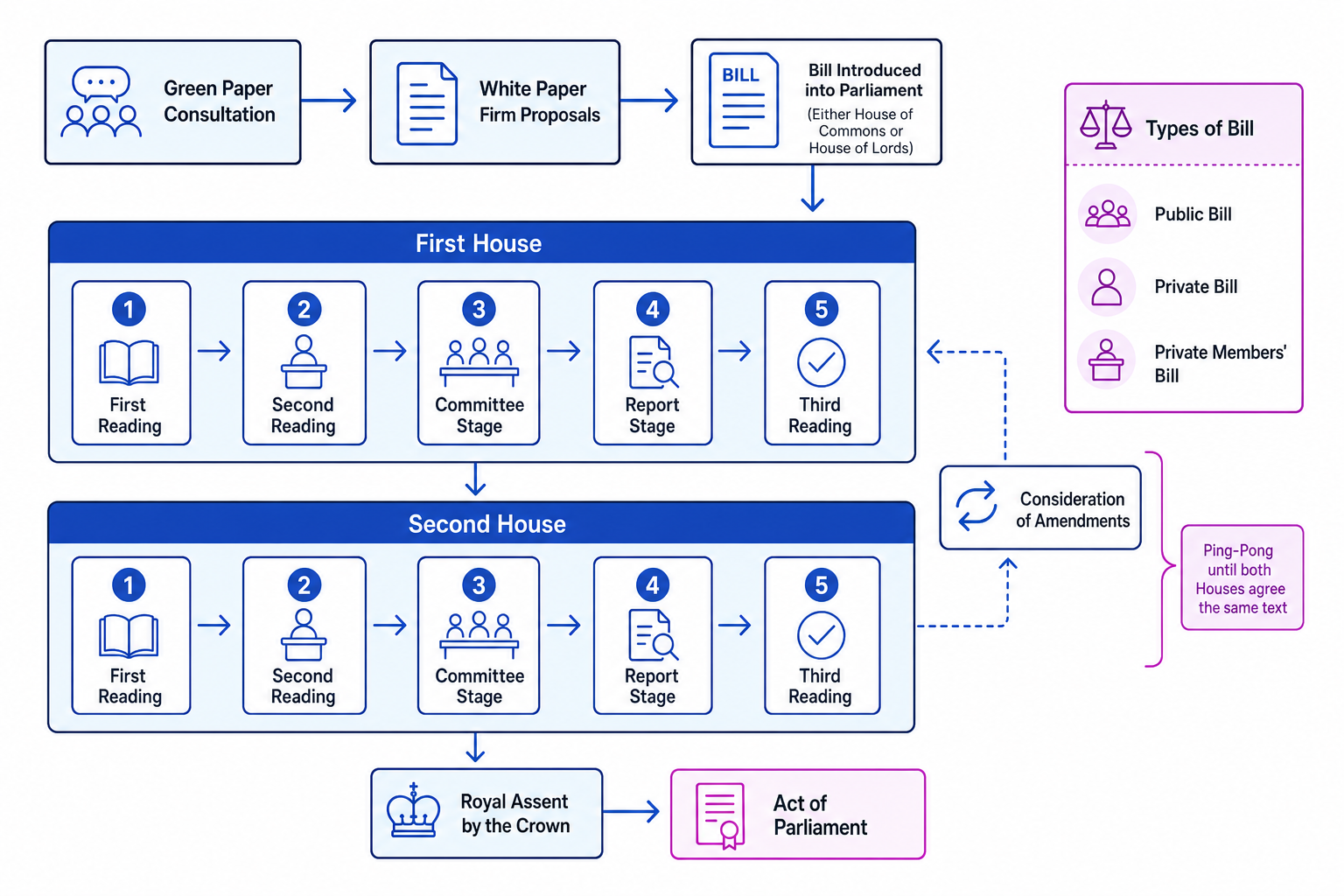
The diagram below shows the normal route from policy idea to Act of Parliament.
Stages in the first House
The “first House” means whichever House the Bill begins in: either the Commons or the Lords.
First Reading
The First Reading is the formal introduction of the Bill. The title is read out, and the Bill is published.
There is no detailed debate at this stage.
Second Reading
The Second Reading is the first major debate on the Bill’s general principles.
MPs or peers consider the overall purpose of the Bill: should this idea become law at all?
Committee Stage
The Committee Stage involves detailed examination of the Bill. A committee looks at the Bill clause by clause.
A clause is a numbered part of a Bill. Once the Bill becomes an Act, clauses usually become sections.
Report Stage
At the Report Stage, the House considers the committee’s work. Further amendments may be debated and voted on.
An amendment is a proposed change to the wording of the Bill.
Third Reading
The Third Reading is the final debate and vote in that House. It is usually focused on the Bill in its final form rather than broad policy.
If approved, the Bill goes to the other House.
Key Idea
Stages are about scrutiny
The stages move from introduction, to debate on principle, to detailed scrutiny, to final approval. This helps Parliament test both the idea and the wording of the proposed law.
Stages in the second House
The second House repeats the same main stages:
- First Reading;
- Second Reading;
- Committee Stage;
- Report Stage;
- Third Reading.
If the second House makes amendments, the Bill must return to the first House for those amendments to be considered. Both Houses must normally agree on the same final wording.
This process of sending the Bill back and forth is sometimes called “ping-pong”.
Tip
Simple memory chain
Use: First, Second, Committee, Report, Third. First introduces, Second debates the principle, Committee checks detail, Report reviews changes, Third gives final approval.
Example
Tracing a Bill through the stages
A Public Bill starts in the House of Commons. It passes Second Reading, is amended in Committee, and then the Lords make further amendments.
- Because the Bill starts in the Commons, the Commons is the first House and must complete First Reading, Second Reading, Committee Stage, Report Stage and Third Reading.
- The Bill then goes to the Lords, which acts as the second House and repeats the same main stages.
- Since the Lords make amendments, the Bill must return to the Commons so MPs can consider whether to accept, reject or change those amendments.
- The Bill can only move on once both Houses have agreed the same wording, after which it can receive Royal Assent.
The role of the Crown
The final stage is Royal Assent. This is the formal approval of the Crown.
In modern practice, Royal Assent is a constitutional formality: the monarch does not normally refuse assent to a Bill passed by Parliament. Once Royal Assent is given, the Bill becomes an Act of Parliament.
Definition
Royal Assent
Royal Assent is the Crown’s formal approval of a Bill. It is the final step needed for a Bill to become an Act of Parliament.
Advantages of the legislative process
Democratic legitimacy
The House of Commons is elected. This gives Acts of Parliament democratic authority because MPs are accountable to voters.
This is especially important for controversial laws. A government can argue that its manifesto and Commons majority give it a mandate to legislate.
Detailed scrutiny
The process contains several stages. Second Reading tests the general principle, while Committee Stage and Report Stage allow detailed scrutiny and amendment.
This can improve the quality of law because errors, gaps and unfair wording may be identified before the Bill becomes an Act.
Bicameral review
The UK Parliament is bicameral, meaning it has two Houses. The House of Lords can act as a revising chamber, bringing expertise and a less party-political perspective to some debates.
Even though the Lords is unelected, its scrutiny can improve technical detail.
Consultation before legislation
Green Papers and White Papers allow ideas to be tested before a Bill is introduced. This can make law more informed and responsive.
For example, consultation can reveal practical problems that ministers may not have noticed.
Disadvantages of the legislative process
Government dominance
Most successful Bills are government Bills. A government with a strong Commons majority can often get its programme through Parliament.
Party discipline and the use of whips — party officials who encourage MPs to vote with the party line — can reduce independent scrutiny.
Time pressure
Parliament has limited time. Some Bills may be rushed, especially if the government wants a quick response to a crisis or political pressure.
This can reduce the quality of debate and increase the risk of unclear law.
Complexity
Modern legislation can be highly technical. MPs may not always have the specialist knowledge needed to understand every detail.
Committees and Lords scrutiny can help, but the process is still vulnerable to technical errors.
Private Members’ Bills often struggle
Private Members’ Bills can raise valuable issues, but they have limited Parliamentary time and often need government support to succeed.
This means an important reform may fail not because it lacks merit, but because it lacks time or political backing.
The unelected House of Lords
The Lords can improve scrutiny, but it is not elected. This creates an AO3 tension: expertise and independence may be useful, but democratic legitimacy is weaker.
Example
Evaluating a rushed Bill
A government introduces a Bill after a major public concern. It passes quickly because the government has a large Commons majority, but lawyers later criticise parts of it as vague.
- The advantage is that Parliament can respond quickly to a public problem, showing democratic responsiveness.
- The disadvantage is that speed may reduce scrutiny, especially at Committee and Report stages where wording should be tested carefully.
- The stronger AO3 conclusion is balanced: speed can be justified in urgent situations, but rushed law risks uncertainty and may create problems for courts, lawyers and citizens later.
Pulling it together for AO1, AO2 and AO3
For AO1, know the key terms and stages accurately: Green Paper, White Paper, Bill, Public Bill, Private Bill, Private Members’ Bill, First Reading, Second Reading, Committee Stage, Report Stage, Third Reading and Royal Assent.
For AO2, apply the process to a situation. If a scenario says a proposal affects everyone, classify it as a Public Bill. If it affects one locality or organisation, consider a Private Bill. If it is introduced by a non-minister MP or peer, identify it as a Private Members’ Bill.
For AO3, evaluate whether the process produces good law. Use balanced points: democratic legitimacy and scrutiny on one side; government dominance, lack of time and complexity on the other.
Exam technique
In the exam
- Start with a clear definition of the term in the question, such as Bill, Green Paper, White Paper or Royal Assent.
- If asked to describe the process, keep the stages in order: First Reading, Second Reading, Committee, Report, Third Reading, then repeat in the second House.
- For evaluation, always balance advantages against disadvantages and reach a short judgement rather than listing points separately.
Self review
Check yourself
- What is the difference between a Green Paper and a White Paper?
- How does a Public Bill differ from a Private Bill and a Private Members’ Bill?
- Why might the legislative process be both effective and imperfect as a way of making law?

Keep learning
Make a free account to read the full revision notes and worked examples.