What you'll learn
- What sociologists mean by youth subculture, deviance, delinquency and crime.
- How subcultural theories explain youth deviance through class, status, education, media and power.
- How labelling and moral panics can turn some young people into “folk devils”.
- How to evaluate these ideas using contemporary UK examples and research-methods points.
The starting point: youth culture
A youth culture is the shared way of life associated with young people: their styles, music, language, leisure, identities and values. This does not mean all young people are the same. Youth cultures vary by class, gender, ethnicity, sexuality, locality and generation.
A subculture is a smaller group within wider society with distinctive norms and values. In youth cultures, this might include punks, goths, skaters, ravers, grime or drill scenes, gamers, “road” cultures, or school-based friendship groups.
Core terms
- Values are beliefs about what is important or desirable.
- Norms are informal rules about expected behaviour.
- Deviance means behaviour that breaks social norms and is negatively judged by others.
- Crime means behaviour that breaks the criminal law.
- Delinquency usually refers to law-breaking or anti-social behaviour by young people.
Deviance is socially constructed. This means an act is not automatically deviant in itself; it becomes deviant when society defines and reacts to it as deviant. For example, a hoodie is just clothing, but in some settings it may be read as threatening because of media stereotypes about youth crime.
Deviance depends on reaction
Not all deviance is criminal, and not all crime is seen as equally deviant. Sociologists ask: who has the power to define young people as troublemakers?
Treating youth culture as automatically deviant
Avoid writing as if youth subcultures are always criminal. Most youth cultures are about belonging, identity, fun and style. Deviance is only one possible dimension.
Why might youth subcultures become deviant?
Sociologists often distinguish between structural explanations and interactionist explanations. Structural explanations focus on how wider social forces — such as class inequality, unemployment, racism or school failure — shape young people’s opportunities. Interactionist explanations focus on everyday meanings, labels and social reactions.
Functionalist and strain theories
Functionalism sees society as a system of institutions, such as family, education and law, that usually work together to create order. However, functionalists also ask why some groups fail to fit into mainstream values.
Merton’s strain theory argues that deviance can occur when people are encouraged to pursue cultural goals, such as success and status, but lack legitimate means to achieve them. Although Merton was writing about American society, the idea can be applied to young people who experience blocked opportunities.
Albert Cohen (1955) developed this into a theory of working-class boys and status frustration. He argued that schools judge pupils by middle-class standards. Some working-class boys cannot gain status through academic success, so they form delinquent subcultures where mainstream values are inverted: being disruptive, tough or anti-school can win peer respect.
Cloward and Ohlin (1960) added that young people also need access to illegitimate opportunity structures: organised routes into crime. They identified criminal, conflict and retreatist subcultures, depending on the local opportunities available.
Applying status frustration to anti-school behaviour
- Start with the institution: school rewards punctuality, obedience, written work and exam success, which Cohen sees as closer to middle-class expectations.
- Apply inequality: a working-class pupil who repeatedly fails to gain teacher approval may experience low status and humiliation.
- Link to subculture: a peer group may create alternative status rules, where answering back, truancy or mocking “boffins” gains respect.
- Connect to deviance: the behaviour is deviant because it breaks school norms, even if it is not always criminal.
Evaluating strain and status frustration
These theories are useful because they link youth deviance to power and stratification: not everyone has the same chances of success. They also connect well to education, especially anti-school subcultures.
However, they can be too deterministic, as if blocked opportunities automatically create delinquency. They also focus heavily on working-class boys and often neglect girls, middle-class deviance and ethnicity. Many young people facing disadvantage do not become delinquent.
Marxist and CCCS approaches: subculture as resistance
Marxist approaches focus on capitalism, class inequality and power. The Centre for Contemporary Cultural Studies, often called the CCCS, studied spectacular youth subcultures such as mods, skinheads and punks.
Writers such as Hall and Jefferson (1976) and Hebdige (1979) argued that youth subcultures can be a form of symbolic resistance. Through clothes, music, slang and style, young people express anger about class inequality, unemployment or lack of control. For Hebdige, punk style was not random: it disrupted respectable mainstream meanings.
This links to culture and identity because young people use style to say “this is who we are”. But it also links to power, because dominant groups may treat working-class youth style as threatening.
Evaluation
CCCS work is important because it takes youth culture seriously rather than dismissing it as childish or pathological. It shows how style can carry social meaning.
But critics argue it sometimes romanticises youth deviance as “resistance”. Not every subculture is politically conscious. CCCS studies also tended to focus on visible, male, working-class groups, while girls’ cultures were less noticed.
McRobbie and Garber (1976) argued that girls were often “invisible” in early subcultural research because their leisure was more home-based, shaped by parental control, safety concerns and gender expectations. Their “bedroom culture” still mattered sociologically.
Labelling theory: how deviance can be produced
Interactionism focuses on face-to-face meanings and social reactions. Becker (1963) argued that deviance is not just the act itself but the result of others applying a label. A young person becomes “deviant” when powerful groups successfully define them that way.
Lemert (1951) distinguished between primary deviance, which is initial rule-breaking, and secondary deviance, where a person accepts or is pushed into a deviant identity after being labelled. Goffman (1963) used the term stigma for a deeply discrediting label.
This diagram shows how labelling, social reaction and further deviance can form a cycle rather than a one-off event.
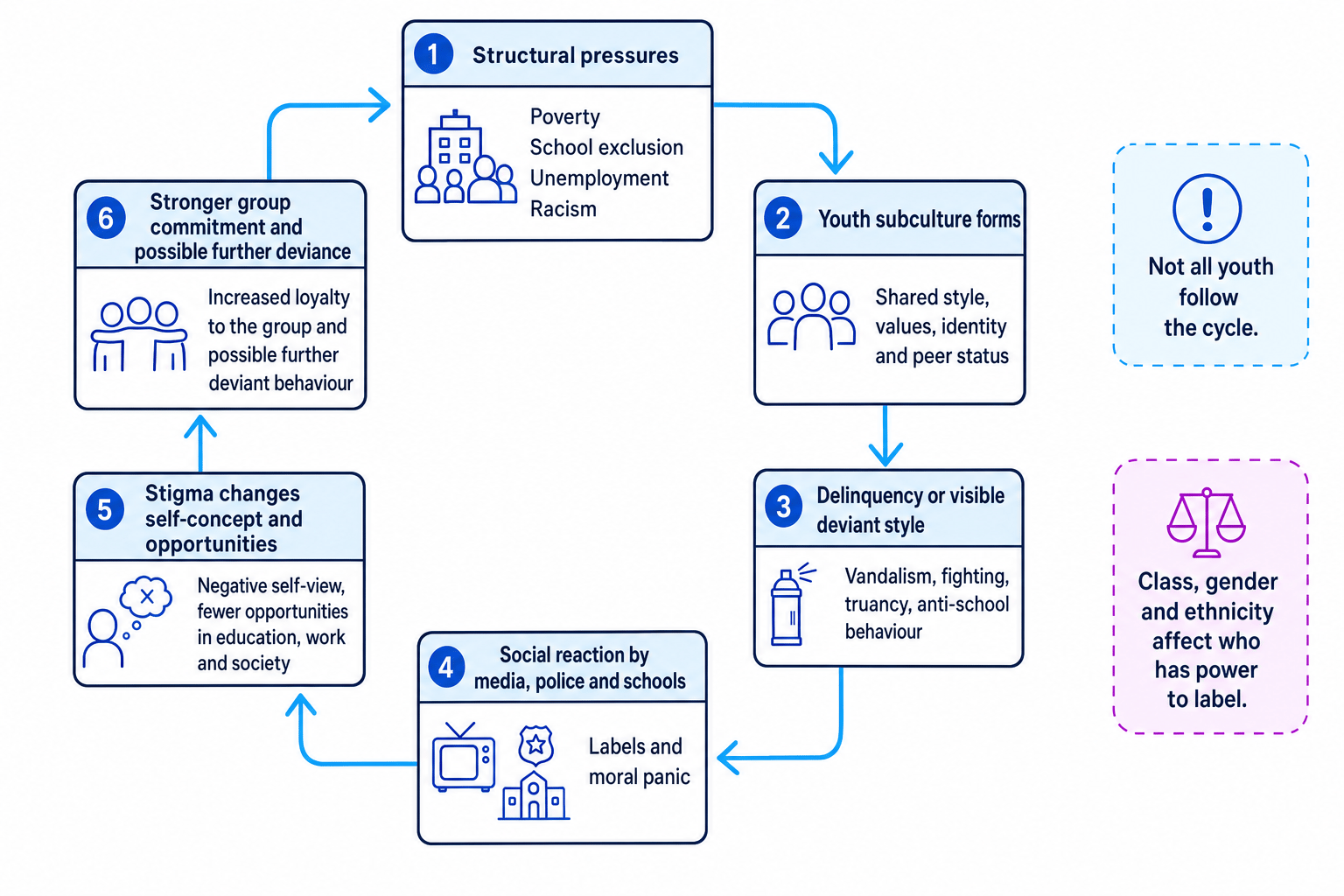
Tracing a labelling cycle after school exclusion
- Identify the primary deviance: a pupil fights once or repeatedly disrupts lessons.
- Apply the label: teachers, peers or parents begin to see the pupil as “trouble”, so ordinary behaviour may be interpreted more negatively.
- Show the consequence: exclusion or isolation reduces access to mainstream school status and may increase time with similarly labelled peers.
- Link to secondary deviance: the pupil may adopt the deviant identity more strongly, making further rule-breaking more likely.
Evaluation
Labelling theory is powerful because it asks why some young people are punished more harshly than others. For example, debates about school exclusions, stop and search, and media coverage of knife crime raise questions about class, ethnicity and gender.
However, labelling theory can underplay the original harm caused by some crimes. It may also make young people seem passive, as if labels simply shape them without resistance.
Media, moral panics and youth crime
Stanley Cohen (1972) studied media coverage of mods and rockers. He argued that the media can create a moral panic, where a group is exaggerated as a threat to society’s values. The group becomes a folk devil, meaning a symbol of everything society fears.
Media attention can lead to deviancy amplification: stronger policing, harsher public reaction and greater subcultural identity may actually increase the behaviour being condemned.
Hall et al. (1978), in Policing the Crisis, argued that the 1970s “mugging” panic connected race, youth and crime in ways that justified tougher policing during a crisis of capitalism. This is useful for AO3 because it combines media, crime, ethnicity and state power.
Contemporary UK examples might include media discussion of knife crime, drill music, gangs, county lines, school exclusions or anti-social behaviour. Policies such as ASBOs under the Crime and Disorder Act 1998, and later Criminal Behaviour Orders, show how the state has sometimes responded to youth deviance through visible labels and restrictions.
AO2 application
When applying moral panic, be specific: name the group, the behaviour, the media reaction, and the possible consequence. For example, “young people involved in drill music” is stronger than just writing “the media exaggerates youth”.
Education and anti-school subcultures
Schools are key sites of youth culture because they bring young people together and rank them through setting, streaming, exams and behaviour systems.
Lacey (1970) described differentiation, where schools classify pupils by ability or behaviour, and polarisation, where pupils move towards pro-school or anti-school groups.
Willis (1977) studied working-class “lads” in Learning to Labour. The lads rejected school authority, valued manual work, masculinity and “having a laff”, and looked down on conformist pupils. Willis argued that their anti-school culture felt rebellious, but it helped reproduce class inequality because they moved into working-class jobs.
Evaluation of Willis
Willis gives rich qualitative insight, so the study has strong validity: we understand meanings from the lads’ point of view. But it was based on a small group of boys in a specific time and place, so representativeness is limited. It also says less about girls, middle-class pupils and contemporary digital youth cultures.
Research methods: how do sociologists study youth deviance?
Official statistics, such as police-recorded crime, youth justice data, school exclusion data and the Crime Survey for England and Wales, can show broad patterns. A positivist sociologist may value these for reliability and comparison over time.
But official statistics are not neutral facts. They reflect reporting rates, policing priorities, school behaviour policies and recording practices. For example, if police focus more heavily on particular estates, transport hubs or music scenes, recorded youth crime may rise there even if actual offending has not changed.
Interpretivist methods, such as participant observation and interviews, are useful for understanding meanings inside youth subcultures. However, they raise practical and ethical issues: access may be difficult, researchers must protect confidentiality, and studying illegal behaviour can create risks of harm or legal dilemmas.
Be careful with crime statistics
Recorded youth crime tells you about both behaviour and social control. Always consider whether a statistic reflects offending, policing, reporting, or all three.
Bringing the perspectives together
| Perspective | Best at explaining | Key limitation |
|---|---|---|
| Strain and status frustration | Class inequality, blocked success, anti-school deviance | Can be deterministic and male-focused |
| Marxist and CCCS | Style, resistance, capitalism and power | May romanticise subcultures |
| Labelling theory | Social reaction, stigma, schools, police and media | Can underplay real harm and initial offending |
| Feminist approaches | Gender, safety, control and hidden youth cultures | Earlier work may need updating for online cultures |
| Postmodern approaches | Fluid identities, consumer choice, online scenes | May underplay structural inequality |
Postmodern writers such as Thornton (1995) and Bennett (1999) argue that youth identities may now be more fluid, consumer-based and temporary. Thornton’s idea of subcultural capital means status gained from knowing the right music, style or scene. This helps explain club cultures, online communities and micro-scenes.
However, inequality has not disappeared. Class, gender, ethnicity and locality still shape who is seen as creative, stylish or threatening.
Best overall judgement
Youth deviance is best explained by combining structure and interaction: inequalities may create pressures, but labels from schools, police and media shape which young people become defined as deviant.
In the exam
- Define the key concept early: if the question says “deviance”, distinguish it from crime and delinquency.
- Use a clear chain of reasoning: cause, subcultural response, social reaction, consequence.
- Balance AO1 with AO2 and AO3: name theorists, apply them to UK examples, then evaluate using power, gender, ethnicity, methods or contemporary relevance.
- Avoid one-theory essays: combine at least two perspectives, such as Cohen’s status frustration with Becker’s labelling or Hall’s media analysis.
Check yourself
- How is deviance different from crime and delinquency?
- Why did Cohen argue that working-class boys might form delinquent subcultures?
- How can media coverage create a deviancy amplification spiral?
