What you'll learn
- How sociologists define youth culture, subculture and neo-tribe.
- Why youth cultures have changed through education, work, consumerism, globalisation and digital media.
- How theorists such as Hebdige, Maffesoli, Bennett, Thornton and Hodkinson explain these changes.
- How to evaluate the neo-tribe idea using contemporary UK examples.
1. Start with the basics: youth, culture and identity
Socialisation means the process through which people learn the norms, values and expectations of society. Culture means shared meanings, beliefs, practices and symbols. Identity means your sense of who you are and how others recognise you.
In sociology, youth is not just a biological age group. It is a social construction, meaning its meaning changes across time and place. In post-war Britain, many young people moved into full-time work earlier. Today, many experience a longer transition through school, college, university, training, insecure work and delayed housing independence.
Keep two Eduqas threads in mind: culture and identity asks how young people learn, express and negotiate who they are; power and stratification asks how inequality shapes those choices. Power means the ability to influence others or control resources. Stratification means patterned inequality, such as by class, gender, ethnicity, disability or locality.
Youth culture
Youth culture refers to the shared styles, practices, values and identities associated with young people, often expressed through music, fashion, language, leisure, online activity and peer groups.
No single youth culture
Do not write as if all young people share one culture. Youth culture is varied, changing and shaped by wider inequalities as well as personal choice.
Showing youth is socially constructed
- Compare two historical contexts: in the 1950s, many working-class young people entered manual work earlier; today, many stay longer in education or training and face higher housing costs.
- Apply this to identity: if young people spend longer in education and peer groups, there is more time for youth-based styles, music scenes and online communities to develop.
- Draw the sociological conclusion: “youth” is not a fixed natural stage; social institutions such as education, work and family shape what being young means.
2. The older model: subcultures
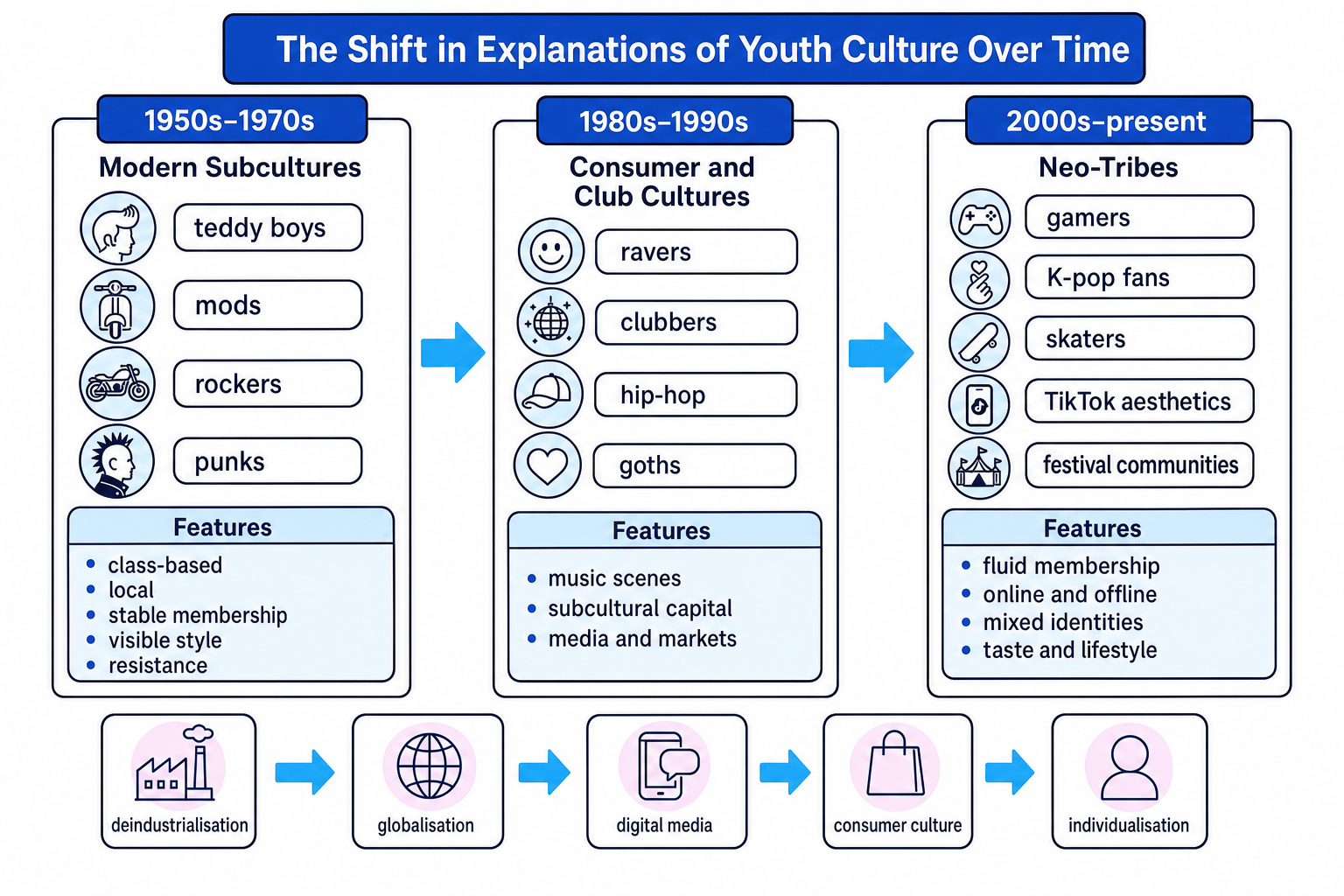
A subculture is a group within wider society with distinctive norms, values or styles. From the 1950s to the 1970s, sociologists often studied youth groups such as teddy boys, mods, rockers, skinheads and punks as relatively clear and recognisable subcultures.
Subculture
A subculture is a smaller cultural group within a wider culture, often with its own style, language, music, values and sense of belonging.
Functionalist sociologists, such as Parsons, saw youth culture as helping young people move from childhood to adulthood by giving them peer-group independence. Functionalism is a consensus perspective, meaning it focuses on how social institutions contribute to social order.
By contrast, the Centre for Contemporary Cultural Studies or CCCS at Birmingham, linked to Hall and Jefferson (1976), offered a more conflict-based view. Influenced by Marxism, a perspective focused on class conflict and capitalism, they argued that working-class youth subcultures were forms of symbolic resistance. This means young people could not easily change capitalism, but they could use style, music and behaviour to express resistance.
Hebdige (1979) argued that punk used bricolage, meaning the creative reuse of objects and symbols, such as safety pins and ripped clothing, to shock mainstream society. Cohen (1972) introduced the idea of a moral panic, an exaggerated public reaction to a group seen as a threat; the blamed group becomes a folk devil. His study of mods and rockers is useful when comparing earlier media panics with more recent reactions to “hoodies”, drill music or knife crime.
The diagram below summarises the broad shift from older subculture theories towards postmodern ideas about neo-tribes.
Reading punk as symbolic resistance
- Identify the social context: punk emerged during economic difficulty, unemployment and dissatisfaction with mainstream politics in 1970s Britain.
- Connect style to meaning: ripped clothing, aggressive music and anti-establishment imagery challenged respectable middle-class norms.
- Apply CCCS theory: punk can be interpreted as symbolic resistance because it expressed anger at society, even if it did not directly change class inequality.
- Evaluate the interpretation: critics argue CCCS sometimes over-read style as resistance and focused too heavily on white, male, working-class groups.
3. Why youth culture has changed
Sociologists link the changing nature of youth culture to wider social change. The key debate is whether young people now have more freedom to choose identities, or whether inequality still strongly structures their choices.
Economic change and longer transitions
Deindustrialisation means the decline of traditional manufacturing industries. This weakened some older working-class communities and made youth transitions less predictable. Stable manual jobs became less available, while service work, gig work and insecure employment grew.
Education also expanded. Across the UK, more young people stay in post-16 education; in England, the participation age was raised so young people must remain in education or training until 18. This can extend youth as a life stage. At the same time, tuition fees, housing costs and precarious work mean the transition to adulthood can feel uncertain.
Consumer culture and lifestyle
Consumer culture means a society where buying goods, brands and experiences becomes central to identity. Young people are often targeted as consumers through fashion, music, gaming, festivals, streaming platforms and social media.
This supports the argument that youth identities have become more about lifestyle and taste than fixed class background. However, Bourdieu would remind us that taste is not completely free. Economic capital means money and material resources, while cultural capital means valued knowledge, tastes and skills. Both affect which youth styles people can access.
Globalisation and digital media
Globalisation means the increasing connection of societies across the world. Youth culture now travels quickly through TikTok, YouTube, Spotify, Instagram, Discord and gaming platforms. A young person in Cardiff, London or Manchester might participate in K-pop fandom, anime communities, American hip-hop debates, UK grime scenes and global climate activism at the same time.
Digital media also blurs online and offline identity. A style can begin as an online “aesthetic”, then appear in clothing, music events, slang and friendship groups. This makes youth culture faster-moving and harder to classify.
Diversity, inequality and control
Youth culture has also changed because society is more openly diverse in terms of gender, sexuality, ethnicity and religion. Intersectionality means different forms of inequality overlap. For example, a young Black British woman’s experience of music, fashion, school discipline and online visibility may be shaped by age, gender, race and class together.
Policy and state power matter too. Cuts to local youth services since 2010 have reduced some offline spaces for young people. Platform regulation, such as the Online Safety Act 2023, reflects concern about young people’s online lives. Policing, stop-and-search, school exclusions and media coverage can also shape which youth cultures are treated as threatening.
Forgetting continuity
A strong answer does not simply say “old subcultures disappeared and neo-tribes replaced them”. Some youth groups are fluid, but class, gender, ethnicity, locality and policing still shape youth culture.
4. Neo-tribes: the core idea
Postmodernism is a perspective which argues that contemporary society is more fragmented, media-saturated and fluid than in the past. Postmodern thinkers often claim that identities are chosen and mixed rather than inherited from class, religion or locality.
Maffesoli (1996) popularised the idea of neo-tribes. Neo means new, and “tribe” is used as a metaphor, not to describe an ethnic or kinship group. Neo-tribes are loose, temporary communities based on shared feelings, styles, leisure and consumption.
Neo-tribe
A neo-tribe is a fluid, temporary and lifestyle-based youth grouping where people come together around shared tastes, emotions, events or online communities, without needing fixed or exclusive membership.
Bennett (1999) applied this to youth culture and argued that the term subculture can be too rigid. For example, clubbers, ravers, gamers, skaters, festival-goers, K-pop fans or TikTok aesthetic communities may move in and out of different scenes. A person can belong to several at once.
Thornton (1995) studied club cultures and introduced subcultural capital, meaning status gained from knowing the “right” music, venues, clothes or language within a scene. This is useful because even fluid neo-tribes can still have insiders, outsiders and hierarchies.
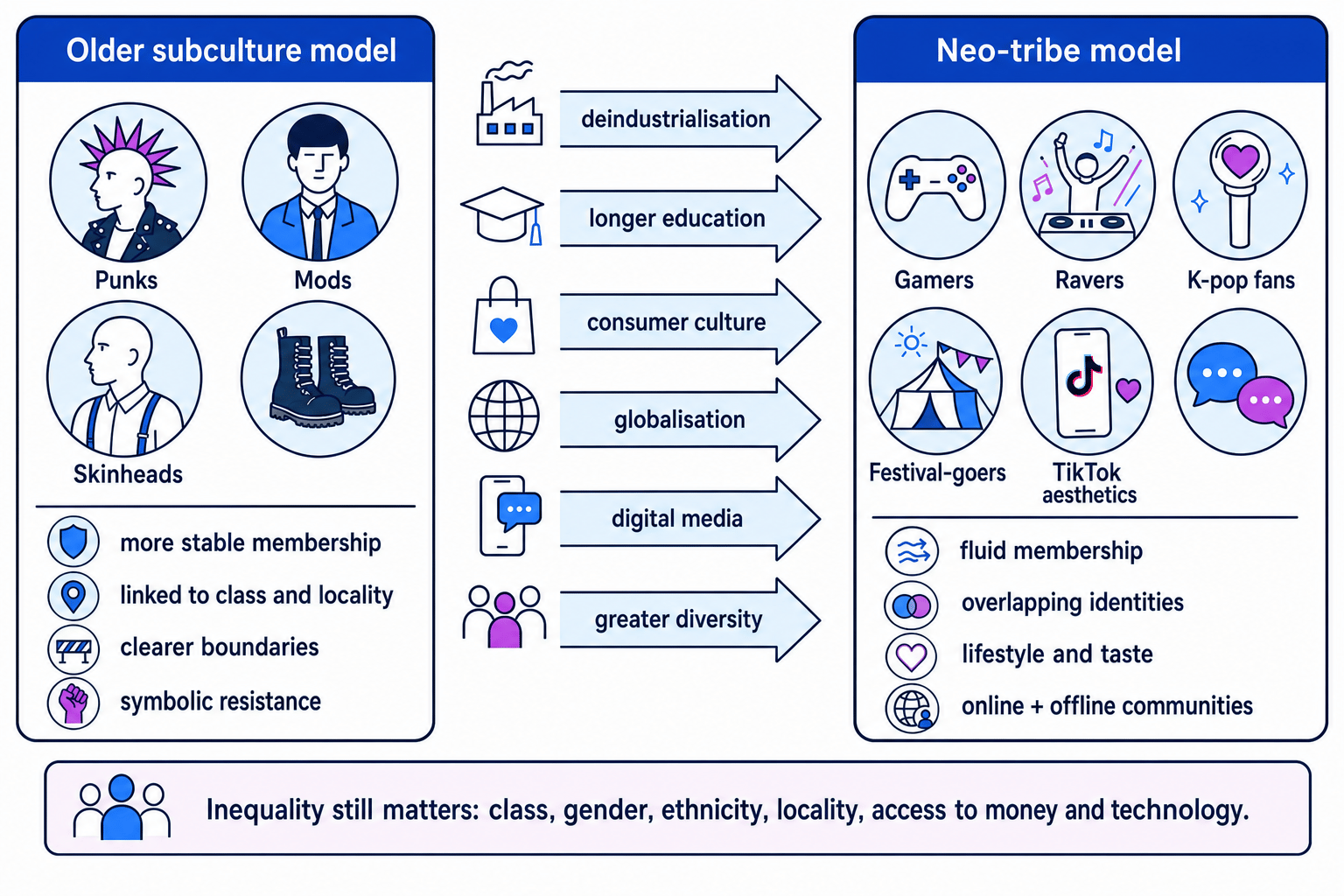
| Older subculture model | Neo-tribe model |
|---|---|
| More stable membership | More temporary and fluid membership |
| Often linked to class and locality | Often linked to lifestyle, taste and consumption |
| Clearer boundaries between groups | Overlapping identities and scenes |
| Examples: punks, mods, skinheads | Examples: gamers, K-pop fans, ravers, TikTok aesthetics |
| Often interpreted as resistance | Often interpreted as identity play and belonging |
Applying neo-tribes to K-pop fandom
- Identify the basis of belonging: fans may share music, dance routines, online edits, merchandise, concerts and emotional attachment to idols.
- Check whether membership is fluid: a fan might also be part of gaming, anime, LGBTQ+ or climate activist communities, so the identity is not exclusive.
- Apply Bennett and Maffesoli: the group works like a neo-tribe because belonging is built through shared taste, emotion and digital interaction rather than fixed class membership.
- Add evaluation: access still depends on money, time, internet access and language skills, so the identity is not completely free from inequality.
5. Evaluating the growth of neo-tribes
The neo-tribe idea is strong because it captures features of contemporary youth culture that older subculture theories struggle with: online communities, mixed identities, rapid style changes and global influences. It fits with Bauman’s idea of liquid modernity, where social life becomes less fixed, and Giddens’ idea of identity as a reflexive project, meaning people actively construct their biographies.
However, there are important criticisms.
Hodkinson (2002) found that goth culture had more continuity, commitment and distinctiveness than the neo-tribe model suggests. This shows that some youth cultures are still relatively stable. Blackman (2005) criticises post-subcultural approaches for underplaying structure and resistance. Shildrick and MacDonald (2006) argue that disadvantaged young people’s lives remain strongly shaped by class, worklessness and locality.
Methodologically, many youth culture studies use qualitative methods, such as interviews, ethnography and participant observation. These can give high validity, meaning they capture meanings in depth. But they may have weaker representativeness, meaning findings from one scene may not apply to all young people. Online research also raises ethical issues around consent, privacy, anonymity and studying under-18s. Surveys and official statistics from the Office for National Statistics can show broad patterns in youth education, work or housing, but they cannot easily capture the lived meaning of style and belonging.
Best essay structure
A strong essay uses a change and continuity argument: explain how youth culture has become more fluid and consumer-based, then evaluate by showing that inequality, moral panics and some stable subcultures continue.
In the exam
- Start with clear AO1 definitions: youth culture, subculture and neo-tribe. Then attach named theorists such as Hebdige, Maffesoli, Bennett, Thornton and Hodkinson.
- For AO2, apply the theory to real examples: drill, grime, gaming, K-pop fandom, TikTok aesthetics, festivals, skate scenes, or online activist communities.
- For AO3, avoid one-sided answers. Compare freedom and fluidity with continuing constraints from class, gender, ethnicity, locality, policing, media labelling and access to money or technology.
Check yourself
- How is a neo-tribe different from a traditional subculture?
- Why might postmodern sociologists argue that youth identities are more fluid today?
- What evidence could you use to argue that class and inequality still shape youth culture?