What you'll learn
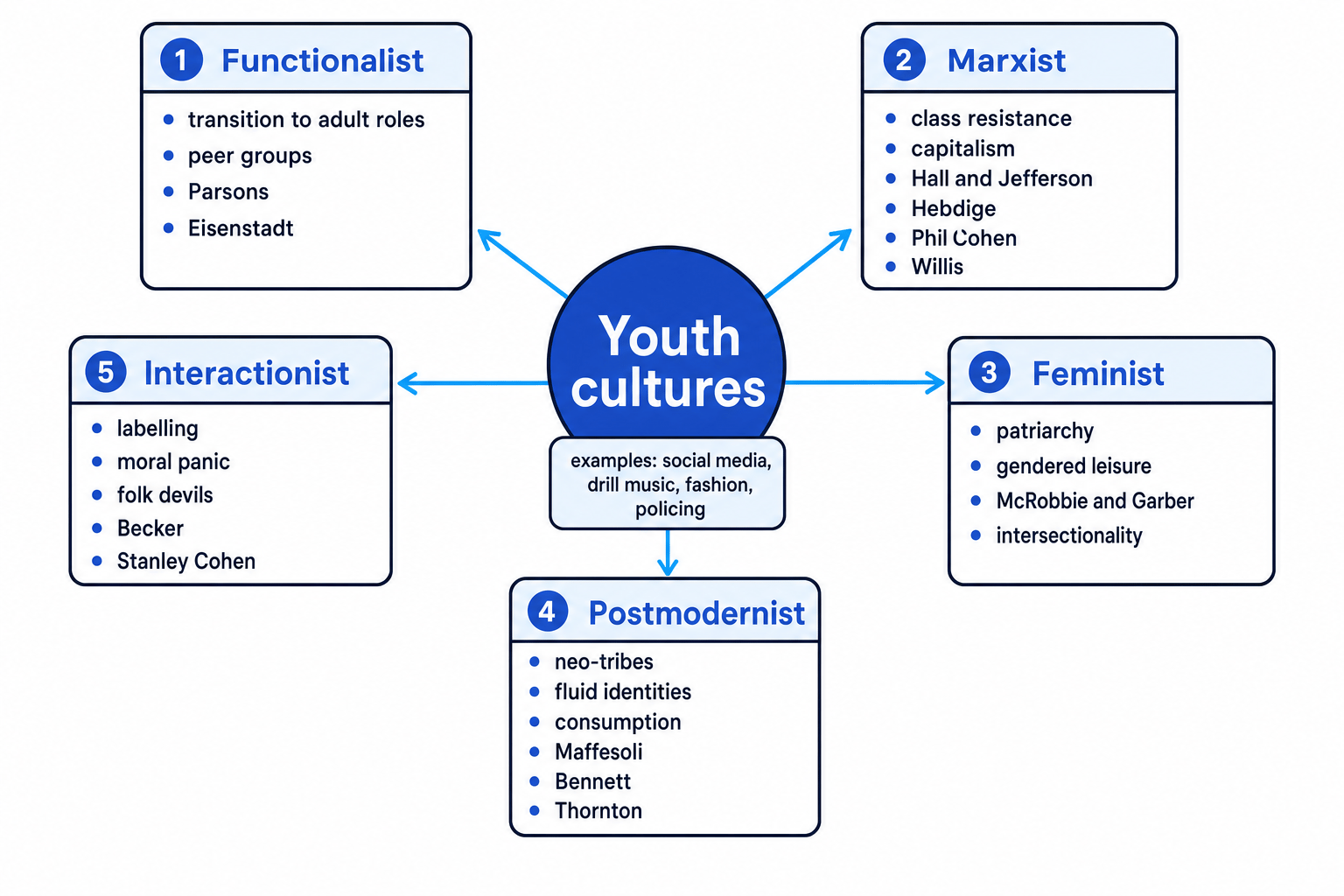
- How functionalist, Marxist, feminist, postmodernist and interactionist perspectives explain youth cultures.
- How to use named theorists and studies such as Parsons, Eisenstadt, Hall and Jefferson, Hebdige, McRobbie, Thornton, Becker and Cohen.
- How to apply these ideas to contemporary UK examples such as social media, drill music, fashion, policing and gendered leisure.
- How to evaluate theories for Eduqas-style essay answers using AO1, AO2 and AO3.
Starting points: what is a youth culture?
Before you compare theories, you need the basic vocabulary. Sociologists do not treat “youth” as just a biological age group. They see it as a social category shaped by schooling, work, law, family expectations, media and consumer culture.
Key terms
- Youth means the life stage between childhood and adulthood, but its meaning varies across societies and time periods.
- Culture means the shared norms, values, symbols, language, tastes and practices of a group. Norms are informal rules; values are beliefs about what matters.
- Youth culture means the shared styles, activities and identities associated with young people.
- Subculture means a smaller cultural group within wider society, often with distinctive dress, music, language or behaviour.
- Socialisation is the process through which people learn norms and values.
- Identity is your sense of who you are, including class, gender, ethnicity, sexuality, locality, religion and age.
The key Eduqas threads are socialisation, culture and identity, and power and stratification. Stratification means the unequal ranking of groups in society, for example by class, gender, ethnicity or age.
The big map of perspectives
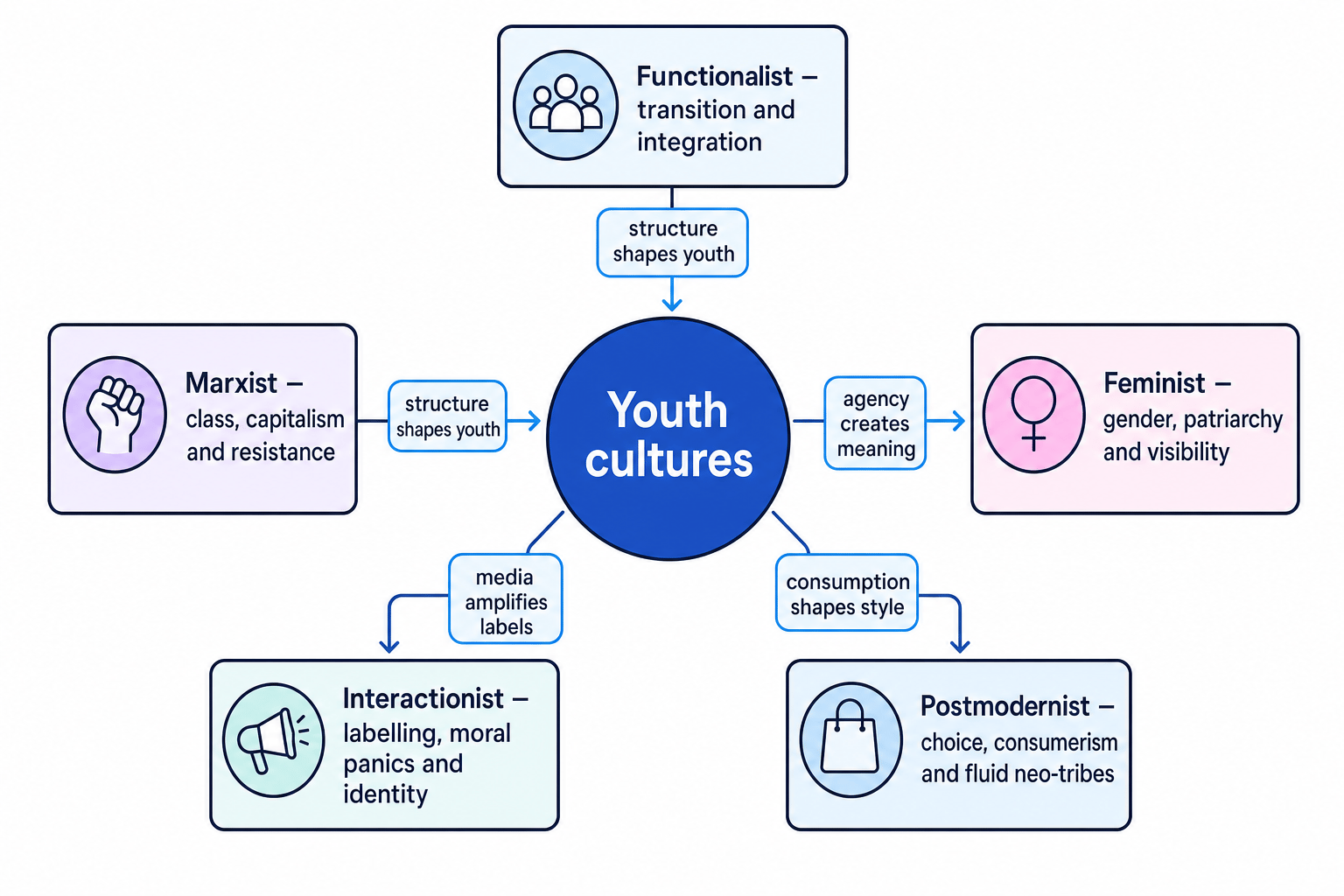
A theoretical perspective is a broad way of explaining society. Each perspective asks different questions: Is youth culture useful? Is it resistance? Is it shaped by patriarchy? Is it created through labels? Is it now fluid and consumer-led?
The main contrast
Functionalists usually see youth culture as helping society work smoothly, while Marxists and feminists see it as shaped by inequality and power. Interactionists focus on meanings and labels, while postmodernists stress choice, consumption and fluid identities.
Functionalist perspectives: youth culture as transition
Functionalism is a consensus theory. A consensus theory argues that society depends on shared values and social order. Functionalists ask what useful role, or function, youth culture performs for society.
Parsons (1942) argued that youth culture helps young people move from childhood dependence to adult independence. Peer groups give young people space to develop identity away from the family, while still learning acceptable adult roles.
Eisenstadt (1956) similarly saw youth groups as helping integration between generations. Youth culture becomes a kind of bridge between the family and adult institutions such as work, higher education and marriage.
In UK society, you could apply this to sixth-form friendship groups, university societies, sports teams, music scenes or National Citizen Service-style programmes. These can help young people practise independence, teamwork and responsibility.
Youth culture as a bridge
- Locate the transition: A sixth-form leavers’ hoodie marks students as no longer ordinary pupils but not yet fully in work or university.
- Apply functionalism: The shared ritual builds peer solidarity and lets young people practise independence within accepted school rules.
- Add evaluation: If the hoodie excludes students who cannot afford it, a conflict perspective would ask who has power and resources.
Evaluating functionalism
Functionalism is useful because it reminds you that youth culture is not automatically deviant or problematic. It can support belonging and socialisation.
However, it can be too positive. It may ignore class inequality, racism, gendered control, youth unemployment and policing. It can also treat “young people” as if they all experience youth in the same way.
Marxist perspectives: youth culture as class resistance
Marxism is a conflict theory. Conflict theories argue that society is shaped by inequality and struggles over power. Marxists focus on capitalism, an economic system based on private ownership, profit and class inequality.
Marxist explanations of youth culture are strongly linked to the Centre for Contemporary Cultural Studies at Birmingham, often called the CCCS. Writers such as Hall and Jefferson (1976) argued that working-class youth subcultures were forms of symbolic resistance to capitalism.
Phil Cohen (1972) studied youth cultures in East London and argued that groups such as skinheads offered “magical solutions” to real class problems. They could not actually solve unemployment, poor housing or the decline of working-class communities, but their style expressed anger and belonging.
Hebdige (1979) argued that subcultural style can challenge dominant meanings. For example, punk used ripped clothes, safety pins and aggressive music to reject respectability. Willis (1977) studied working-class “lads” and showed how anti-school culture could feel rebellious, while still leading them into working-class jobs.
Working-class resistance in style
- Connect culture to class: Punk style emerged in a context of unemployment, economic crisis and distrust of authority.
- Interpret the symbols: Ripped clothes and DIY music can be read as a refusal of middle-class respectability and consumer polish.
- Evaluate the resistance: The challenge may be only symbolic if fashion brands later sell punk style for profit.
Evaluating Marxism
Marxism is strong on power and stratification because it links youth cultures to class, capitalism and inequality. It is useful for analysing austerity, youth unemployment, housing insecurity, gentrification and working-class music scenes.
But classic Marxist subcultural theory has been criticised for focusing too much on spectacular, male, working-class groups. It can underplay girls, middle-class youth, ethnicity, sexuality and ordinary everyday youth cultures. It may also romanticise resistance: buying a style is not the same as changing society.
Feminist perspectives: youth culture as gendered
Feminism focuses on gender inequality and patriarchy, meaning social systems in which men have more power than women. Feminists ask why many classic studies of youth culture focused on boys in public spaces while girls were often ignored.
McRobbie and Garber (1976) argued that girls were not absent from youth culture; researchers were looking in the wrong places. Girls’ cultures were often more private, based around bedrooms, friendships, magazines, romance, music and later digital media. This was partly because girls’ movement in public spaces was more controlled by parents, sexual double standards and fear of harassment.
Feminist approaches also examine how young women are judged through appearance, sexuality and respectability. In contemporary UK society, this can include Instagram beauty standards, online sexual harassment, school dress-code debates, nightlife safety campaigns and the policing of “ladette” behaviour.
Gendered access to leisure
- Compare opportunities: Boys may be more able to occupy streets, parks or night-time spaces without the same level of sexual surveillance.
- Apply feminism: Girls’ youth cultures may develop in bedrooms, friendship networks or online spaces because public leisure is gendered.
- Evaluate with change: Digital media can give girls visibility and voice, but it can also intensify body surveillance and harassment.
Evaluating feminism
Feminism corrects the male bias in early youth-culture studies. It also shows how identity is shaped by power in families, schools, peer groups, media and public space.
However, feminist analysis needs to avoid treating all girls as the same. Young women’s experiences vary by class, ethnicity, sexuality, disability, religion and locality. This is called intersectionality: the idea that inequalities combine rather than operate separately.
Postmodernist perspectives: youth culture as fluid choice
Postmodernism argues that contemporary society is fragmented, media-saturated and less organised around fixed class identities. Postmodernists suggest that young people increasingly create identities through consumption, lifestyle and media.
Maffesoli (1996) used the term neo-tribes for loose, temporary groups based on shared tastes and experiences. Unlike traditional subcultures, neo-tribes do not require lifelong commitment. You might move between gaming communities, K-pop fandom, gym culture, festival scenes, TikTok aesthetics and football fandom.
Bennett (1999) argued that the term “subculture” can be too rigid because young people often mix styles. Thornton (1995) studied club cultures and introduced subcultural capital, meaning status gained from knowing the “right” music, events, language or style within a scene.
TikTok aesthetics and fluid identity
- Identify the fluidity: A young person may move between “clean girl”, anime, gym, rave and vintage styles without belonging permanently to one group.
- Apply postmodernism: Identity is built through media, consumption and changing lifestyle choices rather than one fixed class-based subculture.
- Evaluate the choice: Choice is not equal if some young people lack money, safe spaces, digital access or algorithmic visibility.
Evaluating postmodernism
Postmodernism is useful for modern examples because youth culture is now heavily shaped by social media, global music, streaming platforms, fast fashion and online communities.
But it can exaggerate freedom. Class, gender, ethnicity and locality still shape what young people can afford, where they can go, and how others judge them. Algorithms, brands and influencers also structure “choice”.
Interactionist perspectives: youth culture, labels and moral panics
Interactionism is a micro-level theory. It focuses on everyday meanings, interactions and interpretations. Interactionists argue that youth cultures are not just what young people do; they are also shaped by how adults, media, police and schools react to them.
Labelling theory argues that deviance is not simply in the act itself. Becker (1963) famously argued that social groups create deviance by making rules and applying labels to outsiders. A label can become a master status, meaning it dominates how others see a person.
Stanley Cohen (1972) studied media reactions to Mods and Rockers. He argued that the media created folk devils, groups presented as threats to society, and moral panics, exaggerated waves of public concern. This can lead to deviancy amplification, where harsh reactions make the labelled group more visible and oppositional.
UK examples include ASBO-era debates about “hoodies”, newspaper coverage of knife crime, drill music, stop and search, Public Spaces Protection Orders, and school exclusions.
Moral panic around drill music
- Compare act and reaction: Drill lyrics may be treated not just as music but as evidence of danger, criminality or gang identity.
- Apply labelling: Media and police labels can affect how young people are stopped, searched, excluded or viewed by teachers and employers.
- Analyse amplification: If young people feel unfairly targeted, the label may strengthen group identity and distrust of authority.
Evaluating interactionism
Interactionism is strong because it explains how youth identities are produced through interaction, media and power. It also links well to research on policing, schools and moral panics.
Its weakness is that it may underplay wider structural causes such as poverty, racism, insecure work and cuts to youth services. Labels matter, but they do not explain everything.
Do not make youth sound identical
A theory describes patterns, not every young person. Always qualify your answer by considering class, gender, ethnicity, sexuality, disability, locality and digital access.
Research-methods thread: how do we know?
Many youth-culture studies use qualitative methods, meaning methods that explore meanings in depth, such as interviews, participant observation and ethnography.
Willis’s study of “the lads” used ethnographic methods, giving rich validity because he explored their meanings closely. However, the sample was small and specific, so it may not be representative of all young people.
CCCS studies are sometimes criticised for “reading” the meaning of style without always asking enough young people directly. Thornton’s work on club culture used interviews and observation, which helped capture insider meanings, but access to nightlife scenes can be difficult.
Practical issues include gaining access to closed groups, online spaces or illegal activities. Ethical issues include informed consent, confidentiality, harm, and extra care when researching minors. Theoretical issues include the interpretivist strength of validity versus the positivist concern that findings may be hard to replicate.
Essay shortcut
For each perspective, learn one phrase: functionalist = transition, Marxist = class resistance, feminist = patriarchy, postmodernist = fluid choice, interactionist = labelling.
Pulling it together for essays
A strong Eduqas answer does not just list perspectives. It compares them.
For example, if the item mentions young people gathering in a shopping centre, a functionalist might see peer bonding, a Marxist might ask about consumer capitalism and class exclusion, a feminist might ask whether girls and boys experience the space differently, a postmodernist might focus on lifestyle and consumption, and an interactionist might examine security guards, police labels and media reaction.
In the exam
- Start each paragraph with clear AO1: name the perspective, define the key concept, and use a named theorist or study.
- Add AO2 by applying it to a concrete youth-culture example, such as fashion, music, social media, policing, school, nightlife or local space.
- Add AO3 by comparing with another perspective and judging what your first theory misses.
- Where you use a study, include a quick methods evaluation: validity, representativeness, ethics, access or datedness.
Check yourself
- How would a functionalist and a Marxist explain the same youth subculture differently?
- Why did feminists criticise early studies of youth cultures?
- What does an interactionist mean by a moral panic, and how could it affect young people?