What you'll learn
- How positivists, interpretivists and realists think sociological research should be done.
- How each theory links to methods, data, reliability, validity and representativeness.
- How to apply the theories to UK research examples such as the Census, Crime Survey and school inequality.
- How to evaluate research theories for AO3, especially using power, stratification, culture and identity.
Why research theory matters
A theory of research is a set of assumptions about what society is like and how sociologists can know about it. It shapes every research decision: the question asked, the method chosen, the type of data collected, and the way findings are judged.
A method is a research tool, such as a questionnaire, interview or observation. Methodology means the logic behind the method: why that method fits your view of society.
A theory of research usually involves two deeper ideas:
- Ontology: what kind of thing society is. Is it made of measurable social facts, meaningful interactions, or hidden structures?
- Epistemology: how we can know about society. Should we count patterns, interpret meanings, or combine evidence to uncover causes?
Key research terms
Quantitative data is numerical data, such as percentages from the Census or Crime Survey for England and Wales. Qualitative data is non-numerical data, such as interview responses, fieldnotes or diaries. Reliability means consistency and repeatability. Validity means whether research captures what it claims to capture. Representativeness means whether a sample reflects the wider population.
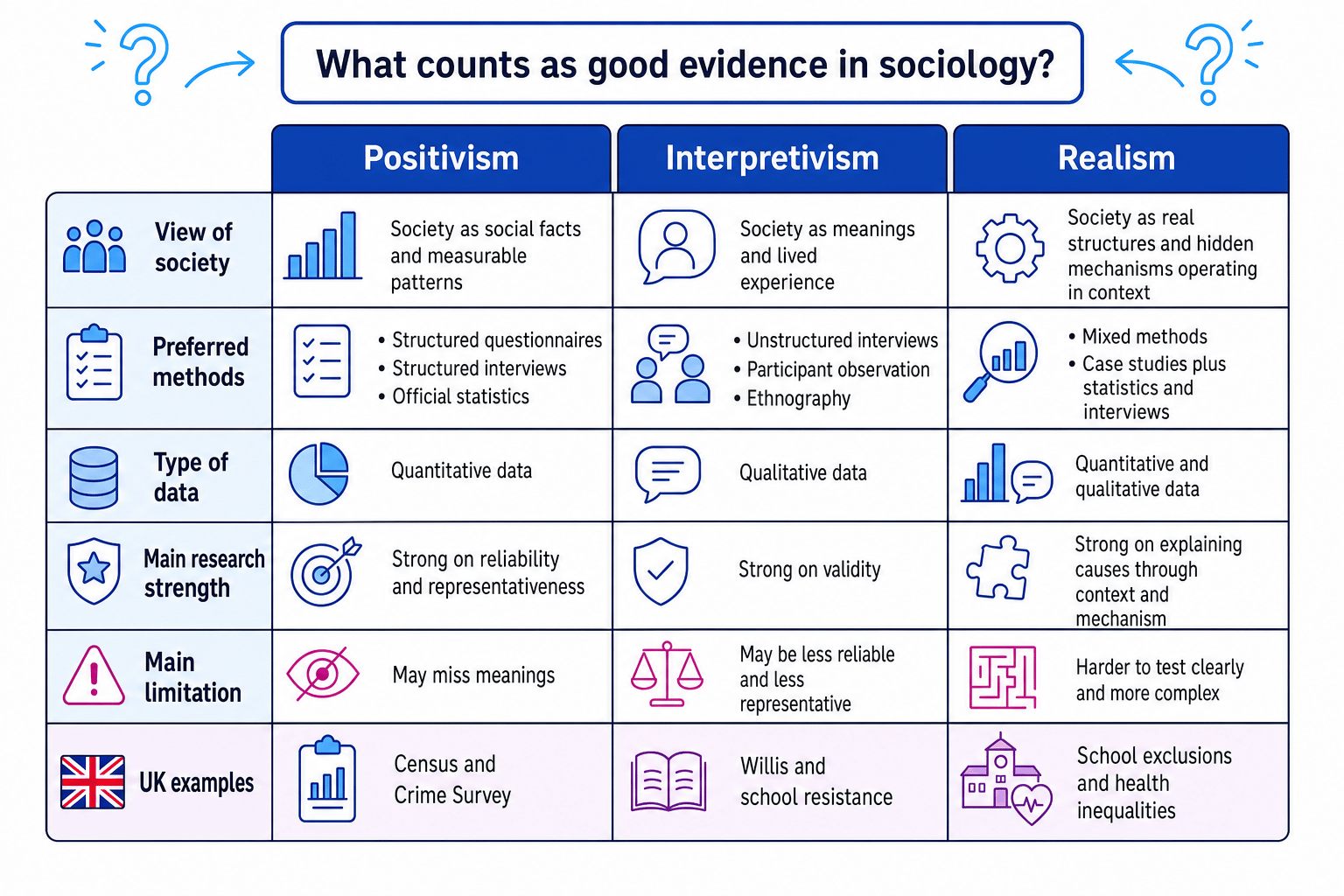
The three theories in this section are easiest to remember as different answers to one question: what counts as good evidence in sociology?
Positivism
Positivism is the view that sociology should be studied scientifically, using objective evidence to identify patterns, correlations and possible causes in society.
Positivism
A positivist approach treats social life as something that can be measured from the outside. Positivists favour quantitative data, standardised methods and research that can be repeated by other researchers.
Classic positivists include Comte, who argued that society could be studied scientifically, and Durkheim, whose study of suicide used official statistics to show that suicide rates varied between social groups. Durkheim called these external patterns social facts: social forces that exist beyond individuals and shape their behaviour.
In methods, positivists tend to prefer:
- Structured questionnaires, where everyone is asked the same questions.
- Structured interviews, where wording and order are fixed.
- Official statistics, such as the Census, ONS deprivation indices or school exclusion data.
- Experiments, where variables are controlled, though true experiments are harder in sociology than in natural science.
A variable is a factor that can vary, such as age, class, gender or income. To operationalise a concept means turning it into something measurable. For example, “social class” might be measured using occupation, income or education level.
Positivist strength
Positivism is especially useful for showing large-scale patterns in power and stratification, such as links between poverty, educational achievement, health inequalities or victimisation.
Positivism in a UK context
A positivist studying inequality might use ONS data to compare unemployment rates by region, ethnicity and gender. A researcher using the Crime Survey for England and Wales could examine patterns in victimisation by age, area deprivation or household income. This can reveal structural inequalities that individuals may not notice in everyday life.
However, positivism can struggle with meanings. For example, official police statistics on domestic abuse may be reliable in how incidents are counted, but they may lack validity if many victims do not report abuse due to fear, shame or distrust of authorities.
Using a positivist design to study educational inequality
- Choose a measurable relationship: for example, whether pupils eligible for free school meals have different GCSE outcomes from pupils not eligible.
- Operationalise the concepts: use free school meal eligibility as an indicator of economic disadvantage and GCSE grades as an indicator of attainment.
- Collect quantitative data from a large sample, such as school performance data across local authorities.
- Compare patterns between groups to see whether disadvantage is associated with lower attainment.
- Evaluate the finding by asking whether the measure is valid: free school meal eligibility captures some poverty, but may miss families who are struggling yet not eligible.
Evaluating positivism
Positivism is strong on reliability, because standardised methods can be repeated. It is also strong on representativeness when large samples are used.
Its weakness is that it may treat people as if they are objects rather than meaning-making individuals. Interpretivists argue that numbers alone cannot explain why pupils resist school, why people join subcultures, or how people experience racism, disability or gender identity.
Numbers are not automatically objective
Do not write that quantitative data is always “true”. Official statistics are socially produced: they depend on definitions, reporting practices, funding priorities and institutional power.
Interpretivism
Interpretivism is the view that sociology should understand the meanings people attach to their actions, identities and relationships.
Interpretivism
An interpretivist approach studies social life from the point of view of participants. Interpretivists favour qualitative methods because they aim for depth, empathy and validity.
The key theorist here is Weber, who argued that sociology should use verstehen, meaning empathetic understanding. For Weber, sociologists should not just record what people do; they should understand what actions mean to the people involved.
Interpretivists tend to prefer:
- Unstructured interviews, where participants can explain their own meanings.
- Participant observation, where the researcher takes part in or closely observes a group.
- Ethnography, which is an in-depth study of a group’s way of life.
- Documents and diaries, which can reveal personal experience and identity.
Interpretivism links strongly to socialisation, culture and identity. It is useful for studying how people learn norms and values, how they construct identities, and how groups create shared meanings.
For example, Willis studied working-class “lads” and found that their anti-school culture was meaningful to them, even though it reproduced class inequality by leading them towards manual work. Becker showed how labelling can affect identity, while Goffman explored how people manage impressions in everyday interaction.
Interpreting pupils’ resistance to school
- Start with a meaning-focused question: instead of asking only whether working-class pupils achieve lower grades, ask how some pupils interpret school authority and academic success.
- Choose a qualitative method, such as participant observation or unstructured interviews, because these allow pupils to explain jokes, peer pressure and classroom behaviour in their own terms.
- Analyse the data for shared meanings: resistance may be linked to masculinity, class identity or distrust of teachers.
- Connect meanings to wider inequality: the pupils’ choices may feel like freedom, but they can still reproduce class stratification.
- Evaluate the research design: the findings may be highly valid for that group, but a small sample may not represent all working-class pupils.
Evaluating interpretivism
Interpretivism is strong on validity, because it gets close to lived experience. It can uncover voices that official data may ignore, such as marginalised youth, disabled people, migrants or victims of hidden crime.
But interpretivist research can be less reliable because another researcher may not gain the same trust or interpret the same situation in the same way. It can also have practical problems: ethnography takes time, access can be difficult, and sensitive topics raise ethical issues such as informed consent, confidentiality and harm.
Reliability versus validity
A simple comparison: positivists often ask, “Can this be repeated?” Interpretivists often ask, “Does this capture real meaning?”
Realism
Realism is the view that society has real structures and causal forces, but these are not always directly observable. It tries to avoid a simple positivist-versus-interpretivist split.
Realism
A realist approach argues that social structures, such as class, patriarchy, racism and institutions, are real because they have effects. However, to understand them properly, sociologists must investigate the mechanisms and contexts that produce outcomes.
The most important version is critical realism, associated with Bhaskar. Critical realists argue that society is an open system, meaning many causes operate at once. This makes sociology different from a laboratory experiment, where variables can be tightly controlled.
A mechanism is an underlying process that helps produce an outcome. For example, poverty may affect educational achievement through mechanisms such as overcrowded housing, lack of private study space, teacher expectations, stress, or restricted access to tutoring.
Realists often support mixed methods, meaning a combination of quantitative and qualitative methods. This can include statistics to identify patterns and interviews or case studies to explore how and why those patterns occur.
Realism is also linked to realist evaluation, associated with Pawson and Tilley, which asks: what works, for whom, in what circumstances, and why? This is useful for evaluating social policies, such as youth mentoring schemes, domestic abuse interventions or school attendance programmes.
Building a realist explanation of school exclusions
- Identify a pattern using quantitative data: for example, exclusion rates may be higher for some groups, such as pupils from deprived areas or some ethnic minority backgrounds.
- Avoid assuming the statistics explain themselves: the pattern shows an outcome, but not the mechanism causing it.
- Investigate context using qualitative data: interviews with pupils, parents and teachers might reveal school discipline policies, teacher expectations, racism, special educational needs support or peer conflict.
- Link context and mechanism: a zero-tolerance behaviour policy may produce different outcomes depending on school resources, staff training and pupils’ previous experiences of authority.
- Reach a realist conclusion: exclusions are shaped by real structures and institutional processes, but those processes operate differently in different settings.
Evaluating realism
Realism’s strength is that it takes both structure and meaning seriously. It recognises that class, gender, ethnicity and disability can have real effects, while also asking how individuals interpret and respond to those conditions.
It is useful for contemporary UK sociology because many problems are complex. For example, health inequalities cannot be explained only by individual choices or only by income statistics. A realist approach might combine NHS data, local deprivation indices and interviews about housing, work, food access and trust in services.
However, realism can be difficult to apply. Hidden mechanisms are harder to prove than simple statistical patterns. Mixed-methods research can be expensive, time-consuming and demanding. There is also a risk that “mechanism” becomes vague unless the researcher explains exactly what process is being claimed.
Do not make realism sound like a compromise only
Realism is not just “a bit of positivism plus a bit of interpretivism”. It has its own argument: real causal structures exist, but they must be studied through context, mechanisms and mixed evidence.
Comparing the three theories
For essays, do not just describe each theory separately. Compare them.
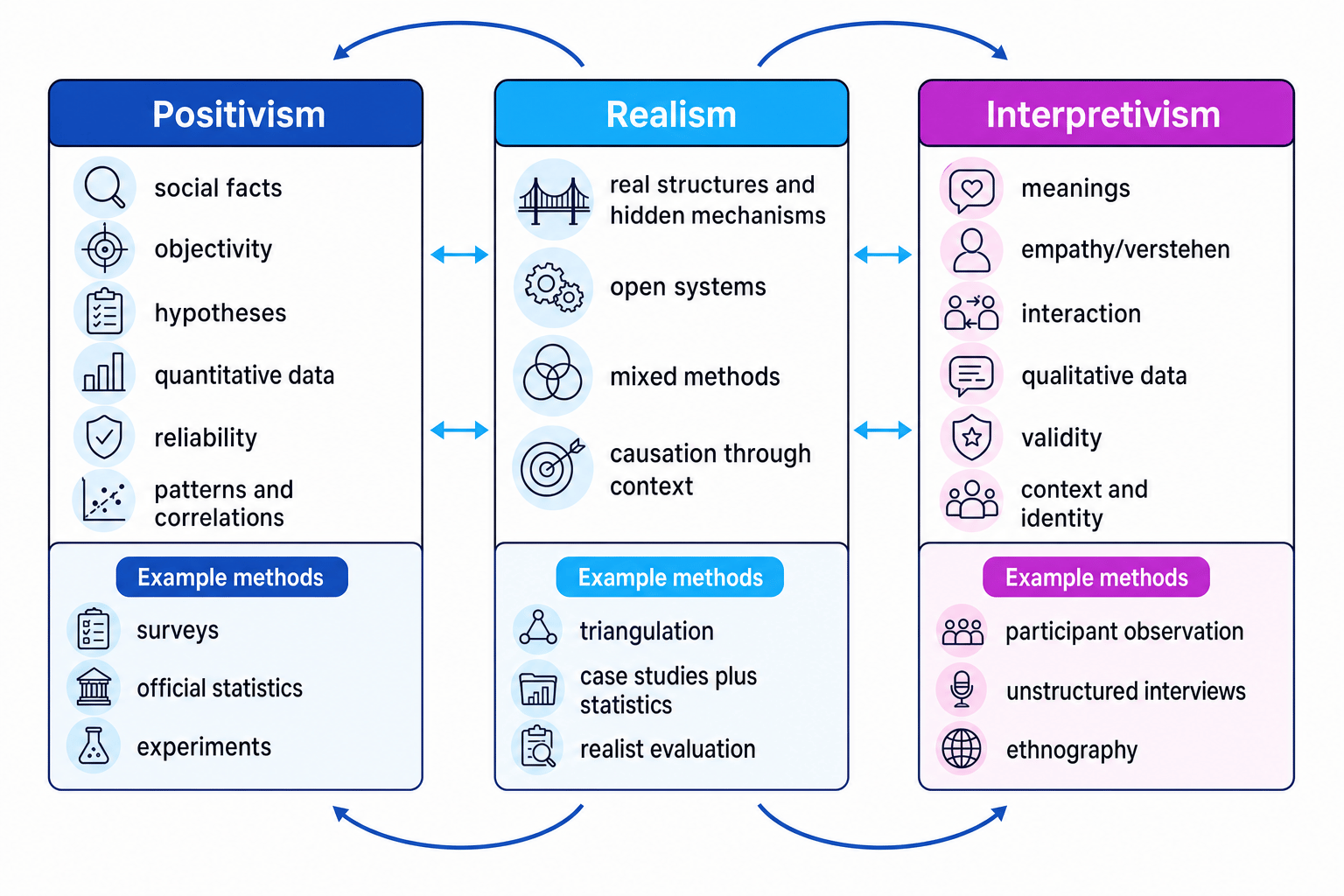
- Positivism is strongest when the aim is to measure patterns across large groups.
- Interpretivism is strongest when the aim is to understand meanings, identities and lived experiences.
- Realism is strongest when the aim is to explain how real structures produce different outcomes in different contexts.
AO3 evaluation often comes from asking what each approach misses. Positivism may miss meaning. Interpretivism may miss large-scale structure. Realism may be harder to test clearly.
A strong answer also links theory to practical, ethical and theoretical issues. For example, a positivist survey may be practical and reliable but suffer from low response rates. An interpretivist ethnography may be valid but raise ethical issues around consent and researcher involvement. A realist mixed-methods project may be powerful but costly and complex.
In the exam
- Define the theory clearly before evaluating it: say what it assumes about society and evidence.
- Link each theory to methods: positivism to quantitative and reliable data, interpretivism to qualitative and valid data, realism to mixed methods and mechanisms.
- Use AO2 examples from UK society, such as the Census, Crime Survey, school exclusions, health inequalities or deprivation data.
- For AO3, compare perspectives directly rather than listing strengths and weaknesses separately.
- Keep returning to the big question: does this approach best explain patterns of power, stratification, culture and identity?
Check yourself
- Why would a positivist prefer official statistics, and what might an interpretivist criticise about them?
- How does Weber’s idea of verstehen help explain interpretivist research?
- What does a realist mean by a hidden mechanism, and why might mixed methods help uncover one?