What you'll learn
- What practical issues are and why they shape sociological research.
- How to explain operationalisation, choice of research topic, target population, access, time and cost.
- How practical issues link to validity, reliability, representativeness, ethics and theory.
- How to use UK examples, named studies and evaluation in Component 2 answers.
The big idea: research has to be doable
In Component 2, you are not just expected to know different research methods. You also need to explain why a sociologist might choose one method rather than another. Practical issues are the “real-world” limits that affect what can actually be done.
Practical issues
Practical issues are the practical constraints and resources that affect research design, such as the topic chosen, how concepts are measured, who is studied, whether the researcher can gain access, and the time and money available.
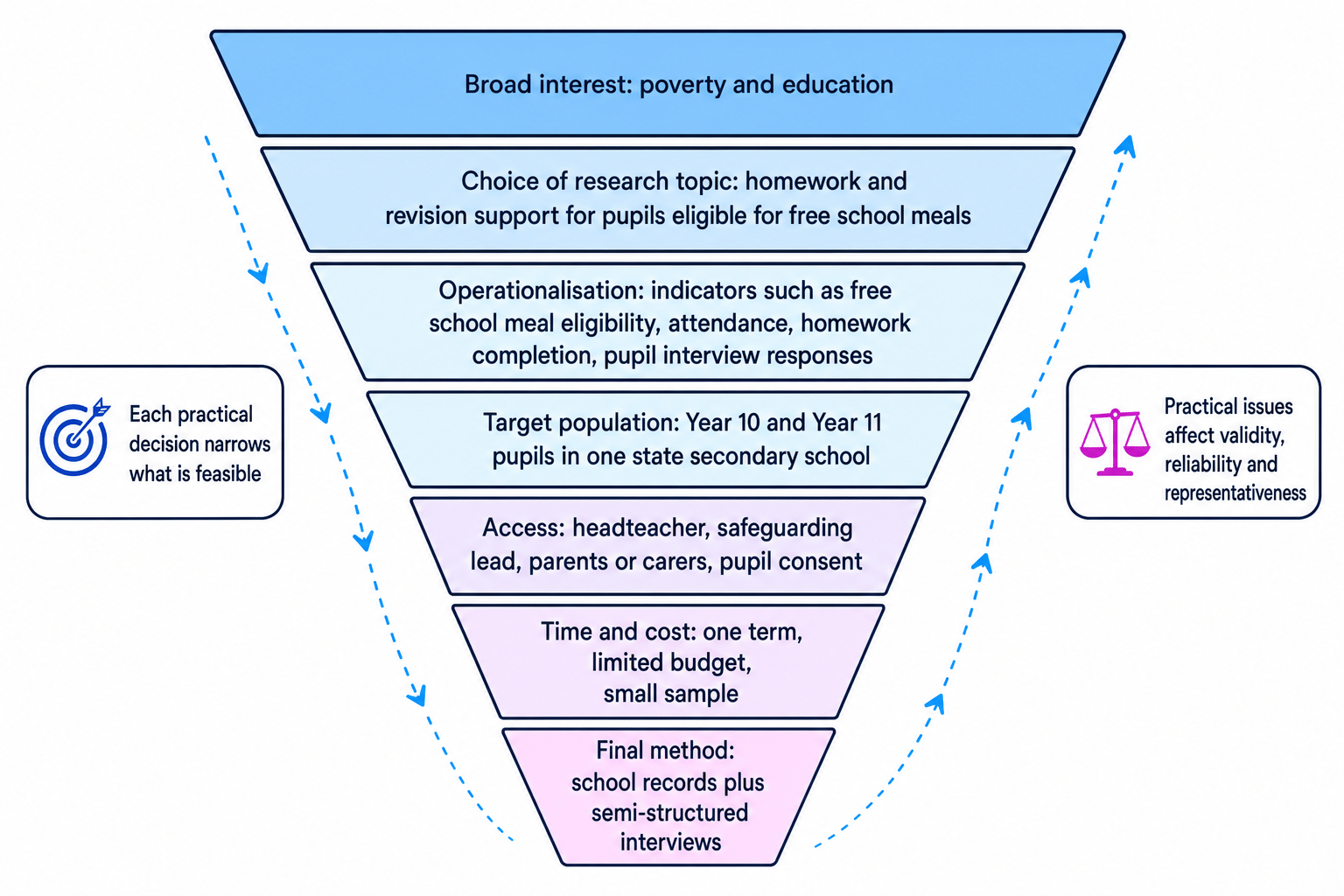
Think of practical issues as a funnel. A sociologist may begin with a big interest, such as inequality, education or crime, but each practical decision narrows the research into something possible.
Practical does not mean unimportant
Practical issues affect the quality of the evidence. A lack of time, money or access can reduce representativeness, validity or reliability, so practical issues are also useful for AO3 evaluation.
Practical, ethical and theoretical issues
You will often see methods evaluated using three broad categories:
- Practical issues: can the research be done with the available resources?
- Ethical issues: should the research be done in this way without causing harm or exploiting people?
- Theoretical issues: what kind of knowledge does the method produce, and does it fit a positivist or interpretivist approach?
Positivist and interpretivist
A positivist approach usually favours measurable, reliable, often quantitative data. An interpretivist approach usually favours detailed, valid, qualitative data about meanings, motives and experiences.
For example, a positivist studying class inequality may prefer a large survey using official categories such as occupation or income. An interpretivist may prefer interviews exploring how people understand their own class identity.
Use the PET link
In methods answers, try to connect Practical, Ethical and Theoretical issues. For example, covert observation may solve an access problem, but it creates ethical problems and raises questions about validity and trust.
Choice of research topic
The choice of research topic means deciding what social issue, group, institution or relationship the researcher will investigate.
Researchers may choose topics because they are:
- Sociologically significant, such as inequality, crime, education, families, religion or health.
- Linked to current social policy, such as school attendance, stop and search, NHS waiting lists or child poverty.
- Connected to existing theory, such as Marxist interest in class power or feminist interest in patriarchy.
- Personally important to the researcher.
- Practical enough to study with available access, time and funding.
Weber argued that values can influence what sociologists choose to study, even if researchers then try to be objective in how they collect and analyse evidence. Becker also raised the question of “whose side” sociologists are on, reminding us that topic choice can reflect power and inequality.
For example, powerful groups such as senior politicians, judges, business elites or police leaders may be harder to research than school pupils or welfare claimants. This creates a power issue: sociology may over-study groups who are easier to access while under-studying those with more power.
Choosing a feasible topic
A student wants to research “the effect of poverty on education”.
- Narrow the topic from a very broad issue to a specific relationship, such as how pupils eligible for free school meals experience homework and revision support.
- Check whether the group can realistically be accessed, for example through one school, a youth organisation or existing official statistics.
- Choose a method that fits the topic: interviews may explore pupils’ experiences in depth, while official statistics may show patterns in attainment and attendance across many schools.
Treating topic choice as neutral
Do not write as if topics simply “appear”. Topic choice can be shaped by funding, policy priorities, researcher values and power relations in society.
Operationalisation
Many sociological ideas are abstract. You cannot directly “see” social class, deprivation, patriarchy, religiosity or social integration. To research them, sociologists must turn them into something observable or measurable.
Operationalisation
Operationalisation means turning an abstract concept into clear, researchable indicators that can be observed, asked about or measured.
A concept is a general sociological idea, such as poverty, identity, achievement or social control. An indicator is a specific sign or measure used to represent that concept.
Examples:
- Educational achievement could be operationalised using GCSE results, A-level grades or attendance.
- Deprivation could be operationalised using free school meal eligibility, income, housing quality or the Index of Multiple Deprivation.
- Religiosity could be operationalised using frequency of attendance, belief in God, prayer or self-identification.
- Crime levels could be operationalised using police-recorded crime, the Crime Survey for England and Wales, or self-report studies.
Operationalisation is especially important for quantitative research because categories and questions must be standardised. This can increase reliability, meaning the research can be repeated in the same way. However, it may reduce validity, meaning the research may not fully capture what people really experience or mean.
Operationalising deprivation
A sociologist wants to study whether deprivation affects school absence.
- Decide what “deprivation” will mean in the study. Possible indicators include free school meal eligibility, local deprivation scores, household income or overcrowded housing.
- Decide what “school absence” will mean. The researcher could use authorised and unauthorised absence recorded by the school, or ask pupils about missed lessons.
- Evaluate the indicators. Free school meal data is easy to access and reliable, but it may miss families who are poor but not claiming. Area deprivation scores are useful for patterns, but they may not reflect every individual household.
Durkheim’s study of suicide is a classic example of using official statistics to study social patterns. He treated suicide rates as social facts, but critics argue that official statistics depend on coroners’ decisions and may not fully capture meanings or hidden cases.
Operationalisation is always a trade-off
Clear indicators make research more manageable and reliable, but they can oversimplify complex social experiences, especially around culture, identity and inequality.
Target population
The target population is the full group the researcher wants to make claims about.
Target population
The target population is everyone the research is intended to represent, such as all Year 12 students in Wales, all UK households, or all young people aged 16–24 in a city.
Researchers rarely study the whole target population. Instead, they use a sample, which is a smaller group selected from the target population. A sampling frame is a list or source from which the sample can be selected, such as a school register, electoral roll, workplace list or postcode database.
This creates practical problems. Some groups are easy to list, such as pupils in a school. Others are difficult to list, such as homeless people, undocumented migrants, gang members, victims of domestic abuse or people involved in illegal work.
When there is no clear sampling frame, sociologists may use methods such as:
- Snowball sampling, where participants help recruit others.
- Opportunity sampling, where the researcher uses whoever is available.
- Quota sampling, where the researcher fills categories such as age, gender or ethnicity.
- Random or stratified sampling, where a clearer list exists and representativeness is more realistic.
Defining a target population
A researcher says they want to study “young people and social media”.
- Make the population precise: for example, students aged 16–18 in state sixth forms in Cardiff.
- Identify a possible sampling frame, such as sixth-form registers, if schools agree to participate.
- Evaluate the limits: the findings may apply well to sixth-form students in those schools, but not necessarily to apprentices, young workers or young people not in education.
Confusing target population and sample
The target population is the wider group you want to generalise to. The sample is the smaller group you actually research.
Access
Access means being able to reach the people, places, organisations or data needed for the research.
Access and gatekeepers
Access is the researcher’s ability to enter a research setting or contact participants. A gatekeeper is someone who can allow or block access, such as a headteacher, prison governor, employer, parent, youth worker or community leader.
Access can be:
- Physical, such as entering a school, workplace, hospital or prison.
- Bureaucratic, such as getting permission from managers, ethics committees or data owners.
- Social, such as gaining trust from participants.
Named studies show why access matters. Willis’s study of working-class “lads” in education depended on gaining enough access and trust to observe everyday school culture. Whyte’s Street Corner Society used a key gatekeeper, “Doc”, to access a street-corner community. Barker’s study of the Unification Church required long-term access to a group that outsiders often misunderstood.
In contemporary UK research, access can be especially difficult in schools, the NHS, prisons and policing because of safeguarding, confidentiality and reputational risk. Researching powerful organisations may be difficult because they can refuse access or manage what the researcher sees.
Planning access to a school
A sociologist wants to interview pupils about exclusions.
- Identify gatekeepers: the headteacher, safeguarding lead, parents or carers, and possibly the local authority.
- Consider how access might shape the sample. If the school selects only “well-behaved” pupils, the data may become biased.
- Reduce disruption and risk by offering clear consent procedures, anonymised reporting and interview times that do not interfere with lessons.
Access can distort findings
If gatekeepers choose who the researcher meets, the data may reflect the organisation’s preferred image rather than the full reality.
Time
Time affects every stage of research: planning, gaining access, collecting data, transcribing interviews, analysing findings and writing up conclusions.
Some research is cross-sectional, meaning it studies one moment in time. Other research is longitudinal, meaning it follows people or groups over time.
Longitudinal research can be very valuable because it shows social change. For example, cohort studies can track education, health, employment and family life across generations. However, they are expensive, slow and risk losing participants over time.
Qualitative methods such as participant observation also take time. Building rapport may be essential for valid data, especially when studying sensitive topics such as racism, youth culture, disability, crime or family conflict.
Cost
Cost includes more than money. It includes staff, travel, recording equipment, transcription, software, incentives for participants, printing, translation, childcare support, and sometimes paying for access to data.
Different methods have different costs:
| Method | Practical cost issue | Possible evaluation |
|---|---|---|
| Online questionnaire | Cheap and quick to distribute | May exclude people without internet access or digital confidence |
| Large social survey | Can produce representative data | Expensive and needs skilled design |
| Interviews | Rich, valid data | Time-consuming to arrange, conduct and transcribe |
| Participant observation | Strong insight into meanings and culture | Very slow and often difficult to access |
| Official statistics | Often cheap or free, such as ONS data | Created for official purposes, not always for the sociologist’s question |
Funding also matters. Governments, charities and universities may fund research that fits their priorities. This can support useful policy research, such as studies of deprivation, crime or health inequalities, but it may also discourage more critical or controversial topics.
Balancing time and cost when choosing a method
A researcher wants to study fear of crime among older people in a town.
- Compare the aim with available resources. If the aim is to identify broad patterns, a questionnaire may be practical. If the aim is to understand feelings and daily routines, interviews may be better.
- Check time and cost. Interviews may produce more valid detail, but travel, transcription and arranging appointments will take longer than a short survey.
- Make a justified compromise. The researcher might use a short questionnaire with a smaller number of follow-up interviews, gaining both some pattern data and some depth.
Link practical issues to data quality
Do not just say “interviews take time” or “questionnaires are cheap”. Add the consequence: time limits may reduce sample size, cost limits may reduce representativeness, and cheap methods may affect validity.
Pulling it together for evaluation
Practical issues rarely appear separately in real research. They overlap.
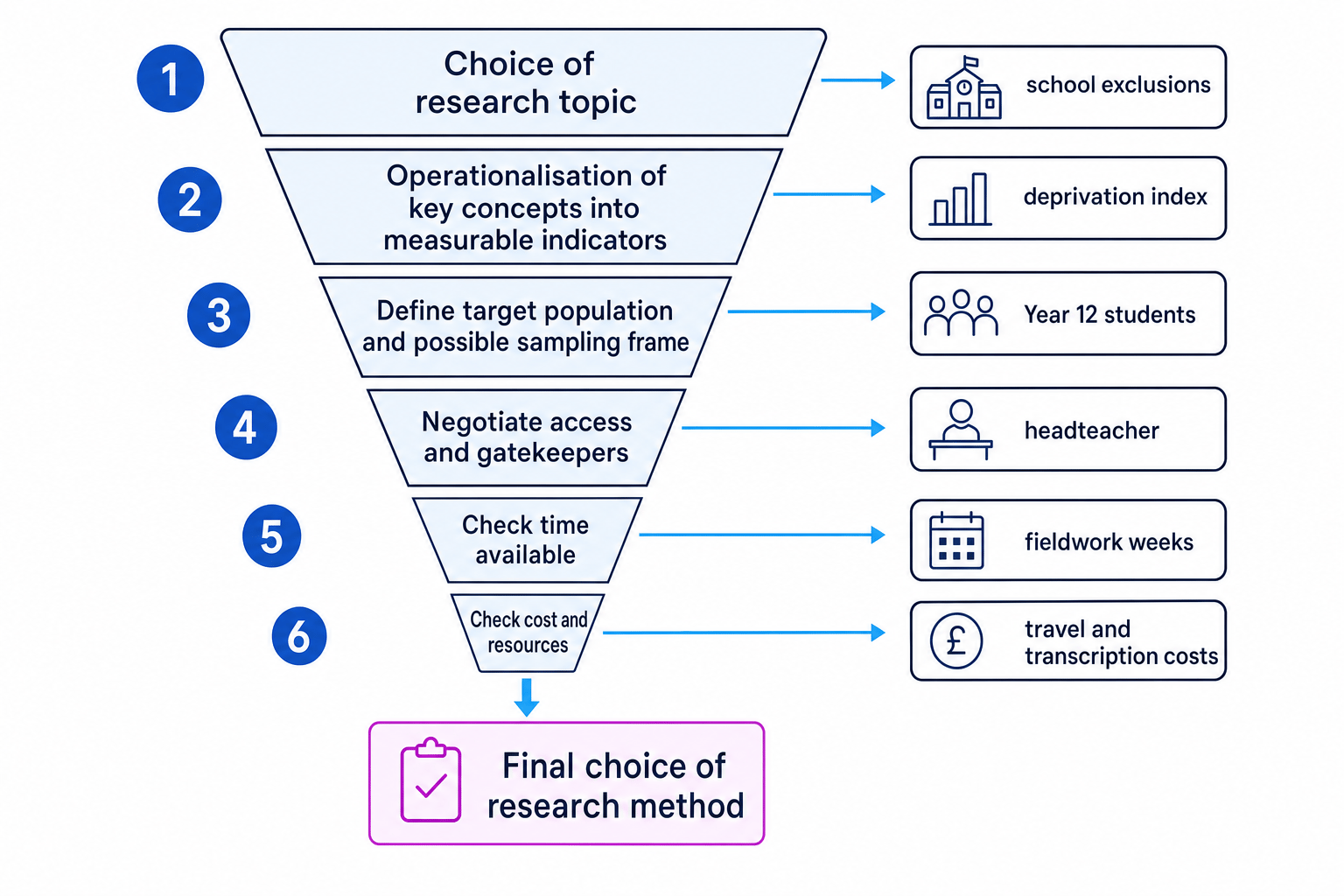
For example, researching school exclusions involves:
- Topic choice: linked to education, inequality and social policy.
- Operationalisation: deciding whether to measure exclusions using official records, pupil experiences or teacher accounts.
- Target population: deciding whether the study is about one school, one local authority, Wales, or the UK.
- Access: schools may worry about reputation and safeguarding.
- Time: trust with excluded pupils may take longer to build.
- Cost: travel, transcription and incentives may limit the sample.
This is where AO3 becomes strong. You can argue that a method is practical but limited, or impractical but potentially more valid. For example, official statistics on school exclusions are cheap and broad, but interviews may reveal hidden processes such as labelling, teacher expectations or pupils’ experiences of power and identity.
Best answers make trade-offs visible
A strong methods answer does not simply list advantages and disadvantages. It explains how practical constraints shape the method, the sample, the data produced and the conclusions sociologists can draw.
In the exam
- Start with the practical issue named in the question, then define it accurately using AO1.
- Apply it to the research context: who is being studied, where, and what data the researcher needs.
- Evaluate the consequence for validity, reliability, representativeness or ethics, rather than just saying “it is difficult”.
- Use named examples where relevant, such as Willis for school access, Barker for long-term research, or ONS/Census data for low-cost secondary statistics.
- Keep linking back to power, culture and identity: some groups are easier to research than others, and this affects what sociology can claim to know.
Check yourself
- How could “poverty” be operationalised in two different ways, and what would each indicator miss?
- Why might access be harder when researching powerful organisations than when researching pupils or service users?
- How can time and cost affect the representativeness and validity of sociological research?