What you'll learn
- What sociologists mean by the role and function of education.
- How functionalists, New Right thinkers, Marxists, feminists and interactionists explain schooling.
- How to apply these theories to contemporary UK examples such as exams, league tables, academies, safeguarding and equality policies.
- How to evaluate the debate for essay-style answers using AO1, AO2 and AO3.
Starting point: what is education “for”?
In sociology, education means the organised process through which people learn knowledge, skills, values and identities. This includes schools, colleges, universities, apprenticeships and informal learning, but in this topic the focus is mainly on formal schooling.
Education is a social institution: a major organised part of society that shapes people’s behaviour and life chances. Other social institutions include the family, religion, the media and the economy.
Role and function
A role is what education is expected to do. A function is the effect education has for individuals or society. Some functions are intended, such as teaching literacy; others may be unintended, such as reproducing class inequality.
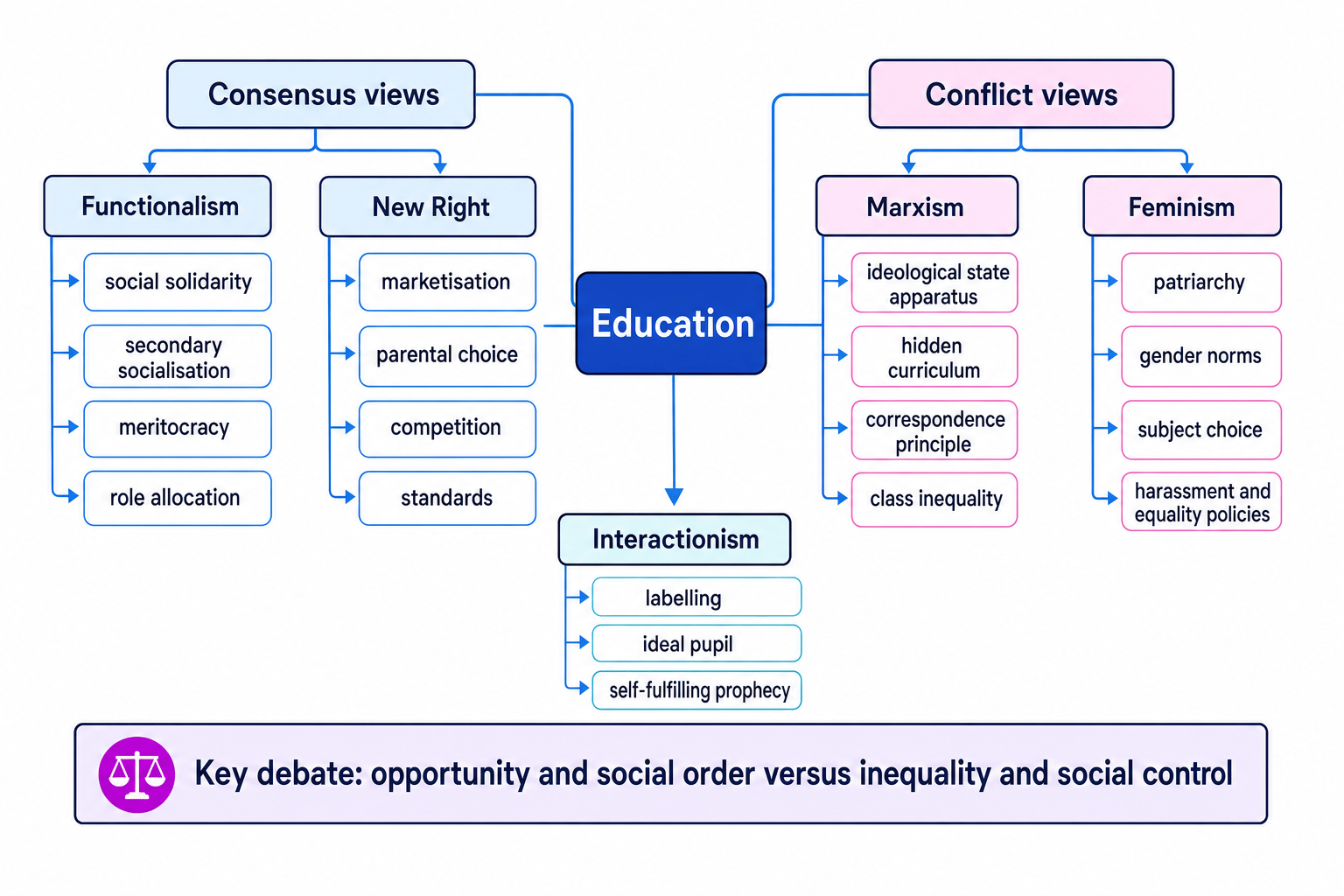
The big sociological debate is simple but powerful: does education mainly create opportunity and social order, or does it mainly reproduce inequality and control?
The overview below shows the main perspectives you need to compare.
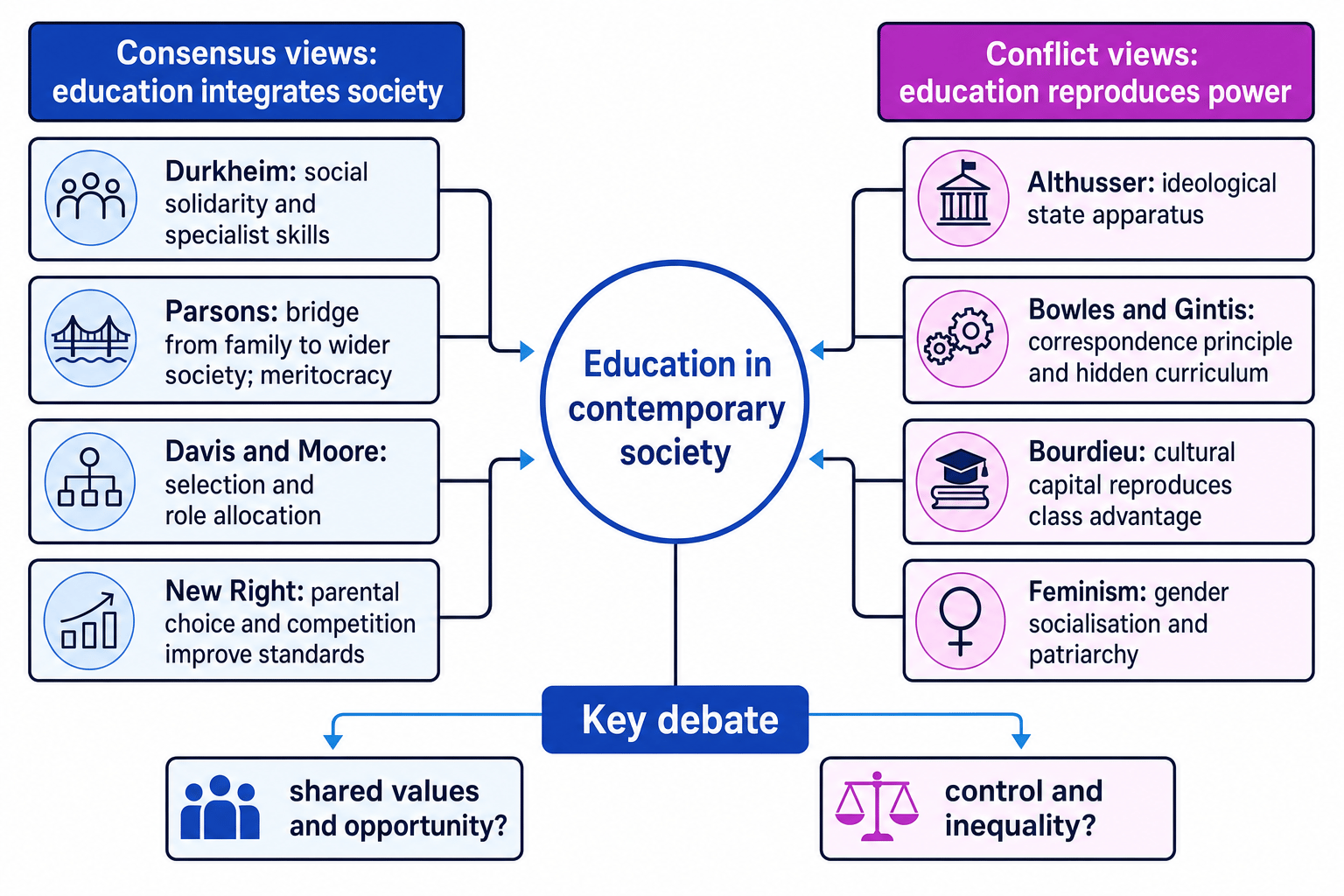
The central debate
Consensus perspectives see education as helping society work smoothly. Conflict perspectives see education as linked to power, inequality and social control.
Education as socialisation
Socialisation is the process of learning society’s norms, values and expected behaviours. Norms are informal rules about behaviour, while values are beliefs about what is important or desirable.
The family provides primary socialisation, which happens early in childhood. Schools provide secondary socialisation, which happens outside the family and prepares young people for wider society.
Durkheim: social solidarity
Émile Durkheim argued that education creates social solidarity, meaning a sense of belonging and shared identity. Schools teach children that they are part of something larger than themselves.
For example, school assemblies, citizenship lessons, national events, school rules and shared routines can encourage pupils to see themselves as members of a wider community.
Durkheim also argued that modern societies need specialist skills. As work becomes more complex, education trains people for different roles in the economy.
Parsons: school as a bridge
Talcott Parsons saw school as a bridge between the family and wider society. In families, children may be judged by particularistic standards, meaning rules based on personal relationships. For example, parents may treat their own child as special.
Schools use universalistic standards, meaning the same rules are meant to apply to everyone. For example, pupils sit the same exams and are judged by common marking criteria.
Parsons linked this to meritocracy, the idea that rewards should be based on talent and effort rather than background.
Applying British values to socialisation
-
Connect the practice to a function: Teaching “British values” such as democracy, tolerance and the rule of law can be seen as secondary socialisation because pupils are learning shared civic norms outside the family.
-
Link it to a theorist: A functionalist could connect this to Durkheim because the school is trying to create social solidarity in a diverse society.
-
Add evaluation: A Marxist or feminist might ask whose values are being presented as “shared”, and whether some groups’ cultures or experiences are marginalised.
Assuming everyone agrees on shared values
Do not write as if society has one simple set of values that everyone accepts. Contemporary UK society is diverse, so “shared values” are always debated.
Education, skills and the economy
Functionalists argue that education prepares people for work. In a complex economy, young people need literacy, numeracy, digital skills, communication skills and qualifications.
Durkheim saw this as necessary for organic solidarity, where people depend on one another because they perform specialised roles. A doctor, electrician, teacher, software engineer and care worker all need different training, but society relies on all of them.
Davis and Moore: selection and role allocation
Kingsley Davis and Wilbert Moore argued that education performs selection, meaning it identifies people’s abilities, and role allocation, meaning it sorts people into suitable positions in society.
From this view, exams, grades and qualifications help match people to jobs. A-Level results, vocational qualifications, apprenticeships and university degrees all act as signals to employers or higher education providers.
However, this view assumes that the system is fair.
Meritocracy is not the same as equality
A meritocracy means people are rewarded according to ability and effort. It does not automatically mean everyone starts with the same resources, support or opportunities.
Evaluation
Functionalist ideas are useful because education clearly does teach skills and qualifications. In contemporary society, schools also teach digital literacy, employability, teamwork and safeguarding awareness.
But critics argue that functionalism is too optimistic. Pupils do not enter school with equal advantages. Private tutoring, parental knowledge, housing near high-performing schools, access to books and digital devices can all shape achievement before exams even begin.
The New Right: choice, competition and standards
The New Right is a political and sociological perspective that supports market principles, individual responsibility and limited state control. In education, New Right thinkers argue that schools improve when parents have choice and schools compete for pupils.
Marketisation means introducing market-like features into education, such as parental choice, league tables, inspections and competition between schools.
In England, the Education Reform Act 1988 introduced major marketisation policies, including the National Curriculum, testing, league tables and greater parental choice. Later policies included academies and free schools. In Wales, education is inspected by Estyn rather than Ofsted, but accountability and school standards are still important policy themes.
Chubb and Moe, writing about the United States, argued that state education could be inefficient and that parental choice would raise standards. This argument influenced wider debates about vouchers, competition and school autonomy.
Using marketisation as AO2
-
Select a policy example: League tables publish school performance data, allowing parents to compare schools.
-
Apply the theory: A New Right view would argue that this creates competition because schools must attract parents by improving results.
-
Evaluate the effect: Critics such as Ball, Bowe and Gewirtz argue that middle-class parents are often better placed to use choice because they have more cultural and economic capital.
Marxist views: education and capitalism
Marxism is a conflict perspective based on the idea that capitalist society is divided between the bourgeoisie, who own major economic resources, and the proletariat, who sell their labour.
Marxists argue that education helps reproduce capitalism. This means it passes on ideas and habits that keep the class system going.
Althusser: ideological state apparatus
Louis Althusser argued that education is an ideological state apparatus. This means it spreads ruling-class ideas and makes inequality appear normal or deserved.
For example, if pupils are repeatedly told that success comes only from hard work, they may blame themselves for failure rather than questioning poverty, racism, underfunding or class advantage.
Bowles and Gintis: the correspondence principle
Samuel Bowles and Herbert Gintis argued that schools mirror the workplace. This is called the correspondence principle.
They also used the idea of the hidden curriculum, meaning the unofficial lessons pupils learn through school routines. These may include punctuality, obedience, hierarchy, competition and acceptance of external rewards.
Applying the correspondence principle
-
Identify the school routine: Pupils are expected to arrive on time, follow instructions, wear uniform and complete work set by teachers.
-
Match it to the workplace: These routines resemble expectations in many workplaces, where employees follow managers’ instructions, meet deadlines and accept hierarchical authority.
-
Draw the Marxist conclusion: Bowles and Gintis would argue that schooling produces a disciplined workforce for capitalism, rather than simply developing individual potential.
Willis: resistance still reproduces class inequality
Paul Willis studied working-class boys, known as “the lads”, in Learning to Labour (1977). He found that they resisted school authority and rejected academic success as unmasculine. However, this resistance still led them towards working-class jobs.
Willis is useful because he shows pupils are not passive. They can resist school values. But his study was small-scale, focused on boys, and belongs to a very different labour market from today’s service-based and digital economy.
Bourdieu: cultural capital and class reproduction
Pierre Bourdieu argued that schools reward the culture of the middle classes. Cultural capital means knowledge, language, tastes and habits that are valued by powerful institutions.
For example, confidence with formal language, familiarity with museums or universities, access to private tutoring, and parental knowledge of admissions systems can all help pupils succeed.
Bourdieu also used the term habitus, meaning deeply learned ways of thinking, speaking and behaving shaped by social background. Schools may treat middle-class habitus as “natural ability”.
This links education directly to power and stratification. Stratification means the way society is layered into unequal groups, such as social classes.
Feminist views: education, gender and patriarchy
Feminism examines gender inequality. Many feminists argue that education has historically reproduced patriarchy, meaning male dominance in society.
Schools can reinforce gender norms through subject choices, teacher expectations, peer pressure, uniforms, sports, textbooks and career advice. For example, girls may still be steered away from some STEM subjects, while boys may face pressure to avoid caring or creative subjects.
Sue Sharpe found that girls’ priorities changed between the 1970s and 1990s, with careers and independence becoming more important. This suggests education and wider society can change gender identities.
Feminists also point to policy progress. The Sex Discrimination Act 1975 and Equality Act 2010 made discrimination less acceptable, while schools now have duties around equality, safeguarding and sexual harassment.
Evaluation
A simple “schools reproduce patriarchy” argument is too narrow because girls now often outperform boys in many areas of education. However, feminists argue that attainment is not the whole story. Subject choice, sexual harassment, leadership, confidence and labour-market outcomes still show gendered patterns.
A stronger answer also uses intersectionality, meaning the way class, gender, ethnicity and other identities combine. For example, middle-class girls, working-class boys and Black Caribbean pupils may experience school differently.
Interactionism: labels and everyday school life
Interactionism is a micro-level perspective that studies face-to-face meanings and interactions. Instead of asking what education does for society as a whole, interactionists ask how teachers and pupils create meanings inside classrooms.
Howard Becker argued that teachers may hold an image of the “ideal pupil”. Pupils who fit this image may be labelled positively, while others may be seen as difficult or less able.
A self-fulfilling prophecy happens when a label affects how someone is treated, and they begin to act in ways that confirm the label. Rosenthal and Jacobson’s study suggested that teacher expectations can influence pupil progress, although the study also raises methodological and ethical questions about deception and measurement.
This perspective is useful for showing how inequality can be produced through everyday interactions. However, it may underplay wider structures such as poverty, school funding and housing inequality.
Contemporary roles: schools do more than teach
In contemporary UK society, schools also have welfare and safeguarding roles. They may provide free school meals, mental health support, child protection, careers advice, sex and relationships education, digital access and support for pupils with special educational needs and disabilities.
This matters for evaluation. Functionalists may see these roles as helping social integration. Marxists may argue that schools are being expected to manage the effects of poverty rather than challenge its causes. Feminists may ask whether safeguarding and relationships education challenge gendered violence and harmful norms.
AO1, AO2 and AO3 shortcut
Use AO1 for the theory or study, AO2 for a concrete example such as league tables or subject choice, and AO3 for a judgement about strengths, limits or alternative perspectives.
Pulling the debate together
For essays on the role and function of education, avoid treating each theory as a separate island. The best answers compare them.
Functionalists and the New Right both see education as potentially beneficial, but they differ. Functionalists stress shared values and social order, while the New Right stresses choice, competition and standards.
Marxists and feminists both focus on power, but they emphasise different inequalities. Marxists focus mainly on class and capitalism. Feminists focus on gender and patriarchy. Bourdieu helps bridge these debates by showing how culture itself can become a form of power.
Interactionists add detail by showing how these inequalities are lived through labels, expectations and classroom relationships.
In the exam
-
Start with the function you are discussing, such as socialisation, role allocation, social control or reproduction of inequality.
-
Attach each point to a named theorist or study, then apply it to a contemporary UK example.
-
Evaluate by comparing perspectives: ask whether education creates opportunity, reproduces inequality, or does both at the same time.
Check yourself
- How would a functionalist and a Marxist explain school rules differently?
- Why might marketisation increase standards for some pupils but inequality for others?
- How can education both challenge and reproduce gender inequality?